
Le Relais de Venise L’Entrecôte’s Secret Sauce: A Parisian Mystery Solved

 Little did we know that when we dined at the corner restaurant near our hotel in Paris we were eating at a place where for decades a family divided had fought over the secret sauce served with their steaks.

        Maybe it’s a French thing.

        For some background. My husband and I were on our honeymoon and had booked a Viking River Cruise on the Seine and then added some before and after stays in Amsterdam where it is more easy to get run over by a bicyclist then a car and Paris where we stayed at a little hotel near the metro in the 17th arrondissement, known as  Batignolles-Monceau, so we could visit other parts of the city without spending a fortune on cabs. Though we didn’t plan it this way, Hotel 10 Le Bis, our hotel was near numerous little cafes and a little grocery store where we could easily—and cheaply–buy food for quick meals and snacks.

        One intriguing café was Le Relais de Venise (the name translates to Venetian Inn) where every night we would see long lines of people waiting to eat either in their dining room or on their outdoor patio. The interior of the restaurant looked so French bistro with its polished dark wood, tiny tables with crisp white table cloths, and servers dressed in black uniforms, the outdoor section was right on a busy corner filled with traffic and pedestrians, noise, and the rumbled of trucks and sounds of horns honking. So depending upon your mood you could choose where to dine.

        What could be so great that people would wait for hours for a table when there were so many great cafes and restaurants around? And so we didn’t go until one evening, after ascending from the metro station and seeing there was no line, we decided to give it a try. The only tables available were outdoors and so we sat at a very small table next to another small table where a single woman sat, smoking a cigarette. That turned out to be a very lucky thing.

        When our server arrived I asked to see a menu and she (we would find out later her name was Gertrude) abruptly told us she was the menu. Well, what’s on the menu? Steak frites, she replied. “bloody or well done.”

        We told her “bloody”, and she gave us an approving look. But we were a little baffled. Was there really only one dish on the menu?  As it turns out, there is no menu and only one entree, one salad with one dressing, steak frites (French fries), and bread. Do not expect butter, ketcup, mayonaaise, or any other condiment. They do only one thing but they do it very well. That’s how it was when Le Relais de Venise opened in 1959 and that’s the way it is now at all the restaurants throughout the world–New York City, London Marylebone, London City, Mexico City

When Gertrude returned with a salad topped with walnuts (no one inquired whether we had a nut allergy—which fortunately we don’t) and a crusty French baguette, I saw there wasn’t butter on our table and asked for some. Oops, one would think I had tried to order a Big Mac.

        “No butter,” Gertrude told us.

        “There’s no butter?” I asked.

        “No butter,” she replied.

        “How about olive oil?”

        “No olive oil,” she told us.

        Now, I knew that in a French restaurant there had to be both in the kitchen, but I guess neither butter nor olive oil was allowed to be carried into the dining area, so we ate the bread—which was very good—without either.
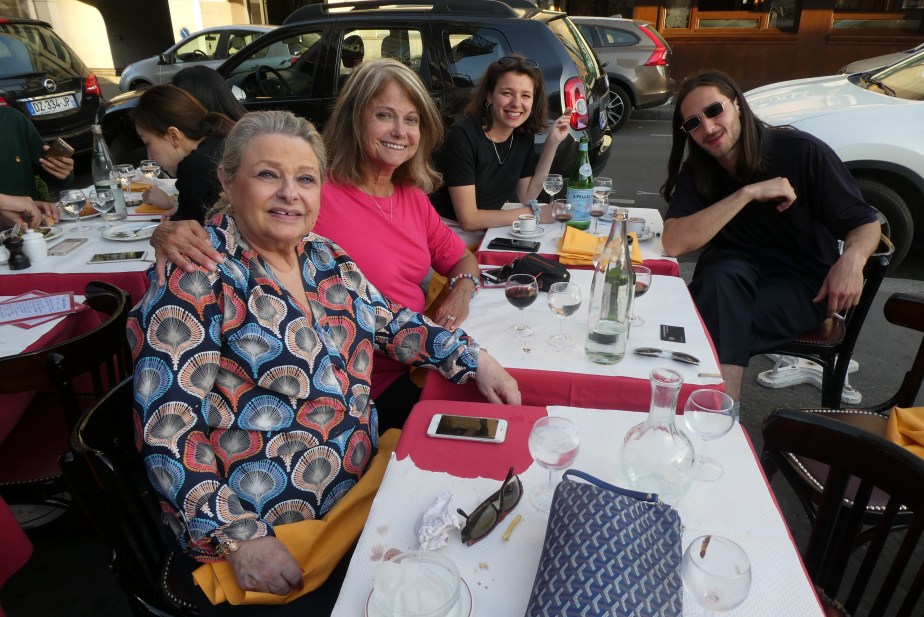
        This is when the woman at the table next to us decided to intervene. She lived in Paris she told us but had spent years in the United States working as a publicist for musicians in New York. Le Relais de Venise de Entrecote was unique, she continued, because they only served one dish—steak with French fries and their famed green sauce called  Le Venise’s Sauce de Entrecote.  I guess that makes decided what to order for dinner super easy. If you’re wondering what entrecote is, as I was, it’s a cut of meat like a New York strip or strip steak. Or at least in it is in Paris.

        Since the creation of the sauce, its exact ingredients have long been a secret and that probably worked until invention of the internet.  After a family squabble resulted in a going of separate ways, the sauce itself became a battleground so complex and full of intrigue that the Wall Street Journal did a lengthy article about it all eight years ago.   I guess when you serve only one dish and the sauce is a necessary part of it, feelings about who owns the recipe loom large. So large in fact that’s there was a million dollar lawsuit as to who had rights to use the name and sauce.

        Anyway, after we ate our salad (no choice of dressing as it already was dressed with a vinaigrette which was very good), our steak with fries arrived—with the sauce spooned over the meat. It was delicious.

        What’s in it? I asked the woman next to us.

        “It’s a secret,” she said. “But I’ve been eating here for decades so I know it. But it’s really better to come here.”

        She promised to give me the recipe, but she must have changed her mind because she never returned my phone calls or emailed it like she said she would. She may have been afraid Gertrude would get mad at her or maybe the restaurant owners wouldn’t allow her back in. Neither would be surprising. And believe me, you don’t want to cross Gertrude.

        I noticed, as we were eating, that the servers were moving through the crowded café with platters of meat and piles of crisp, hand-cut pomme frites. Almost as soon as I had cleared my plate, Gertrude showed up again, heaping—without asking but that was okay—more frites and slices of bloody steak and then pouring the secret sauce on top. At no charge. but no ketchup or mayonnaise either for dipping the fries Gertrude informed us.

        “They’ll do that until you say you don’t want anymore,” the woman told us about the second and third helpings.

        “Is there a charge?”

        “No, it’s all part of the meal.”

        Which was a deal as the tab wasn’t very high even with the addition of a glass of the house wine produced at the family owned vineyard Chateau de Saurs in Lisle-sur-Tarn, 30 miles northeast of Toulouse. Indeed, the restaurant was opened by Paul Gineste de Saurs as a way to help market the wines but now there are at least three more restaurants—in New York City, Mexico City, and London. As for the sauce there are several stories. A rival restaurant said to serve a similar sauce says that it is not new but instead wis one of the classic sauces that are considered the backbone of French cuisine.

        Another has it that the restaurant where we ate was modeled after Cafe de Paris bistro in Geneva which has served this dish since the 1940s. The sauce, according “The History and the Development of the L’Entrecote Secret Sauce,”  a Facebook page devoted to the subject, was developed by the owner’s father-in-law.

        I told you it was complicated.

        Of course, as soon as we got back to our room, I Googled the restaurant and the sauce. It took some digging, but I found recipes for both the secret sauce and the salad. Or so I think. I’m planning on trying them soon along with a French baguette or two from Bit of Swiss Bakery which I will be serving with butter.

Le Relais de Venise-Style Salad Dijon Vinaigrette

1 tablespoon Dijon mustard
1 tablespoon white wine vinegar
Kosher salt to taste (nutritional info based on 1/4 tsp)
Freshly cracked black pepper, to taste
2 tablespoons extra virgin olive oil (or walnut oil)

Whisk or shake in a mason jar until mixture is homogenous.

Serve on a bed of mixed salad leaves topped with some chopped walnuts and shaved Parmesan.

Serving Size: 4

Le Relais de Venise’s Steak Sauce

  • 1 tablespoon olive oil
  • 2 large shallots
  • 3 cloves garlic, chopped
  • 2 cups chicken stock
  • 1 teaspoon pepper
  • 2 tablespoons mustard
  • 1 bunch tarragon
  • 1 to teaspoons red wine vinegar, and increase the amount if you’d like more zip
  • 1 teaspoon anchovy paste
  • 1 teaspoon Worcestershire sauce
  • 1 teaspoon kosher salt

Peel and slice the shallots.

Peel and roughly chop the garlic.

Add the olive oil to a small pot over medium heat.

Add the garlic and shallots and cook until soft and slightly colored.

Add the chicken stock. Simmer for three minutes.

Pull the tarragon leaves off of the stems and put them in a blender.

Add the remaining ingredients to the blender.

Carefully pour the chicken stock mixture into the blender.

Puree until completely smooth.

Pour back into the pan and bring to a boil. Cook for one minute. If the sauce is too thin simmer for a few more minutes.

Pour over slices of rare or as Gertrude calls it “bloody” or however you like your steak. Serve with potatoes or French fries.

Lost Chicagoland Classics: George Diamond Steak House Redux

In an update to my previous post about George Diamond Steak House and for all those who are into 1950s-style supper clubs and Chicagoland food history, check out this great You Tube post about George Diamond Steakhouse. Back in the day, there were several in the Chicago area including at 630 S. Wabash in the South Loop, Las Vegas, Acapulco, and Antioch (where there was also a George Diamond Golf Course) as well as in Whiting, Indiana.

If you’re thinking how does Whiting, an industrial city on the Indiana-Illinois border fit in with such locations as Vegas, Chicago, and Acapulco–well, consider this–at one time Whiting, now best known as the place where Polish foods are celebrated every year at the Pierogi Fest, one of the top festivals in the U.S. was a major destination for both Chicago and Northwest Indiana residents who enjoyed swank dining and perch dinners. It rocked from the early 1900s to the early 1980s and had such classic places as Phil Smidt’s and Vogel’s. Indeed the latter sold so many frog legs that they started raising their own in nearby Lake George.

And, if you’re really into George Diamond history, Etsy has two of the restaurant’s shot glasses for sale for $145.

For more about vintage restaurants in the Chicagoland area, check out Classic Restaurants of Northwest.Indiana.

Three Charming Villages on the shores of Lake Chapala

Born in the United Kingdom, Tony Burton, a Cambridge University-educated geographer with a teaching certificate from University of London, first traveled to Mexico after spending three years as a VSO [Voluntary Service Overseas] volunteer teaching geography, and writing a local geography text, on the Caribbean island of St. Kitts. From there his travels took him to Mérida in summer 1977, where he spent several weeks backpacking around southern and central Mexico, returning two years later to teach at Greengates School in Mexico City.

Over the next seven years, Tony traveled extensively throughout Mexico, visiting every state at least once, and organizing numerous four-day earth science fieldwork courses for his students. He co-led the school’s extensive aid efforts following the massive 1985 earthquake.

From Mexico City, he moved to Guadalajara, where he continued to organize short, residential fieldwork courses for a number of different schools and colleges and began organizing and leading specialist eco-tours for adult groups to destinations such as Paricutín Volcano, the monarch butterfly sanctuaries, and Copper Canyon.

An award winning author, he’s written numerous books about Mexico including his latest Lake Chapala: A Postcard History (Sombrero Publishing). It’s part of a series he’s written on this region which is located about an hour south of Guadalajara. The 417-square-mile lake, Mexico’s largest, located in the states of Jalisco and Michoacán is situated at an elevation of  5,000ft in the middle of the Volcanic Axis of Mexico and is known for its wonderful climate, laid-back ambience, and is a popular destination for both travelers and ex-pats looking for a charming, low-key place to relocate. The three main towns along the lake are Chapala, Ajijic and Jocotepec. In an intriguing aside, Tony met his wife Gwen Chan Burton when she was working as at the director of the pioneering Lakeside School for the Deaf in Jocotepec. Gwen writes about the school and all that it has accomplished in her book, New Worlds for the Deaf, also published by Sombrero Books.

Tony’s other books about this region include Western Mexico A Traveler’s Treasury, illustrated by Mark Eager, now in its fourth edition; Mexican Kaleidoscope: Myths, Mysteries and Mystique, illustrated by Enrique Veláquez, and Foreign Footprints in Ajijic: Decades of Change in a Mexican Village. I’ll be covering them in upcoming posts.

Because I’m always interested in foodways, Tony was kind enough to share a copy of an undated Spanish language project put together by students from the Instituto Politécnico Nacional School of Tourism titled “Gastronomy of Jalisco.”  It includes numerous recipes from the region including one for the famous Caldo Michi of Chapala (the recipe is below).

I had the chance to ask Tony, who currently is the editor of MexConnect, Mexico’s leading independent on-line magazine, about Lake Chapala: A Postcard History as well as the time he spent in this beautiful region of Mexico.


How did you first become familiar with Lake Chapala?

I first visited Lake Chapala in early 1980, on my way back to Mexico City from the Copper Canyon and Baja California Sur. Little did I imagine then that it would be where I would later fall in love, get married, and have two children!

What inspired you to write Lake Chapala: A Postcard History?

There is no single overwhelming inspiration. I realized, while living at Lake Chapala and writing my first books about Mexico, that a lot of what had been previously written was superficial and left many unanswered questions. In the hopes of finding answers, I decided to trawl through all the published works (any language) I could find, which resulted in Lake Chapala Through the Ages (2008), my attempt to document and provide context to the accounts of the area written between 1530 and 1910.

My next two books about Lake Chapala—If Walls Could Talk: Chapala’s Historic Buildings and Their Former Occupants, and Foreign Footprints in Ajijic: Decades of a Change in a Mexican Village—focused on the twentieth century history of the two main centers for the very numerous foreign community now living on ‘Lakeside.’ Part of my motivation was to dispel some of the myths that endlessly recirculate about the local history, as well as to bring back to life some of the many extraordinary pioneering individuals indirectly responsible for the area becoming such an important destination for visitors.

Lake Chapala: APostcard History is my attempt to widen the discussion and summarize the twentieth century history of the entire lake area. Its reliance on vintage postcards makes this a very visual story, one which I hope will appeal to a wide readership, including armchair travelers.


What were some of the challenges you encountered in writing this book? Was it difficulty finding the numerous postcards you included? And doing the extensive research that went into the book? Are there any intriguing stories about hunting down certain postcards and any “aha” moments of discovery when writing your book?

The main challenge was in deciding how best to structure the material. Because of the originality of what I’m doing, it is impractical to follow the advice that writers should start with a detailed plan and then write to that plan! In my case, after collecting the information and ideas that exist, the challenge is to select what can be teased and massaged into a coherent and interesting narrative.

Because the postcard book is the product of decades of research, I had ample time to build my personal collection of vintage postcards, through gifts, auctions and online purchases.

There were many significant “aha” moments in the process: some concerned the photographers and publishers responsible for the postcards and some the precise buildings or events depicted. While I’m saving some of these “aha” moments–because they are central to a future book–one was when it suddenly dawned on me that wealthy businessman Dwight Furness was the photographer of an entire series of cards (Figs 6.3, 6.4, 6.5, etc.) that relate to my next response.


If you could go back in time to visit one of the resorts that is no longer there that you featured in your book, is there one that stands out and why is that?

Ooohhh; I’d love to go back to about 1908 and stay at the Ribera Castellanos resort (Chapter 6) during its heyday. While staying there, perhaps I could interview owner Dwight Furness, his wife and a few guests? Apart from a few ruined walls, Furness’ postcards of the resort are pretty much the only remaining evidence of the hotel. And perhaps one night I could invite local resident and prolific professional photographer Winfield Scott and his wife to dinner to hear their stories?

How long did it take to write Lake Chapala?

The writing took less than a year; but only because of the many prior years of research.

Since I often talk about food and travel, are there any culinary specialties in the Lake Chapala region?

Long standing culinary specialties of the area include (a) Lake Chapala whitefish (b) charales (c) caldo michi. And, when it comes to drinks, there is a very specific link to postcards. The wife of photographer José Edmundo Sánchez, who sold postcards ( Figs 7.5, 7.6 and 7.7) in the 1920s from his lakefront bar in Chapala, is credited with inventing sangrita, still marketed today as a very popular chaser or co-sip for tequila. (Chapter 7, page 74).

Is there anything else you’d like readers to know about your book?

I hope readers find the book as fun and interesting to read as it was to write!

MICHI BROTH

Ingredients:

  • 2 tablespoons corn oil
  • ¾ kg of tomato seeded and in pieces
  • ¼ onion in pieces
  • ½ kg carrot, peeled and cut into diagonal slices
  • ½ kg of sliced ​​zucchini
  • 4 or 6 chiles güeros
  • 100 gr. chopped coriander
  • 2 sprigs of fresh oregano
  • Salt to taste
  • 2 ½ liters of water
  • 1kg well washed catfish, yellow carp or red snapper

PREPARATION: Heat the oil and stew the vegetables in it, add water and salt to taste, let it simmer over low heat until the vegetables are well cooked, then add the fish and leave it for a few minutes more until it is soft.

Sangrita

I had the opportunity to stay at Tres Rios Nature Park, a 326-acre eco-resort north of Playa del Carmen and was first introduced to sangrita during my stay. I took several cooking lessons and learned to make a dish with crickets, but that is a different story. Chef Oscar also talked to us about the history of sangrita. The Spanish name is the less-than-appetizing “little blood” but hey, when you’re learning to grill crickets, you can deal with a name like that. The drink, as Tony writes in his postcards book, originated in Chapala in the 1920s.

Here is the excerpt:

”In the same year the Railroad Station opened, Guillermo de Alba had become a partner in Pavilion Monterrey, a lakefront bar in a prime location, only meters from the beach, between the Hotel Arzapalo and Casa Braniff,” he writes. “The co-owner of the bar was José Edmundo Sánchez. Regulars at the bar included American poet Witter Bynner, who first visited Chapala in 1923 in the company of D H Lawrence and his wife, Frieda. Bynner subsequently bought a house near the church. When de Alba left Chapala for Mexico City in 1926, Sánchez and his wife—María Guadalupe Nuño, credited with inventing sangrita as a chaser for tequila—ran the bar on their own. After her husband died in 1933, María continued to manage the bar, which then became known as the Cantina de la Viuda Sánchez (Widow Sánchez’s bar).”

Sangrita is typically used as accompaniment to tequila, highlighting its crisp acidity and helping to cleanse the palate between each peppery sip. According to Chef Oscar, the red-colored drink serves to compliment the flavor of 100% agave tequila. The two drinks, each poured into separate shot glasses, are alternately sipped, never chased and never mixed together.

Here is Chef Oscar’s recipe and below is one from Cholula hot sauce which originated in Chapala. Tony has a great story about that as well. More in my next post on his books.

For one liter of Sangrita:

  • 400 ml. orange juice
  • 400 ml. tomato juice
  • 50 ml. lemon juice
  • 30 ml. Grenadine syrup
  • 20 ml. Worcestershire sauce
  • Maggi and Tabasco hot sauce (mixed up) to taste
  • Salt and pepper to taste

Mix together all the ingredients and serve cold. Suggested duration of chilling : 3 to 4 days.

Cholula’s Sangrita

  • 1/4 cup (2 ounces) fresh orange juice
  • 1/4 cup (2 ounces) fresh grapefruit juice
  • 2 tablespoons fresh lime juice
  • 20 pomegranate seeds
  • 3 fresh sprigs of cilantro or to taste
  • 1/2 stalk celery
  • 3 teaspoons smoked coarse sea salt or sal de gusano, divided
  • 1 tablespoon Cholula® Original Hot Sauce

Place all ingredients except salt in blender container, with about 1 cup ice cubes. Puree until smooth.Strain twice though a fine mesh sieve, discarding any solids.

Rim shot glasses with sea salt. Serve sangrita cold in rimmed shot glasses alongside your favorite tequila.

Two Recipes of the The Brown Hotel’s Hot Brown

What do you do with hungry dancers in the wee hours of the morning?

Well, if you’re Chef Fred Schmidt at the Brown Hotel in Louisville back in the Roaring 1920s, you improvise and come up with a dish that is sure to please the more than 1200 guests attending the newly opened hotel’s dinner dances each evening. Determining they wanted something more than just ham and eggs, Schmidt created an open-faced turkey sandwich topped with bacon and a rich Mornay sauce.

Can you say Hot Brown?

The Hot Brown is wonderful and the Brown itself is divine. An architectural gem, the  Georgian-Revival style hotel is listed on the National Register of Historic Places and it’s showstopping elegance is all gold, grandeur, gilt, glitter, and glamour.

From when it opened in 1923, it’s allure attracted the crème-de-la-crème of society. According to the hotel’s website,  the French American operatic soprano and actress Lily Pons, who was staying there while playing at the Brown Theatre, let her pet lion cub roam free in her suite. Al Jolson, also playing at the Theatre, got in a fight in the hotel’s English Grill, but said everything was all right—his makeup would cover the shiner. Queen Marie of Romania, when she was on a diplomatic tour of the U.S. with her children, visited in 1926 and was entertained in the Crystal Ballroom in royal style complete with red carpet and a gold throne on a dais. Victor Mature had a brief career as an elevator operator at the hotel before moving on to find fortune and fame in Hollywood.

Other well-known visitors have included the Duke of Windsor, Harry Truman, Elizabeth Taylor, Robert Young, Joan Crawford, Muhammad Ali, Jimmy Carter, George H. Bush, and Barack Obama.

As for the Hot Brown, it’s become more than just a Louisville tradition and has been featured in Southern Living, The Los Angeles Times, NBC’s Today Show, ABC News with Diane Sawyer, Travel Channel’s Man v. Food, and The Wall Street Journal, and is a regular entry in many of the world’s finest cookbooks.

Here is the Brown Hotel’s Hot Brown Recipe.

It makes two Hot Browns.

  • 2 oz. Whole Butter
  • 2 oz. All Purpose Flour
  • 8 oz. Heavy Cream
  • 8 oz. Whole Milk
  • ½ Cup of Pecorino Romano Cheese
    Plus 1 Tablespoon for Garnish
  • Pinch of Ground Nutmeg
  • Salt and Pepper
  • 14 oz. Sliced Roasted Turkey Breast, Slice Thick
  • 4 Slices of Texas Toast (Crust Trimmed)
  • 4 Slices of Crispy Bacon
  • 2 Roma Tomatoes, Sliced in Half
  • Parmesan Cheese
  • Paprika
  • Parsley

In a two‑quart saucepan, melt butter and slowly whisk in flour until combined and forms a thick paste (roux). Continue to cook roux for two minutes over medium‑low heat, stirring frequently. Whisk heavy cream and whole milk into the roux and cook over medium heat until the cream begins to simmer, about 2‑3 minutes. Remove sauce from heat and slowly whisk in Pecorino Romano cheese until the Mornay sauce is smooth. Add nutmeg, salt and pepper to taste.

For each Hot Brown, place two slices of toast with the crusts cut off in an oven safe dish – one slice is cut in half corner to corner to make two triangles and the other slice is left in a square shape – then cover with 7 ounces of turkey. Take the two halves of Roma tomato and two toast points and set them alongside the base of the turkey and toast.

Next, pour one half of the Mornay sauce to completely cover the dish. Sprinkle with additional Pecorino Romano cheese. Place the entire dish under a broiler until cheese begins to brown and bubble. Remove from broiler, cross two pieces of crispy bacon on top, sprinkle with paprika and parsley, and serve immediately.

Hot Brown Casserole

  • 1 cup butter
  • 3⁄4 cup flour
  • 2 eggs, beaten
  • 6 cups milk
  • 1 cup grated parmesan cheese
  • 1⁄4 cup heavy whipping cream
  • 16 slices white bread
  • 16 slices cooked turkey (roast)
  • Paprika
  • 1 lb. bacon (to make 1 cup bacon bits)
  • 1 cup tomatoes, seeded & diced
  • 1⁄4 cup chopped fresh parsley
  • Salt and pepper

The Brown Hotel’s Hot Brown Casserole

Melt the butter in a large saucepan. Add flour stirring to make a roux; cook 2 to 3 minutes.

Thoroughly beat eggs; beat into milk. While stirring, very slowly add milk mixture to butter mixture.

Stir in parmesan cheese. Cook until mixture thickens, but do not boil. This will take 30 to 45 minutes.

Mixture should heavily coat the back side of a large spoon.

Remove from heat. Fold in whipping cream and add salt and pepper to taste.

Trim crust from bread edges. Toast 10 slices in a regular toaster or place in pan under broiler till golden. Repeat on the other side. Reserve remaining bread slices.

Line the bottom of a 9x13x2-inch casserole with 6 slices of toast. Place the remaining 4 slices of toast in an 8x8x2-inch pan. (If you can place all in one pan then do so.). Top with slices of turkey. Cover with sauce, dividing the sauce between the two casseroles. Spread all of the sauce over the turkey.

Sprinkle with remaining Parmesan cheese and paprika.

Place in a pre-heated 350 degree oven for 15 minutes or till golden brown.

While casserole is baking, fry bacon till crisp; drain on paper towels. When cooled, break into bits.

Toast remaining slices of bread. Cut on a diagonal. When casserole is done, place toasted bread around outer edge, point side up.

Garnish top of casserole with bacon bits and diced tomatoes. Sprinkle with chopped parsley.

Serve while hot.

Over 25 Reasons to Follow the Saxon Wine Trail


Hiking the Saxon Wine Trail is divided into 6 daily stages averaging 8 miles, or 5 to 6 hours of walking per day. 2022 is 30th Anniversary.

The Saxon Wine Trail, a 50 mile walk and wine tasting experience through more than 850 years of wine making, is easily divided into six stages with an average of eight miles or five to six hours of walking a day. This region of German, nicknamed the Saxon Rivera, follows parts of the Elbe River as it winds its way through countryside near such historic Saxon towns as Pirna, Meissen and Dresden, all renowned for their porcelain, art, architecture, history and castles. With temperatures averaging about 75 degrees during summer and orchards and vineyards brimming with fruit, the trail is also lovely in autumn when the leaves are ablaze of colors. For those who’d rather drive, it’s 34 miles by car.

Either way, according to Victoria Larson, USA Press Representative, State Tourist Board, visitors can sample over 60 grape varieties – including Riesling, Pinot Blanc, Pinot Gris and Pinot Noir, but also Traminer, Scheurebe and the Goldriesling, which is only grown on the Elbe.

“You will pass beautiful villas and magnificent castles,” says Larson. “A detour into the old town of Dresden leads to the Zwinger, Semper Opera and Frauenkirche. In Radebeul, you can take time to visit the Saxon Wine Museum Hoflößnitz and the beautiful 850-year old winery in Europe at Wackerbarth Castle where you can treat yourselves to fabulous tours, meals and a great gift shop. The journey continues to Meissen: the imposing castle hill with the cathedral and Albrechtsburg Castle can be seen from afar. The WineExperienceWorld of the Saxon Winegrowers’ Cooperative Meissen offers information and insights into the history and current practices of winegrowing in the area.”

In the last 40 years, Saxony has experienced a true renaissance of wine growing with young and experimental vintners leading the way. Although Saxony is still Germany’s smallest and northernmost wine region, currently there are not only many professional growers but also about 1000 hobby winemakers. Typically grapes are grown on hillside terraces requiring that most tending and harvesting be done by hand.

The northern starting point of the Saxon Wine Route is the charming village of Diesbar-Seusslitz with its beautiful baroque castle surrounded by formal gardens.

The most prominent winery of the route is Schloss Proschwitz housed in a baroque-style castle built by one of Saxony’s oldest families who lost their home after WWII but bought it back after reunification. With dedication, labor and love, they recreated one of Saxony’s leading and largest privately owned wineries. Their wine production includes a range of wines from Pinot Gris and Pint Blanc to Müller-Thurgau and Goldriesling, a Saxony speciality. The castle and vineyard are year-round destinations for events and weddings as well as the concerts that are part of Dresden’s famous music festivals.  

Not far away, Meissen, once the seat of the Saxon electors which gives it a special prominence in this historic land, also has extensive vineyards.

“Two trademarks of this 1000-year-old city on the Elbe are the Albrechtsburg, an enormous Gothic cathedral, and the well-known Meissen porcelain manufactory, MEISSEN, a must-visit destination for anyone interested in design and craft, jewelry, art and architecture,” says Larson.

The capital city of Dresden with its magnificent skyline is notable for the dome of the Protestant Church of Our Lady (Frauenkirche), the smaller dome of the Catholic Palace Church (Hofkirche), the roof line of the Semper Opera and the ornate gates to the museums in the Zwinger Palace.

Just down the river, the next highlight is Castle Pillnitz, the summer palace of the Wettin kings and Saxon electors. The baroque palace is home to the Arts and Crafts Museum of the Dresden State Art Collection as well as a castle museum and has an extensive formal garden and park. The most spectacular way to get to the palace is by paddle boat from Dresden as the riverbank is lined with beautiful villas and castles built by noble families who wanted to be near the king.

A magnificent winery in Pillnitz with views over the Elbe River Valley is Weingut Klaus Zimmerling, where visitors can stay for a wine tasting and view the fields and the outstanding sculptures by Malgorzata Chodakowska.

The last stop on Saxony’s Wine Trail is the medieval town of Pirna, the gateway to Saxon Switzerland. Pirna is famed beyond the borders of Saxony due to the paintings by Venetian artist Bernardo Bellotto, the nephew of the famous Italian painter, Canaletto, who often took his uncle’s name to further his own reputation. The medieval town is much as it has always been and features winding streets, leading visitors in between town houses, charming courtyards and numerous fountains, and taking you on a journey through the past.

Every autumn, towns like Pirna and Radebeul host wine festivals where visitors get to taste the local wines and meet regional growers. Saxony and Dresden is an easy car or train ride from Berlin or Frankurt both of which have many direct flights from the U.S. and Canada.

What to Do in Augusta Georgia: Arts, Food and Outdoors

Guest Road Tripper Kathy Witt takes us to charming Augusta, Georgia in her latest travel piece. Always glad to have you, Kathy!

Mention Augusta, GA and thoughts immediately leap to the Masters Tournament. After all, this small town charmer on the banks of the Savannah River has been home to the famous golf tournament for nearly 90 years. But Augusta is also a vibrant artists community, culinary hotspot and urban playground with adventures aplenty for foodies, history buffs, arts aficionados, nature and outdoor lovers, music fans and more.

Downtown Augusta, GA. Photo Destination Augusta.

In Augusta’s walkable downtown, browse the boutiques and vintage stores along Artists Row. Catch a show at the Imperial Theatre, a former vaudeville hall that James Brown once used as rehearsal space. Speaking of the Godfather of Soul, follow the story of the world-famous soul singer who called Augusta home on the new James Brown Journey. The walking tour takes visitors to locations that played a key role in Brown’s life, each marked by vinyl artwork and a QR code that opens into an audio tour narrated by his family and friends.

Walk with the Godfather of Soul on the James Brown Journey. Photo: Destination Augusta

A Walk Along the Savannah River

The Riverwalk serves as the front porch of Augusta and one of this Georgia city’s most popular parks. Destination Augusta

Wander along Augusta’s Riverwalk, a multilevel brick trail meandering along the banks of the Savannah River to ornamental gardens, children’s playgrounds, historical monuments, museums including the Morris Museum of Art and Augusta Museum of History, the Jessye Norman Amphitheater where live concerts are performed, and several restaurants.

Play:

Embrace the stories, sights and sounds of Augusta with a visit to the Augusta Canal National Heritage Area. Destination Augusta.

The Augusta Canal National Heritage Area (www.augustacanal.com) is an outdoor enthusiast’s mecca, with hiking and biking on the historic canal’s towpath, fishing from the canal banks and paddling and kayaking in its lazy waters. Cruises aboard a replica open-air canal cargo boat glide visitors into the past, floating by Georgia’s only remaining 18th century houses and 19th century textile mills; on wildlife expeditions, spotting otters, heron and even the occasional alligator; and into dreamy nights on moonlight music cruises.

Paddle boarding on the Augusta Canal. Destination Augusta.

Boat tour tickets include free admission to the Augusta Canal Discovery Center. Located in a former textile mill, the center features exhibits, orientation film and gift shop.

Stay:

The historic 112-year-old Partridge Inn (www.partridgeinn.com), part of the world-class Curio Collection by Hilton, recently underwent a multimillion dollar renovation. The result? A luxurious escape with all the amenities, but one that keeps the hotel’s historical charm and character intact. The hillside oasis offers 140 rooms and suites, each beautifully appointed and some with balconies, top-tier dining with its 8595 restaurant and Six South rooftop bar, lounge and bar areas and outdoor swimming pool and courtyard.

Eat:

Augusta is developing a reputation for fun and funky downtown culinary hotspots serving everything from vegan/vegetarian comfort food like Ube (sweet purple yam) pancakes topped with maple icing and toasted walnuts and paired with a mimosa at the Bee’s Knees to gourmet small plate fine dining accompanied by a sublime wine list at Craft & Vine.

 
Edgar’s Above Broad, a rooftop dining and entertainment experience in downtown Augusta, GA, is an adult’s playground with life-sized games and Instagrammable views. Photo: Destination Augusta.

The new and already popular Edgar’s Above Broad brings rooftop dining to Augusta’s dynamic downtown foodscape, with a seasonal tapas menu and tantalizing craft cocktails – like the Imaginary Friend (the house mule with strawberry-infused vodka and a ginger beer topper) – served in a fun setting with putting green, bocce ball and sweeping downtown views.

Treat:

For wildlife lovers, there’s nothing better than an outing to Phinizy Swamp Nature Park (www.phinizycenter.org), located just minutes from downtown: great blue herons, red-shouldered hawks, river otters and the elusive alligator go about their business in natural woodland and wetland settings sheltered by Bald Cypress, Water Oak, Sweetgum trees and spread out over thousands of acres. Scenic and serene, it has a steel and wooden bridge crossing over Butler Creek and providing occasional glimpses of turtle and river otters – the place where dragonflies, damselflies and even the rare Mayfly are known to buzz about.

A wooden boardwalk with covered observation deck is the perfect spot to catch busy woodpeckers, warblers and hawks and the Pond Trail peeks into the pine forest for glimpses of waterfowl and wading birds. The Phinizy Swamp Shop and Visitor Center is open Saturdays and Sundays and has natural history exhibits, observation hive with active bee colony, Kids’ Corner, park info, souvenirs and snacks.

Read:

To learn more about Georgia’s second oldest city, pick up a copy of Tom Mack’s book, 100 Things To Do in Augusta, GA Before You Die (Reedy Press). Mack personally ate at every restaurant, shopped at each venue and visited all the cultural attractions included in the book. Readers will find detailed descriptions of each venue as well as Mack’s insider tips to help them get the most out of a visit to Augusta.

Augusta, GA has enticing experiences to tempt every member of the family. Use Destination Augusta’s Trip Builder (www.visitaugusta.com/tripbuilder) to create a personalized itinerary. Find more information at www.visitaugusta.com.

RECIPES

A visit to Augusta, GA simply would not be complete without sampling a true Southern pimento cheese dish. From The Partridge Inn’s restaurant, 8595, here is Executive Chef Thomas Jacobs’ Fried Green Tomatoes and Pimento Cheese recipe.

Green Tomato Recipe

Ingredients

  • 1 C all-purpose flour
  • 1/2 tsp kosher salt
  • 1 tsp blacken seasoning
  • 1/4 tsp fine-ground black pepper
  • 1/4 C buttermilk
  • 2 large eggs
  • 1/2 C panko breadcrumbs
  • 1 C yellow cornmeal
  • 2 large green tomatoes, sliced 1/4-inch thick

Instructions

Line a baking sheet with paper towels and top with a cooling rack. Set up a dredging station with 3 shallow bowls. In the first bowl, add the flour, salt and pepper, and whisk to combine. In the second bowl, beat the buttermilk, eggs and blacken season together. In the third bowl, stir together the cornmeal and panko.

Working in batches, dredge both sides of the tomato slices in the seasoned flour, shaking each piece to remove any excess.

Dip the tomato slices into the egg and buttermilk mixture. Then coat the tomato slices in the breadcrumb/panko mixture evenly on both sides. Place the prepared tomatoes in the basket of an air fryer and spritz the top with olive oil. Air fry at 400°F for 5 minutes, flip and spritz with olive oil, and continue to air fry for 3 additional minutes, or until golden brown. Serve immediately.

Chef Thomas Jacobs’ Fried Green Tomatoes and Pimento Cheese are served at the Partridge Inn’s restaurant, 8595. Photo: Chef Thomas Jacobs

Pimento Cheese

Ingredients

  • 1 C shredded extra-sharp cheddar cheese
  • 1 C white cheddar
  • 1/2 C smoked Gouda cheese
  • 1 C Tomme Cheese
  • 8 oz cream cheese, softened
  • 2 1/2 C mayonnaise (Dukes preferably)
  • 1/4 tsp garlic powder
  • 1/4 tsp ground cayenne pepper
  • 1/4 tsp onion powder
  • 1 jalapeno pepper, seeded and minced
  • 4 oz diced pimento, drained
  • salt and black pepper to taste

Instructions

Place the cheddar, white cheddar, Gouda, Tomme and cream cheeses, mayonnaise, garlic powder, cayenne pepper, onion powder, minced jalapeno and pimento into the large bowl of a mixer. Beat at medium speed, with paddle, if possible, until thoroughly combined. Season to taste with salt and black pepper.

Add pimento cheese on top of fried green tomatoes.

About Guest Blogger Kathy Witt

Writer and author Kathy Witt is a member of SATW Society of American Travel Writers and the Authors Guild

She is the author of Secret Cincinnati; The Secret of the Belles; Atlanta, GA: A Photographic Portrait

NEWCincinnati Scavenger: The Ultimate Search for Cincinnati’s Hidden Treasures arriving October 2022.

NEWPerfect Day Kentucky: Daily Itineraries for the Discerning Traveler arriving Fall 2023.

www.KathyWitt.comwww.facebook.com/SecretCincinnatiNKY

www.LinkedIn.com/in/KathyWittwww.Instagram.com/Kathy.Witt

3 Great Ingredients: Burgoo, Barbecue and Bourbon The Kentucky Trinity

Burgoo, barbecue and bourbon, historically acknowledged as the trinity of good taste in Kentucky, have traditional roots going back to the days of Daniel Boone. W.A. Schmid, a chef and food historian, delves deep into the cultural heritage of these foods in his book, Burgoo, Barbecue, and Bourbon: A Kentucky Culinary Trinity (University Press of Kentucky 2021).

Known as “the gumbo of the Bluegrass,” burgoo is a meat stew consisting of a variety of meats that were often smoked as that’s one of the ways they preserved food back then. The list of ingredients included at least one “bird of the air” and at least one “beast of the field.” The latter could include squirrel, ground hog, lamb, pork jowl, and rabbit. Added to that were whatever vegetables (think corn, tomatoes, turnips, potatoes, carrots, onions, okra, and lima beans) were either in season or still stored and edible in the larder. Sometimes oysters, oatmeal and/or pearl barley were thrown in as well. Schmid also includes, among his many burgoo recipes, one that feeds 10,000 which calls for a ton and a half of beef (I’m not including it but if you’re expecting a huge crowd over email me and I’ll send it) and another that makes 1200 gallons.

“Often you’ll find this dish paired with one of the Commonwealth’s other favorite exports, bourbon, and the state’s distinctive barbecue,” writes Schmid, who immersed himself in archives of early cookbooks.

He takes us back to the days of Daniel Boone, uncovering forgotten recipes of regional dishes and such lost recipes as Mush Biscuits and Half Moon Fried Pies. There are numerous recipes for burgoo starting from early pioneer days, each unique depending on the region, food tastes, and what ingredients were easily sourced. Burgoo was an early community dish with people coming together to prepare it in vast amounts for celebrations.

Women would gather for peeling parties which meant endlessly peeling and dicing vegetables while men would stir the ingredients as they simmered in the huge pots throughout the night, most likely with sips of bourbon to keep them enthused about the task. Whether women got to sip bourbon too, we can only hope so. But in an age where water wasn’t safe to drink and even children were given wine, cider, small beer, and the dregs of their parents sweetened spirits to drink, I’m guessing so.

As for the name burgoo, well, no one, not even Schmid is sure where it comes from.

“It may have described an oatmeal porridge that was served to English sailors in the mid-1700s, or it may have come from the small town of Bergoo, West Virginia,” Schmid hypothesized. The word might also be a slur of bird stew or perhaps bulger; it could also be a mispronunciation of barbecue, ragout, or an amalgam of the lot. If the oatmeal story is true, burgoo continued as a military staple as it became a hearty stew for soldiers who could travel light and hunt and gather ingredients ‘from wild things in the woods’ once they stopped moving for the day—so they did not have to move the supplies from one location to another.”

Of course, a hearty burgoo demands a great bourbon drink and Schmid offers quite a few of those as well. One name I’m particularly taken with is called Kentucky Fog, presumably because over-consumption left one in a fog. Other great names for bourbon drinks mentioned in the book are Moon Glow, Bourbaree, and the Hot Tom and Jerry.

The following recipes are from Burgoo, Barbecue, and Bourbon.

Kentucky Fog

12 servings

  • 1 quart Kentucky bourbon
  • 1 quart strong coffee
  • 1 quart vanilla ice cream

Combine the ingredients in a punch bowl and serve.

Moon Glow

  • Crushed ice
  • 1½ ounces bourbon
  • 2 ounces cranberry juice
  • 2 ounces orange juice
  • 2 teaspoons maraschino cherry juice

Pack a tall glass with crushed ice. Add the cranberry juice and the orange juice. Add the maraschino cherry juice. Then add the bourbon. Stir well with a bar spoon and garnish with 2 maraschino cherries and a straw.

Burgoo

This recipe is used at Keeneland, the famous racetrack in Lexington, Kentucky and dates back to 1939.

  • Oil
  • 3 pounds stew meat
  • 1 teaspoon ground thyme
  • 1 teaspoon sage
  • 1 teaspoon oregano
  • 1 teaspoon garlic, minced
  • 1 cup celery, diced
  • 1 cup carrot, diced
  • 1 cup onion, diced
  • 12-ounce can diced tomatoes in juice
  • 2 16-ounce cans mixed vegetables
  • 7-ounce can tomato purée
  • 2 pounds fresh okra, sliced
  • 1 tablespoon beef base
  • 1 teaspoon Worcestershire sauce
  • 1 cup sherry
  • 3 pounds potatoes, peeled and diced
  • Cornstarch

Heat the oil in a large Dutch oven. Brown the stew meat with the herbs and garlic. Add the remaining ingredients, except the cornstarch, and cover with water. Bring to a boil, reduce heat, and simmer for at least 3 hours. Adjust seasonings to taste and thicken with cornstarch.

Spoonbread with Bourbon

  • 6 servings
  • 2 cups water, boiling
  • 1 cup cornmeal
  • ½ teaspoon salt
  • 2 teaspoons sugar
  • 3 egg yolks, beaten
  • 3 egg whites, stiffly beaten
  • 1 cup buttermilk
  • 4 tablespoons butter
  • ½ teaspoon baking soda
  • 2 tablespoons lard
  • 1 tablespoon bourbon

Preheat oven to 325 degrees F.

Boil the water; add the lard and butter; to this mixture add

the cornmeal, egg yolks, and baking soda. Stir in the buttermilk and stiffly beaten egg whites. Add the bourbon and pour into a buttered casserole dish. Bake for 35 minutes.

Original Kentucky Whiskey Cake

15–20 servings

  • 5 cups flour, sifted
  • 1 pound sugar
  • 1 cup brown sugar
  • ¾ pound butter
  • 6 eggs, separated and beaten
  • 1 pint Kentucky bourbon
  • 1 pound candied cherries, cut in pieces
  • 2 teaspoons nutmeg
  • 1 teaspoon baking powder
  • 1 pound shelled pecans
  • ½ pound golden raisins, halved, or ½ pound dates, chopped

Soak cherries and raisins in bourbon overnight.

Preheat oven to 250–275 degrees F.

Cream the butter and sugars until fluffy. Add the egg yolks

and beat well. To the butter and egg mixture, add the soaked fruit and the remaining liquid alternately with the flour. Reserve a small amount of flour for the nuts. Add the nutmeg and baking powder. Fold in the beaten egg whites. Add the lightly floured pecans last. Bake in a large, greased tube pan that has been lined with 3 layers of greased brown paper. Bake for 3–4 hours. Watch baking time carefully.

Store any leftovers in an airtight container in the refrigerator.

Richard Hougen was the manager of the Boone Tavern Hotel of Berea College and the author of several cookbooks, including Look No Further: A Cookbook of Favorite Recipes from Boone Tavern Hotel(Berea College, Kentucky), Hougen includes the recipe for Boone Tavern Cornsticks. He notes at the bottom of the recipe, adapted here, how important it is to “heat well-greased cornstick pan to smoking hot on top of the stove before pouring in your batter.

Boone Tavern Hotel Cornsticks

  • 2 cups white cornmeal
  • ½ cup flour
  • 2 eggs, well beaten
  • 1 teaspoon baking powder
  • ½ teaspoon baking soda
  • 2 cups buttermilk
  • ½ teaspoon salt
  • 4 tablespoons lard, melted

Preheat oven to 450–500 degrees F.

Sift the flour, cornmeal, salt, and baking powder together.

Mix the baking soda with the buttermilk, and then add to the dry ingredients; beat well. Add the eggs and beat. Add the lard. Mix well. Pour the batter into very hot well-greased cornstick pans on

top of stove, filling the pans to level.

Place pans on the lower shelf of the oven and bake for 8 minutes. Move the pans to the upper shelf and bake for an additional 5–10 minutes.

The top 10 reasons to city-break in Cork this autumn

With its warrens of narrow streets, vibrant spirit and warm welcome, Cork is the perfect city break destination for when the nights are drawing in.

Here are 10 reasons why you should be in this historic city as the seasons switch.

1. Food worth travelling for

Thanks to an abundance of high-quality local producers and a profusion of creative and passionate chefs, Cork has a deserving reputation as Ireland’s food capital. Whether you’re browsing the overflowing stalls at the famous and centuries-old English Market or sampling dishes at the city’s amazing restaurants, pubs and cafés, great food will always be on the menu.

2. And all that jazz

Having hosted jazz greats such as Ella Fitzgerald, Oscar Peterson and Mel Tormé throughout its long history, the lively Cork Jazz Festival pulls in thousands of music fans every October. Sponsored by Guinness and with events taking place in pubs and venues all across Cork, the city will be buzzing once again this autumn with groundbreaking music, fun and charm from 27 – 30 October.

3. Titanic tales

One of the most popular day trips from Cork city is to the town of Cobh, a beautiful Irish seaport with a bittersweet history. Once the main point of emigration from Ireland, Cobh was the Titanic’s last port of call before she sailed onwards to her fate. The story is told magnificently at the Titanic Experience located in the old White Star Line offices on the seafront.

4. Epic Cork City Gaol

Cork City Gaol ( museum), Cork, Ireland

Experience life in the nineteenth and early twentieth century at Cork City Gaol, a museum that offers a unique insight into the city’s history, both inside and outside of the prison walls. Take a trip back in time and wander through the wings of the gaol, accompanied by the shuffling feet of inmates and the jingle of the warders’ keys.

5. City sight-seeing

You can easily explore Cork on foot, but it’s worth checking out one of the excellent, locally led tours to find out what really makes Ireland’s second city tick. Cork City Walks are full of history and folklore, or you can jump on an open-top double-decker bus and see the sights with Cork City Tours.

6. Art galleries galore

Crawford Art Gallery

As a former European Capital of Culture, Cork is packed with museums, galleries, theatres, music and dance academies and more. You will find everything from opera to street art within the thriving art and culture scene, with the Crawford Art Gallery, the Glucksman Gallery and the Lavit Gallery among the best visual art spaces to make a beeline for.

Cobh, County Cork


7. The Wild Atlantic Way

One of the best sections of the 2,500km Wild Atlantic Way route starts – or ends – in Kinsale, just half an hour away from Cork city. This makes the city the perfect jumping-off point for exploring the breath-taking scenery and remote peninsulas of West Cork.

8. Ring the Shandon Bells

A visit to Cork isn’t complete without climbing to the belfry of the eighteenth-century St Anne’s Church to ring the world-famous Shandon Bells. There are 135 steps to reach the viewing balcony, but the reward is fantastic panoramic views over the city and surrounding countryside.

Old_Cork_Waterworks_Experience_Entrance

9. Fitzgerald Park

For a gorgeous feel of autumn foliage in Cork, head down to Fitzgerald Park on the banks of the River Lee. Home to Cork Public Museum, the Sky Garden, a series of sculptures, cafés, walks and more, the park offers a quiet retreat from the hustle and bustle of the city.

10. You can kiss the Blarney Stone

The world-famous Blarney Castle, home of the iconic Blarney Stone, is one of Ireland’s top attractions and is located just ten minutes from Cork city. Legend has it that kissing the Blarney Stone will give you the ‘gift of the gab’ – as in great eloquence or persuasiveness. A great reason to go!
 
www.ireland.com

Supper Clubs: An American Dining Experience

Neon lights. Big cars with rich men and beautiful dames. Martinis and music. Relish trays and super-sized steaks. Tucked away on country roads—perfect for bootleggers to deliver their goods in the dark of night or on the streets of big cities where midnight deliveries are no problem.

These are the supper clubs of old and while these vestiges of a glamorous past maybe somewhat different now, author Ron Faiola chronicles it all in his series of book, including the most recent, “The Wisconsin Supper Clubs Story: An Illustrated History, with Relish” (Agate Midway 2021; $26.66). His other two books, “Wisconsin Supper Clubs: An Old Fashioned Experience” and “Wisconsin Supper Clubs: Another Round” as well as his movie, Wisconsin Supper Clubs: An Old Fashioned Experience makes Faiola a supper club expert. His books, which make for great reading, are also perfect as guidebooks, taking us on a round of supper clubs still in business.

In his latest book, Faiola, a native of Wisconsin a state that seems to have the most of supper clubs of any state, went deep into their history and along the way dispelled at least one major legend—that the first American supper club was established in the 1920s in Beverly Hills, California by Milwaukee native Lawrence Frank.

 “It always bothered me because it named the guy, but not the supper club,” said Faiola.  “And why Beverly Hills and not New York City or even Wisconsin?  Once I delved into the Frank family history, I had my answers which became chapter one in the book.”

There was another legend to question as well. Faiola has visited close to 150 of the places. But there was a guy named Al (last name Capone) who seemed to have visited even more—at least according to claims by owners. Faiola demolished that one as well.

Join us in a conversation with Faiola.

The resurgence of supper clubs has been going on for several years.  It first began when my documentary, Wisconsin Supper Clubs – An Old Fashioned Experience,” was released in 2011. 

Additionally, once the first book–“Wisconsin Supper Clubs: An Old Fashioned Experience” was released, instead of sitting on a coffee table, people brought their copies along on trips to supper clubs and had the owners and staff sign their pages. They’d put menus and make notes about the drinks and food that they had. That snowballed as more people saw what others were doing.  It was fun for them and the supper club owners loved the attention.  I’ve heard from so many owners about the number of books they’ve signed.  They’re very proud of that.  

More recently, when all restaurants closed as the pandemic started, people thought they were going to lose their favorite supper clubs.  Once clubs started reopening, even just for take-out orders, customers were very supportive.  As clubs fully reopened, diners returned in droves in the summer of 2020 and even more so during 2021.  I’ve seen photos on social media of people standing in line waiting to get into supper clubs.  Last summer the wait for a table at Ishnala was three to four hours and yet people were cheerfully tailgating in the parking lot!  The great return to the Restaurants of Yesteryear has not only drawn more people to the clubs, but there is now a wide range of supper club souvenirs: glasses, apparel, posters, and even more books.  

Can you share a story or two about discoveries that most surprised you?

One of the things that surprised me the most was that the price of food was about the same as today when adjusted for inflation.  I tell people to multiply the menu prices they see in the book by 10, so those $3.95 T-bone steaks and 60¢ old fashioneds in 1950 would be about $39.50 and $6.00 today.

If readers wanted to take a road trip and visit some of your favorites that are still in business, which ones would you suggest?

Start by going to some of the supper clubs that are a little below the radar – Roepke’s Supper Club in Chilton, Pinewood Supper Club in Mosinee, The 615 Club or The Butterfly Club in Beloit or The Duck Inn in Delavan.  Then hit the more well-known clubs: Ishnala or the Del-Bar in the Wisconsin Dells, HobNob in Racine overlooking Lake Michigan, Five O’Clock Steakhouse in Milwaukee and The Buckhorn Supper Club in Milton with a great view of Lake Koshkonong.

Do you have a favorite supper club dish? Besides, the relish tray that is?

I enjoy a nice medium rare cut of prime rib, or a New York Strip, but one of my favorites that is only found in the southern part of Wisconsin is Shrimp de Jonghe.  It’s a Chicago recipe and is basically a garlicky, buttery shrimp casserole.  

How did you get interested in supper clubs?

I’ve always enjoyed going to supper clubs my whole life, whether it was around where I lived in the Milwaukee suburbs, or up north when I’d go fishing with my grandfather.  I got the idea to do the movie when I was working on a fish fry documentary–Fish Fry Night Milwaukee, 2009–and I was looking for a supper club fish fry to put in the movie.  I realized no one had documented supper clubs and there needed to be a light shined on that tradition.  I went on the road to visit 14 clubs in 2010 and the documentary aired on Milwaukee PBS in 2011 and was licensed to PBS stations nationwide for several years.

Anything else you’d like readers to know?

I’m going to be busy visiting even more supper clubs this summer (hint hint).   

Photo credits: Hoffman House courtesy of Bob Prosser. The El Dorado photo and the Ray Bussler photo are Photo courtesy Ron Faiola

Traveling Through Time: Cruising the Danube Narrows to Weltenburg Abbey

Weltenburg Abbey was more than four centuries old before the monks first began brewing ale—or at least ale worth noting–in 1050. Now vying for the title of the oldest monastic brewery in the world (Weihenstephan Abbey also claims the honor), they set their claim on maintaining the original brewing process. Like the beer, much is as it was remains at the Abbey, the somewhat plain exterior of the cathedral opens onto an elaborately ornate and gilded interior. Services are still held regularly, and monks still live and work on the premises. And just as abbeys were places for gatherings for a millennium and more, Weltenburg also remains a destination. Located 25 miles west of the charming Bavarian city of Regensburg, a UNESCO World Heritage City and just three miles from Kelheim, it is accessible by car. But I totally like immersing myself in history and my goal today is to replicate—as much as I can—the 1050 experience.

default

Long Wall and St. Nepomuk

On the ferry from Kelheim, I watch as the boat’s wake cuts through waters reflecting the dark greens of dense woods and whites of limestone rocks of the Fränkische Alb mountains, some rising 300-feet high. Winds, water and time have carved caves and nooks in the limestone and in one of these crannies on an expansive stretch of stone called the Long Wall someone has tucked a statue of St. Nepomuk, the patron saint of water and bridges who was drowned when he refused to reveal the confessions made to him by the Queen of Bavaria. Her husband must have really wanted to know what she was up to.

The Danube Narrows

Today it will take 40 minutes to travel the Danube Narrows, an ancient waterway to and from Weltenburg Abbey or if you want to be really German about it, Weltenburger Klosterbrauerei, a sprawling complex of Baroque stone buildings surrounded by the lush rural beauty of Southern Bavaria.

There are times when the river is a lively place with small boats passing by and bicyclists and hikers making their way along the riverbank. Then suddenly, navigating a bend, it’s all calm waters and quiet.  I imagine this is how it was when pilgrims and tradesmen (and hopefully tradeswomen as well) came to the abbey to retreat from the world, rest or conduct business. It was a time when travel was mainly by water as roads barely existed and their trip would have taken much longer without our gas powered engines. But the sight they saw when making the final curve is much the same as today—Weltenburg’s blue tower roof and the washed pink walls.

Weltenburger Klosterbrauerei

The abbey sits on a bend of the river and in front is a small sandy beach and shallow waters where people play. It’s hot today—a heat wave is moving across Europe—and I envy them as the water looks cool and refreshing. But history calls and instead I move up the walk leading from the dock to the entrance already awed by the size and beauty of the place.

There are always hard choices and today I need to decide whether to tour first (there are self-guided and guided tours available) or take a seat in the sun at the biergarten, It appears that most people have chosen the latter and rather than wait for a table or sit inside the restaurant, I enter the church.

St. Georg Church

We’re talking seriously rococo inside, an overdrive of theatrical flourishes mixed with more Gothic elements. Paintings date back to the 1300s, a statue of the church’s namesake St. George or St. Georg as its spelled here, sculpted in smooth, sleek marble, rides his horse most likely on his way to slay the dragon. The main room, its ceiling 65-feet high, has alcoves off to the sides, each one just as ornate. It’s hard to take in everything at once, the artistry, pageantry and craftsmanship are so amazing.  Standing near a group tour, I hear phrases like “eight ionic columns, Weltenburg marble and gold fresco” and hurriedly write the words down as it helps sort out this wonderment of riches.

Bavarian Fare

Back outside, I spot an empty table and grab it. Addicted to German fare (yes, really), I order pigs’ knuckle known as schweinshaxe, schnitzel and even though I’m in Bavarian and not the Black Forest (hey, it’s nearby) the famous cake from that region. Of course, I need a glass of their Kloster Barock Dunkel—an almost black in color ale which is still made on site in a rock cave and then sent by pipeline to the monastery taps. Also available—to drink or take home, there is a gift store of course–are other brews and such medicinal spirits as their Weltenburg monastery bitters and liqueurs. And if you want to go full abbey, there’s their klosterkas and monastery sausage both based on ancient Weltenburg recipes.

Maybe I shouldn’t have eaten that last schnitzel and definitely not the cake. To assuage my conscience, I climb the mountain path as it winds past the Stations of the Cross. It’s steep but the gaps in the woods offer commanding views of the valley, abbey and gorge below. I briefly contemplate spending the night at the St. Georg Guest House to be able to walk the abbey grounds late at night when all the visitors are gone but I don’t have a reservation. Next time for sure.

The Oldest Wheat Beer Brewery in Bavaria

          Returning to Kelheim isn’t exactly like entering the 21st century. In the old town I wander the narrow streets snapping photos of perfectly maintained Medieval-era buildings just a short walk from the docks and on the way to where I parked my car, I let my friends talk me into stopping at Weisses Bauhaus Kelheim.

It’s a beautiful place, all wood, vaulted ceilings and archways leading from room to room. Outside we sit in, yes another beer garden, this one next to a small stream, and order a round of their wheat beer. Really, I had to since they’ve been brewing beer here since 1607, making the Weisses Brauhaus the oldest wheat beer brewery in Bavaria.


I’m not typically a beer lover but both the Kloster Barock Dunkel at the abbey and the TAP7 here, made from the original 1872 recipe, are robust and flavorful without bitterness or an overly hoppy taste. I’m driving so instead of more beer, I listen to the live music, enjoy the myriad of colorful blooms cascading from window boxes, baskets and containers and contemplate how I’ve spent the day moving through history and only now have reached the 17th century.