In 1924, Peter Levant’s opened what was one of Whiting’s famous “perch palaces,” a place that served freshly caught perch right from Lake Michigan. They also advertised such menu items as steak, chicken, and, of course, this being The Region, frog legs—mostly likely from nearby Lake George.
Indeed, frog legs were so in demand that Vogel’s, another Whiting restaurant, which was just down the street and totally classy—raised their own frogs for legs in Lake George, just steps behind their restaurants. But that’s a different story.
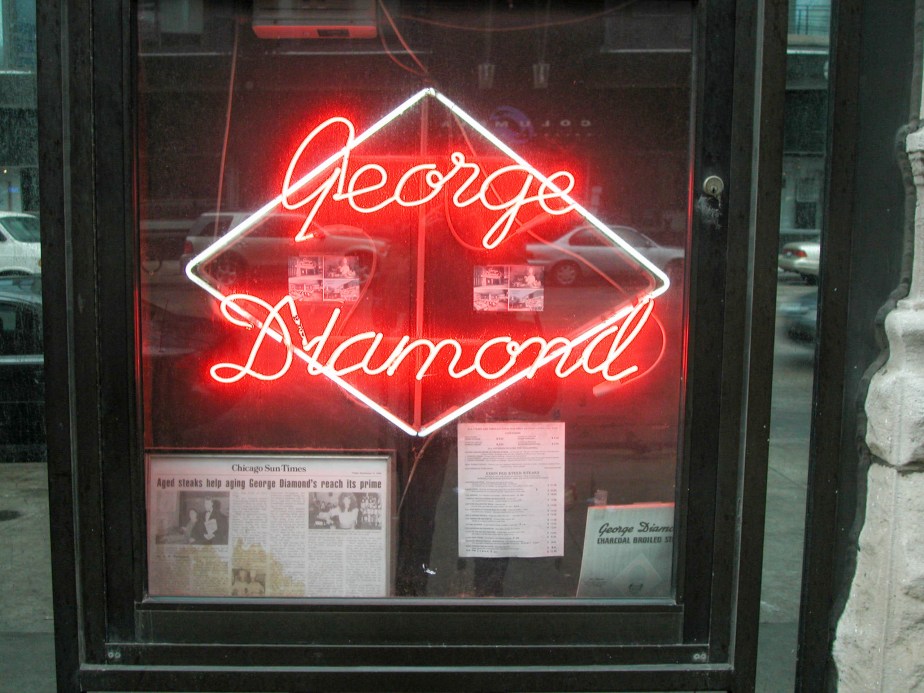
Located at 1247 Calumet Avenue, Levent’s became the home of George Diamond’s and then later Juster’s Charcoal Broiled Steaks.
Photo courtesy of Steve Shook.
Though my mom liked to cook, my parents were totally into eating out as well and though its been years and years, I remember going with them to George Diamond’s. It was the kind of place where everything was overlarge—the steaks, the salads, the charcoal flames, and even the menus.
That Diamond (yes, there was a George Diamond) even opened a place in Whiting shows the town’s status as a food destination. Indeed, around that time, there were a lot of great restaurants–and I’m sure I’m leaving a lot of places out–Vogel’s, Phil Smidt’s, Margaret’s Geneva House, Al Knapp’s Restaurant and Lounge, and the Roby Café. But Diamond was international.
Besides his flagship restaurant at 630 S. Wabash Avenue in Chicago that was said to have cost over $1 million to renovate in a style I call 1950s swank, all red velvet and red upholstery, he had places in Las Vegas, Palm Springs, on a golf course in Antioch, Illinois on a golf, and Acapulco, Mexico.
What I remember most was the house salad dressing which they bottled and sold on the premises. It was so unique that even now it has a cult-like online following with people searching for the recipe. It wasn’t Russian and it certainly wasn’t French or at least not the orangish French dressing we buy in bottles now. Diamond’s dressing was an almost translucent reddish pink. And if the recipe I found online is close to the original, it’s main ingredient was tomato soup.
There’s nothing left of Diamond’s empire today. Diamond died in 1982 at age 80 and the building housing the Wabash Avenue restaurant went up in flames in 2006. But people still remember that dressing.
George Diamond’s salad dressing
1 (10-ounce) can condensed tomato soup
2/3 cup oil
1/2 cup each: white vinegar, sugar
1 small onion, peeled and grated
1 clove garlic, peeled and halved
1 tablespoon dry mustard
1/4 teaspoon each: salt, ground black pepper
Place undiluted soup, oil, vinegar, sugar, mustard, salt, pepper, onion and garlic in a blender or food processor fitted with a metal blade. Cover and blend or process on high speed until pureed, about 2 minutes. Serve chilled. Store covered leftovers in refrigerator.
At one time, almost every stream, creek, and river had at least one mill, using water to power the grinding stone, turning grain into flour. Now few mills are left in Indiana but the one in Story survived and the bottom floor is an event area and the top floor a place to stay.
A view of the general store, built in 1916 after the original burned down. The basement is The Story Still, a place to get a drink, so called because a still was found on the property during Prohibition. But, of course, stills were found throughout Brown County both before, during and after Prohibition. The main floor is the dining room with the original potbelly stove (electricity didn’t come to Story until around 1949), and the four rooms upstairs are for overnight guests and, some say, for the Blue Lady who checked in and never checked out over a century ago.
Saxony is Germany’s Land of Christmas, a place where tradition and craftsmanship shine year-round. Throughout the state, artisans create exquisite handmade goods, and during the holidays, their work fills markets with warmth and wonder, allowing visitors to explore a mix of history, culture, art, cuisine, and festive cheer. From Dresden’s historic Striezelmarkt, one of Germany’s oldest Christmas markets, to Leipzig’s music-filled Old Town, Saxony’s centuries old cities radiate holiday spirit and cheer.
In Seiffen, the famous “toy village” of the Ore Mountains, generations of craftspeople continue to carve nutcrackers and candle arches that are now timeless symbols of Christmas. Meanwhile, Bautzen and Görlitz enchant visitors with medieval streets and castle views steeped in history and folklore. Even after a century of challenges, Saxony’s dedication to quality and artistry endures—especially at Christmastime, when only the finest craftsmanship will do.
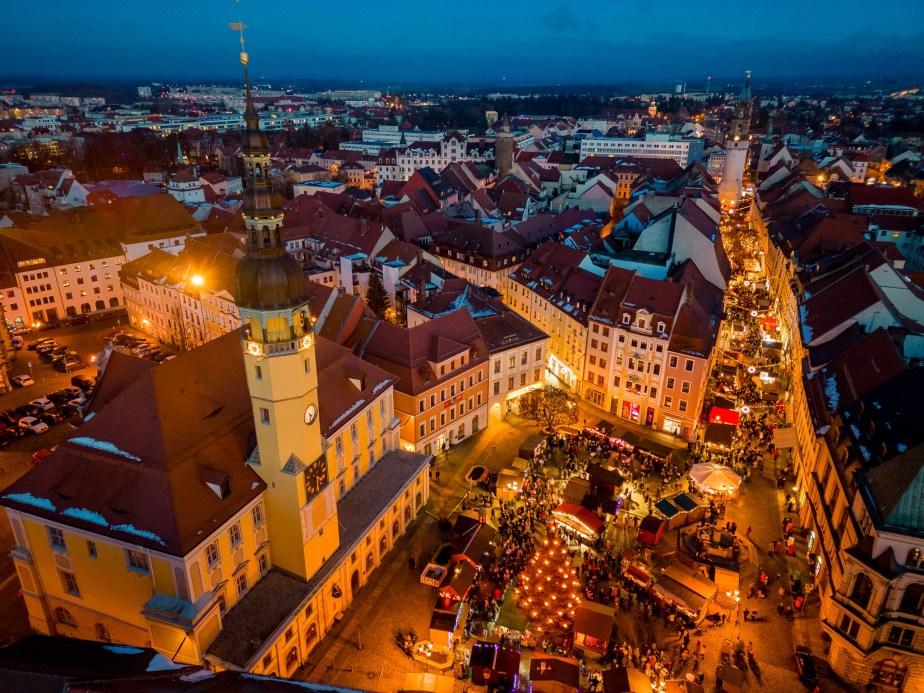
The Striezelmarkt in Dresden, with its many beautifully decorated stalls filled with a cornucopia of items, is a stunning spectacle during the winter and Christmas season. Photo: Sebastian Weingart (DML-BY)
View of the 588th Dresden Striezelmarkt from the tower of the Kreuzkirche. Photo: Michael Bader (DML-BY)
Dresden: One of Germany’s Oldest Christmas Markets
Dresden’s Striezelmarkt is the crown jewel of Saxony’s Christmas. By medieval right this market dates to 1434, and in 2025 Dresden celebrates its 591st anniversary. The market opens Wednesday, November 26 at 4 pm with a parade and the ceremonial lighting of the stalls. Highlights include the 40 ft high Ore Mountain pyramid and the giant candle arch (both record‐breakers), plus a historic Ferris wheel offering views over the glittering Old Town. Visitors can sip Glühwein and nibble on Dresden’s famous Stollen, which even has its own festival on Dec 6. Beneath the illuminated church towers, shoppers browse handcrafted wooden toys, ornaments and regional foods.
Leipzig: Music, Markets, and Magic in the Old Town
An hour by train west of Dresden, Leipzig lights up for Christmas in historic style. Leipzig’s festive season begins on Tuesday, November 25, 2025, with the opening of the historic Christmas market, running through December 23. The city center will feature over 300 stalls, blending tradition, music, and culinary delights.
Highlights include the Historic Market Square with its 60 ft Christmas tree, nightly trombone performances from the Old Town Hall balcony, and a festive stage with choirs and musicians; the Naschmarkt, showcasing medieval crafts, mead, and freshly baked Handbrot; St. Nicholas Churchyard with the beloved Feuerzangenbowle pyramid for mulled wine; and Augustusplatz, featuring Finnish and South Tyrolean villages and a 125 foot Ferris wheel offering panoramic views.
Trendy districts like Connewitz and venues such as WERK2 and Feinkost host smaller markets with handmade arts, crafts, and regional foods. Music lovers can enjoy performances at St. Thomas Church, including Bach’s Christmas Oratorio, along with numerous advent concerts celebrating Leipzig’s rich musical heritage. Beyond the city, visitors can explore the medieval Christmas market at Felsenkeller, the illuminated Christmas garden walk at Park Markkleeberg, and the traditional Gänsemarkt in Werms, featuring Christmas geese, carp, handicrafts, and Nordic decorations.
Eastward in the Lusatian Hills in an area in the east of Saxony that is the center of Sorbian culture in Saxony, the medieval town of Bautzen in Upper Lusatia, is a perfect backdrop for a fairy tale Christmas with turrets and towers and beautiful churches and buildings.
In Bautzen’s old town, the historic Wenzelsmarkt (28 Nov – 22 Dec 2025)carries the name of King Wenceslas IV, who in 1384 granted the town market rights. Stalls line Hauptmarkt and Reichenstraße beneath the Reichenturm tower, decked with lights and a giant tree. Bakers’ guilds sell Stollen and smoked sausages, and on weekends a medieval market at the Moench Church Ruins highlight sword-fights and minstrels. Children can enjoy seasonal surprises at the library and hear Christmas tales at the Nikolaiturm (St. Nicholas Tower).
Festive rides at the Kornmarkt (Corn Market) provide extra fun, while live music fills the air throughout the city. From December 1st onward, Santa Claus will delight crowds daily on Wenceslas’s Stage beneath the Main Market tree, opening a new door of the Advent calendar.
From the Napoleonic Wars to WWII, the Saxon town of Görlitz was part of the Prussian province of Silesia, which now belongs to Poland. Today, Görlitz is part of Germany right on the border with Poland and the city maintains many of the Silesian customs, traditions, costumes, cuisine and even its dialect.
The city’s historical importance is evident in its well-preserved architecture, which reflects its past as a wealthy trading town. It was never destroyed during the war and so its buildings are original and incredibly romantic. Each year the city stages the Schlesischer Christkindelmarkt(Silesian Christmas Market). From Friday, November 28 to Sunday, December 14, 2025 the Untermarkt (below the medieval hall) is transformed into a festive village. Wooden chalets brim with gingerbread, hand-carved angels and regional crafts, and the scent of mulled wine wafts past the Gothic St. Peter’s Church. There are special church services,baking, reading, singing and music, plus the “Görlitz Christkind” (christ child) which makes a daily appearance on the market. Bautzen offers a quiet, historic counterpoint to the big-city markets.
Seiffen: Germany’s Christmas Capital in the Ore Mountains
Nestled high in the “Erzgebirge” (Ore Mountains), the village of Seiffen is the Christmas capital of all Germany as it is where many of the beautiful Christmas treasures are created. The nutcracker and the smokers were invented in Seiffen as the woodcutters used their winter time in industrious ways to create the wooden toys, gifts, keepsakes, candles and figurines.
Here families have been making wooden toys and decorations for over 300 years. In Seiffen’s narrow lanes, workshops and shops spill out seasonal bounty: nutcrackers, smoking men, pyramids and candle arches. Local artisans say this craft is truly their passion. As one woodcarver explains, “People are amazed that we can spend so long painting a few details on a minuscule doll’s head… But we love our craft – it’s a love many of us have had since we were children.” Visitors to Seiffen can tour family workshops and the Toy Museum (Spielzeugmuseum), tasting Erzgebirge biscuits amid snow-dusted firs and candlelight. It is truly quintessential Saxon Christmas tableau.
Lemon Creek Winery, established in 1834, is a multi-generational family farm and winery at 533 E Lemon Creek Road, Berrien Springs, Michigan. 269-471-1321. They will be pairing their wines with classic restaurants mentioned in my book. It’s a cool idea, I wish I could claim it as my own. But alas, no.
The members of the Sacred Heart of Mary Catholic ChurchBook/Movie Discussion Group have invited me to speak this Wednesday, June 11th at 6:30 p.m. If you have the time and are interested in the history of restaurants in Michiana, please come. The church is lovely, located in a beautiful country setting at 51841 Leach Rd, Dowagiac, Michigan. The event itself is next door in the Parish Hall.
Mary’s City of David Vegetarian Cafe in Benton Harbor, which opened in 1931 and closed in 1975, specialized in farm-to-table meals.
Here is the flyer that Terri Moore sent out:
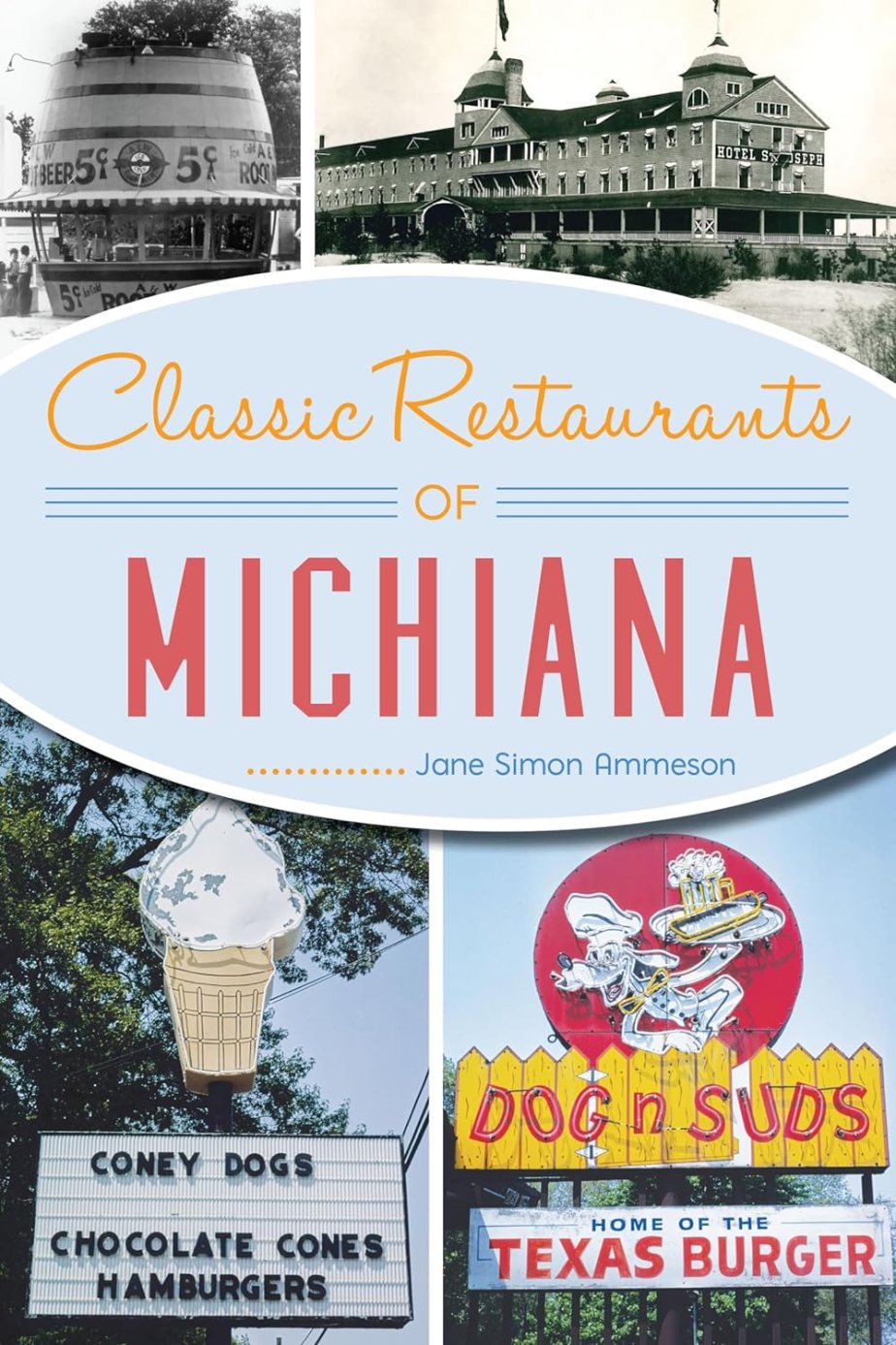
Over the centuries, residents of Michiana have never wanted for superb dining choices. Award-winning author Jane Simon Ammeson will lead us on a culinary road trip through Northern Indiana and Southwestern Michigan.
A cigarette girl at the posh House of David motor lodge and restaurant/nightclub called the Vista Grande
Once a stagecoach stop, The Old Tavern Inn has been open since the time of President Andrew Jackson. Tosi’s is known for its gorgeous starlit garden and gastronomic traditions stretching back almost a century, and The Volcano was amongst the first pizzerias in the country.
One of the earliest hotels in St. Joseph, the Perkins house, built in 1840, stood on the corner of State and Ship Streets. Note the side entrance for the saloon which was, of course, given the times, for men only.
These restaurants and other classic eateries remain part of the thriving local food scene. But the doors of others have long been closed. Some like Mead’s Chicken Nook and Robertson’s Tea Room linger in memories while The Owl Saloon, O. A. Clark’s Lunch Rooms, and Lobster Lounge are long lost to time.
The restaurant is still open at the Barbee, it was a fav of Al Capone. However, when he arrived, all the other guests had to leave.
Jane Simon Ammeson is a food and travel columnist who has authored seventeen books, including Classic Restaurants of Northwest Indiana. Always willing to travel for food, she blogs about her experiences at janeammeson.com.
At one time, the lakeside towns of southwesterern Berrien County had a large Swedish population. The Swedish Coffee Pot was just one of several. Only the Swedish Bakery remains.
In less than a year, one of Marshall’s most historic yet long-vacant buildings has been converted into an elegant, first-class event space called Venue 19 Zero 9. An extension of Schuler’s Restaurant and Pub, is named for the year in which Schuler’s was founded–1909. The public is invited to view the transformation of Venue19 Zero 9 at an Open House on Thursday, March 20 from 4-7pm.
“We can’t wait to share this newly renovated space with our community and guests,” says Sue Damron, President & CEO of Venue 19 Zero 9 and Schuler’s. “Over the years, we’ve been committed to expanding and enhancing the hospitality experience here in Marshall. The addition of Venue 19 Zero 9 gives us another unique space to create memorable events complete with catering and planning services.”
Housed inside an 1880s historic landmark, known for many years as Dreamers Furniture, Venue 19 Zero 9 sits two blocks from the Marshall’s legendary Schuler’s Restaurant. The restoration of the iconic stone structure aligns with the town’s dedication to its heritage, offering the perfect blend of tradition and modernity while creating a beacon of sophistication and unparalleled experience for weddings, corporate events, and other special occasions.
The multi-use Venue 19 Zero 9 features a large room accommodating up to 300 seated guests, an intimate soft-seating area, two changing quarters for wedding parties to get ready, as well as three stylish boutique hotel rooms, adding a touch of class for those seeking an all-encompassing experience.
To ensure an exceptional culinary offering, Venue 19 Zero 9 features exclusive catering by Schuler’s Restaurant. Known for its impeccable service and delectable cuisine, Schuler’s will bring its signature touch to elevate events held at Venue 19 Zero 9 including unparalleled professional onsite planning services. Drawing upon the extensive hospitality experience of the Schuler’s team, the venue aims to provide full-scale event coordination, ensuring that every detail is meticulously executed.
The Venue 19 Zero 9 project is the latest initiated by Damron, who acquired the legendary restaurant in 2019 and has worked for the company for almost three decades. Over the past five years, she and her team have been responsible for ongoing renovations at the restaurant and pub, but more notably she led the charge to transform former office and storage space (part of the building’s original hotel footprint) into seven new mixed-income units—four of which are reserved for low-to-moderate-income residents—and five boutique guest rooms branded as The Royal Hotel. In 2020, she also developed a picturesque off-site outdoor venue in rural Calhoun County called Hyde Away, which adds diversity to the company’s hospitality portfolio.
Damron says she couldn’t have completed this project without the support of the City of Marshall, Michigan Economic Development Corporation, Marshall Area Economic Development Alliance, and Homestead Savings Bank. The project was eligible for a grant coupled with significant investment from Damron and Schuler’s Restaurant.
Founded in 1909, Schuler’s is noted as one of Michigan’s most iconic restaurants. With more than a century of successful years in the industry, Schuler’s remains a hospitality leader not only in Michigan, but throughout the country.
Schuler’s Restaurant & Pub is located at 115 S Eagle St. in Marshall, Michigan. (269) 781-0600; SchulersRestaurant.com
Venue 19 Zero 9 is located at 112 N Eagle St., Marshall, Michigan. https://19zero9.com
Extensive collection of national outlets name Louisville a top place to visit
As fans of Bourbon City raise a glass to mark the end of 2024, it’s time to recap and celebrate a momentous year in the city’s dynamic tourism industry.Louisville was frequently in the winner’s circle over the past 365 days, earning top travel accolades from national travel media heavyweights such as TripAdvisor, Travel + Leisure, and Airbnb, among others.
Louisville started out 2024 on a high note, being named to Travel + Leisure’s list of ‘50 Best Places to Travel to in 2024.’ Contributing to Louisville’s historic year was the back-to-back hosting of the 150th running of the Kentucky Derby and the 106th PGA Championship, helping Louisville earn a spot on Travel Pulse, Condé Nast Traveler, and The Manual’s lists of ‘Best Places to Travel to in May.’ Both TripAdvisor and Airbnb marked Louisville as a top “trending destination” in the United States, with the online platforms using reviews and booking data to affix Louisville to the prestigious lists.
Throughout 2024, Bourbon City upheld its status with an outpouring of accolades for its vibrant culinary and cocktail scene. Louisville’s restaurant reputation is sizzling, with Travel + Leisure highlighting it as one of the ‘Best Food Cities in the U.S.’ and Cheapism proclaiming it as one of ‘America’s Best Food Cities.’ The hip and artsy NuLu neighborhood earned recognition from AFAR magazine as one of the ‘Best Food Neighborhoods in the USA,’ with numerous NuLu restaurants also receiving individual accolades.
The LEE Initiative, co-founded by Top Chef contestant and recent ‘Culinary Class Wars’ competitor Edward Lee, received a James Beard Humanitarian award, marking the Louisvillian’s second James Beard Award win. Lee also received a shout for his Butchertown restaurant Nami, which was named to USA Today’s ‘2024 Restaurants of the Year’.
Several of Louisville’s beer and bourbon festivals were also recognized nationally. The sixth annual Bourbon & Beyond music festival hada record attendance of 210,000 attendees over the four-day weekend, including 60,000 on a single day. This marked the festival’s highest single-day attendance ever.
Fort Nelson Distillery. Photo Jane Simon Ammeson.
Garden & Gun magazine highlighted festivals Bourbon & Beyond, Garden & Gun Distilled and the Bourbon Boule as three of the ‘Seven Standout Southern Bourbon Festivals,’ while Tailspin Ale Fest captured a spot on USA Today’s 10Best ‘Beer Festivals in the US.’
Louisville’s powerful reputation as a convention destination was also widely recognized with a trifecta of awards including winning the Groups Today Readers’ Choice U.S. ‘Destination of the Year,’ a MeetingsToday’s ‘Best Destination Marketing Organizations in the South,’ and a ConventionSouth Readers’ Choice Award.
Some of Louisville’s top national accolades for 2024 include:
“Best Places to Travel in 2024” – Travel + Leisure
“Best Places to Go in 2024” (Kentucky) – Frommer’s
“The World’s Best Travel Destinations in 2024” – Culture.org
“The South’s Best Cities 2024” – Southern Living
“Trending Destinations – United States” – TripAdvisor
“Top Trending Destinations Locals Love” – Airbnb
“Most Up-and-Coming Neighborhoods in the U.S.” (Butchertown) – TravelMag
“Best Places to Travel in The South This April” – Southern Living
“Best Places to Travel in May” – Conde Nast Traveler
“Where to Travel in May 2024” (Churchill Downs) – Travel Pulse
“Best Places to Visit in May”– The Manual
“Best Places to Honor Black History in 2024” – U.S. News
“These 10 Destinations Elevate Black Culture Year-Round” – The Points Guy
“Awesome and Unique Bachelorette Party Destinations” – Purewow
“Best Vacations in the U.S. to Explore America’s Adventure Capitals” – Men’s Journal
“2024 Readers’ Choice Awards” (Destination of the Year) – Groups Today
Visit the city’s official tourism website for the complete list of Louisville-based accolades received in 2024, including those for hotels, restaurants, and festivals.