Even though St. Patrick’s Day has come and gone, there’s no reason not to celebrate the Irish culture in Chicago
Head to Beverly, a historic Irish neighborhood with a higher concentration of Irish bars here than anywhere else in the city as well as the multi-disciplinary Beverly Arts Center.
Head to the city’s Northwest side, where the Irish American Heritage Centeris a nonprofit organization that offers year-round cultural programming incorporating music and theater, literature, and language. (You may recognize it as the place which taught Conan O’Brien Irish step-dancing back in 2012.)
Keep an eye out for the grand opening of Guinness’s second U.S. taproom and brewery, which is slated to open later this year in the West Loop neighborhood.
April: EXPO Chicago Opens at Navy Pier
EXPO Chicago, the Exposition of Contemporary & Modern Art, celebrates its10th anniversary edition by opening this year at Navy Pier, from April 13-16. This year the fair features more than 170 international exhibitors from 36 countries and 90 cities, fostering an environment for creative discovery paired with a week of citywide collaborations with museums, galleries, and the City of Chicago.
Prominent Chicago galleries exhibiting include Corbett vs. Dempsey, Stephen Daiter Gallery, McCormick Gallery and more, as well as galleries from major domestic cities (such as New York, Los Angeles and Houston) and international cities (such as London, Madrid and Cape Town). The full list can be accessed here.
In the lead up to the centerpiece fair, the city will also host an EXPO ART WEEK (from April 10-16), offering a series of aligned programming including museum exhibitions and gallery openings for locals and visitors alike.
Those in town for the art fair shouldn’t miss the opportunity to stop by the Art Institute of Chicago to check out the Salvador Dalí exhibition (the first devoted to the Spanish Surrealist at the museum) and Fresh Up, an exhibit on the intersection on Blackness and womanhood from multidisciplinary artist Gio Swaby.
Also, check out programming at local hotels. For example, The Peninsula Chicago will be presenting Neo Chicago, featuring highlights from the Beth Rudin DeWoody Collection. The installation debuts on April 14 and will be displayed throughout the hotel’s public space through May 2023, as a part of the latest iteration of Art in Resonance, The Peninsula Hotels’ global contemporary art program dedicated to being an originator of culture through its engagement with artists who push the boundaries of their mediums, in works that engage the senses.
May: Celebrate Chicago’s Newest National Park with Railroad Days at Pullman
In December 2022, President Biden signed a designation declaring Chicago’s Pullman District (which was first designated a National Monument under President Obama in 2015) now a National Historic Park!
The Pullman Company played a transformative role in American train travel as well as a pivotal role in the U.S. labor movement due to the Pullman Strike of 1894.
From May 20-21, the district is celebrating the second annual Pullman Railroad Dayswhere, in partnership with Metra, and the American Association of Private Railroad Car Owners, visitors will be able to explore historic Pullman rail cars from different eras at the 111th Street/Pullman Metra Electric station.
Included are the 1923 New York Central 3, the 1950 Royal Street Observation car, and the 1950 Blue Ridge Club.
The weekend-long event is a mix of free events and single-ticket entry access to some sites.
Guinness Open Gate Brewery (OGB) Chicago is opening its doors to the public this coming summer, bringing locally-inspired brews and community collaborations to Chicago’s vibrant West Loop neighborhood. This is Guinness’ second brewing facility and taproom in the United States, the first of which is the Guinness Open Gate Brewery in Baltimore, Md.
“Chicago and Guinness have been part of each other’s stories for more than a century, and OGB Chicago has been a dream throughout – we are thrilled to open our doors to the West Loop community this summer,” said Ryan Wagner, national ambassador of Guinness. “As we grow closer to the opening date, we are looking forward to the brewery becoming a part of our new neighborhood with a lively food and beverage program, unique retail offerings and impactful community partnerships.”
Located in Chicago’s West Loop neighborhood at 901 W. Kinzie St., the Guinness Open Gate Brewery Chicago will deliver an American craft beer experience that is authentically Guinness and distinctly local. The taproom will showcase local collaborations that highlight the rich history and flavors of Chicago, bringing the style of each of Chicago’s 77 unique neighborhoods to life within the taproom walls.
“Guinness has a long history of hospitality, communion and bringing people together from all walks of life, and that fits so well with the spirit of Chicago,” said Rodney Williams, president, Diageo Beer Company. “This is a great moment in time for Guinness in America, and we can’t wait to tap into all the different flavors and variety of heritages represented in this great city.”
The brewery’s name takes inspiration from the Guinness Open Gate Brewery in Dublin – the brand’s original location, where it has innovated and experimented in beer for more than a century. And since the first barrels of its famous Extra Stout rolled into the Windy City in 1910, Guinness’ story has also been a part of Chicago’s rich history. Arthur Shand, Guinness World Traveller, remarked in 1911 that Chicago has and will always be an important point for Guinness Stout. Over a century later, the iconic brand is proud to further that statement as it extends its reach in the United States.
Community Engagement
“At the Guinness Open Gate Brewery, we are engaging with the community through a number of local Chicago partnerships, and we’re just getting started,” said Wagner. “It is extremely important that we highlight the diversity of our new home and continue to lead in sustainability initiatives that work towards the greater good.”
The Open Gate Brewery Chicago is committed to working with diverse business owners, leading in energy and environmental design, and empowering the next generation of hospitality professionals. The brewery will feature solar panel arrays and will pursue Leadership in Energy and Environmental Design (LEED®) Platinum certification for the site. The brewery is also strengthening an existing relationship with Open Water, a Chicago-based bottled water company committed to reducing single-use plastic and carbon emissions. The company’s products have been featured at the OGB Baltimore for the last several years.
The OGB Chicago also plans to work with Chicago-based coffee company Intelligentsia on developing and implementing its coffee program and will continue its partnership with Baltimore’s Cane Collective on the development of both beer cocktails and non-alcoholic cocktails.
Additionally, Guinness will bring parent company Diageo’s Learning Skills for Life program to Chicago. The program, which provides unemployed and underemployed individuals with free hospitality and employability skills training, is currently running in five locations across North America, and will launch in Chicago this spring.
For more information on the Guinness Open Gate Brewery Chicago, visit www.guinnessbrewerychicago.co and follow @GuinnessBreweryChi on social media channels to keep up to date with the latest news ahead of the summer opening.
About Guinness
The Guinness brand was established in 1759, when Arthur Guinness signed a 9,000 year lease on St. James’s Gate Brewery in Dublin. Brewed using four main ingredients, water, barley (malted & roasted), hops and yeast, Guinness is the world’s most popular stout brand. The iconic beer is brewed in 49 countries worldwide and sold in over 150 with almost 9 million glasses of Guinness beers enjoyed everyday around the world. The most Guinness is sold in Great Britain, Ireland, USA, Nigeria and Cameroon. More information can be found at http://www.guinness.com.
About Diageo Beer Company
Diageo Beer Company USA (formerly Diageo-Guinness USA) is the U.S. beer and flavored malt beverage business of Diageo. Brands within Diageo Beer Company include the iconic Guinness, Harp, Smithwick’s and Smirnoff ICE.
About Diageo
Diageo is a global leader in beverage alcohol with an outstanding collection of brands including Johnnie Walker, Crown Royal, Bulleit and Buchanan’s whiskies, Smirnoff, Cîroc and Ketel One vodkas, Captain Morgan, Baileys, Don Julio, Tanqueray and Guinness. Diageo is listed on both the New York Stock Exchange (DEO) and the London Stock Exchange (DGE), and products are sold in more than 180 countries around the world. For more information about Diageo, its people, brands and performance, visit www.diageo.com. Visit Diageo’s global responsible drinking resource, www.DRINKiQ.com, for information, initiatives and ways to share best practice.
“even if we never make these dishes of ancient times, Miller’s book is a fascinating read.”
“They say ‘history is written by the victors,’ but in my experience, history is written by those who write stuff down, and food is no exception,” writes Max Miller in the introduction to Tasting History, his new cookbook that delves into the foods we’ve eaten throughout millennia.
Four years ago, Miller had little interest in cooking. But when a friend became sick while they were vacationing and they watched seasons of a cooking shows while overindulging on nachos, that all changed. Developing a passion for baking, he soon was taking his cakes and pastries to Walt Disney Studios where he worked. Besides sharing his creations, Miller also explained the origins of the recipes. Suggestions from friends influenced him to start a YouTube show titled “Tasting History with Matt Miller.” Shortly after, the pandemic hit, Miller was furloughed from his job, as were many others, and his show became a hit to all those stuck at home.
Now Miller has taken it to the next level with this deep dive into food history that includes original recipes and Miller’s adaptations for home chefs as well as photos, original drawings, anecdotes, and cook’s notes.
The recipe for this stew is easy, but even if a person could, though it’s unlikely, find the fatty sheep tails, another ingredient—risnatu—has no definite translation, though Miller says it’s commonly agreed upon that it’s a type of dried barley cake. He solves both those problems in his adaptation of the recipe by providing appropriate substitutions that honor the dish’s origins but make it available to modern kitchens.
But even if we never make these dishes of ancient times, Miller’s book is a fascinating read. As we get closer to our own times—the book is arranged chronologically—we find dishes that are more recognizable such as precedella, a German recipe originating in 1581 that instructed cooks to “Take fair flour, a good amount of egg yolk, and a little wine, sugar and anise seed and make a dough with it.”
Of course, modern pretzels don’t typically have wine and anise seeds in them, but Miller provides a recipe using all those ingredients so we can get the same flavor profile as the precedellas that were baked almost 500 years ago. It is indeed tasting history.
Miller has culled recipes from around the world. The book also includes the foodways of medieval Europe, Ming China, and even the present with a 1914 recipe for Texas Pecan Pie that Miller describes as “a time before corn syrup came to dominate the dessert.” His adaptation of the original recipe uses sugar since corn syrup didn’t begin to dominate until the 1930s. The 1914 recipe also calls for a meringue topping, an addition not found in modern pecan pies. So even within a short time span of just over 100 years, Miller shows us how a recipe has evolved though he assures us, we’ll like the 1914 version best.
Facility That Sharing the Stories of the Survivors of the Last Slave ShipTo Arrive in the United States Will Open This Summer
At a February 3 event honoring the 110 survivors of the Clotilda, the last slave ship to arrive in the United States, the page was turned for the next chapter of a story that’s been being told for more than 150 years … in secret for decades but now shared on a global stage.
This past weekend marked the “Spirit of Our Ancestors” festival in the Africatown community of Mobile, Alabama. As part of the annual tribute, which is coordinated by the Clotilda Descendants Association, the community came together at the site of the new Africatown Heritage House to witness the unveiling of a signature piece of artwork and to hear the news that the facility is set to open on July 8, the 163rd anniversary of the date the community’s founders arrived in the United States … in shackles.
To understand the magnitude of this announcement, it helps to know some history:
Under the cover of night in the summer of 1860, a ship carrying 110 Africans slipped into Mobile Bay. The Clotilda, the last known U.S. slave ship, made its illegal voyage 52 years after the international slave trade had been outlawed. (Though it was illegal to bring enslaved people into the United States, domestic slavery itself remained legal until 1865.)
Upon arrival in Alabama, the captives were offloaded into the marshes along the Mobile River. In an attempt to conceal the crime, Timothy Meaher, the man who arranged the transfer, ordered the boat burned and sunk. Some captives remained in Mobile, enslaved by the Meaher family, and others were sold to Alabama plantations north of Mobile.
When slavery was abolished in 1865, the survivors dreamed of returning to Africa, but they didn’t have the financial means to make that happen. Instead, many of them pooled their limited resources to purchase land from the Meahers and turned it into the independent community known as “Africatown.” There they maintained their African identities, continued to speak their own languages, established their own set of laws and – in the early years – even had a chief. They built churches, schools and businesses based on what they knew from their homeland, and they effectively created their own world on the northern end of Mobile.
In 2019, it was verified that the shipwreck of the Clotilda rested at the bottom of the Mobile River, providing a tangible link to the names and stories that have been passed down through generations of descendants.
Africatown Heritage House
Africatown Heritage House is a community building that will house “Clotilda: The Exhibition,” to share this long-untold story. The facility was built by the Mobile County Commission but is a collaborative project that involves several entities working in partnership with the community. This includes the Alabama Historical Commission, which is leading the scientific efforts surrounding the search for, authentication and protection of the ship Clotilda and related artifacts, and the History Museum of Mobile, which curated, constructed and funded “Clotilda: The Exhibition” with generous support from other local organizations. The museum will operate Africatown Heritage House when it opens this summer.
The exhibition is especially focused on the people – their individuality, their perseverance and the extraordinary community they established. It will introduce the world to 110 remarkable men, women and children, from their beginnings in West Africa, to their enslavement, to their building the community of Africatown. Their stories will be shared through a combination of interpretive text panels, documents and artifacts, including some pieces of the sunken ship scientifically verified to be the Clotilda.
Africatown Heritage House and “Clotilda: The Exhibition” will open to the public on Saturday, July 8. Called “The Landing” by the descendants of the Clotilda’s survivors, this date marks 163 years since their ancestors arrived on American soil, forced against their will. Events and activities in acknowledgment of the date’s significance are being planned by the Clotilda Descendants Association and other local entities.
Africatown Heritage House will be open from Tuesdays through Saturdays, from 10 a.m. to 5 p.m. The exhibition will have limited capacity, so tickets should be purchased in advance. Tickets will likely become available online in early summer.
For more information about the facility and the exhibition, please visit Clotilda.com, which is operated by the History Museum of Mobile. The latest details will be shared as they become available.
Mobile, Alabama Proudly embracing its history and culture, Mobile, Alabama remembers and honors all the people who have shaped its story. And you can learn about some of these stories at the Dora Franklin Finley African American Heritage Trail which highlights notable people of color throughout Mobile’s history and offers the chance for visitors to learn about parts of the past that must never be forgotten.
Included in this history is the story of the Clotilda, the last known slave ship to arrive in the United States in 1860 – decades after international slave trade was outlawed – and which was recently verified to be resting at the bottom of the Mobile River near 12 Mile Island and just a ways north of the Mobile Bay delta.
After the Civil War, Clotilda survivors formed their own community, naming it Africatown, and this year their descendants and the entire Mobile community are celebrating the long-anticipated opening of Clotilda: The Exhibition at the Africatown Heritage House. The exhibition shares the stories of the Clotilda, her survivors and those who came after them, and also serves as a place of reflection for the many African Americans who have been unable to trace their stories in the same way.
There will also be water tours that take visitors down the Mobile River to hear stories of captives on the schooner, Clotilda, a two-masted wooden ship. According to the Smithsonian, the ship was owned by steamboat captain and shipbuilder Timothy Meaher who bet another wealthy White man that he could bring a cargo of enslaved Africans aboard a ship into Mobile despite the 1807 Act Prohibiting the Importation of Slaves.And so in the autumn of 1860 Captain William Foster sailed for West Africa, capturing and successfully smuggled 110 enslaved Africans from Dahomey into Mobile. One captive did not survive the wretched conditions aboard, and perished during the Middle Passage.
The story of last shipment of enslaved people who landed on American soil, showcases not only the avariciousness and immorality of slave traders and those who profited off of the slaves but also the survival and heroism of the enslaved. It is ultimately a tale of resiliency and the ability to overcome adversity. After the Civil War, these enslaved people founded the Africatown community which still exists today.
Pull on your hiking boots, get out the trail maps, and pick out the perfect place for a beer. Afterall, our mantra is that the tastiest beer every is the one you quaff after a hike. And what better place to do so than in California’s gorgeous and historic Gold Country.
Known for its rolling hills dotted with forests and scenic vistas as well aits many artisan breweries, Placer County is an outdoor adventurer’s – and a beer lover’s – dream. With 30 miles of trails,
Hidden Falls Regional Park is a great stop for a leisurely hike before checking out the local breweries such as Hillenbrand, Goathouse and Dueling Dogs. Near the Auburn State Recreation Area, the 10.8-mile Quarry Trail will take you along the American River, surrounded by sheer limestone.
Then head to Moonraker Brewing for renowned lagers, IPAs, sours and hard seltzers. Also popular trail is the 4.5-mile Lake Clementine Trail, which passes under the highest bridge in California. Post hike, stop by Crooked Lane Brewing for their fruit infused beer such as their Fruited Sour with Raspberry, Tangerine, and Pineapple as well as Mandarin Pale Ale.
Photo: Erik Bergen, Placer County
While you’re at the Auburn State Rec Area, take the easy Olmstead Loop Trail that parallels historic Highway 49 near the town of Cool on one side and the American River Canyon on the other. The trail passes through rolling oak woodlands and includes canyon descents, climbs and water crossings, with elevations ranging from 1,350’ to 1,500’.
Three minutes away, Cool Beerwerks offers cold beer in warm environs with occasional live music. The Monte Vista Trail, located in El Dorado Hills near Folsom Lake, is a scenic three-mile loop that boasts various views, including the South Fork of the American River as it curves toward Folsom Lake. You may see wildflowers, green meadows, and birds depending on the time of year. Off Salmon Falls Road, the trailhead also accesses the Brown’s Ravine trail and New York Creek for a longer hike. Either way, a cold beer awaits just seven minutes away at Mraz Brewery.
Finish your Gold Country Hike & Beer tour around Yosemite National Park. In the park, you can cap off a hike on virtually any trail with a cold one Mariposa’s own 1850 Restaurant and Brewery which has taps at The Mountain Room at the Yosemite Valley Lodge.
Outside of the park, 1850’s tap house in downtown Mariposa is a great spot to grab a burger and brew after a day at the park or a hike at Stockton Creek Preserve, which is just a three-minute drive away. The Lewis Creek National Scenic Trail is a popular trailhead in the Oakhurst area and South Gate Brewing is a perfect place to grab a cold one after this four mile trek.
Little did we know that when we dined at the corner restaurant near our hotel in Paris we were eating at a place where for decades a family divided had fought over the secret sauce served with their steaks.
Maybe it’s a French thing.
For some background. My husband and I were on our honeymoon and had booked a Viking River Cruise on the Seine and then added some before and after stays in Amsterdam where it is more easy to get run over by a bicyclist then a car and Paris where we stayed at a little hotel near the metro in the 17th arrondissement, known as Batignolles-Monceau,so we could visit other parts of the city without spending a fortune on cabs. Though we didn’t plan it this way, Hotel 10 Le Bis, our hotel was near numerous little cafes and a little grocery store where we could easily—and cheaply–buy food for quick meals and snacks.
One intriguing café was Le Relais de Venise (the name translates to Venetian Inn) where every night we would see long lines of people waiting to eat either in their dining room or on their outdoor patio. The interior of the restaurant looked so French bistro with its polished dark wood, tiny tables with crisp white table cloths, and servers dressed in black uniforms, the outdoor section was right on a busy corner filled with traffic and pedestrians, noise, and the rumbled of trucks and sounds of horns honking. So depending upon your mood you could choose where to dine.
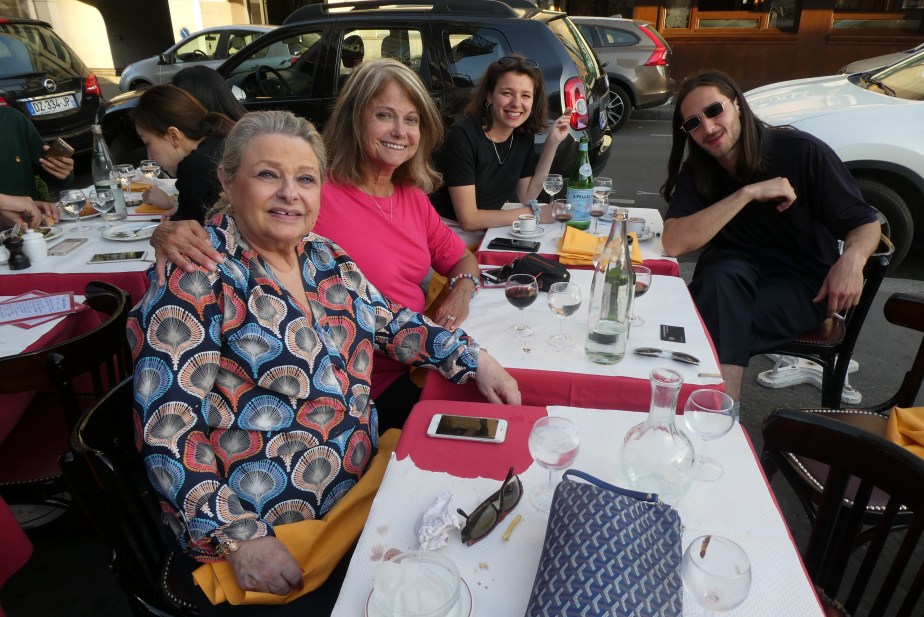
What could be so great that people would wait for hours for a table when there were so many great cafes and restaurants around? And so we didn’t go until one evening, after ascending from the metro station and seeing there was no line, we decided to give it a try. The only tables available were outdoors and so we sat at a very small table next to another small table where a single woman sat, smoking a cigarette. That turned out to be a very lucky thing.
When our server arrived I asked to see a menu and she (we would find out later her name was Gertrude) abruptly told us she was the menu. Well, what’s on the menu? Steak frites, she replied. “bloody or well done.”
We told her “bloody”, and she gave us an approving look. But we were a little baffled. Was there really only one dish on the menu? As it turns out, there is no menu and only one entree, one salad with one dressing, steak frites (French fries), and bread. Do not expect butter, ketcup, mayonaaise, or any other condiment. They do only one thing but they do it very well. That’s how it was when Le Relais de Venise opened in 1959 and that’s the way it is now at all the restaurants throughout the world–New York City, London Marylebone, London City, Mexico City
When Gertrude returned with a salad topped with walnuts (no one inquired whether we had a nut allergy—which fortunately we don’t) and a crusty French baguette, I saw there wasn’t butter on our table and asked for some. Oops, one would think I had tried to order a Big Mac.
“No butter,” Gertrude told us.
“There’s no butter?” I asked.
“No butter,” she replied.
“How about olive oil?”
“No olive oil,” she told us.
Now, I knew that in a French restaurant there had to be both in the kitchen, but I guess neither butter nor olive oil was allowed to be carried into the dining area, so we ate the bread—which was very good—without either.
This is when the woman at the table next to us decided to intervene. She lived in Paris she told us but had spent years in the United States working as a publicist for musicians in New York. Le Relais de Venise de Entrecote was unique, she continued, because they only served one dish—steak with French fries and their famed green sauce called Le Venise’s Sauce de Entrecote. I guess that makes decided what to order for dinner super easy. If you’re wondering what entrecote is, as I was, it’s a cut of meat like a New York strip or strip steak. Or at least in it is in Paris.
Since the creation of the sauce, its exact ingredients have long been a secret and that probably worked until invention of the internet. After a family squabble resulted in a going of separate ways, the sauce itself became a battleground so complex and full of intrigue that the Wall Street Journal did a lengthy article about it all eight years ago. I guess when you serve only one dish and the sauce is a necessary part of it, feelings about who owns the recipe loom large. So large in fact that’s there was a million dollar lawsuit as to who had rights to use the name and sauce.
Anyway, after we ate our salad (no choice of dressing as it already was dressed with a vinaigrette which was very good), our steak with fries arrived—with the sauce spooned over the meat. It was delicious.
What’s in it? I asked the woman next to us.
“It’s a secret,” she said. “But I’ve been eating here for decades so I know it. But it’s really better to come here.”
She promised to give me the recipe, but she must have changed her mind because she never returned my phone calls or emailed it like she said she would. She may have been afraid Gertrude would get mad at her or maybe the restaurant owners wouldn’t allow her back in. Neither would be surprising. And believe me, you don’t want to cross Gertrude.
I noticed, as we were eating, that the servers were moving through the crowded café with platters of meat and piles of crisp, hand-cut pomme frites. Almost as soon as I had cleared my plate, Gertrude showed up again, heaping—without asking but that was okay—more frites and slices of bloody steak and then pouring the secret sauce on top. At no charge. but no ketchup or mayonnaise either for dipping the fries Gertrude informed us.
“They’ll do that until you say you don’t want anymore,” the woman told us about the second and third helpings.
“Is there a charge?”
“No, it’s all part of the meal.”
Which was a deal as the tab wasn’t very high even with the addition of a glass of the house wine produced at the family owned vineyard Chateau de Saurs in Lisle-sur-Tarn, 30 miles northeast of Toulouse. Indeed, the restaurant was opened by Paul Gineste de Saurs as a way to help market the wines but now there are at least three more restaurants—in New York City, Mexico City, and London. As for the sauce there are several stories. A rival restaurant said to serve a similar sauce says that it is not new but instead wis one of the classic sauces that are considered the backbone of French cuisine.
Of course, as soon as we got back to our room, I Googled the restaurant and the sauce. It took some digging, but I found recipes for both the secret sauce and the salad. Or so I think. I’m planning on trying them soon along with a French baguette or two from Bit of Swiss Bakery which I will be serving with butter.
Le Relais de Venise-Style Salad Dijon Vinaigrette
1 tablespoon Dijon mustard 1 tablespoon white wine vinegar Kosher salt to taste (nutritional info based on 1/4 tsp) Freshly cracked black pepper, to taste 2 tablespoons extra virgin olive oil (or walnut oil)
Whisk or shake in a mason jar until mixture is homogenous.
Serve on a bed of mixed salad leaves topped with some chopped walnuts and shaved Parmesan.
Serving Size: 4
Le Relais de Venise’s Steak Sauce
1 tablespoon olive oil
2 large shallots
3 cloves garlic, chopped
2 cups chicken stock
1 teaspoon pepper
2 tablespoons mustard
1 bunch tarragon
1 to teaspoons red wine vinegar, and increase the amount if you’d like more zip
1 teaspoon anchovy paste
1 teaspoon Worcestershire sauce
1 teaspoon kosher salt
Peel and slice the shallots.
Peel and roughly chop the garlic.
Add the olive oil to a small pot over medium heat.
Add the garlic and shallots and cook until soft and slightly colored.
Add the chicken stock. Simmer for three minutes.
Pull the tarragon leaves off of the stems and put them in a blender.
Add the remaining ingredients to the blender.
Carefully pour the chicken stock mixture into the blender.
Puree until completely smooth.
Pour back into the pan and bring to a boil. Cook for one minute. If the sauce is too thin simmer for a few more minutes.
Pour over slices of rare or as Gertrude calls it “bloody” or however you like your steak. Serve with potatoes or French fries.
Dust off your boots and don your cowboy hat for a step back in time at Lone Mountain Ranch’s 11th annual authentic wild west PBR week. Taking place from July 17th – 23rd, 2023, the action-packed Touring Pro Division PBR week is Big Sky’s biggest week of the year, as the community events and fun winds up to a weekend of world-class bull riding.
Exclusively available to guests of Lone Mountain Ranch, this all-inclusive Rodeo Week Package offers guests authentic ranch lodging at this luxury historic Montana guest ranch with three meals a day at the farm-to-table Horn & Cantle restaurant, and special dinners around the ranch each night, including a barn party one night, and live Western music in the rustic saloon. Guests also receive tickets to the PBR events on Friday and Saturday nights, with VIP access to event seating, food, and drinks.
Lone Mountain Ranch guests who join the Rodeo Package enjoy a six-night ranch experience, and scheduled daytime activities including horseback rides, naturalist hikes, mountain biking, canoeing, paddleboarding, archery, fly-tying course, yoga, axe throwing, guided Yellowstone tours, high ropes course, history hikes, photography hikes, yoga, axe-throwing, and more. In addition to the scheduled activities, other exclusive events on property include an on-ranch professional Rodeo with PBR qualifiers, followed by an exciting concert.
Besides that, Lone Mountain makes it easy to get around the local Big Sky area with transfers to and from Bozeman Yellowstone International Airport, as well as in-person and text service from a personal Ranch Concierge for the optimum rustic experience during this year’s Rodeo Week.
2023 Rates:
July 17, 2023 – July 23, 2023: Adult, $1500* Child, $1200*
*Rates are per person per night, minimum occupancy applies per cabin
*All package rates are subject to a 6% tax and a 15% Resort Fee (resort fee is taxed by 12%)
Celebrating more than a century as a symbol of the American West, Lone Mountain Resort was around during the early days of Yellowstone Park, the formation of the town of Big Sky, the evolution of ranching and logging in the Northern Rockies and the preservation of this magnificent wilderness.
Ever since it was homesteaded in 1915, Lone Mountain Resort’s story practiced real Western-style hospitality, welcoming to all. This is truly the Old West and for those staying at Lone Mountain Resort, it’s like turning the clock back more than century.
We call it the Real Montana and you’ll see what we mean when you arrive.