17s the focus of community events throughout the summer
WALLOON LAKE, MICH—In celebration of this summer’s 90th anniversary of the 17-square-meter sailboats — which were first made in Walloon Lake in 1934 — the Walloon 17 Foundationare organizing a series of public events, including:
Wednesday, July 17 (starting at 2pm) – a sail around the Village to Michigania; the public can view the activities from Melrose Beach.
Saturday, August 3 (starting at 2pm) – a 17 Regatta during the annual Walloon Woodies at The Foot of Walloon Lake
Saturday, August 17 (starting at 2pm) – a Media Race around The Foot of Walloon Lake.*
The Crooked Tree District Library (Walloon Lake branch) also has an exhibit on the 17s on display throughout the summer.
About the 17s
The first boat, 17 #1, was built on Walloon over the winter of 1933-34 by Bill Loughlin & Henry (Jordan) Cawthra and she again sails on Walloon Lake after a recent renovation. A total of 42 17s have been built over their 90-year history, first in wood and later in fiberglass. These boats still actively race 17s on Walloon Lake, the only fleet in existence, thanks to the Walloon Yacht Club and its members.
The 17 Square Meter is a one-design sailing yacht with a sloop rig and spinnaker with a fixed keel with 850 pounds of cast iron or lead and a 1620-pound sailing displacement. It is 24.9 inches in Length, 5’ 1 ½” in Beam with 17 square meters (183 square feet) of sail area, originally. The Class ensign, a red 17 in a Square indicates the vessels are a Square meter boat versus the 12 Meter Class which has a line under the 12 indicating a linear rule. The 12 Meter class raced for the Americas Cup from 1958-87 and other classes are also designed to the linear International Rule, like the 6 Meter Class. There were other popular Square Meter boats such as the 22 Square Meter.
About the Walloon 17 Foundation
The Walloon 17 Foundation was formed to protect, preserve, and perpetuate the 17 Square Meter Class. This includes the design, the boats, and the history of the 17s. The Foundation sponsors training, races and other events to promote 17s and administers the 17 Class. Members have written several articles on the 17s and in 2017 the Foundation published a coffee table book called Seventeens of Walloon Lake written by Frank Grossi and Bill Bray. The 87-page book includes stunning pictures of the boats in action over the years along with histories of the families who owned the classic sloop sailboats. It is available through the WYC website for $59, with proceeds benefitting the Walloon 17 Foundation.
The Foundation invites sailors and Wallooners who appreciate 17s to contribute their knowledge and stories as the group continues finding new techniques to share the history and legacy.
Mari Vineyards on beautiful Old Mission Peninsulais dedicated to making exquisite red and white wine from experimental Italian grapes alongside traditionally grown appellation varieties.
Mari Vineyards. Photo courtesy Two Twisted Trees.
Mari Vineyards, known for their estate grown wine and Italian varieties, is now a food destination as well with menu offerings ranging from sizzling small plates to s’more kits, available daily with varying specials.
The small plate menu is designed to sample, share, or have all to yourself. From cool Cucumber Crostini to hot Meatball Skillets, dishes are sure to please everyone with not only savory items, but sweets such as Fire Roasted S’mores and Chocolate Cake made with Mari wine. All of the dishes from the Mari Kitchen are selected to pair perfectly with Mari estate wine, with each dish featuring a wine recommendation hand picked by Mari staff. Current wine selections range from sparkling cider, to Chardonnay, to Italian red blends.
New weekly discounts and events invite a variety of guests to take advantage. Pasta Tuesdays feature unique pasta dishes with wine pairings; Thursday is OMP Local’s Day, offering Old Mission Peninsula residents 25% off small plates with the purchase of a wine flight or glass; Friday Happy Hour from 4-7pm includes half-off small plates and 20% off wine by the glass with live local music from 4-6pm; Saturdays are Educator’s Day, with half off small plates and 20% off wine by the glass and wine flights for teachers of any kind; and Sundays from 11am-3pm the new one-mile Winter Trail at Mari is open—hikers can purchase insulated tumblers full of mulled cherry wine, grilled paninis will be available to order, and hot cocoa is free for kids.
Mari Tasting Room. Photo courtesy of Two Twisted Trees.
Offering new experiences and wine pairing opportunities is important to Mari Vineyards’ Chef, Aric Anagnost. “The enthusiasm from both new guests and returning club members at having increased food options available during their visits has been overwhelmingly positive” he said. Stop in to enjoy fantastic food, delicious wine, live music, and great discounts by the fire this season before these hot items are off the menu. Summer experiences and menus will begin this May.
To find out more about Mari Vineyards’ winter menu, wine, hours of operation, and experiences please visit www.marivineyards.com or call 231.938.6116. 8175 Center Dr. Traverse City, MI 49686.
—Mari Vineyards, an estate grown and produced winery, is located on Old Mission Peninsula just north of Traverse City, Michigan. Growing over 20 different grape varieties, Mari produces both local favorites such as Riesling and unexpected Italian varieties like Nebbiolo. Old Mission Peninsula’s stunning appellation and proximity to Lake Michigan provide not only an ideal climate for growing varietal wine grapes, but a breathtaking travel destination as well. Visit Mari for tastings, glasses, small plates, and wine cave tours.
The 26th Annual Michigan International Auto Show rolls into the DeVos Place in downtown Grand Rapids this week, running February 1-4. Starting today, hundreds of vehicles from nearly 30 global manufacturers including a variety of trucks, SUVs, electrics and performance vehicles, will be moving into place.
Show Features
GENTEX Be sure to check out presenting sponsor, Gentex’s massive, heavily-modified Chevrolet Silverado Trail Boss (2LT). Sitting atop the truck’s custom Mule Sam roof rack is a DJI Matrice 300 RTK drone for scouting the surrounding terrain. The truck is paired with a companion Vorsheer XOC (Extreme Overland Camper) featuring the same overland theme and matching wrap. It comes loaded with every outdoor adventure necessity, including a heater and air conditioning, propane stove, sink, fridge/freezer, rooftop tent, and more.
PUT IT IN BARK Visit the Subaru Loves Pets exhibit and consider adopting a new furry friend. Subaru believes all pets deserve a loving home. Through their Subaru Loves Pets® initiative, Subaru and our retailers have been committed to improving the lives of as many shelter animals as possible. Those not looking to adopt today areinvited to make a donation to help pets in the community. All donationsand proceeds to their exhibit will go directly to the animals in their partner shelters. To learn more information about the #SubaruLovesPets initiative, visit https:// http://www.subaru.com/makeadogsday
NEVER DISPLAYED BEFORE The Gilmore Car Museum opened tomthe public in 1966 with thirty-five cars and has grown to become North America’s Largest Auto Museum with more than 600 cars today. For the past 20 years, the non-profit museum has displayed 10-12 historic vehicles at the Michigan International Auto Show.
It may surprise you that the museum relies solely on the generosity of donors who freely give their vehicles to the collection. This year they are showcasing some recent donations that have never been displayed here or at the museum before.
MICHIGAN AUTO SALON The Midwest’s only true Automotive Salon experience, featuring an exclusive lineup of Exotics, Supercars, High-Performance, and Specialty vehicles.
The Michigan Auto Salon is a gathering point for automotive enthusiasts, owners, and connoisseurs alike.
CHARGE IT UP Head over to the Electric Avenue at the river end of Hall C to see electric vehicles old and new. View electrics and hybrids from several different brands and learn about their motors, batteries, mileage, output, and special features.
For five days each January, the Thunder Bay National Marine Sanctuary brings the world of cinema to northeast Michigan with some of the most impressive ocean and Great Lakes films from around the world. Film screenings are complemented by social events, educational activities, and opportunities to meet filmmakers.
The Thunder Bay Film Festival is the only water-focused cinematic event in the state of Michigan—which is surrounded by four of the five Great Lakes and boasts nearly 3,200 miles of freshwater coastline (the longest in the country). The Great Lakes cover more than 94,000-square-miles and holds an estimated six quadrillion gallons of water—about one-fifth of the world’s freshwater surface water supply and nine-tenths of the U.S. supply. The protection of water, native aquatic species and a healthy environment are of particular interest to Michiganders and the documentaries lined up for this year’s festival are sure to educate and entertain.
WHEN: Wednesday,January 24 through Sunday, January 28, 2024
DETAILS:
68 Films
3 Venues
3 cities in 3 counties in northeast Michigan
HIGHLIGHTS:
Michigan premier of RELENTLESS (Running time: 92 minutes. Writer/Director/Producer: Thomas Lindsey Haskin). Narrated by Oscar-winning actor J.K. Simmons, this film tells the fascinating true story about remarkable people tackling an exotic species invasion that nearly destroyed the largest freshwater ecosystem on Earth: the Great Lakes. The silent predator devastated jobs and businesses, threatening the survival of cities, towns and indigenous communities across the region. The film traces how tenacious scientists identified the menace then struggled to control it. Their work continues to influence the Great Lakes region’s economic fortunes and sounds a warning about how invasive species threaten the future of vital natural resources and the prosperity of millions around the world today. This January 24 screening takes place in Rogers City which sits a short drive south of Lake Huron’s Hammond Bay where fishery scientists took up the challenge of controlling sea lamprey at a laboratory that still stands there. The Hammond Bay Biological Station remains the primary US federal laboratory conducting research into methods to control sea lamprey in the Great Lakes. People involved in that fight live in the region—including many who worked there in the 1960s.
Crossing Ontario: The End. Join Emmy award-winning photojournalist and documentary producer Corey Adkins for the premier of the latest in his 6-part Paddling the Great Lakes series on Friday evening as part of the Great Lakes Gala Reception & Films, taking place at the Great Lakes Maritime Heritage Center in Alpena from 6-9pm. Working as a cameraman/producer/director for the non-profit Stand Up for the Great Lakes, Corey has documented the group’s endeavors in crossing the Great Lakes (as well as traversing Michigan’s 50-mile Chain of Lakes Water Trail) in order to raise awareness and funds for these critical natural resources. Corey’s previous films from this series have been shown at the TBIFF and this, the final installment, is the culmination of the group’s 9-year project. With a 25-year video production career, Corey is also the Content/Communications Coordinator for the Great Lakes Shipwreck Historical Society.
Sanctuary Selections. The first professional film competition at the Thunder Bay Film Festival, solely focused on Great Lakes Content. The theme is “Representing the Great Lakes through Strong Storytelling” with a focus on discovery, authentic experience and human connection. The Top 5 films will be shown on Saturday, January 27 at 6pm at the Great Lakes Maritime Heritage Center in Alpena, when the winner will be announced. This competition is being held in partnership with The Sunset Project—a nonprofit organization focused on investing in creative communities and changing how northeast Michigan views mental health.
Student Film Competition. Students in grades 6 through 12 are invited to submit a short film, three minutes or less, related to “Life in the Great Lakes.” There is no entry fee and selected films will be shown at the festival on Saturday, January 27. Submission deadline: January 5, 2024. See attached for details.
COST:
All Access Thunder Pass – Valid for the entire festival ($125 per person)
TBIFF on the Road – Rogers City (Wednesday, January 24, 6-9pm, Rogers Theater. $10 per person)
TBIFF on the Road – Harrisville (Thursday, January 25 @ 6pm, Alcona County LIbrary. $10 per person)
Great Lakes Gala Reception & Films (Friday, January 26 – Great Lakes Maritime Heritage Center in Alpena, 6-9pm. $30 per person includes hors d’oeuvres and dessert, with a cash bar)
Sanctuary Selections with The Sunset Project (Saturday, January 27 – Great Lakes Maritime Heritage Center in Alpena, 6-9pm. $20 per person includes light snacks, with a cash bar)
Programs (Varied times Friday, Saturday & Sunday. $10 per person, per program)
The Thunder Bay National Marine Sanctuary encompasses 4,300 square miles in northwestern Lake Huron and exists to preserve our Great Lakes maritime heritage, including a significant collection of historic shipwrecks. Through innovative, accessible educational programs and community outreach, the sanctuary strives to protect our great lakes for future generations. The sanctuary promotes appreciation and responsible use of Thunder Bay, the Great Lakes and the oceans. Visit the sanctuary at ThunderBay.noaa.gov and at facebook.com/ThunderBayShipwrecks
5-Room Boutique Royal Hotel in Downtown MarshallContinues a Historic Tradition.
It’s been more than 50 years since a hotel has operated at 115 S. Eagle St. in historic downtown Marshall, but starting this summer guests will once again find overnight accommodations at The Royal Hotel – a name honoring the original hotel that stood at the corner of Eagle and Green, purchased by Albert Schuler in 1924. Reservations are being accepted now exclusively through the website for stays beginning June 16th for the 5-room boutique hotel located above Schuler’s Restaurant & Pub.
Phase II of the Schuler’s Rehabilitation Project is wrapping up now in a defined wing of the building, where thoughtfully designed and decorated rooms (ranging in size from 192- to 366-square-feet) reflect the unique character of the building. In December, Phase I of the project opened up seven mixed-income apartment units on the second and third floors of the building.
Several local companies collaborated to bring this project to fruition, including financing through Homestead Savings Bank in Albion, architectural work from Driven Design in Battle Creek, general contracting services with First Contracting in Ovid, and granite countertops from MKD (Michigan Kitchen Distributors) in Marshall.
“The last year has been a whirlwind as we transformed what had become nothing more than storage, first into much-needed apartments and now into our own boutique hotel,” says Schuler’s President and CEO Sue Damron, who purchased the company in November 2019 from Hans Schuler, grandson of founder Albert Schuler. “Schuler’s is synonymous with hospitality. It’s a philosophy we have embraced since we first opened in 1909. While we’ve focused our attention over the past half-century on feeding our customers, neighbors, family and friends, the opening of The Royal Hotel allows us to once again provide lodging in our charming little community.”
Each of the hotel units offer contactless entry and are outfitted with Keurig coffee makers, 55-inch smart TVs, AC, WiFi and walk-in showers. Four of the five units include mini fridges, three feature bar sinks and one is ADA compliant. Four of the rooms are equipped with king beds and one with a queen; the Grand Suite features a separate living/bath area. A washer and dryer in the hall will be available for guests. Specific room amenities can be found here: https://schulersrestaurant.com/the-royal/.
Damron’s next project involves rehabilitating and repurposing a dilapidated downtown building that she plans to turn into an event space that can seat up to 250 people.
Founded in 1909, Schuler’s is noted as one of Michigan’s most iconic restaurants. With more than a century of successful years in the industry, Schuler’s remains a hospitality leader not only in Michigan, but throughout the country.
About Marshall Michigan
Settled in 1831, Marshall has one of the nation’s largest architecturally significant National Historic Landmark Districts. The Royal Hotel is located in the historic downtown, within walking distance of such landmarks as the Honolulu House Museum, the Brooks Memorial Fountain, United States Postal Museum, andThe American Museum of Magic. The downtown also has many shops, restaurants, green spaces, and galleries.
“Ladies of the Lights” Presentation by Michigan Maritime Expert Dianna Stampfler Showcases Female Keepers of Michigan’s Historic Beacons
“Ladies of the Lights” Presentation Showcases Female Keepers of Michigan’s Historic Beacons
Michigan lighthouse historian and author Dianna Stampfler has announced a series of presentations of her popular “Ladies of the Lights” in honor of Women’s History Month. This program, which includes readings from newspapers and autobiographies, as well as countless historic photos, sheds light on the dedicated women who served at lights around the state dating back as early as the 1830s.
These were women before their time, taking on the romantic yet dangerous and physically demanding job of tending to the lighthouses that protected the Great Lakes shoreline. Given this was also a government job, their involvement was even more unique. In all, nearly 50 women have been identified who excelled in this profession over the years.
One of the most notable was Elizabeth (Whitney) VanRiper Williams who took over the St. James Harbor Light on Beaver Island after her husband, Clement, died while attempting to rescue the crew of a ship sinking in the harbor. She later became the first keeper of the Little Traverse Lighthouse in Harbor Springs, retiring after a combined 44 years of service.
There is also Julia (Tobey) Braun Way who outlived two husband keepers at the Saginaw River Rear Range Lighthouse in Bay City, and some say who still haunts the place today. Anastasia Truckey served as the interim keeper at the Marquette Harbor Lighthouse in the 1860s while her husband, Nelson, was off serving in the Civil War. Mary Terry served 18 years before she died in a fire at the Sand Point Lighthouse in Escanaba in 1886 – her death still shrouded in mystery 137 years later.
Stampfler has been researching Great Lakes lighthouses for more than 25 years and is the author of Michigan’s Haunted Lighthouses (2019) and Death and Lighthouses on the Great Lakes (2022) both from The History Press. She has penned countless articles and been interviewed extensively about the lighthouses and their keepers. She is also the president of Promote Michigan.
Summer cottages conjure up images of restful days by the lake or in the woods, a time of family gatherings, reading a book, watching the sunset and spending time in the kitchen (at least for those of us who like to cook) preparing dishes using local and seasonal ingredients to serve at dinner time.
Taking us on a culinary road trip along the Lake Michigan coastline, Levin shows us her favorite places to eat or shop for food, collecting recipes along the way. She shares recipes for Wood Smoked Barbecue Ribs and Sweet Potato and Pineapple Salad provided by Bill Reynolds, owner of New Buffalo Bill’s in New Buffalo and a Korean Pork Bao Sandwich from Ryan Thornburg, the former culinary director for Round Barn Winery, Distillery and Brewery.
She was also inspired by local ingredients such as the spicy fennel sausage made by Pat Mullins, who with his wife Ellie, owns Patellie’s Pizza in Three Oaks and formerly owned Local, an artisan butcher shop in New Buffalo, Levin created her recipe Spicy Fennel Sausage and Peppers with Garlicky Heirloom Tomato Sauce which is a homage to a favorite popular at old school Italian restaurants in Chicago. A fan of Froehlich’s Deli, also in Three Oaks, she devised a deviled egg recipe reminiscent of the ones sold there. These she tops with caviar made by Rachel Collins, owner of Flagship Specialty Foods & Fish Market in Lakeside Michigan.
“I have a soft spot for New Buffalo and Harbor Country because I have family there,” says Levin who graduated from the University of Michigan. “I also fell in love with Fennville which is a really strong artisan food and farming area and I have recipes in the book from Kismet Cheese and Bakery, Salt of the Earth restaurant and Virtue Cider.”
She was also inspired to invent her recipe for Rustic Apple Gallette with Goat Cheese, Caramelized Onions and Thyme using cheese produced by Evergreen Lane Artisan Cheese in Fennville.
Starting her book—and her trip where she wandered counter-clockwise around Lake Michigan—in Door County, we learn about fish boils, those classic throw everything—chunks of red potatoes, freshly caught white fish or lake trout and sliced onions–in a pot set on coals above an open fire and Friday night perch fries.
“I have a recipe for a fish boil you can easily do at home,” says Levin, a Chicago-based food writer and chef who also works as a food consultant and recipe developer. Serve with Bavarian Dark Rye Bread, reflective of the German heritage in Door County, and Creamy Coleslaw.
There is, of course, Door County-style cherry pie though Levin points out that Northern Michigan, including Traverse City, grows the same kind of Montmorency cherries that are perfect for using in all things cherry such as the Door County Cherry French Toast served at the White Gull Inn in Fish Creek, Wilson Restaurant & Ice Cream Parlor’s Vanilla Sundaes with Seaquist Orchard’s Cherry Topping, Cherry Poached Pears with the Mascarpone Cream in Ephraim, Wisconsin, crossing into Michigan, Levin’s take on the many recipes for cherry chicken salad found in the Traverse City area–Grilled Chicken Salad with Greens and Cherry Vinaigrette.
Spicy Fennel Sausage and Peppers with Garlicky Heirloom Tomato Sauce
For the sauce:
1 pound heirloom tomatoes
Four garlic cloves, unpeeled
For the sausage:
2 tablespoons olive oil
One pound Italian-style or fennel sausage, links or cut into four links style
One medium or sweet onion, halved and sliced
Two medium red bell peppers, halved, seeded and cut into 1 inch strips
1 tablespoon good-quality balsamic vinegar or red wine vinegar
1/3 cup of thinly sliced fresh basil
For the sauce, preheat the oven to broil. Line a baking sheet with aluminum foil. Bro the tomatoes and garlic on the baking sheet until partially blocking, turning occasionally. Remove the garlic cloves. Peel the skins from the tomatoes and transfer the tomatoes and juices to a blender by lifting the foil. When cool enough to handle, squeeze the garlic out of the blackened peels into the blender. Puree until smooth.
For the sausage, heat 1 tablespoon of the oil in a large skillet over medium heat. Add the sausage and brown on all sides, about five minutes. Remove the sausage from the skillet. Add the remaining 1 tablespoon oil and the onions, and cook until soft and translucent, about two minutes.
Add the peppers and cook until the onions begin to brown and the peppers begin to soften, about five minutes. Add the vinegar and cook until reduced by half, about one minutes, stirring frequently to deglaze the pan.
Return the sausages to the pan and pour the tomato pepper sauce over them. Simmer over medium heat until vegetables are tender and the sauce is thickened, 10 to 15 minutes. Serve top with Parmesan and basil.
Door County Cherry Pie
Serves 6–8
For the Pastry:
1¼ cups unbleached all-purpose flour
½ teaspoon salt
½ cup (1 stick) unsalted butter, cut into pieces, cold
3–5 tablespoons ice water
For the Filling:
½ cup sugar
¼ cup unbleached all-purpose flour
4 cups well-drained bottled tart Montmorency cherries in unsweetened cherry juice
1 tablespoon unsalted butter, cut into small pieces
For the Topping:
1 tablespoon whole milk
1 tablespoon sugar
For the pastry, combine the flour and salt in a medium bowl. Add the butter and use a pastry blender or two knives to cut in the butter until it is the size of coarse crumbs.
Drizzle 3 tablespoons of the ice water over the top and stir with a fork. Gently knead the mixture with your hands until the dough holds together. If it is dry, add more ice water, 1 tablespoon at a time, and knead until the dough holds together. Shape into two oval disks, wrap each in plastic wrap, and refrigerate for at least 40 minutes.
Roll one of the chilled dough disks on a lightly floured surface to ⅛-inch thickness and about 11 inches in diameter. Gently roll the pastry around the rolling pin and transfer it to a 9-inch pie pan or dish. Without stretching the dough, fit it into the bottom and up the sides of the pan.
Preheat the oven to 325º F.
For the filling, combine the sugar and flour in a large bowl. Add the cherries and mix well. Spoon the mixture into the pie shell and top with the butter.
Roll out the remaining dough disk to ⅛ inch thick and about 11 inches in diameter. Drape the dough over the cherry filling. Fold the edges under the bottom crust and flute attractively or use a fork to press down the crust. Cut several slits in the center of the pie to allow steam to escape during baking.
For the topping, brush the milk over the top and sprinkle the sugar evenly over the pie.
Place the pie on a rimmed baking sheet and bake for 1 hour 30 minutes or until golden brown. Let stand on a wire rack for at least 1 hour before serving.
Cherry Streusel Muffins
For the muffin batter:
1½ cups unbleached all-purpose flour
⅓ cup granulated sugar
¼ cup firmly packed dark or light brown sugar
2 teaspoons baking powder
1 teaspoon ground cinnamon
½ teaspoon salt
1 egg, slightly beaten
½ cup (1 stick) unsalted butter, melted
½ cup whole or 2% milk
1 cup pitted tart fresh cherries or well-drained bottled cherries, coarsely chopped
1 teaspoon grated lemon zest
For the streusel topping:
½ cup coarsely chopped pecans or walnuts
½ cup firmly packed dark or light brown sugar
¼ cup unbleached all-purpose flour
1 teaspoon ground cinnamon
1 teaspoon grated lemon zest
2 tablespoons unsalted butter, melted
For the muffin batter, preheat the oven to 350 F. Line 12 standard muffin cups with paper liners or butter the cups. Combine the flour, granulated and brown sugars, baking powder, cinnamon, and salt in a large bowl. Make a well in the center and add the egg, butter, and milk. Mix just until the dry ingredients are moistened. Stir in the cherries and lemon zest. Spoon a level ¼ cup of the batter into each muffin cup.
For the streusel, combine the pecans, brown sugar, flour, cinnamon, and lemon zest in a medium bowl, mixing well. Add the butter and mix until crumbly. Spoon about 1 tablespoon of the streusel over each muffin.
Bake for 22 to 25 minutes, until a wooden pick inserted in the center comes out clean and the topping is golden brown. Transfer the pan with the muffins to a wire rack and let cool for 10 minutes. Remove the muffins from the pan and serve warm or at room temperature. Any extra muffins may be ¬frozen for up to 3 months.
Though vegetarianism is much more mainstream today than it was even ten years ago, the movement is not new. Back in the early part of the last century, though vegetarianism was rare, it was practiced in Southwest Michigan. Indeed, though it’s surprising to learn, starting in 1908 there were several vegetarian restaurants that thrived until the mid-1970s.
The premise is similar to the current philosophy of sustainable local agriculture – eating what is grown near home–contributed to the popularity of three restaurants that thrived for a considerable amount of time. They were Eden Springs Park Restaurant (opened in 1908 and closed in 1932), Mary’s Vegetarian Restaurant which opened in 1932 and closed 34 years later and Mary’s Café, in business from 1931 to 1975 in downtown Benton Harbor.
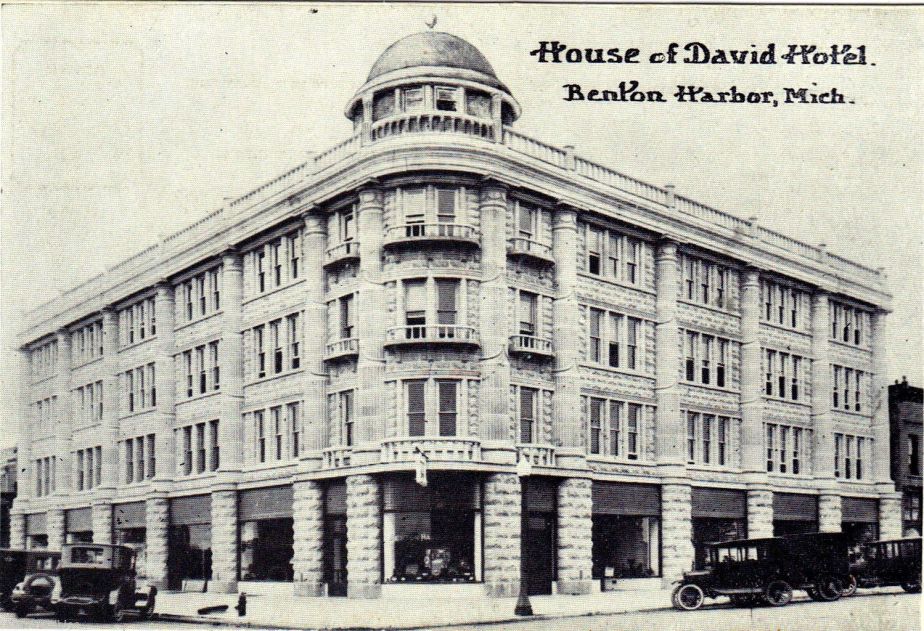
Produce served in these establishments was grown on the grounds of the Israelite House of David in Benton Harbor, founded in 1903 and reorganized by Mary Purnell in 1930 as Mary’s City of David.
1912 Vegetarian Cookbook
According to Ron Taylor, of Mary’s City of David, one of the nation’s oldest continuing communes, the freshness of the ingredients used was one of the reasons for the long time popularity of the restaurants. Taylor, who worked at Mary’s Café for the last four years of its existence, has long been an archivist of the colony’s history. Several years ago he reprinted a limited edition of the 1912 cookbook titled “Vegetarian Cookbook” with recipes from the Eden Springs Restaurant.
Now, Taylor has put together the “Vegetarian Cookbook” that includes not only the recipes from the 1934 cookbook but also photos and historic anecdotes from the years when Mary’s City of David had their own bakery, dairy, cannery, chickens (for eggs) and orchards.
“We had a greenhouse for growing vegetables in the winter,” said Taylor at the time we chatted. Taylor, an avid historian dedicated to preserving the unique history of the community.
Mary’s City of David also attracted a large clientele of visitors who spent the summer in the numerous cottages on the property.
“The cottages didn’t have cooking facilities,” said Taylor, “and so people ate at the restaurant.”
Interestingly, one of the largest groups of returning summer residents were Romanian Jews from Chicago.
“They were attracted to coming here because vegetarian is Kosher,” said Taylor.
The colony’s commitment to vegetarianism came from the Gospels, as Taylor points out in the book by quoting Biblical passages including ‘Meats of the belly and the belly for meats and both shall be destroyed (1 Cor. 6-13).
The book also includes old menus from Mary’s Restaurant which was located on Britain Avenue. Like most old menus, it’s always amazing to see how cheap prices used to be. The 1947-48 menu lists such items as a pimento cheese sandwich costing 20 cents and homemade pie or cake ten cents and spaghetti in tomato and cheese sauce going for 35 cents. For those who often splurge on lattes or cappuccinos, take note, a cup of coffee with extra cream cost 15 cents while something called Boston coffee sold for 15 cents as well.
“This is a book of recipes,” Taylor writes in his introduction. “It continues authentic and unique tastes of a history, from a community of that generation. It was designed to serve a healthy and nutritious meal for a working class. Convenience to a fresh market of local produce precluded the use of exotic ingredients and thus retained the colony’s desire of making an affordable and family friendly menu. It remains a book of ingredients that saw its popularity within the era of one of America’s greatest generations.”
Mary’s City of David
The cookbook is for sale at Mary’s City of David at 1158 Britain Avenue in Benton Harbor. The cost is $24.95. For more information or to order, call 269-925-1601, order online at www.maryscityofdavid.org or stop by in the afternoons when the office is open. For those who’d like to visit and have a meal from the cookbook, the annual, “Welcome Back To 1934” Vegetarian Lunch will be served at noon on September 29th at Mary’s City of David, 1158 E Britain Avenue, Benton Harbor.
Recipes
Note: These are old fashioned recipes where the directions are often vaguer than what we’re used to in modern recipes. Often, there are no temperature settings for oven and instead terms like slow oven and hot oven are used. Also, the cookbook uses the term tablespoonfuls, cupfuls, etc. rather than the current terminology of cups, teaspoons and the like.
Butter-Scotch Pie
2 cups brown sugar
4 tablespoons flour
2 cups milk
3 eggs
2 heaping tablespoons butter
1 teaspoon vanilla
Beat the yolks of eggs until light; add flour, sugar, milk and butter; cook in double boiled until thickened. Remove from fire and add vanilla. Have ready two under crusts baked and fill with the butter-scotch. Whip the whites of eggs to a stiff froth and add two tablespoons sugar. Spread lightly over the top of the pies and set in a slow oven to color a golden brown.
Sidebar: Mary’s City of David Bakery
Within their first year of business, the bakers at Mary’s City of David Bakery were working seven days a week providing food for the more than 300 members of the colony as well as for the baked goods shop in the downtown Benton harbor hotel and the resort restaurant. Baked good as well as milk, butter, cream and eggs, all grown on the colony’s grounds, were also sold at the bakery. Here are several baked goods recipes from the cookbook that were made at the bakery.
Bran Muffins
1 cup flour
1 teaspoon salt
¼ cup sugar
2 teaspoons baking powder
1 cup bran
1 egg, beaten light
1 ¼ cups milk
3 tablespoons melted shortening
Sift the first four ingredients together twice; add the bran, the egg, milk and shortening. Mix together thoroughly. Bake in hot, well-greased muffin pans about 25 minutes.
Cheese Dreams
2 teaspoons baking powder
½ teaspoon salt
½ cup milk
1 cup flour
½ cup cheese
1 tablespoon oil
Mix and sift dry ingredients. Work in oil lightly with tips of fingers. Add liquid gradually and then sprinkle in the cheese which has been grated. Toss on floured board and roll out one quarter inch in thickness ad cut with small cutter. Bake in hot oven ten minutes and serve hot with salad course.
Michigan is home to more lighthouses than any other state and about 40 of those are rumored to be haunted by the spirits of former keepers, mariners and others with ties to these historic beacons.
Inside the pages of Michigan’s Haunted Lighthouses, long-time researcher, writer and promoter of all things Michigan, Dianna Stampfler, shares stories of those who dedicated their lives — and afterlives — to protecting the Great Lakes’ shoreline. Her second book, Death & Lighthouse on the Great Lakes, Stampfler delves into the historic true crime cold case files that have baffled lighthouse lovers for as many as two centuries.
Throughout the fall season, Stampfler will be speaking at libraries around the state, sharing her lively and upbeat presentation about these lights. Copies of her books will be available for purchase and signing at every program.
For the complete schedule of upcoming events (including other topics beyond lighthouses), visit the Promote Michigan Speaker’s Bureau online.
About Michigan’s Haunted Lighthouses
Michigan has more lighthouses than any other state, with more than 120 dotting its expansive Great Lakes shoreline. Many of these lighthouses lay claim to haunted happenings. Former keepers like the cigar-smoking Captain Townshend at Seul Choix Point and prankster John Herman at Waugoshance Shoal near Mackinaw City maintain their watch long after death ended their duties. At White River Light Station in Whitehall, Sarah Robinson still keeps a clean and tidy house, and a mysterious young girl at the Marquette Harbor Lighthouse seeks out other children and female companions. Countless spirits remain between Whitefish Point and Point Iroquois in an area well known for its many tragic shipwrecks.
About Death & Lighthouses on the Great Lakes
Losing one’s life while tending to a Great Lakes lighthouse — or any navigational beacon anywhere in the world for that matter — sadly wasn’t such an unusual occurrence. The likelihood of drowning while at sea or becoming injured while on the job ultimately leading to death were somewhat common back in the late nineteenth and early twentieth century.
Death by murder, suicide or other unnatural and tragic causes, while rare, are not unheard of. In fact, more than dozen lighthouse keepers around the Great Lakes met their maker at the hands of others – by fire, poisoning, bludgeoning and other unknown means. A handful of these keepers, either because of depression or sheer loneliness, took their own lives. A few we may never know the true story, as the deaths now 100 or more years ago, weren’t subjected to the forensic scrutiny that such crimes are given today.
In the pages of Death & Lighthouses of the Great Lakes: A History of Misfortune & Murder, you’ll find an amalgamation of true crime details, media coverage and historical research which brings the stories to life…despite the deaths of those featured.