Coming this July, Journeyman Distillery’s new Corsets, Whips & Honey is the latest evolution of their nationally acclaimed Corsets, Whips & Whiskey (which won the distillery Craft Distiller of The Year AND Best in Show: Whiskey of The Year at the 2023 American Spirit Council of Tasters Awards).
This bottle takes the beloved 100% wheat whiskey and elevates it with real Michigan honey from Great Lakes Bee Co. The result is a smooth, sippable spirit with layered notes of cereal grain, sweet oak, toffee, and vanilla with a subtle hint of spice.
The new Corsets, Whips & Honey Whiskey is available at Journeyman Distillery locations in Three Oaks, MI and Valparaiso, IN, beginning July 4th, and is expected to be available nationally via online ordering later this summer.
The members of the Sacred Heart of Mary Catholic ChurchBook/Movie Discussion Group have invited me to speak this Wednesday, June 11th at 6:30 p.m. If you have the time and are interested in the history of restaurants in Michiana, please come. The church is lovely, located in a beautiful country setting at 51841 Leach Rd, Dowagiac, Michigan. The event itself is next door in the Parish Hall.
Mary’s City of David Vegetarian Cafe in Benton Harbor, which opened in 1931 and closed in 1975, specialized in farm-to-table meals.
Here is the flyer that Terri Moore sent out:
Over the centuries, residents of Michiana have never wanted for superb dining choices. Award-winning author Jane Simon Ammeson will lead us on a culinary road trip through Northern Indiana and Southwestern Michigan.
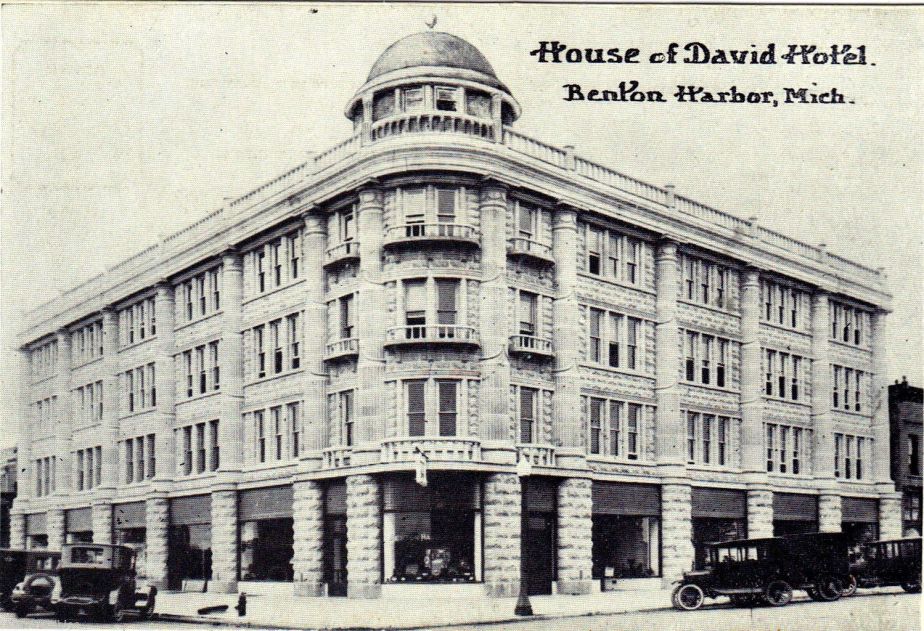
A cigarette girl at the posh House of David motor lodge and restaurant/nightclub called the Vista Grande
Once a stagecoach stop, The Old Tavern Inn has been open since the time of President Andrew Jackson. Tosi’s is known for its gorgeous starlit garden and gastronomic traditions stretching back almost a century, and The Volcano was amongst the first pizzerias in the country.
One of the earliest hotels in St. Joseph, the Perkins house, built in 1840, stood on the corner of State and Ship Streets. Note the side entrance for the saloon which was, of course, given the times, for men only.
These restaurants and other classic eateries remain part of the thriving local food scene. But the doors of others have long been closed. Some like Mead’s Chicken Nook and Robertson’s Tea Room linger in memories while The Owl Saloon, O. A. Clark’s Lunch Rooms, and Lobster Lounge are long lost to time.
The restaurant is still open at the Barbee, it was a fav of Al Capone. However, when he arrived, all the other guests had to leave.
Jane Simon Ammeson is a food and travel columnist who has authored seventeen books, including Classic Restaurants of Northwest Indiana. Always willing to travel for food, she blogs about her experiences at janeammeson.com.
At one time, the lakeside towns of southwesterern Berrien County had a large Swedish population. The Swedish Coffee Pot was just one of several. Only the Swedish Bakery remains.
Virtue Cider founder Gregory Hall, a pioneer in the farmhouse cider industry and a major player in Southwest Michigan’s craft beverage landscape, has repurchased the proper farmhouse cider brand from beer titan Anheuser-Busch. Nestled in the distinctive fruit-growing terroir of coastal Southwest Michigan, which Greg deems the “Napa Valley of cider making,”
Virtue Cider is taking its sustainable old-world production methods back to its independent roots, bringing the brand’s deep commitment to clean, high-quality ciders to new heights with a series of announcements for the new era. These include a full distribution overhaul, a farmhouse tasting room renovation coupled with a new menu direction, guest chef dinners, local artist collaborations and a reinvigorated direct-to-drinker subscription service delivering sustainable sips nationwide.
“My heart and soul have always been devoted to crafting independent beverages that connect with our local community,” says Hall. “I’ve poured myself into building both Goose Island and Virtue Cider on this foundation, guided by a passion for creativity and collaboration. As Virtue Cider enters this new chapter, I’m excited to return to our roots, refine our winemaker’s approach to craft cider, and rediscover the sense of independence that inspires us and helps us grow.”
Following his 20-year tenure at Goose Island Beer Company, founded by his father John Hall, Greg immersed himself in European cider culture, soaking up time-honored techniques from some of England and France’s top cider craftsmen. He brought that same spirit home to the United States, purchasing the brand’sFennville, Michigan farm in 2011 and building a haven for craft cider production anchored in two ingredients: apples and time.
Hall sold a 51% stake in Virtue Cider to Anheuser-Busch in 2015 and reacquired the brand in late summer 2024. A constant throughout Virtue Cider’s history, the brand will continue to use only local heirloom fruit with absolutely no added sugar, uplifting the apple farmers of the Midwest’s “Cider Coast” and raising a glass to sustainable Michigan-made sips.
WHAT TO EXPECT IN VIRTUE CIDER’S NEW CHAPTER:
Once again embracing its spirit of independence, Virtue Cider is leaving big beer-backed cans on grocery store shelves behind and committing to 750 ML bottles, only available at Virtue Farm or through the brand’s robust direct-to-drinker shipping program.
In tandem, Hall will stay true to his love of grassroots relationship development in the chef community, pouring new seasonal releases and beloved bottle varieties at intimate gatherings inside some of the Midwest’s best chef-driven restaurants.
Hall will also welcome some of the nation’s most prominent culinary talents to Fennville for guest chef dinners with fine cider pairings, embracing the local bounty of the micro-region.
On the 48-acre Virtue Farm, the tasting room will undergo extensive renovations and welcome a vibrant new food program, with a menu refresh to align with the brand’s wine-making approach to cider. Menu details are forthcoming but will focus on seasonal, homestyle comforts made with regionally sourced ingredients.
Hall and his team are also excited to continue nurturing their direct-to-drinker and Cider Society subscription box programs, delivering proper farmhouse cider from the fermentation tank to the front porch. Cider enthusiasts in 43 states across the country can give the gift of Michigan cider to themselves and their loved ones with access to holiday boxes and exclusive seasonal releases.
Virtue Cider has also forged new partnerships with local musicians and makers through amped-up live music programming at Virtue Farm and merchandise and cider label partnerships with acclaimed regional artists. Tony Fitzpatrick, whose work has been showcased at the Museum of Modern Art in New York City, is the first of many Midwest artists to join the list of collaborators.
More details on Virtue Cider’s upcoming craft cider releases, renovations, events, and more to be released in 2025. For more information, follow Virtue Cider on Instagram or visit the website at www.virtuecider.com.
ABOUT VIRTUE CIDER: Located on a 48-acre farm in Fennville, Michigan, Virtue Cider is a craft cider company committed to creating exceptional farmhouse ciders that blend old-world traditions with modern cider fermentation and aging techniques. Embracing a deep-rooted respect for sustainable practices and local partnerships, Virtue was founded in 2011 by Gregory Hall, who brought two decades of innovation and an impressive collection of 14 consecutive Great American Beer Festival medals from his tenure as head brewmaster at Goose Island Beer Company.
After his time at Goose Island, Hall set out on a pilgrimage to the cider capitals of England and France to study time-honored European cider-making traditions, and Virtue was born. Virtue Farm, Virtue Cider’s headquarters, is specifically located in the heart of one of the country’s premier apple-growing regions, known as the Midwest’s “Cider Coast.” Hall has cultivated a deep bench of local farming partners, using the bounty of the highest quality Midwestern heirloom apples to craft a collection of crisp, complex, award-winning ciders, which never contain added sugar.
Apples are pressed on-site and fermented in tanks below ground to maintain a steady temperature, housed within three cider houses with architecture that emulates the Norman French style and a strong environmental focus. Virtue Cider’s farm is open year-round and is a vibrant destination for visitors, offering scenic trails, a tasting room featuring a seasonal menu and samples of a variety of ciders, cider flights, and more from their extensive portfolio. For more information on Virtue Cider, please visit www.virtuecider.com.
ABOUT VIRTUE FARM: Virtue Farm, located in Fennville, Michigan, is a 48-acre farm and the destination headquarters of Virtue Cider. Three Norman French-style cider houses, built with Michigan White Pine, hold Virtue’s below-ground fermentation tanks, which use only locally sourced apples and are naturally cooled and heated by the region’s climate.
Most of the farm’s electricity is sourced from 200 solar panels, just one piece of the farm’s vast commitment to sustainability and nourishing its community. Over 20 acres of the farm are grasslands, creating a monarch waystation for Michigan pollinators, and the farm is home to several Gloucestershire Old Spot pigs, harking back to old orchard folklore, as well as a variety of chickens. Virtue Farm also features a full tasting room with cider flights, handhelds, and charcuterie selections, offers guided tastings and tours for visitors, hosts live music, and supplies seasonal bottle selections for Virtue Cider’s national Cider Society subscription service.
PostBoy, Southwest Michigan’s long-awaited chef-driven restaurant from Ben Holland and Chef James Galbraith (Anemel, Houndstooth), fresh off their November 1st opening. Now, they’re hitting the ground running by welcoming a star-studded lineup of the region’s best chefs through their doors, kicking the collaborative dinners off with Chicago’s James Beard Award-winning Chef Zachary Engel of MICHELIN-Starred Galit on Sunday, November 17th.
Chef Zachary Engel
Chef James and Chef Zachary will be combining their culinary talents through a multi-course wine dinner, featuring items like Galit’s beloved hummuswith roasted lamb bulgogi banchan, a cucumber and melon salad with ramps, and smoked turkey shawarma with sweet potato and medjool date. As Southwest Michigan continues to make a name for itself in the national culinary landscape, this ticketed dinner will be an exclusive chance to taste the work of one of Chicago’s most revered chefs and New Buffalo’s newest trailblazer all under one roof.
Full details of the dinner are below, and tickets can be purchased via Tock HERE.
DATE: Sunday, November 17
TIME: 6:30 p.m. ET
DETAILS: Guests will taste the collaboration between MICHELIN-starred Galit’s Zachary Engel and PostBoy’s James Galbraith during a multi-course wine dinner, with canapes, dueling dishes and delectable desserts. Items will include snacks like foie gras with toasty challah and last summer’s Michigan cherries, cucumber salad with melon and last year’s ramps, smoked turkey shawarma with sweet potato and Medjool date, and beyond.
TICKETS: $120 per person with a $50 wine supplement, prior to tax and gratuity. Tickets available via Tock HERE.
Nestled in the picturesque landscapes of Creekside Growers, this Field to Vase Dinner promises to be an unforgettable evening celebrating the artistry of local wine paired with the beauty of locally grown flowers, the bounty of Michigan’s agriculture, and the culinary delights that highlight the best of local produce. Guests will dine amidst the blooming fields, enjoying a farm-to-table meal that showcases the freshest seasonal ingredients.
Farmhouse Deli. Photo courtesy of Farmhouse Deli.
Michigan Wine Collaborative member wineries Modales, Domaine Berrien, and MAWBY will be providing the wines for the dinner. prepared by Chef Christine Ferris of Farmhouse Deli in Douglas, Michigan. Guests will delight in a curated menu that emphasizes local and sustainable ingredients, and of course expertly paired with local and sustainable wines.
Southwest Michigan is home to two of the state’s AVAs with Fennville being the oldest AVA in Michigan and the third to be established in the United States. Modales calls Fennville home. Their commitment to sustainable and regenerative agriculture and to the people who make the finished wines possible shine through in each glass of wine produced on the estate.
Their neighbors to the south, Domaine Berrien, are the first and only Rhone Rangers not only in the Lake Michigan Shore AVA but the entire Midwest. Specializing in the Rhone Valley varietals, Syrah, Viognier, Rousanne, and Marsanne, Domaine Berrien also hosts a wide array of vinifera and hybrid varieties.
Representing Leelanau Peninsula AVA is another significant producer, MAWBY, who planted its first vines in 1973. MAWBY is the authority on sparkling wine production in Michigan. For 50 years MAWBY has helped Michigan sparkle. With an emphasis on classic production techniques, sustainable farming methods and quality customer service.
These three producers are coming together to provide a variety of wines for Field to Vase that will represent the diversity and prestige of the Michigan wine industry. Just like the flowers and the food, the wine will be 100% local as well as expertly paired.
“This collaboration of agriculture, artistry, and passion will prove to be a vibrant experience that guests of the dinner will cherish for years to come.” Says Emily Dockery, Executive Director of the Michigan Wine Collaborative, “We hope that these guests will form an emotional connection with Michigan wine that inspires them into planning trips to Michigan wine country regularly and emboldens them to demand local wines at their favorite wine shops, retailers, and restaurants.”
Tickets for the Field to Vase Dinner at Creekside Growers are limited and expected to sell out quickly. Don’t miss your chance to be part of this extraordinary event. For more information and to purchase tickets, please visit the Eventbrite page.
About Certified American Grown. Certified American Grown is a diverse community of cut flower and foliage farmers from across the
United States. As the voice for domestic farms, CAG works towards sustainability and prosperity through a unified voice, effective advocacy, and strategic promotion. Certified American Grown flower and foliage farms participate in an independent, third-party supply-chain audit to verify both origin and assembly of the flowers and foliage grown. When it appears on bouquets, bunches, packaging or signage, the iconic brand mark instills consumer confidence in place of origin. For more information about Certified American Grown, visit americangrownflowers.org.
The Michigan Wine Collaborative is the voice of the Michigan wine industry. Our mission is to enhance the sustainability and profitability of the Michigan wine industry by supporting wineries, growers, and other businesses and individuals connected to the industry – today and for future generations.
For media inquiries and more information, contact us by reaching out to info@michiganwinecollaborative.com or send us a message on social media.
Voting Michigan Wine Collaborative Members and Premium Vintage Michigan members are eligible for exclusive discounts on admission to the dinner. Those members will be emailed instructions for purchasing discounted tickets. Feel free to CONTACT US for that code or Join MWC OR Vintage Michigan to unlock benefits and discounts all year long!
Summer cottages conjure up images of restful days by the lake or in the woods, a time of family gatherings, reading a book, watching the sunset and spending time in the kitchen (at least for those of us who like to cook) preparing dishes using local and seasonal ingredients to serve at dinner time.
Taking us on a culinary road trip along the Lake Michigan coastline, Levin shows us her favorite places to eat or shop for food, collecting recipes along the way. She shares recipes for Wood Smoked Barbecue Ribs and Sweet Potato and Pineapple Salad provided by Bill Reynolds, owner of New Buffalo Bill’s in New Buffalo and a Korean Pork Bao Sandwich from Ryan Thornburg, the former culinary director for Round Barn Winery, Distillery and Brewery.
She was also inspired by local ingredients such as the spicy fennel sausage made by Pat Mullins, who with his wife Ellie, owns Patellie’s Pizza in Three Oaks and formerly owned Local, an artisan butcher shop in New Buffalo, Levin created her recipe Spicy Fennel Sausage and Peppers with Garlicky Heirloom Tomato Sauce which is a homage to a favorite popular at old school Italian restaurants in Chicago. A fan of Froehlich’s Deli, also in Three Oaks, she devised a deviled egg recipe reminiscent of the ones sold there. These she tops with caviar made by Rachel Collins, owner of Flagship Specialty Foods & Fish Market in Lakeside Michigan.
“I have a soft spot for New Buffalo and Harbor Country because I have family there,” says Levin who graduated from the University of Michigan. “I also fell in love with Fennville which is a really strong artisan food and farming area and I have recipes in the book from Kismet Cheese and Bakery, Salt of the Earth restaurant and Virtue Cider.”
She was also inspired to invent her recipe for Rustic Apple Gallette with Goat Cheese, Caramelized Onions and Thyme using cheese produced by Evergreen Lane Artisan Cheese in Fennville.
Starting her book—and her trip where she wandered counter-clockwise around Lake Michigan—in Door County, we learn about fish boils, those classic throw everything—chunks of red potatoes, freshly caught white fish or lake trout and sliced onions–in a pot set on coals above an open fire and Friday night perch fries.
“I have a recipe for a fish boil you can easily do at home,” says Levin, a Chicago-based food writer and chef who also works as a food consultant and recipe developer. Serve with Bavarian Dark Rye Bread, reflective of the German heritage in Door County, and Creamy Coleslaw.
There is, of course, Door County-style cherry pie though Levin points out that Northern Michigan, including Traverse City, grows the same kind of Montmorency cherries that are perfect for using in all things cherry such as the Door County Cherry French Toast served at the White Gull Inn in Fish Creek, Wilson Restaurant & Ice Cream Parlor’s Vanilla Sundaes with Seaquist Orchard’s Cherry Topping, Cherry Poached Pears with the Mascarpone Cream in Ephraim, Wisconsin, crossing into Michigan, Levin’s take on the many recipes for cherry chicken salad found in the Traverse City area–Grilled Chicken Salad with Greens and Cherry Vinaigrette.
Spicy Fennel Sausage and Peppers with Garlicky Heirloom Tomato Sauce
For the sauce:
1 pound heirloom tomatoes
Four garlic cloves, unpeeled
For the sausage:
2 tablespoons olive oil
One pound Italian-style or fennel sausage, links or cut into four links style
One medium or sweet onion, halved and sliced
Two medium red bell peppers, halved, seeded and cut into 1 inch strips
1 tablespoon good-quality balsamic vinegar or red wine vinegar
1/3 cup of thinly sliced fresh basil
For the sauce, preheat the oven to broil. Line a baking sheet with aluminum foil. Bro the tomatoes and garlic on the baking sheet until partially blocking, turning occasionally. Remove the garlic cloves. Peel the skins from the tomatoes and transfer the tomatoes and juices to a blender by lifting the foil. When cool enough to handle, squeeze the garlic out of the blackened peels into the blender. Puree until smooth.
For the sausage, heat 1 tablespoon of the oil in a large skillet over medium heat. Add the sausage and brown on all sides, about five minutes. Remove the sausage from the skillet. Add the remaining 1 tablespoon oil and the onions, and cook until soft and translucent, about two minutes.
Add the peppers and cook until the onions begin to brown and the peppers begin to soften, about five minutes. Add the vinegar and cook until reduced by half, about one minutes, stirring frequently to deglaze the pan.
Return the sausages to the pan and pour the tomato pepper sauce over them. Simmer over medium heat until vegetables are tender and the sauce is thickened, 10 to 15 minutes. Serve top with Parmesan and basil.
Door County Cherry Pie
Serves 6–8
For the Pastry:
1¼ cups unbleached all-purpose flour
½ teaspoon salt
½ cup (1 stick) unsalted butter, cut into pieces, cold
3–5 tablespoons ice water
For the Filling:
½ cup sugar
¼ cup unbleached all-purpose flour
4 cups well-drained bottled tart Montmorency cherries in unsweetened cherry juice
1 tablespoon unsalted butter, cut into small pieces
For the Topping:
1 tablespoon whole milk
1 tablespoon sugar
For the pastry, combine the flour and salt in a medium bowl. Add the butter and use a pastry blender or two knives to cut in the butter until it is the size of coarse crumbs.
Drizzle 3 tablespoons of the ice water over the top and stir with a fork. Gently knead the mixture with your hands until the dough holds together. If it is dry, add more ice water, 1 tablespoon at a time, and knead until the dough holds together. Shape into two oval disks, wrap each in plastic wrap, and refrigerate for at least 40 minutes.
Roll one of the chilled dough disks on a lightly floured surface to ⅛-inch thickness and about 11 inches in diameter. Gently roll the pastry around the rolling pin and transfer it to a 9-inch pie pan or dish. Without stretching the dough, fit it into the bottom and up the sides of the pan.
Preheat the oven to 325º F.
For the filling, combine the sugar and flour in a large bowl. Add the cherries and mix well. Spoon the mixture into the pie shell and top with the butter.
Roll out the remaining dough disk to ⅛ inch thick and about 11 inches in diameter. Drape the dough over the cherry filling. Fold the edges under the bottom crust and flute attractively or use a fork to press down the crust. Cut several slits in the center of the pie to allow steam to escape during baking.
For the topping, brush the milk over the top and sprinkle the sugar evenly over the pie.
Place the pie on a rimmed baking sheet and bake for 1 hour 30 minutes or until golden brown. Let stand on a wire rack for at least 1 hour before serving.
Cherry Streusel Muffins
For the muffin batter:
1½ cups unbleached all-purpose flour
⅓ cup granulated sugar
¼ cup firmly packed dark or light brown sugar
2 teaspoons baking powder
1 teaspoon ground cinnamon
½ teaspoon salt
1 egg, slightly beaten
½ cup (1 stick) unsalted butter, melted
½ cup whole or 2% milk
1 cup pitted tart fresh cherries or well-drained bottled cherries, coarsely chopped
1 teaspoon grated lemon zest
For the streusel topping:
½ cup coarsely chopped pecans or walnuts
½ cup firmly packed dark or light brown sugar
¼ cup unbleached all-purpose flour
1 teaspoon ground cinnamon
1 teaspoon grated lemon zest
2 tablespoons unsalted butter, melted
For the muffin batter, preheat the oven to 350 F. Line 12 standard muffin cups with paper liners or butter the cups. Combine the flour, granulated and brown sugars, baking powder, cinnamon, and salt in a large bowl. Make a well in the center and add the egg, butter, and milk. Mix just until the dry ingredients are moistened. Stir in the cherries and lemon zest. Spoon a level ¼ cup of the batter into each muffin cup.
For the streusel, combine the pecans, brown sugar, flour, cinnamon, and lemon zest in a medium bowl, mixing well. Add the butter and mix until crumbly. Spoon about 1 tablespoon of the streusel over each muffin.
Bake for 22 to 25 minutes, until a wooden pick inserted in the center comes out clean and the topping is golden brown. Transfer the pan with the muffins to a wire rack and let cool for 10 minutes. Remove the muffins from the pan and serve warm or at room temperature. Any extra muffins may be ¬frozen for up to 3 months.
First introduced in the mid-1940s, Sholom, a deliciously sweet wine made from 100% Michigan Concord grapes, has been a popular offering from the Michigan winery. It ceased production in 2020 due to the loss of the winery’s longtime friend and rabbi. In order for a wine to be deemed kosher, the wine must be made under supervision of a rabbi, include only kosher ingredients and must be processed using equipment rabbinically certified to make kosher wines. The kosher certification allows many different communities to enjoy its fresh grape flavors and aromas.
“Kosher certification is something that we take very seriously. We want to be respectful of different communities and know that we are providing a legitimate option for those looking for kosher qualification,” explains Apollo Braganini II, President at St. Julian Winery which is located in Paw Paw, in Southwest Michigan.
Rabbi Miller visited St. Julian Winery this past summer. After meeting the team and touring the location, he agreed to a partnership with the winery to assist in the production of Sholom.
“Over the past few years, many people – including a local Michigan rabbi – reached out to me about Sholom wine, telling me that they love the product but that it wasn’t available anymore. I reached out to the team at St. Julian and they also said they’ve heard from many fans of Sholom who miss it and want it back. We began discussing whether it would be possible for me to certify the wine as kosher.”
“After a visit to the winery and more in-depth discussions, it began to seem like a reality that Sholom wine would be in production again. Kosher Michigan is following the exact same kosher supervision process as the rabbis who previously certified Sholom wine for many decades, so there should be no concern that the highest kosher standards are being followed.”
“While this is the first wine that KM has certified in its fifteen years of existence, it just feels like this is the right one to start with. There’s such a rich history with Sholom, a huge following, and a local Michigan connection” explains Rabbi Miller.
Kosher Michigan is a kosher certification agency founded by Rabbi Miller. KM certifies thousands of products throughout North America and India. Rabbi Miller is from Metro Detroit, Michigan and has served on several local and national boards. He is also an alum of the Rabbis Without Borders fellowship through the National Jewish Center for Learning and Leadership, among many other accolades.
St. Julian is Michigan’s largest and longest-operating winery and has been family-owned since its founding in 1921. In addition to the winery in downtown Paw Paw where they produce hundreds of award-winning wines, sparkling juices, spirits and hard cider, St. Julian also offers tasting rooms in Dundee, Frankenmuth, Rockford, Troy and Union Pier and distributes to thousands of retail partners throughout the Midwest.
Though vegetarianism is much more mainstream today than it was even ten years ago, the movement is not new. Back in the early part of the last century, though vegetarianism was rare, it was practiced in Southwest Michigan. Indeed, though it’s surprising to learn, starting in 1908 there were several vegetarian restaurants that thrived until the mid-1970s.
The premise is similar to the current philosophy of sustainable local agriculture – eating what is grown near home–contributed to the popularity of three restaurants that thrived for a considerable amount of time. They were Eden Springs Park Restaurant (opened in 1908 and closed in 1932), Mary’s Vegetarian Restaurant which opened in 1932 and closed 34 years later and Mary’s Café, in business from 1931 to 1975 in downtown Benton Harbor.
Produce served in these establishments was grown on the grounds of the Israelite House of David in Benton Harbor, founded in 1903 and reorganized by Mary Purnell in 1930 as Mary’s City of David.
1912 Vegetarian Cookbook
According to Ron Taylor, of Mary’s City of David, one of the nation’s oldest continuing communes, the freshness of the ingredients used was one of the reasons for the long time popularity of the restaurants. Taylor, who worked at Mary’s Café for the last four years of its existence, has long been an archivist of the colony’s history. Several years ago he reprinted a limited edition of the 1912 cookbook titled “Vegetarian Cookbook” with recipes from the Eden Springs Restaurant.
Now, Taylor has put together the “Vegetarian Cookbook” that includes not only the recipes from the 1934 cookbook but also photos and historic anecdotes from the years when Mary’s City of David had their own bakery, dairy, cannery, chickens (for eggs) and orchards.
“We had a greenhouse for growing vegetables in the winter,” said Taylor at the time we chatted. Taylor, an avid historian dedicated to preserving the unique history of the community.
Mary’s City of David also attracted a large clientele of visitors who spent the summer in the numerous cottages on the property.
“The cottages didn’t have cooking facilities,” said Taylor, “and so people ate at the restaurant.”
Interestingly, one of the largest groups of returning summer residents were Romanian Jews from Chicago.
“They were attracted to coming here because vegetarian is Kosher,” said Taylor.
The colony’s commitment to vegetarianism came from the Gospels, as Taylor points out in the book by quoting Biblical passages including ‘Meats of the belly and the belly for meats and both shall be destroyed (1 Cor. 6-13).
The book also includes old menus from Mary’s Restaurant which was located on Britain Avenue. Like most old menus, it’s always amazing to see how cheap prices used to be. The 1947-48 menu lists such items as a pimento cheese sandwich costing 20 cents and homemade pie or cake ten cents and spaghetti in tomato and cheese sauce going for 35 cents. For those who often splurge on lattes or cappuccinos, take note, a cup of coffee with extra cream cost 15 cents while something called Boston coffee sold for 15 cents as well.
“This is a book of recipes,” Taylor writes in his introduction. “It continues authentic and unique tastes of a history, from a community of that generation. It was designed to serve a healthy and nutritious meal for a working class. Convenience to a fresh market of local produce precluded the use of exotic ingredients and thus retained the colony’s desire of making an affordable and family friendly menu. It remains a book of ingredients that saw its popularity within the era of one of America’s greatest generations.”
Mary’s City of David
The cookbook is for sale at Mary’s City of David at 1158 Britain Avenue in Benton Harbor. The cost is $24.95. For more information or to order, call 269-925-1601, order online at www.maryscityofdavid.org or stop by in the afternoons when the office is open. For those who’d like to visit and have a meal from the cookbook, the annual, “Welcome Back To 1934” Vegetarian Lunch will be served at noon on September 29th at Mary’s City of David, 1158 E Britain Avenue, Benton Harbor.
Recipes
Note: These are old fashioned recipes where the directions are often vaguer than what we’re used to in modern recipes. Often, there are no temperature settings for oven and instead terms like slow oven and hot oven are used. Also, the cookbook uses the term tablespoonfuls, cupfuls, etc. rather than the current terminology of cups, teaspoons and the like.
Butter-Scotch Pie
2 cups brown sugar
4 tablespoons flour
2 cups milk
3 eggs
2 heaping tablespoons butter
1 teaspoon vanilla
Beat the yolks of eggs until light; add flour, sugar, milk and butter; cook in double boiled until thickened. Remove from fire and add vanilla. Have ready two under crusts baked and fill with the butter-scotch. Whip the whites of eggs to a stiff froth and add two tablespoons sugar. Spread lightly over the top of the pies and set in a slow oven to color a golden brown.
Sidebar: Mary’s City of David Bakery
Within their first year of business, the bakers at Mary’s City of David Bakery were working seven days a week providing food for the more than 300 members of the colony as well as for the baked goods shop in the downtown Benton harbor hotel and the resort restaurant. Baked good as well as milk, butter, cream and eggs, all grown on the colony’s grounds, were also sold at the bakery. Here are several baked goods recipes from the cookbook that were made at the bakery.
Bran Muffins
1 cup flour
1 teaspoon salt
¼ cup sugar
2 teaspoons baking powder
1 cup bran
1 egg, beaten light
1 ¼ cups milk
3 tablespoons melted shortening
Sift the first four ingredients together twice; add the bran, the egg, milk and shortening. Mix together thoroughly. Bake in hot, well-greased muffin pans about 25 minutes.
Cheese Dreams
2 teaspoons baking powder
½ teaspoon salt
½ cup milk
1 cup flour
½ cup cheese
1 tablespoon oil
Mix and sift dry ingredients. Work in oil lightly with tips of fingers. Add liquid gradually and then sprinkle in the cheese which has been grated. Toss on floured board and roll out one quarter inch in thickness ad cut with small cutter. Bake in hot oven ten minutes and serve hot with salad course.
In honor of its 25 Anniversary, the Michigan Brewers Guild has announced the release of its Great Beer State Documentary which draws from more than 60 interviews gathered over four years. Building on the work from the 2019 book A Rising Tide – The Story of the Michigan Brewers Guild and Michigan’s Great Beer State Podcast which was launched in 2020, the film was produced by The Beervangelist, Fred Bueltmann, author of A Rising Tide and co-host of the Guild’s podcast.
“Besides celebrating 25 years, this film shows stark differences between then and now, when it comes to locally brewed beer and its contribution to community culture. From before the Michigan Brewers Guild in the mid-eighties, to the formation of the Guild in 1997 and up until the present day, there has been a cultural transformation,” stated Bueltmann. “The storyline is loosely held, shared through stories and observations from dozens of brewery folks who have been a part of the brewing scene; past, present, and future.”
The documentary premiered at the Michigan Summer Beer Festival in Ypsilanti last weekend with a private viewing for brewery members on Friday evening and a VIP screening for Enthusiast Members on Saturday morning. A series of public viewings is being organized across the state at member breweries, Allied Member locations and community friends of Michigan beer. The schedule will be posted on MiBeer.com and shared via the Guild’s Facebook page. This is an essential element in the 25th Anniversary campaign which will culminate in a “Wrap Party” on October 22 following the Detroit Fall Beer Festival at Eastern Market (the actual 25th Anniversary of the Guild).
“The film is a fun and engaging look inside the Michigan beer community,” says Scott Graham, the Guild’s executive director. “After 25 years local beer is truly part of our culture and fabric; it is part of what makes Michigan great.”
It was October 22, 1997 when a surprising collection of 49 people representing 30 operating breweries gathered at a pub in Saginaw to discuss how they could collectively promote Michigan-made beer. A consensus arose out of that meeting that a formal association of Michigan brewers should be organized and on December 3, 1997, the Michigan Brewers Guild was officially formed.
The Michigan Brewers Guild is the network of innovative and passionate brewers that serves as the recognized advocate for the Michigan craft beer industry. The mission of the Guild is to promote and protect the Michigan craft beer industry with an overarching goal to help craft beer acquire 20% of the market by 2025.
Michigan’s thriving brewing industry conservatively contributes more than $144 million in wages with a total economic contribution of more than $600 million. In terms of overall number breweries, microbreweries and brewpubs, Michigan ranks #6 in the nation – thus supporting its claim as “The Great Beer State.”
Formed in 1997, the Michigan Brewers Guild held its first festival in July 1998. Today, it hosts five festivals dedicated exclusively to Michigan beer produced by its nearly 300 member breweries (a number that increases on a monthly basis). Within the state, and beyond, Michigan is referred to as “The Great Beer State” ranking #6 nationally for the number of breweries.
Located at Eagle Point Marina in St. Joseph, Michigan, Nia’s Pontoon Rentals offers boating opportunities on both the St. Joseph River and Lake Michigan. Available for full or half day rentals, in certain cases animals are welcomed aboard.
The St. Joseph River is a great place to cruise with sightings of bald eagles, herons, seagulls, deer, squirrels, and even, very rarely, beavers.
Pack a lunch or dock at one of the restaurants located on the river including Plank’s.
Head out into Lake Michigan past the century-plus old lighthouse, Silver and Tiscornia beaches, and downtown St. Joseph.
2351 Niles Road, St. Joseph, Michigan. For more information contact Nia at 269-932-2070.