EXPERIENCE THE GASTRONOMY OF THE LOIRE VALLEY

Known as the “Garden of France,” the Loire Valley has a rich and varied gastronomy, garden-to-plate experiences, and unique culinary specialties. From goat cheese to Michelin-starred experiences to traditionally made vinegar to Tarte Tatin, below are some of the many quintessential culinary experiences of the Loire Valley.

Auberge du XIIème Siècle (Credit: Marieke Gourdin)

In the Loire Valley, more than 170 “Maîtres Restaurateurs” utilize the local produce and ingredients of the region to create their own unique mark on the local gastronomy, while honoring traditional French art de vivre. Les Jardiniers, located in the heart of the Loire Valley’s Rabelais region along an old railway line, received its first Green Michelin Star in 2024. Chef Martin Bolaers brings a true “garden-to-plate” experience, using produce from their extensive vegetable garden and truffle farm to create creative, seasonal dishes.

Château d’Azay-le-Rideau. Credit Benoît Bâlon at Wikimedia Commons.

The Auberge du 12ème Siècle, a 12th-century inn and restaurant located in the charming village of Saché, was awarded a Michelin star in March 2024. Led by chef Kevin Gardien, the restaurant features locally sourced ingredients and innovative cuisine served in a beautifully preserved, medieval dining room.

Photo courtesy of Auberge du 12 ème Siècle 

Culinary specialties of the Loire Valley include the famous upside-down apple tart, Tarte Tatin; slow-cooked meat from the 19th century, Tours rillettes; toasted almonds dating back to the 17th century, Pralines de Montargis; and Orléans vinegar. Orléans vinegar dates back to the Middle Ages, when the city became a hub for vinegar production due to its strategic position as a major wine trading center.

Photo courtesy of Martin-Pouret.

As wines were transported to Paris, some would spoil during the journey and instead of discarding these wines, local merchants in Orléans began converting them into vinegar. Today, Martin-Pouret, a master vinegar-maker since 1797, still makes the famous Orléans vinegar in its traditional method, which allows wine to ferment slowly in wooden barrels. As of October 2024, travelers can now visit Martin-Pouret’s new vinegar factory located right outside of Orléans in Boigny-sur-Bionne, which has just opened to the public for the first time. Visitors can attend workshops to see how the vinegar is made, as well as participate in cooking and mixology classes using the vinegar.

Wine Tasting in a Historic Cave

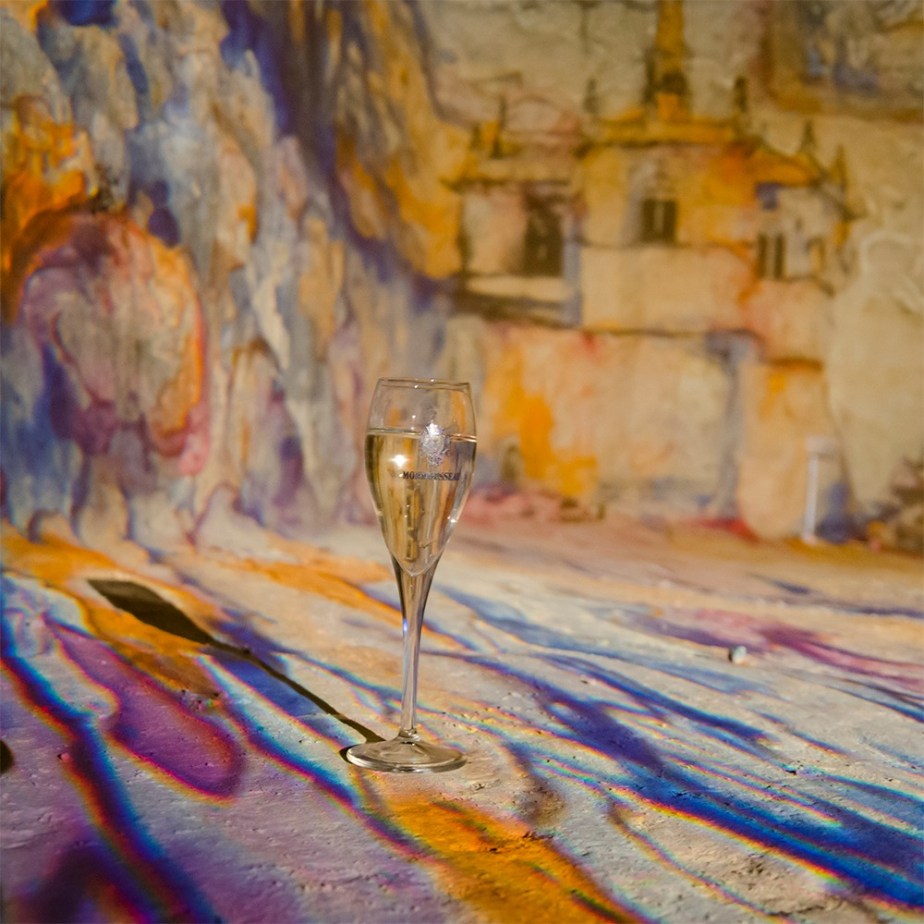
Caves Monmousseau (Credit: Caves Monmousseau)

Some of the most unique wine tasting experiences in the Loire Valley take place in historic troglodyte caves. “Troglo Degusto” at Domaine des Tabourelles includes an underground tour of 22 miles of historic troglodyte galleries, located below the village of Bourré. After the underground tour, guests can try the domain’s wines along with food pairings.

At Caves Monmousseau, visitors can try sparkling wines that have been perfected for over 130 years, while experiencing a very unique art show in the underground cellars: images are illuminated on the tunnel walls, telling the story of the châteaux of the Loire through a spectacular sound and light show.

Experiencing the Loire Valley’s Goat Cheese

Trefle du Perche (Credit: Clara Ferrand)

The Loire Valley is celebrated for its diverse and high-quality goat cheeses with notable varieties include Sainte-Maure-de-Touraine, recognized by its rye straw center; Selles-sur-Cher, with its ash-coated rind and hazelnut flavor; Chavignol, also known as Crottin; Valençay, a pyramid-shaped cheese; and Pouligny Saint-Pierre.

Additionally, the region has introduced Trèfle du Perche, a four-leaf clover-shaped cheese gaining popularity in the region. Open since 2019, Les Passerelles, located in Sainte-Maure-de-Touraine, is a museum dedicated to showcasing the region’s heritage and goat cheese. The museum includes an immersive experience into the world of cheese-making, showcasing the history, techniques and traditions behind the production of some of the most famous cheeses in the area.

It’s a One Time Only Dining Experience: Chef Christian Hunter of the Michelin-starred Atelier joins Chef Sean Richardson at Rune Restaurant on December 22

What: A Collaborative Tasting Dinner featuring Chefs Sean Richardson of Rune Restaurant in Fort Wayne and Christian Hunter of Atelier in Chicago

Where: Rune Restaurant 2725 Broadway – Fort Wayne, Indiana  

When: Sunday, December 22, 2024, with two seatings at 5 pm and 7:30 pm

How: Reservations are required by clicking here, or by calling (260) 278-0674

Tickets are $115 per person

What started years ago as a fun exchange about cheese at Zingerman’s in Ann Arbor, turned into a lasting friendship between Chefs Sean Richardson and Christian Hunter. Since those days, both were recognized in their own right by the James Beard Foundation. Later this month, they will reunite. Only this time, it’s on in the kitchen! 

Fort Wayne locals have quickly become Rune devotees since its opening in March of this year. Chef Richardson uses locally raised ingredients for his seasonal menus that introduce guests to an array of international flavors in approachable ways. Chef Christian Hunter has a similar approach at his Michelin-starred restaurant, Atelier, in Chicago. Hunter is now a partner in the restaurant featuring a nightly 12-14 course menu highlighting dishes ranging from home cooking to something more fancy which always “tries to be true to our roots,” said the Lexington, Kentucky native.

The two lauded chefs are joining forces for a one-night-only collaborative tasting dinner at Rune Restaurant on December 22, 2024. 

Richardson says guests can expect five courses featuring the best of the region’s producers. He’s excited to share the kitchen with his friend and said, “Any opportunity to share a space with another chef, especially one as successful and down to earth as Christian, is always exciting. The fact that it is our space in my city is extremely exciting.”  

“It’s going to be a dinner that honors the local producers. So, I’m here to cook Fort Wayne food, and to learn about Fort Wayne. So, to me, it’s a very cool kind of exchange that we’re about to do. That’s what I’m looking forward to,” said Hunter. 

About Christian Hunter

Chef Christian Hunter is inspired by his upbringing, global flavors, sustainable food production, and nutritional anthropology.

He first encountered diverse cuisines in his hometown of Lexington, Kentucky. As soon as he was earning his own money, he’d spend it checking out the newest restaurants in town from Mexican and Thai to Indian. “It was like I was searching for something,” Hunter recalls. That early childhood exposure all comes to fruition on his plates.

His signature style focuses on infusing New American fare with unexpected global flavors. He adds zing to locally sourced products with chermoula, freekeh, berbere, house-made garam masala, salsa macha, locally made miso, and many more.

Hunter has a culinary degree from Paul Smith’s College in upstate New York and has cooked at Relais & Châteaux’s Lake Placid Lodge and The Weekapaug Inn in Rhode Island. He spent four years in Charleston cultivating relationships with local farmers and also his own culinary identity, emphasizing global flavors. He joined Community Table in Litchfield, Connecticut during the challenging year of 2020. Chef used the time to familiarize himself with area farms and shape the culinary direction of the restaurant. 

The Chef also brings his Southern heritage to Atelier. Coming from a humble background, he strives to get the most out of everything he brings into the kitchen. Hunter also wants to illuminate the ability of African American chefs to cook amazing food of any cuisine or genre.

Chef Hunter’s notable recognitions thus far:

  • 2024 Chicago Magazine 50 Best New Restaurant
  • 2024 Jean Banchet Rising Star Chef Nominee
  • 2024 James Beard Best New Restaurant Semi-Finalist (Atelier)
  • 2023 Michelin Chicago Young Chef Award Winner
  • 2023 Michelin 1* (Atelier)
  • 2023 James Beard Best Chef Finalist Northeast (Community Table/ CT)

About Sean Richardson

An Indiana native, Chef Sean Richardson remembers cooking alongside his grandparents as a child. Making everything from handmade sausages to varenyky and kapusta, he says that they “taught me what cooking could be.” So, when he moved to Fort Wayne to pursue a degree in creative writing from Purdue University, he also explored what cooking really could be by embarking upon his culinary career starting at The Oyster Bar in 2008, before honing his craft in 2013 at the award-winning Joseph Decuis in Roanoke in Indiana.

In 2017, he joined forces with Chef Aaron Butts to open The Golden in Fort Wayne where he was nominated by the James Beard Foundation as Best Great Chef of Great Lakes. His collaborative efforts have also put him on the map of notable chefs working on projects with Chef Jonathan Brooks of Milktooth, Chef and educator Kate Hill of Camont in Gascony, France, and Chef Dan Barber of Blue Hill at Stone Barn.

Most recently he helmed the culinary program at another Fort Wayne original – Conjure. It was here that he began dreaming about his latest project – Rune Restaurant and Bar which opened its doors in March 2024 in the 07 (46807) neighborhood of Fort Wayne, Indiana.

Richardson says that he has worked over the past decade to perfect his voice, and feels he’s finally ready to express a voice that is “loud with big flavors, a bit chaotic, technical when it needs to be, but never fussy, and always delicious.” He and his wife, Natasha, live in the neighborhood and value family time with their two sons – Rune and Casper. He also explores his creative expression by writing songs with his band –Best Sleep which performs regularly at various listening rooms in Fort Wayne.

NYTimes: The 25 Most Influential Cookbooks From the Last 100 Years

The 25 Most Influential Cookbooks From the Last 100 Years https://www.nytimes.com/2024/11/15/t-magazine/most-influential-cookbooks.html?smid=nytcore-android-share

Zachary Engel of MICHELIN-Starred Galit &  Ex. Chef James Galbraith Create a Special One Night Only Menu at New Buffalo’s PostBoy

Chef James Galbraith.

PostBoy, Southwest Michigan’s long-awaited chef-driven restaurant from Ben Holland and Chef James Galbraith (Anemel, Houndstooth), fresh off their November 1st opening. Now, they’re hitting the ground running by welcoming a star-studded lineup of the region’s best chefs through their doors, kicking the collaborative dinners off with Chicago’s James Beard Award-winning Chef Zachary Engel of MICHELIN-Starred Galit on Sunday, November 17th

Chef Zachary Engel

Chef James and Chef Zachary will be combining their culinary talents through a multi-course wine dinner, featuring items like Galit’s beloved hummus with roasted lamb bulgogi banchan, a cucumber and melon salad with ramps, and smoked turkey shawarma with sweet potato and medjool date. As Southwest Michigan continues to make a name for itself in the national culinary landscape, this ticketed dinner will be an exclusive chance to taste the work of one of Chicago’s most revered chefs and New Buffalo’s newest trailblazer all under one roof. 

Full details of the dinner are below, and tickets can be purchased via Tock HERE.

DATE: Sunday, November 17

TIME: 6:30 p.m. ET

DETAILS: Guests will taste the collaboration between MICHELIN-starred Galit’s Zachary Engel and PostBoy’s James Galbraith during a multi-course wine dinner, with canapes, dueling dishes and delectable desserts. Items will include snacks like foie gras with toasty challah and last summer’s Michigan cherries, cucumber salad with melon and last year’s ramps, smoked turkey shawarma with sweet potato and Medjool date, and beyond.

TICKETS: $120 per person with a $50 wine supplement, prior to tax and gratuity. Tickets available via Tock HERE.

Bocuse d’Or in Lyon: Honoring the Legendary Paul Bocuse

On July 21, the Selection Committee presided by Jérôme Bocuse met to decide which countries in the Asia-Pacific region would qualify for the Grand Final of the Bocuse d’Or, a two-day biennial world chef championship. Named in honor of Paul Bocuse, the renowned chef and restauranteur who was the recipient of the coveted France’s prestigious “Meilleur Ouvrier de France,” the Bocuse d’Or is considered one of the most prestigious gastronomic competition in the world.

Held in Lyon, the home town of Bocuse, the next competition is scheduled for January 22 and 23, 2023 and is held during Sirha Lyon, the World Hospitality & Food Service trade show. Lyon, the capital city in the Auvergne-Rhône-Alpes region of France is nestled at the confluence of the Rhône and Saô rivers.

According to Inés Carrayrou of Monet+Associates Agency for the Bocuse d’Or Americas 2022, each team vying for a chance to participate in the Grand Final was required to submit a recipe based upon a main ingredient and make a presentation. 24 chefs will ultimately be selected and during the intense two-day competition will have just five hours and 35 minutes–and not a second longer–to prepare their dish which is then presented ‘à la française’ on a tray or platter. Each entry is exquisite and the winner recieves what the Bocuse d’Or website describes as “the most beautiful trophy in the world of gastronomy.”

5 TALENTED TEAMS JOIN THE WINNERS OF THE PREVIOUS 2022 SELECTIONS

The five winning countries are:

Australia – Alexander McInstosh
China – Nick Lin
Japan – Tomoyuki Ishii
New Zealand – William Mordido
South Korea – Hwang Byeong Hyen

The teams, the recipes as well as the theme plates they’ll be preparing will be announced this fall.

Listed below are the teams that qualified for the different continental selections.

Bocuse d’Or Europe 2022

1st: Denmark – Brian Mark Hanse
2nd: Hungary – Bence Dalnoki
3rd: Norway – Filip August Bendi
4th: Sweden – Jimmi Eriksson
5th: Iceland – Sigurjón Bragi Geirsson
6th: Finland – Johan Kurkela
7th: France – Naïs Pirollet
8th: United Kingdom – Ian Musgrave
9th: Switzerland – Christoph Hunziker
10th: Belgium – Sam Van Houcke

Bocuse d’Or Americas 2022

1st: USA – Jeffery Hayashi
2nd: Canada – Samuel Sirois
3rd: Chile – Ari Zúñiga
4th: Colombia – Carlos Pajaro
5th: Mexico – Marcelo Hisaki

Paul Bocuse was the incarnation of French cuisine,”  said then-French President Emmanuel Macron in 2018 when Bocuse passed away in Collonges-au-Mont-d’Or, in Lyon, where he was born and operated his main restaurant. Bocuse, credited with changing French cuisine with the introduction of nouvelle cuisine, a lighter, fresher approach to the classic cookery of France.

At the time of his death, Bocuse’s restaurant, L’Auberge du Pont de Collonges, had retained three Michelin stars since 1965, which according to The Washington Post, was “one of the longest runs in Michelin history.

Below is one of his famed recipes.

Paul Bocuse’s Apple Tarte Tatin

Shortcrust Pastry

Caramel

Tart

Melt the butter in a double-boiler, stirring it with a whisk. Let cool for a few seconds. Add the salt and mix. Add the confectioners’ sugar. Mix. Add the flour in a steady stream, while continuing to mix. Once the dough begins to come together, take out the whisk and continue to mix with a spatula. Work in the baking powder.

Break the egg into a ramekin, beat it with a fork, then pour it into the dough. Mix it until the dough comes together into a ball. Flatten it slightly, put it on a plate, and leave it to rest in the refrigerator for 1 hour.

If you prepare the dough the day before, remember to take it out of the refrigerator a bit before you want to use it, so that it is not too hard.

You can also make the caramel several hours in advance. There is no need to reheat it before arranging the apples.

Step 2: Caramel

Heat the sugar over high heat in a saucepan. When the sugar has turned a nice, golden color and is beginning to foam, mix it with a wooden spoon. Add the butter. Mix until the butter is melted.

To make a successful caramel, wipe the pan out carefully before starting the process. Move it around during the cooking of the sugar, but do not use any utensils.

The caramel should have a good color without becoming at all brown. Allow 3 to 4 minutes or so.

Pour the caramel into a 8-inch (20-cm) metal baking dish. Split the vanilla pod in two without separating the two halves. Put it into the pan, right in the middle, to form a “V”.

Step 3: Tart

Preheat the oven to 325°F (160°C). Peel and core the apples. Cut them in half vertically. Arrange the apples, standing them upright in the pan. Fill in the center, and fill up any gaps.

It is important for the success of the tart that the apples are all the same thickness. Peel them immediately before cooking to make sure they do not oxidize when in contact with the air.

Place the pan in the bottom of the oven and cook for 1 hour. Check that the apples are cooked. Allow to rest for 10 minutes, then chill for 1 hour.

Preheat the oven to 400°F (200°C). Place the dough on parchment paper, and flour it lightly. Roll it out into a circle about 1/8-inch (3-mm) thick. Lay the lid of the dish upside down on the pastry, and cut the pastry out to the same interior dimensions as the lid. Cut away the excess.

Prick the surface of the dough all over, using a fork. Trim the greaseproof paper to within 1/2 inch (12 mm) of the edge of the dough. Slide the dough, on the paper, onto a baking tray. Bake for 10 minutes. Lay the cooked pastry on a cooling rack. Allow it to cool and harden.

It is always helpful to use parchment paper: there is no need to butter the pan, and the transfer of the pastry base is easy.

After 10 minutes of cooking, the pastry will still be soft. It hardens completely when cool. Handle it with care!

A few minutes before serving, gently warm a serving plate. Place the pastry disk over the apples. Unstick the apples by holding the pastry with one hand and turning the pan from all angles.

When the apples are unstuck from the bottom, turn out the tart. Lay the plate upside down over the pan, invert, and lift the pan away. The tart is ready to be devoured!

This recipe was originally published in “My Best Paul Bocuse” (Éditions Alain Ducasse).