In Goldberry Woods: An Inn and Farm Far Off the Beaten Path But Close to Everything

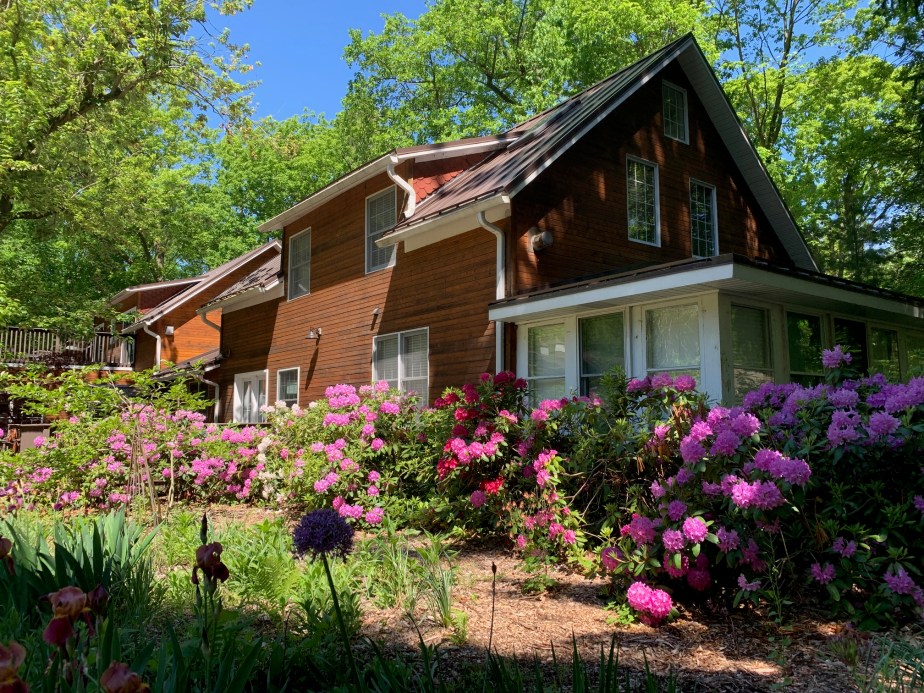
       Nestled on a peninsular formed where the curve of the Galien River is intersected by a small unnamed creek, Goldberry Woods Bed & Breakfast is definitely off the beaten path even for those who know their way around the backroads of Southwest Michigan.

       “Yet we’re close to Lake Michigan and Red Arrow Highway,” says Julie Haberichter who with her husband Eric own and operate the inn.

       You wouldn’t guess that by looking around at the surrounding woods and lack of traffic sounds. And, of course, that’s part of the charm. Here on 30 acres of woods, old and new orchards, grapevines, and gardens, the Haberichters have re-imagined an old time resort albeit one with all the modern twists—swimming pool, farm-to-table cuisine, kayaks ready to go on the banks of the Galien, walking trails, and cottages and their Innkeeper’s Inn with suites for large groups or individual stays.

       Goldberry Woods is the story of how a couple painstakingly restored a resort that had fallen into disrepair, creating a major destination for those who want to get away from it all.

       But this is also a story about how two engineering majors from the Chicagoland area met in college, discovered they lived just towns apart, married, honeymooned at a B&B that was a working flower farm in Hawaii and decided that quirky inns were the type of places they wanted to stay.

       That is, until, while vacationing in Harbor Country in 2011 they happened upon what had been the River’s Edge B&B in Union Pier and decided that unique places were instead where they wanted to live. By 2012, Julie and Eric had bought the property, restored it and had opened Goldberry Woods B&B.

       A little more explaining is needed here. If you’re like me and are thinking goldberries are some rare, antique type fruit like say lingonberries, marionberries, or gooseberries, you’d be very wrong. It turns out that Goldberry, also known as the River Woman’s Daughter,  was a minor character in Christopher Tolkien’s The Lord of the Rings, though she never made it into the movie series. An ethereal blonde with a penchant for green velvet gowns, she was from the Withywindle River in the Old Forest and certainly seems as though she’d be at home here surrounded by ripening fruit and veggies.

       It’s obvious that the Haberichters are more familiar with The Lord of the Rings than I am but then Julie also knows someone who learned to speak Elvish, the language of the elves. If that sounds unique, consider this. According to some sources, there are more people now who speak Elvish as it is spoken in The Lord of the Rings movies than Irish.

       Whether that’s true or not, I’m not sure but the name Goldberry does speak to the charm of this place where the Haberichters forage and grow old fashioned foods, plant organic, practice sustainability, and  harvest the eggs from the heirloom chickens, ducks, and quail that at times run free range in Goldberry’s gardens.

       Julie brims with excitement as she takes me on a tour, pointing out the novelty and heritage produce she grows. There are pumpkin eggplants also known as pumpkin-on-a-stick which indeed look like miniature pumpkins, ground cherries which she uses in her Jasmine and lemon tea,  Malabar spinach with its rich glossy oversized leaves, and cucumelons (tiny little veggies that can be eaten straight from the vine) among many others.

Because what’s in season changes quickly as does the weather, there’s always something different or a variation of a favorite at Goldberry Woods.

       “The oatmeal we serve at Goldberry Woods is constantly changing from season to season, served hot or chilled based on the outdoor weather and the availability of seasonal fruit,” says Julie, who shared the summer version of her Chilled Coconut Steel Cut Oatmeal (see below).

       There’s also some serious forging going on.
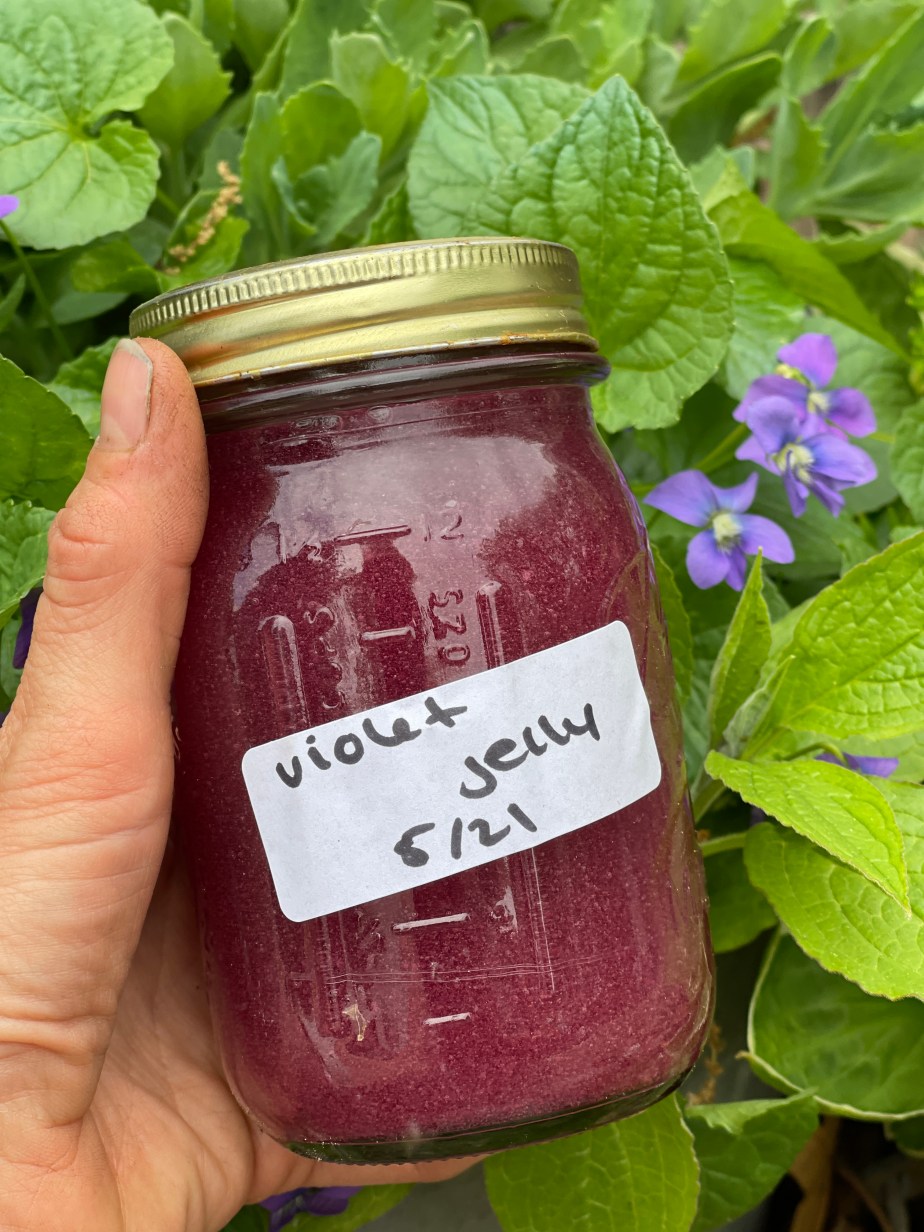
       “We started looking for as many fun and unusual ways to use the wild plants growing throughout our flower beds and woods as possible,” says Julie. “ We have experimented with dandelions, violets, spruce tips, and sassafras to name a few.”

       While she’s talking, Julie brings out glass jars of jam. I try the spruce tips—made from the new tips of the spruce tree at the beginning of spring. Scooping up a small teaspoon to try, I note a definite evergreen taste, refreshing and somewhat woodsy with just a touch of sweetness. It would work on buttered biscuits, toast or even as sauce for lamb and pork. The violet jam is a deep purple and there’s an assortment of pepper jams such as habanero gold pepper jelly with chopped sweet apricots. Unfortunately, Julie didn’t any have jars of the dandelion jam or the pear lime ginger jelly she makes—it goes fast. But she had a large bushel basket full of colorful peppers which would soon become a sweet and spicy jam.

  August, she told me as we walked into the old growth orchard, was begging her to make a yellow floral jelly from goldenrod flowers. So that was the next chore of many on her list.

       Having learned to determine the edibility of certain mushrooms she forages the safe ones from where they grow in the woods, frying up such fungi as puff balls which she describe as having a custard-like interior. In the spring, there are fiddlehead greens easily available, but Julie has to trade for ramps which though they seem to grow wild every place where there are woods, don’t appear anywhere within Goldberry’s 30 acres.

       Now focused fully on running Goldberry Woods and raising their three daughters, Julie previously worked as a chemical engineer in a food processing plant that used a million gallons of corn syrup per day. Now she teaches classes in how to harvest honey–there are, naturally, bee hives on the property.  If all this sounds like a real divergence from a career in corn syrup and a degree in chemical engineering, Julie started an environmental club in high school and gardened in college.

       Unfortunately, you can’t eat at Goldberry Woods unless you’re an overnight guest. But you can stop and visit as the couple has set up their Goldberry Market in a 1970s trailer.  It’s very cute plus they have an outdoors stand on the property. They also take their produce to the New Buffalo Farmer’s Market which is held on Thursday evenings. As for what to do with the unique produce they sell, there are recipes on their website and Julie will always take the time to give ideas. It’s her passion to share the best of what Southwest Michigan produces.

For more information, visit goldberrywoods.com

The following recipes are courtesy of Goldberry Woods.

Chilled Coconut Steel Cut Oatmeal

Serves 8

  • 2 cups coconut milk (1 can)
  • ½ cup steel cut oats
  • 1 teaspoon salt
  • 1 cup old fashioned oats
  • ¼ cup of seeds such as quinoa, chia, flax or amaranth
  • ¼-1/2 cup sugar
  • 1 teaspoon cinnamon
  • ½ teaspoon cardamom
  • Drizzle of honey
  • Fresh sliced peaches

Bring coconut milk, 2 cups of water, salt, and the steel cut oats to full boil in an 8-cup microwaveable bowl, approximately 6 minutes.  Do not let the oats boil over as this makes a sticky mess.

Remove bowl to the counter and stir.  Allow the concoction to cool down a bit, stirring occasionally, maybe 30 minutes (this is to keep from heating up your fridge!)  Cover and refrigerate overnight.

In the morning, add the old fashioned oats, seeds, sugar and spices.

You may need to add more liquid at this time to reach your desired consistency.  We find this recipe to be refreshing and like the oatmeal to be a bit thin.  Adjust sweetness to your taste.

If it’s chilly out, reheat in the microwave.

Here’s the fun part.  Stir in whatever looks good to your taste.  Here are some ideas:

  • Use coconut milk and stir in vanilla, shredded coconut, bananas, honey, dried apricots, almonds….
  • Use apple cider and stir in applesauce, sautéed apples, raisins, nuts, maple syrup, walnuts

Goldberry Woods Egg Rollup

Makes about 8 servings

Egg Mixture

  • 4 ounces cream cheese, softened
  • ¾ cup milk
  • 2 tablespoons corn starch
  • ¼ teaspoon salt
  • 12 eggs
  • Salt and pepper

Filling

  • 12 ounces precooked meat and veggies of your choosing (Malabar Spinach, sausage, ham, bacon, asparagus, peppers, greens, mushrooms…..)
  • 2 cups shredded cheese (we usually use a good sharp cheddar and a shredded Monterey Jack that melts well—feta is great, too)

Preheat oven to 375 degrees

Combine all the Egg Mixture Ingredients in a blender and blend until smooth.

Spread parchment over a 11×17 jelly roll, tucking into the corners.  Pour the egg mixture onto the parchment paper.

Bake the eggs for 15-20 minutes.  Wait until the top sets completely.

Remove the egg roll pan and spread the filling over the eggs evenly.

Use a towel and the parchment paper to tightly roll up the eggs.  Leave the seam side down and cover the whole rollup with the parchment paper so that it doesn’t dry out.

Return to the oven for 10 more minutes to allow the cheese to melt and the filling to heat up.

Slice into 1 ½ inch slices.

About 8 servings.

Golden Rod Jelly

YIELD: Makes 4 pints

  • 8 cups packed Goldenrod flowers
    4 teaspoons lemon juice
    2 packages pectin powder
    6 cups sugar

Make a goldenrod tea.  Put the flowers in a stainless steel pot and add just enough cool water to cover. Bring to a gentle simmer for 3 minutes.  Turn off the heat and allow the flowers to  steep for at least an hour or overnight in the refrigerator. Strain the flowers through a fine metal sieve.  Gently squeeze excess liquid from the flowers.  Measure 5 cups of liquid.  Add water if necessary.

Place goldenrod tea back into pot and add lemon juice.  Add the pectin, stir, and bring to a boil until pectin is fully dissolved.

Add sugar and bring to a full boil for one minute. Remove from heat and pour into sterile canning jars.  Keep jelly in the fridge for up to one month.

What to do in Union Pier

While visiting Goldberry Woods, take time to stop at St. Julian Winery’s tasting location in Union Pier. St. Julian is the oldest winery in the state. There’s also the Round Barn Tasting Room next door.

Stop at Union Pier Market for a great selection of gourmet goods, beer, and wine. Next door, also on Townline Road, is the Black Currant Bakehouse for made from scratch pastries as well as sandwiches and such distinctive beverages as their Rose Quartz Latte, Chaga Chai, and Honey Lavender Latte. Milda’s Corner Market next to Union Pier Market features foods from over 40 countries and freshly made Lithuanian fare including “Sūreliai” Mini Cheesecake bars, Koluduna (dumplings), and Kugelis.

Head to Townline Beach and then consider dinner at The Grove Restaurant, just off Townline Road and steps from the beach.

For more information on what to do in the area, visit Harbor Country.

The article on Goldberry Woods previously ran in the Herald Palladium.

TRAVEL: NOW’S THE TIME TO PLAN AND TRAIN FOR THAT BIG BIKE TRIP

If you’ve always dreamed of taking a big, cross-country bike trip, possibly with some camping along the way, then now is the time to start planning and training for that trip right now with this advice from guest blogger Lisa Walker.

You can see the world from a bicycle, and enjoy the scenery along that way. You can plan to ride all day and cover lots of miles, or take short travel stints and spend more time at each stop. The itinerary is up to you. There are so many options for bicycle travel that the opportunities are literally endless. Cycle along a coastline and stop to visit boardwalks in beach towns. Travel from hamlet to ski town through the Alps. Cross the steppes of Mongolia if you want to. Start imagining; then start planning.

First, decide where you’re going and what kind of mileage you plan to put on your bike. Figure out the terrain and what kind of equipment you need. Visit your favorite bike shop and ask a lot of questions. Chances are, the people on staff have all been on similar trips, so they will know what you need or who to ask. Ask if your bike is the right type for the terrain and mileage. If not, look into purchasing a better one or modifying the one you have. If you buy a bike, get the highest quality bike you can afford. It will pay off on the road.

Look into the type of camping equipment you’ll need. Lower elevations will require different weather gear than the mountains. You should be aware of the climate where you’re going and prepare for it. Even if you’re not camping, you will likely be carrying your stuff on your bike, so be mindful of weight. Don’t forget a hydration system and sunscreen. Even in colder climates, you need water and sun protection.

Next you need to start training. If you haven’t been going long distances on your bike, you should start venturing out on longer rides. Work during the week on shorter distances with higher intensity and building up muscles by cross-training. On the weekends, spend your time gaining higher mileage. Add some more distance with each long ride, eventually building up to the distance you need for your trip. Make sure to train in similar conditions to your trip. If you’re climbing mountains, you should definitely try to mimic those hills at home.

When you’ve trained and you’re ready to head out on your trip, tidy up loose ends at work so you won’t have any lingering work-related worries distracting you. If you run a business, simple actions like designating a registered agent can make things run smoothly while you’re gone. When you establish a registered agent in Michigan, you designate a person to receive important legal notifications and other information about your business. This way you’re covered if anything serious pops up, like a lawsuit or tax notification, while you’re gone. If you’re an employee, work with your boss or manager to make sure your key tasks will be covered while you’re gone and set an away email message indicating who folks should contact while you’re out.

Leaving your home for an extended period of time can cause some anxiety. Will your belongings be safe? What if there’s a fire or break-in and you don’t know about it? Ensuring home security before you leave will help. A good home security system with electronic home monitoring will give you peace of mind while on your amazing adventure. Set your lights on timers and stop your mail and newspapers. Let your trusted neighbors know you’ll be gone so they can keep an eye on your home for you.

To ensure safety on your trip, make sure your bike is tuned up well in advance of your trip. Just before you go, you can stop in for a quick safety check, making sure everything works as it should. Spend a lot of time on the bike you plan to take with you. You don’t want to use a brand new bike without getting to know it a bit before you go.

Once you’re all ready, just get going! Enjoy the outdoors with friends or alone. You’ll see the world while your body reaps the benefits.

VERDANT HOLLOW: TRUSTING NATURE AND THE GOOD OF THE EARTH

“It’s hard work but it’s good work,” says Molly Muchow about co-managing the 230-acre Verdant Hollow Farmhttps://www.verdanthollowfarms.com/ on Garr Road in Buchanan with her husband Brett.

It’s also a big change in lifestyle for the couple who until a few years ago were living in Chicago with their three children and Molly was working as a personal chef and Brett as a certified teacher on the city’s South Side. But they like the vision that owner Susan Flynn had when she purchased the land in 2016.

Her goal was to create an Animal Approved Welfare by AGW farm for producing certified grass fed lamb, goat milk, pasture raised pork, vegetables, and eggs.

The AGW designation is the only label guaranteeing that animals are raised outdoors on pastures or ranges for their entire lives on an independent farm using truly sustainable, high-welfare farming practices. It’s an independent, nonprofit farm certification program. one of the top five fastest growing certifications and label claims in the country. Welfare Approved farm using regenerative practices to produce seasonal vegetables,

Obtaining these certifications was a goal not just for raising animals to bring to market but also to create a place to host visitors for retreats, education, and to carry forth the concept of regenerative practices in raising the best produce possible. It’s a type of farming designed to reverse climate change by rebuilding soil organic matter and restoring degraded soil biodiversity with the end result of reducing carbon output.

It is a beautiful piece of land, with hollows, woods, pastures, and an 1860s-era barn repurposed by Stanley Tigerman, an award winning architect whose work incorporates an urban whimsicalness to rural structures.

         “We plan to build six cabins—it will be a place for people for relaxation and detach from technology, returning to the pace of what farm life was,” says Flynn who though she’s from Chicago knows the area well because she has had a home in nearby in the area for the last two decades.  

         “That would be before the 1940s,” says Brett.

He adds that Verdant Hollow is a no-till farm.

I tell him that as an urban dweller, the concept of no-tilling evades me. Brett explains that tilling upsets the ecosystem of the soil. No-tilling also provides protection from soil erosion. To further protect the soil, in the winter they cover crop, using plants to protect and nourish the soil.

“We also don’t use any treated wood here,” says Brett.

         “Our animals are pasteurized year round,” says Molly, noting that the goats have seven acres to roam.

As part of their educational outreach, they also invite school groups out to visit, showing them the rhythms of what farm life was list long ago.

         “The kids really liked the chickens,” says Flynn.

         They also liked the goats and sheep and the two Colorado Mountain dogs—June and Case—who protect them.

         “Two of them can take out a mountain lion or cougar and are always on the alert to protect the other animals,” says Brett.

I must have passed some unspoken Colorado Mountain Dogs’ test because today they’re just friendly as can be, letting the goats come up to the fencing so I can pet them.

But while I’m doing so, I come under the watchful eye of a llama who is also a guardian animal and seems less disposed to accept me than the dogs. Indeed, he stares from within what looks like a guard box that allows a wide open view of the animals in the large pen. The latter encloses a large, wooded area where the animals can munch away to their hearts delight. That also includes the Katahdin Hair Sheep, prized for the taste of their meat and heritage hogs who are allowed to run free through the woods as well. What’s raised here is sold to local restaurants and can be purchased by anyone at the farm.

It’s all still a work in progress. Besides building guest cabins, they also laying out new roads, erecting a welcome pavilion and expanding green and hoop houses, ensuring a longer growing season for microgreens and starting vegetables earlier in the spring as well as the medicinal herbs they grow. There is are solar panels, a system for collecting rainwater, big areas for composting, yurts, and meditation platforms.  The farm is  also part of pilot project for Cannabidiol (CBD) which is an active ingredient in cannabis derived from the hemp plant that’s can be used to help reduce pain, insomnia, and anxiety and features CBG (cannabigerol) which is more potent for healing as well as beneficial in treating such conditions as inflammatory bowel disease, Crohn’s disease, and cancer.

In all, they’ve come a long way and there’s still so much they want to do. But living on the farm yields a sense of satisfaction, of accomplishment, and of producing from the land, food that is good, healthful, and helpful.

Verdant Hollow Farms Recipes

Slow Cooker Bone Broth

1 whole pasture raised chicken (stew or soup bird)

2 whole carrots, skin on, scrubbed, and quartered

1 whole onion, skin on, clean and cut in half

3 stalks celery, clean, and quartered

1 whole head of garlic, clean, and cut in half horizontally

1 tablespoon raw apple cider vinegar

Optional additions: clean veggie scraps, fresh ginger, fresh herbs, dried mushrooms

Place all ingredients in a slow cooker and cover with cold water. 

Set to low and let simmer for 12-24 hours (the longer the better).  Strain through a cheese cloth and add salt to taste. 

Drink on its own, as a base for soups, or stir in some cooked rice and winter greens for a quick lunch.

Molly’s Notes:  

I always freeze a couple containers to have on hand when someone gets the sniffles or just needs a warm cup of goodness!

*I keep a baggie in the freezer to collect any carrot peels, veggie scraps, or chicken bones while cooking other meals.  Add these scraps to your slow cooker for extra flavor and a way to reduce kitchen waste.

Carnitas

1 3-4 pounds bone in or boneless pork shoulder or butt roast

1 tablespoon chili powder

1 tablespoon ground cumin

1 tablespoon salt

1tablespoon ground pepper

2 tablespoons bacon fat, olive oil, or avocado oil

¼ cup fresh lime juice

¼ cup fresh orange juice

Fresh lime juice and salt to taste

Chopped cilantro

Taco toppings: shredded lettuce or cabbage, queso fresco, salsa, pickled or raw red onions

Warm tortillas (Molly Muchow prefers the corn, but flour works also)

Season your pork shoulder roast with the chili powder, cumin, salt, and pepper.  Heat your oil in a large sauté pan.  Once it is hot enough to sizzle with a drop of water, add your shoulder roast.  Brown on both sides and transfer to your slow cooker.  Add your lime, orange juice, and a ½ cup of water.  Cook on low for 8-10 or until it starts to fall apart from the bone.

Preheat your oven to 425.  While the roast is still hot, shred with two forks, discarding the bone. Spread the shredded meat and a cup of the juices on a large sheet pan.  Sprinkle an additional 2-3 tsp of salt over the pork and place in the oven.  Stirring every five minutes until slightly crispy, but still tender.  

Squeeze additional lime juice (to taste) over the shredded pork and serve with warm tortillas, chopped fresh cilantro, and any of your favorite taco toppings.

*The pork roast can also be slow cooked in the oven.  Once seared on all sides, place in a deep roasting pan with the juices/water, cover with foil and cook at 325 for 3.5-4.5 hours.

Lamb Curry

½ medium onion, diced

3 medium carrots, peeled and diced

½ head cauliflower, diced

1 tablespoon fresh garlic, chopped

1 tablespoon fresh ginger, chopped

1 tablespoon ground lamb

3 tablespoons ground curry powder

2 tablespoons coconut oil (can substitute with other oil you have on hand)

1-2 handfuls of chopped greens (kale, chard, or spinach)

Chili flakes (optional)

2 teaspoons salt

Cooked rice (I prefer jasmine or basmati)

Sauté the onion, carrot, cauliflower, garlic, and ginger over medium heat until soft.  Season with salt and add the ground lamb.  Sauté the lamb and vegetables until the lamb is browned (5-10 minutes).  Add the curry powder (and chili flakes to taste) and continue cooking until it is well incorporated into the lamb and vegetables.  Remove from heat and fold in your chopped greens, letting them wilt in the pan.  Serve over rice with a side of warm naan on a cold winter day!

*This recipe is a great way to use up any veggies you have in your fridge.  Feel free to add any other chopped vegetables you have on hand (zucchini, fennel, peppers, etc.)

For more information: 773-882-4431; verdanthollowfarms.com

YOU’RE INVITED TO A SPECIAL CENTENNIAL WEDDING RECEPTION FOR ERNEST AND HADLEY (RICHARDSON) HEMINGWAY

Get set for the wedding of the last century when, as part of its year-long HEMINGWAY HOMECOMING celebration, the Village of Walloon Lake hosts its “Hemingway Centennial Wedding Reception.”

Tickets for the event are now available for its “Hemingway Centennial Wedding Reception” on Friday, September 3 at the Talcott Center. The event, benefitting the Michigan Hemingway Society, is being held on the 100th anniversary of Ernest Hemingway’s wedding to Hadley Richardson. A special appearance by the newlyweds Ernest & Hadley is one of the highlights of this commemorative evening.

The evening begins at 6 p.m. with a Hemingway themed Happy Hour that features a cash bar and such spirits as wine from Walloon Lake Winery, Two Hearted Ale from Bell’s Brewery and spirits from Michigan’s Wise Men Distillery and Papa’s Pilar, a brand endorsed by the Hemingway Foundation.

Dinner, featuring foods from the Pinehurst Inn in Horton Bay (the same place the real Ernest and Hadley said “I do) will be served by Wine Guys Catering in Petoskey at 7 o’clock. Menu items the inn’s famous fried chicken, poached local fish, cabbage salad, tomato pudding, sweet potatoes with apples, Parker House rolls and Velvet cake for dessert.

Throughout the evening, attendees are invited to bid on a variety of unique Hemingway and Walloon Lake themed items and experiences, with live auctioneer Scott MacKenzie of Boyne City.

For those interested in an after-hours party, a cash bar with signature cocktails as well as cigars – available for purchase on-site from Ernesto’s in Petoskey – will be offered on the Talcott patio until 11 o’clock.

Tickets for the “Hemingway Centennial Wedding Reception” are $125 per person, $200 per couple or $1000 for a VIP sponsored table for eight guests (with space limited to 200). Tickets can be purchased online here: https://hemingwayweddingreception.eventbrite.com.

On Saturday, September 4, village officials will dedicate a series of historical signs in Circle Park downtown, which tell the story of early visitors and residents to Walloon Lake (first called Bear Lake, then Tolcott/Talcott) – from the trains, passenger steamboats and resorts – as well as several pieces specific to Hemingway, in partnership with the Michigan Hemingway Society.

Ernest Hemingway was just three months old when he made his first trip from his hometown of Oak Park, IL to Walloon Lake where his parents – Clarence and Grace (Hall) – had purchased property along the North Shore. He spent time each and every summer until 1922 at the family’s beloved Windemere cottage (including his 1921 honeymoon). The cottage is still owned by descendants of the Hemingway family.

Details for all upcoming events will be posted on the village website at WalloonLakeMi.com or online www.Facebook.com/WalloonLakeMi

Walloon Lake YouTube (The Nick Adams Stories Discussions)

Hemingway Daiquiri

We don’t know if Ernest drank these at his first wedding, but they are said to be one of his favorites so in case you want to toast this great American author, celebrate with one of his cocktails.

Hemingway Daiquiri

  • Ice
  • 2 ounces white rum
  • ¾ ounce fresh lime juice
  • ½ ounce fresh grapefruit juice
  • ½ ounce maraschino liqueur
  • 1 lime wheel, for garnish (optional)

Fill a cocktail shaker with ice. Add all of the remaining ingredients except the lime wheel and shake well. Strain into a chilled coupe and garnish with the lime wheel

Hummingbird Lounge: Appalachia cooking Meets New American Cuisine on Michigan’s Sunset Coast.

         Raised in Southern Appalachia in Stagg Creek, a slip of a town tucked in a corner of North Carolina hills and hollows near the Tennessee state line, Shane Graybeal describes the region as “food heaven” and the beginning of his fascination with food.

         “Both my grandparents had farms,” says Graybeal, who after graduating from culinary school at Johnson & Wales University in Charleston, South Carolina worked in France, Italy, Washington D.C. and spent seven years in Chicago working at such well known restaurants as  Bin 36 and Sable Kitchen & Bar. Along the way he was inducted into Chaîne des Rôtisseurs, the world’s oldest, largest and most prestigious food and wine society.

         But he missed small town living and being close to the farms where he sourced his foods.

          “I’ve been a fan of Southwest Michigan for many years,” says Graybeal who now is executive chef at the recently opened Hummingbird Lounge in New Buffalo. “When I was living and working in Chicago, I  sourced a lot from Southwest Michigan.”

         Among the local food producers they use are the Mick Klug Farm in St. Joseph and Kaminski Farms Meats in Three Oaks.

         Another plus for Graybeal was being back in a small town.

         “Though compared to Stagg’s Creek, which has a population of about 300, New Buffalo seems like a big city,” Graybeal adds with a laugh.

         Graybeal describes his food as a “cheffy take on American classics, comfortable food all dressed up.” I loved the description but was surprised to learn that “cheffy” is an actual word meaning relating to or characteristic of a chef.

         His take on food matches the overall philosophy of Hummingbird’s owner and operator Ben Smock who wanted to create a cocktail bar and restaurant that was comfortable and “served food you want to eat.” The lounge opened in April and is located in what had been a grand home built in 1901 that once housed a creperie in  New Buffalo.

         Smock has an extensive background in the food industry starting when he worked at his grandfather’s bowling alley in Davison, Michigan where he grew up. He graduated from Michigan State University’s hospitality program, worked at McCormick Place, Levy Restaurant group and the Ravinia Music Festival and started his own consulting business where he provided food service planning and events. He’s also opened a number of venues.

         The menu changes frequently, depending on what’s in season. Graybeal was excited because the first peaches were hitting the market along with blueberries and raspberries.

         “I’m thinking fruit cobblers,” he says.

         He also brings a bit of Appalachia to the menu.

         “Food is very important there,” he says, making one want to jump in a car and head south to see what he’s talking about. “And I think in the right context—pickling, charcuterie, foraging–it comes across very well.”

Earlier in the season, he took ramps, cut them into a tiny matchstick size and flash fried the garlicky wild greens to add to an asparagus dish. We’re guessing that the round super thin pickled with cherry Kool-Aid hails from the mountains as well—and they’re delicious.

Graybeal also made ramp vinegar which he now uses in some of his dishes. Now with fresh Michigan peaches available, he makes a jam to pair with pork, but kicks it up a notch with the addition of jalapeno peppers.

But, he notes, the food is a side note to the cocktails and what’s on the menu are more like a tapas bar—nibbles that are share,able. The Lounge’s cocktail team takes what Graybeal is preparing in the kitchen and concocts drinks to accent his flavors.

The cocktails—which also change frequently—have in the past included a Smoked Pineapple Margarita, a tequila based drink with seasoned and smoked pineapple and salted foam, The HRG Manhattan using Traverse City Whisky Company blend along with sweet Vermouth, Angostura bitters and a fancy cherry and A Real Dandy Old Fashioned with rum, demerara syrup, bitters and expressed orange. For those who don’t drink, there are spirit-free cocktails. There’s also a small wine list offering by the glass or bottle and local brews.

         Why did they name the place Hummingbird? Smock says they chose it because hummingbirds drink all day and it just fit because they are open throughout the season. For warm weather dining, there’s a large back porch and garden area. The garage has been redone and is now an inviting event space. The interior of the restaurant itself is very cozy with a curated antiquated feel to go with the history of the home including a fireplace flanked by columns, its mantel topped with a large mirror and coach lanterns, cozy rooms, polished wood floors, and the deep gray walls are accented with lots of white woodwork. The bar is sleek—less Victorian and more urban trendy which makes for a nice contrast.

Chef Graybeal’ s Pork and Peaches

Rub pork belly with salt, sugar, and vanilla powder. Place in pot. Cover and marinate overnight. The next day cover with lard and cook on low heat for three to four hours. Cool and then crisp up in a hot pan until golden brown and tender.

Peach Jam

Cook together for two hours, them finish with a squeeze of lime juice. Puree in blend until smooth and cool.

To serve—crisp the pork belly, put two ounces of jam on a warmed plate, top with the pork belly, slice a peach and toss with aged sherry vinegar, basil, parsley and mint and a little olive oil. Place on top of the pork.

Beef Skewers with Whipped Feta

For the Beef Skewers:

Grind the brisket, combine with the other ingredients and whip with the paddle attachment. Form into balls and then into long rolls, place each roll on a skewer.  Grill for six minutes on both sides.

For the Whipped Feta:

Combine in the mixer, whip using the the whip attachment until light and fluffy-like similar to icing.

Just for fun, I thought I’d include a recipe for Kook-Aid brined veggies.

Trish Yearwood’s Fruit Drink Pickles

Drain the brine from the pickles into a bowl. Add the fruit drink packet and sugar into the brine and stir until dissolved. Pour the brine back to the jar, discarding any that’s leftover. Refrigerate at least 2 days and up to 1 month.     

Hungry for Harbor Country: Food, Friendship, and Fun in Southwest Michigan

Lindsay Navama

         Growing up in Tahoe City, a one stoplight town in California’s High Sierra Mountains, Lindsay Navama yearned for the big city life. Los Angeles offered just that, and she was happy there in her career as a recipe developer, personal chef, and  owner of Cookie Culture, a boutique bakery.  

Lake Life Cranberry Limeade Cosmo

         But when she and her husband, David, moved to Chicago for work, Navama felt unmoored and wondered what to do next in her life.

         Lured by articles about the wonders of Harbor Country, the swath of countryside starting at the state line and curving north along Lake Michigan to Sawyer, Michigan, the couple decided to check it out.

         Unfortunately, upon arrival the two were totally underwhelmed.

“We heard people call it the ‘Hamptons of the Midwest but we thought is this it?” says Navama.

Whistle Stop Asian Noodle Salad

         The two didn’t return for several years,  but when they did—they both experienced what she describes as the region’s magic.  It was more than just the beautiful beaches, the eight quaint small towns each unique in its own way, lush farmlands, orchards, rivers, and woods, there was also an appealing vibe. Each visit brought new discoveries– an estate winery, a fun delicatessen that became like a second home, a Swedish bakery that first opened for business in 1912–and new friends.

         Wanting to spend more time there, the couple moved into a small place in New Buffalo and dubbed it “Camp Navama.” There Navama cooked and entertained, developing her own recipes and tweaking them when needed to feed friends on gluten-free, vegan, vegetarian, keto, paleo, and other diets. She learned the rhythms of the land and seasons such as when deep blue Concord grapes were  peaking at Dinges’ Farm in Three Oaks or when an order of fresh caught sturgeon arrived at Rachel Collins’ Flagship Specialty Foods and Fish Market in Lakeside.

Buffalo Cauliflower

         In ways it was a convergence of Navama’s experiences growing up in the High Sierras and adulthood in the ever-so-hip L.A. food and cultural scene. Navama identified with many Harbor Country residents who moved to or had second homes in the area and brought that big city sensibility with them when it came to art, food, entertaining but appreciated a more rural way of living and a lot less concrete.

         Navama no longer felt lost and instead saw the direction her life should take.

 “I wanted to preserve those memories, great meals, and good times in Mason jars,” she says.     

Of course, jars can’t hold memories, but paper does and so Navama  wrote “Hungry for Harbor Country: Recipes and Stories From the Coast of Southwest Michigan,” (Midway 2020; $34.95).

A great cookbook with 50 recipes and photos by Gabrielle Sukich of Benton Harbor, it’s also a travel guide with small maps, listings of restaurants, wineries, intriguing hideaways, and everything else the area has to offer.

“I never saw myself as living any other place than California and here I am in a tiny town in the Midwest,” she says. “And I’m beyond grateful it happened.”

Whistle Stop Asian Noodle Salad

4–6 servings 

Contributed by Whistle Stop Grocery and Chef Eva Frahm

1 pound angel hair or capellini pasta

5 ounces shiitake mushrooms, stemmed and thinly sliced

¼ cup plus ⅓ cup extra virgin olive oil, divided

¾ teaspoon kosher salt, divided

½ teaspoon freshly ground black pepper, divided

¾ cup hoisin sauce, divided

1 medium red bell pepper

1 medium yellow bell pepper 

¼ cup seasoned rice wine vinegar

1 tablespoon garlic chili sauce

Sriracha, to taste (optional)

4 scallions, thinly sliced

1 cup lightly packed cilantro leaves, chopped

Bring a large pot of water to a boil. Salt the pasta water, if desired. Add the angel hair and cook 7 to 8 minutes until just al dente, so the noodles are still slightly firm and not overcooked. Drain into a colander, rinse gently with cold water, let drain again, then place in a large bowl. Set aside.

In a skillet over medium heat, sauté the mushrooms in ¼ cup of the olive oil for about 7 minutes, or until lightly browned. Season with ⅛ teaspoon of the salt and ⅛ teaspoon of the pepper. Remove from the heat and add 2 tablespoons of the hoisin sauce. Stir to coat and set aside.

Julienne the bell peppers by cutting them into ⅛-inch-thick strips. Set aside.

In a small mixing bowl, whisk together the remaining 10 tablespoons hoisin sauce, the remaining ⅓ cup olive oil, the rice vinegar, the garlic chili sauce, and the Sriracha (if using). Set aside.

Add the mushrooms, peppers, scallions, cilantro, and sauce mixture to the noodles. Toss gently to incorporate. Season to taste with the remaining salt and the remaining pepper and transfer to a serving bowl or store covered in the refrigerator for 5 to 7 days.

Lake Life Cranberry Limeade Cosmo

1 serving 

3 ounces favorite vodka

1 ounce triple sec

2 ounces cranberry juice cocktail

3 tablespoons limeade concentrate, thawed

a cocktail shaker and martini glass in the freezer for about 20 minutes.

Add the vodka, triple sec, cranberry juice, and limeade concentrate to the chilled cocktail shaker. Shake your booty while you shake your Cosmo for about 10 seconds, because why not?!

Reprinted with permission from Hungry For Harbor Country by Lindsay Navama, Agate Publishing, Photos © Gabrielle Sukich.

Golden Raspberries: The Perfect End to Autumn

Amber colored with a touch of light pink, golden raspberries are a rare find compared to their red and black equivalents. But they’re worth the search.

“They taste like raspberries dipped in honey,” says Cindy Grewett who raises golden raspberries at Kitty Hill Organics, her 14-acre farm in Dowagiac, Michigan, a small town located close to the Indiana-Michigan border.

“Or candied raspberries,” adds her assistant Ashley Morris.

Golden raspberries at Kitty Hill Organics in Dowagiac, Michigan. Photo Jane Simon Ammeson.

“Have you ever tasted one?” Ron Goldy, Senior Extension Educator at the Southwest Michigan Research and Extension Center, Michigan State University, asks me when I call to get more details about golden raspberries and who else might be growing them in Southwest Michigan.

I tell him I have—Grewett sells them at the St. Joseph Farmers Market held on Saturdays on the bluff overlooking the pier and where the St. joseph River flows into Lake Michigan. People also stop by at the farm where she and her husband live in a 150-year-old farmhouse but it’s best to call ahead to make sure she hasn’t sold out.

Golden Raspberry Custard with Chocolate Sauce. Photo by Jane Simon Ammeson.

“They’re sweeter than red raspberries,” I say.

Cindy Grewett adds golden raspberries to a glass of Tabor Hill Sparkling Wine. Photo by Jane Simon Ammeson.

“But they still taste like raspberries,” Goldy says and he’s right.

I’ve never thought of red raspberries as anything but sweet and tasty. Yet compared to goldens they’re tough stuff with a taste that’s stronger and with just a little more bite.

They may be milder and sweeter but goldens are also more fragile than their black and red counterparts and
thus transporting them is a trickier and more expensive proposition as they’re more likely to bruise and crush.

Kitty Hill Organics. Photo by Jane Simon Ammeson.

“That’s one reason why people don’t grow them,” says Grewett.

“We know what we know– we all get used to eating things we know and are familiar with like red raspberries,” says Goldy, offering another reason why they aren’t as popular as reds.

There’s truth to that. How many of us have bought kohlrabi lately?

“I don’t know of anyone else growing them in the area,” he adds.

All this makes them more of niche market type of fruit, found more often at farmers’ markets than in stores.
There are other distinctions as well, Grewett explains.

Unlike red and black raspberries that have two growing seasons and often are referred to as everbearing, goldens fruit just once in late August and into September.

When looking for goldens, remember they’re also called by the rather bland name of yellow raspberries and the much more exciting champagne raspberries.

More golden raspberries. Photo by Jane Simon Ammeson.

Speaking of that bubbly drink, Maria Neville, owner of Body Logic in downtown St. Joseph suggested adding golden raspberries to a freshly poured glass of champagne, prosecco, or other sparkling wine. It’s about easy as can be except for getting the cork out of the bottle and but the look and taste is both elegant and spectacular. If you’re not in the mood for a cocktail, Grewett suggests adding goldens to seltzer water or lemonade.

“That is if you have any left,” she says, noting that they’re so tasty as is, they’re often consumed straight out of the box.

Grewett also likes goldens, a naturally muted strain of red raspberries, because of their health benefits.
“They’re full of vitamins B and C,” she says, adding that they also contain folic acid, iron, copper, and ellagic acid, a phenolic compound thought to prevent cancer. And despite their delicate looks, goldens are a powerhouse of dietary fiber accounting for approximately 20% of its weight.

Photo by Jane Simon Ammeson

Eating healthy and raising pesticide-free produce is one reason Grewett left a job as a hostess at Tosi’s Restaurant in Stevensville, Michigan one requiring her to dress in heels and formal wear and become a full-time farmer. She already was growing organic fruits, vegetables, meats and eggs for friends and family as well as for herself but wanted to make it easily available for others as well.

Now, when you stop by the farm, she’s typically wearing old jeans or shorts, t-shirts, thick gloves, and knee-high rubber boots good for mucking around in the dirt and mud.

“When people bring their children here and they see carrots or here and they see carrots or fresh beets growing out of the ground or raspberries on the vine they get so excited,” she says. “I like that they can pick and eat a tomato still warm from the sun and not have to worry about chemicals. It’s a great way to show kids—and adults—the connection to what we grow and what we eat.”

Cindy Grewett’ s Golden Raspberry Custard with Chocolate Sauce

2 cups milk

2 tablespoons butter, softened

2 teaspoons vanilla

2 tablespoons corn starch

1/3 cup sugar

¼ teaspoon salt

2 egg yolks, lightly beaten

Golden raspberries

Chocolate sauce

Place milk, butter and vanilla extract in a saucepan and cook at medium heat until mixture is simmering being sure to stir frequently so mixture doesn’t burn.

Remove mixture from heat before it comes to a boil. Mix cornstarch, sugar, salt, and egg yolks in a saucepan, stirring until sugar dissolves.

Return milk and butter mixture to the stove and slowly add cornstarch mixture (if you add too quickly egg yolks will cook), whisking constantly until custard thickens enough to coat the bottom of a spoon, approximately 5 to 10 minutes.

Remove from heat. Let cool. Top with golden raspberries and then drizzle chocolate sauce over the custard. Serve.

Red & Golden Raspberry White Chocolate Napoleon. Photo courtesy of Driscoll’s Berries.

Red and Golden Raspberry White Chocolate Napoleon

Recipe courtesy of Driscoll’s Berries

2 tablespoons butter, melted

1 tablespoon granulated sugar

4 ounces chopped white chocolate or white chocolate chips (about 2/3 cup)

4 ounces reduced fat cream cheese

1/2 cup part-skim or reduced fat ricotta cheese

1 1/3 cup each red and golden raspberries

3 sheets filo dough (14 x 18 inches each)

Confectioners’ sugar

Preheat oven to 350°F.

Line a large baking sheet with parchment paper. Set aside a second baking sheet and parchment paper of the same size.

Place one sheet of filo on work surface.

Brush with one-third butter and sprinkle with half sugar. Cover with the second sheet of filo, brush with one-third butter and sprinkle with remaining sugar. Lay third sheet of filo on top and brush with remaining butter. Trim filo edges evenly and cut stack into 18 rectangles, about 2-1/2 x 4-inches each.

Arrange rectangles in a single layer on parchment lined baking sheet. Cover with second piece of parchment and second baking sheet. (Bake in two batches if pieces don’t fit in one pan.) Bake 15 to 17 minutes until filo is golden brown, lifting top baking sheet to check. Transfer to wire rack to cool. Heat white chocolate in a glass or ceramic bowl in microwave 60 seconds, or just until chocolate is softened. Stir until melted. Stir in cream cheese and mix until smooth. Stir in ricotta and mix well. Mixture can be prepared up to four hours ahead, covered and refrigerated.

To assemble the layers, spread a thin layer (about 1 1/2 teaspoons) white chocolate and cheese mixture on each of the six filo pieces. Top with about 12 raspberries. Spread a layer of filling on six more filo pieces, place white chocolate side down over raspberries. Repeat filling and raspberries on each napoleon. Reserve 1 1/2 teaspoons white chocolate mixture and set aside.

Spread remaining white chocolate mixture on last six pieces of filo. Place white chocolate side down over berries. Dust with confectioners’ sugar and secure a raspberry on top each napoleon with a dab of the reserved white chocolate mixture. Serve within 30 minutes.

Midwest Made: Honeyed Raspberry and White Chocolate Cream Pie

After more than a decade of living in California, Shauna Sever resettled with her family in her home state of Illinois and rediscovered the storied, simple pleasures of home baking in her Midwestern kitchen, developing what she calls the 5 tenets of Midwest baking: Bake Big, Bake Easy, Bake with Purpose, Bake from the Past, and Bake in the Present. You may have seen Shauna discussing these tenets and sharing some of her favorite Midwest foods recently on CBS This Morning: Saturday.

As she’ll tell you: “From the Dakotas to Ohio, from Minnesota to Missouri, the Midwest is a veritable quilt of twelve states full of history, values, recipes, people, and places that make up the baking culture of the Heartland.” And with MIDWEST MADE, Sever offers bold recipes for treats we’ve come to know as all-American—from Bundt cakes to brownies—most traced to German, Scandinavian, Irish, Polish, French, Arab, and Italian immigrant families that came to call the American Midwest their home. Recipes include             Swedish Flop, Polish Paczki, Danish Kringle, German Lebkuchen, Candy Bar Baklava, Ozark Skillet Cake, Cleveland-Style Cassata Cake, Nebraskan Runzas, Apricot and Orange Blossom Kolacky, Dark-Chocolate Pecan Mandelbrot, Marshmallow Haystacks and so much more…

Here’s one that you’ll be sure to love.

Honeyed Raspberry and White Chocolate Cream Pie
Serves 8 to 10
From the outset, this pie appears to be one of those floaty, feminine food things, because it’s just so dang pretty. However! The fluff factor here—a cloud of white chocolate cream, bolstered by cream cheese—is quickly tempered by the thick raspberry layer beneath it, sharp and nubbly with all those nutty little berry seeds, which I happen to love. The mix of cooked and raw berries help to intensify the raspberry flavor, making you wonder: why there aren’t more raspberry pies out there, anyway?

Midwest Made by Shauna Sever.

CRUST:
2 ounces/57 g high-quality white chocolate, chopped
1 tablespoon heavy whipping cream
1 single batch My Favorite Pie Crust (see recipe at bottom), blind baked and cooled
FILLING:
2/3 cup/132 g granulated sugar
1/4 cup/32 g cornstarch
1/4 teaspoon fine sea salt
1 cup/225 g lukewarm water
3 tablespoons/63 g honey
1 teaspoon freshly squeezed lemon juice
4 cups/500 g fresh raspberries, divided
1 tablespoon unsalted butter
TOPPING:
1 cup/240 g heavy whipping cream, very cold
1 teaspoon pure vanilla extract
1/4 teaspoon pure almond extract
4 ounces/113 g full-fat cream cheese
4 ounces/113 g high-quality white chocolate, melted and cooled

Prepare the crust: Combine the white chocolate and cream in a small, microwave-safe bowl. Microwave with 20-second bursts on medium, stirring until smooth. Spread evenly over the bottom of the cooled crust. Allow to set at room temperature.

In a 3- to 4-quart/2.8 to 3.75 L saucepan, whisk together the sugar, cornstarch, and salt until lumpfree.
Whisk in the lukewarm water, honey, and lemon juice. Add 2 cups/250 g of the raspberries. Cover and set the pan over high heat. Bring to a boil, stirring occasionally. Once the berries begin to break down and the mixture is slowly bubbling all over the surface like lava, cook for 2 timed minutes, stirring often. Stir in the butter. Remove the pan from the heat and let cool completely, about 1 hour.

Prepare the topping: In the bowl of an electric mixer fitted with the whisk attachment, whip the cream with the vanilla and almond extract until stiff peaks form. Transfer the whipped cream to a clean bowl. Swap out the whisk attachment for the paddle. Add the cream cheese and melted white chocolate to the mixer bowl (no need to clean it). Beat on medium speed until smooth and creamy. Gently stir about a third of the whipped cream into the cream cheese mixture to lighten it, then carefully fold in the remaining whipped cream.

Assemble the pie: Scatter 1 cup of the remaining berries over the bottom of the crust. Spoon the raspberry filling over them, then add the remaining berries on top. Pipe or dollop the white chocolate cream topping over the pie, leaving a 1-inch/2.5 cm border of the ruby red filling all around the edges. Refrigerate for at least 3 hours to set. Let soften at room temperature for about 20 minutes before serving.

My Favorite Pie Crust
Pie crust purists will likely object, but I’m a big believer in using a food processor for pie crust making. If you don’t overdo it, it just doesn’t get any easier or faster.

We’ve all heard a thousand times that keeping the fat as cold as possible is the key to great pie crusts, and that’s certainly a great tip. But I add a few pinches and splashes that I consider insurance, for when the kitchen is hot or I’m distracted by any number of children or things.
Vinegar is great for tenderness: I like red wine vinegar, but cider vinegar is good, too. A little pinch of baking powder makes a flakier crust a little more foolproof in case you happen to overwork the dough (happens to the best of us). For a crust with a savory filling, I include the smaller amounts of sugar as listed here for flavor and browning. For sweet pies, use 1 or 2 tablespoons, as you like.

SINGLE
MAKES: 1 (9- or 10-inch/23 or 25 cm) round bottom pie or tart crust
11/3 cups/170 g unbleached all-purpose flour, spooned and leveled
1 teaspoon to 1 tablespoon granulated sugar (see headnote)
1/2 teaspoon fine sea salt
1/8 teaspoon baking powder
1/2 cup/113 g very cold unsalted butter, cubed
1/4 cup/57 g ice water
11/2 teaspoons red wine vinegar
SPECIAL NOTES > Pat the finished dough into a round disk before wrapping and chilling to make rolling it into a circle later much easier.

DOUBLE

MAKES: 1 (9- or 10-inch/23 or 25 cm) round double-crusted or lattice-topped pie
22/3 cups/340 g unbleached all-purpose flour, spooned and leveled
2 teaspoons to 2 tablespoons granulated sugar (see headnote)
1 teaspoon fine sea salt
1/4 teaspoon baking powder
1 cup/225 g very cold unsalted butter, cubed
1/2 cup/113 g ice water
1 tablespoon red wine vinegar
SPECIAL NOTES > Divide the dough in half before shaping and wrapping. For a lattice top, make one disk slightly larger for the bottom crust.

SLAB
MAKES: 1 (10 x 15-inch/30 x 43 cm) slab pie
51/3 cups/680 g unbleached all-purpose flour, spooned and leveled
4 teaspoons to 4 tablespoons granulated sugar (see headnote)
2 teaspoons fine sea salt
1/2 teaspoon baking powder
2 cups/453 g very cold unsalted butter, cubed
1 cup/225 g ice water
2 tablespoons red wine vinegar

SPECIAL NOTES: Make the dough in 2 batches (2 recipes of the doubled recipe, left), for the top and bottom crusts. Shape and wrap each batch separately.

METHOD: In the bowl of a food processor, combine the flour, sugar, salt, and baking powder. Pulse a few times to blend. Sprinkle half of the butter pieces over the dry ingredients. Process until the mixture resembles cornmeal, about 15 seconds. Add the remaining cold butter and pulse about 10 times, until this batch of butter cubes is broken down by about half.

In a measuring cup, combine the water and vinegar. Add about three quarters of the liquid to the bowl. Pulse about 10 times, or until the dough begins to form a few small clumps. Test the dough by squeezing a small amount in the palm of your hand. If it easily holds together and your palm isn’t dusty with floury bits, it’s done. If not, add an additional 1/2 tablespoon of vinegared water and pulse 2 or 3 more times. Repeat this process as needed just until the dough holds together. Turn out the mixture onto a work surface. With a few quick kneads, gather the dough into a mass.

For a single crust, pat the dough into a disk, wrapping tightly in plastic wrap. For double crust, divide the dough in half and shape into disks. For 2 slab crusts, shape each half of the dough into a 5 x 8-inch/12.5 x 20 cm rectangle. Refrigerate for at least 2 hours before rolling.
TIP > The dough will keep tightly wrapped in the fridge for up to a week, and in the freezer for up to 6 months.

Reprinted with permission from MIDWEST MADE © 2019 by Shauna Sever, Running Press.

Wisconsin Supper Clubs: An Old Fashioned Experience

Photo courtesy of Ron Faiola.

         When I was young, my parents liked to dine at supper clubs. To me, they were swank places of dark wood, bold colored banquettes, and oversized menus where your dad would order a martini and your mom a Manhattan while you, because you were only seven or so, had to do with a Shirley Temple. But at least it came with a pretty paper umbrella and a maraschino cherry

         These were the supper clubs of yore. Often tucked away on back roads that seemed to take hours—no make that days—to reach when you were riding in the back of that big boat-like Buick your parents owned and no iPad or cell phone existed yet to keep you entertained. Just a coloring book and a box of Crayolas your mother handed you as you climbed into the car. If your brother came along you could kill time by arguing over whether the Cubs or Sox were better—a fight that endures to this day. If not, you colored and asked every three minutes (I know because my dad timed it once) “are we there yet?”

         In Michigan there are few supper clubs that I know of. Maybe D’Agostino’s Navajo Bar & Grille in Bridgeman, family owned for almost 70 years would qualify. It has that feel. There’s Talon’s Supper Club in Norway way up in the U.P. where old fashioned ice cream drinks (typically one of the deciding factors in determining if a place is a supper club) like Grasshoppers and Brandy Alexanders are on the menu. But let’s face it, is anyone going to drive 400 miles one way to go to a supper club? In Norway Michigan—population 2,845?  No, I didn’t think so.

Photo courtesy of Ron Faiola.
Courtesy of Timmerman Supper Club.

         Much more local, there’s the Heston Supper Club, in Heston, Indiana just north of LaPorte on the Michigan-Indiana border. And yes, it is in the middle of nowhere. In Syracuse, Indiana less than 90 minutes, The Sleepy Owl has been around for more than a half century. I haven’t been there yet, but definitely will when we can finally leave the house.

Courtesy of The Sleepy Owl.

         Geraldine’s Supper Club in Indy is a hat tip to the classic places of the 1930s and 1940s. There are a few more in Illinois, like the 60-year plus old Timmerman’s Supper Club on the Mississippi River in East Dubuque as well as several in towns I’ve never heard of like Scapecchi’s Supper Club in Farmington.

Photo courtesy of Ron Faiola.

         Because they’re becoming big again, Millie’s Supper Club in Chicago has the look—polished wood, red leather, low lighting—which is cool unless you want old.

Courtesy of Heston Supper Club.

         But for the largest selection of real back-in-the-day supper clubs, the place to go is Wisconsin and Ron Faiola has got them covered in his two large, heavy-on-photos books,  Wisconsin Supper Clubs: An Old Fashioned Experience and the follow-up Wisconsin Supper Clubs: Another Round both published by Agate, a Chicago publishing company. The books came about after Faiola’s film (its name is the same as the first book) was shown nationwide on PBS nine years ago. He also has a website, wisconsinsupperclubs.net, with lists of supper clubs organized by region including many not mentioned in his books. And amazingly, there are lots of them.

Relish Tray courtesy of Ron Faiola.

         So what exactly is a supper club? You’d know if you walked into one of them but Faiola describes them as usually only open for dinner and family owned with great service and food as well as a club-like atmosphere. The reason for all that, he says, is because there’s usually at least one family member on the premises to ensure quality is maintained and guests are happy.

Courtesy of CHUCKMAN’S PHOTOS ON WORDPRESS: CHICAGO NOSTALGIA AND MEMORABILIA 
Courtesy of The English Inn Supper Club with locations in Fish Creek and Green Bay, Wisconsin.

         “When you come back to a place a few times, you get to be family too,” he says.

         Expect steaks and classic dishes like shrimp deJonghe. The latter is totally Chicago-centric, dating back to Chicago and the three deJonghe brothers who immigrated from Belgium in 1891. Two years later they opened a restaurant at the 1893 World’s Fair: Columbian Exposition, a global celebration of Christopher Columbus’ discovery of the Americas. The brothers went on to operate several restaurants including, from 1899 to 1923, DeJonghe’s Hotel and Restaurant at 12 E. Monroe Street. Their most famous dish, the one Henri deJonghe or their chef, Emil Zehr, is said to have created, is Shrimp deJonghe. Heston Supper Club has it on their menu as Sautéed deJonghe. They also serve frog legs, an old fashioned supper club dish if there ever was one and one even harder to find than Shrimp deJonghe. Ditto for The Sleepy Owl, though they call theirs Shrimp Scampi which really is pretty much the same. And yes, they have frog legs as well.

Shrimp deJonghe by Jane Simon Ammeson.

         Lobster, ribs, prime rib, perch and Friday night fish fries are also popular supper club items. Oh and don’t forget, the relish tray and/or salad bar.

         Drinking is part of the experience. That’s one reason there are so many Wisconsin supper clubs further north like in Door County says Faiola. During Prohibition as liquor was offloaded from boats coming from Canada and delivered via back roads to the big cities, supper clubs out in the boonies got their orders filled as gangsters, avoiding the highways and the cops, stopped by.

Courtesy of Ron Faiola.

         The cocktails people drank back then are popular again. But the thing with supper clubs is they never went out of style. In Wisconsin, the big one is the brandy old-fashioned sweet. I’d never heard of it but according to Faiola—and he should know—people in Wisconsin drink more brandy than anyone else in the U.S. and that’s usually by consuming a lot of brandy old-fashioned sweets.

Courtesy of Greenwood Supper Club which opened in 1929 in Fish Harbor in Door County.

         But supper clubs aren’t cookie cutters, says Faiola. Each is unique because of the family factor. Just like going to one friend’s home versus another.

Courtesy of Florian Supper Club in Bailey Harbor, Wisconsin.

         His books make great guides and people use them to explore the state, choosing which supper club to try next. Even in these days when we really can’t go anywhere yet, they’re still fun to look at—both a step back in time and a look forward when we can hit the road again. Also, I’m also going to be on the hunt for more Michigan supper clubs so if anyone knows of any, let me know.

RECIPES

         Here is the original recipe served at the deJonghe Brothers’ various restaurants. It’s interesting because it calls for ingredients not usually associated with fish dishes—nutmeg and mace. But while both are more pie ingredients today, in Europe a century and more ago, they were often used in savory cooking as well.

         As for why last place the deJonghe Brothers owned closed, supposedly it was because of liquor violations during Prohibition. But that doesn’t really sound like Chicago, does it?

         Also, shrimp can be expensive. A reasonable substitute (after all, this dish is really about the butter, garlic and breadcrumbs) is a tender, mild white fish or even cauliflower that’s cooked in boiling water until barely tender just like the shrimp. For fresh mild white fish, it’ll bake in the oven and doesn’t need to be parboiled beforehand.  

The Original Shrimp deJonghe

2 pounds large shrimp (40), or 48 slightly smaller

1 large garlic clove, mashed with the side of a knife or finely minced

1 1/2 teaspoon salt

1 tablespoon finely chopped fresh tarragon

1 tablespoon finely chopped fresh parsley

1 tablespoon finely chopped fresh chervil

Pinch of dried thyme crumbled between your fingers and thumb

1 shallot, minced (very finely chopped)

1 tablespoon minced onion

1 cup (2 sticks) unsalted butter, softened

1 1/2 cups fine dry breadcrumbs

Pinch of freshly grated nutmeg

Pinch of mace (optional)

1/2 teaspoon black pepper

Cook shrimp in a 4-quart pot of boiling salted water (see note below) until just cooked through, about 1 1/2 minutes. Drain shrimp in a colander, then immediately transfer to a large bowl of ice water to stop cooking.

Preheat oven to 350°F.

Mash garlic to a paste with 1/4 teaspoon salt using a mortar and pestle (or mince and mash garlic with salt using a large knife), then stir together with fresh and dried herbs, shallot, onion, 1 1/2 sticks (3/4 cup) butter, 1 cup bread crumbs, nutmeg, mace, 3/4 teaspoon salt, and 1/4 teaspoon pepper.

Melt remaining 1/2 stick butter and stir together with remaining 1/2 cup breadcrumbs, 1/2 teaspoon salt, and 1/4 teaspoon pepper to make topping.

Arrange shrimp in 1 layer (slightly overlapping if necessary) in a buttered 3-quart flameproof gratin dish or other wide shallow ceramic baking dish. Cover with herbed breadcrumb mixture, then sprinkle with topping. Bake in upper third of oven until golden, about 15 minutes. Turn on broiler and broil until crumbs are golden brown, about 2 minutes.

Note: When salting water for cooking, use 1 tablespoon for every 4 quarts water.

Note: This can also be made in 8 small baking ramekins for appetizers, or 4 larger individual baking dishes for main dish-sized.

Relish Tray

These are all suggestions. Add or subtract as you like.

Spreadable cheese and crackers

Black olives

Green olives

Olives stuffed with blue cheese

Gherkins

Bread and butter pickles

Sweet pickles

Pickled beets

Pickled onions

Pickled watermelon rind

Pickled baby corn

Pickled Brussel sprouts

Pepper slices (pickled or fresh)

Pickled cauliflower

Carrots, cut into sticks

Celery, cut into sticks

Hand-Muddled Brandy Old-Fashioned Sweet

1 maraschino cherry

½ slice of orange

1 sugar cube or 1 teaspoon sugar

2-3 dashes of bitters

1 ½ to 2 ounces brandy

7UP

Ice

In a 10-12 ounce tumbler, combine the cherry, orange, sugar and bitters. Muddle (mash) together.

Add ice, then the brandy and top off with 7UP. Garnish with an orange slice and a maraschino cherry.

Abra Berens: Lessons from the farm & James Beard nominee

              For all those who have been opining that Southwest Michigan is indeed become a food-centric destination thanks to our great farmers and the crops they grow in fields and orchards, multiple wineries, breweries, distilleries, chefs and food producers, the biggest proof came last week when Abra Berens, chef in residence for Granor Farm in Three Oaks was nominated for the Best Chef award in the Great Lakes Region by the James Beard Foundation. This coveted honor came about for multifold reasons including her best selling cookbook Ruffage: A Practical Guide to Vegetables (Chronicle Books 2019: $35). The book make veggies easily accessible and tasty. Containing 300 recipes based upon 29 vegetables, the cookbook was on numerous top ten cookbooks for 2019. Then there is also Granor’s Farmhouse Dinners, often featuring celebrity chefs, she prepares. These dinners, based on what’s grown on the farm as well as locally sourced foods, attract people locally but also from Chicago, Detroit and even Indianapolis. For the last two years, each dinner has sold out and has had a waiting list.

“I never thought it would happen to me,” says Abra when I called to congratulate her. “I think the term was gob smacked when I found out. A long time ago I figured it was not my wheelhouse because my food is not fancy food.”

It turns out that Abra heard about the honor from a friend who lives in Pennsylvania and saw the press release from the James Beard Foundation and immediately pulled it up on her phone. It was hard to read but there it was.

Abra Berens’s Vinegar Braised Onions with Seared Whitefish and Arugula

She grew up cooking and has worked in restaurants since she was 16 including Zingerman’s Deli in Ann Arbor and then at Ballymaloe Cookery School and Farm, a 100-acre organic farm in Shanagarry, County Cork, Ireland. In ways Ballymaloe was similar to Granor in that what they grew on the farm was served at its restaurant and guest house.

“It was an education for me—that connection with what a farm is growing and the meals you eat,” she says.

Abra Berens’s Roasted Parsnips w/Fresh Goat Cheese, Pecans and Pickled Apricots

Next stop was Neal’s Yard Dairy, a serious cheese shop where staff people like her worked with some 40 cheesemakers, in selecting, maturing and selling farmhouse cheese made in the United Kingdom and Ireland.  From there, she headed to Chicago where became the executive chef at Stock Café at Local Foods, Vie and the Floriole Cafe & Bakery. As if that wasn’t hectic enough, Abra also co-founded Bare Knuckle Farm in Northport in Michigan’s Leelanau Peninsula. That meant a round trip commute of 700 milers on a regular basis for six years

It was worth it, says Abra about those six years, because she wanted to do dinners based on what she grew.

It worked well in Chicago and definitely does in Three Oaks as well.

              Granor Farm is expanding too.

              “We’re adding new space to the kitchen and we’re working to grow vegetables year round by building indoor growing space,” she says. “We’re putting in refrigeration to add dairy such as artisan cheeses from Windshadow Farm in Hartford, Evergreen Lane Cheese and Creamery in Fennville and Capriole Goat Cheese in Greenville, Indiana.”

              They’re also growing heritage varieties of wheat, rye and corn. Their Bloody Butcher corn, a variety grown by Daniel Boone’s brother Squire almost 250 years ago, is used by Molino Tortilleria in Sawyer to make their corn tortillas.  Abra also plans on making and selling bread from these heirloom grains using a wood burning oven.

Tortillas from Molino Tortilleria

              All in all, though she didn’t ever expect it, Abra definitely deserves the James Beard nod. It’s a first for Southwest Michigan and shows all the great things—foodwise—to come.

The following recipes are reprinted from Ruffage by Abra Berens with permission by Chronicle Books, 2019.

“Parsnips are perfect for roasting because they are naturally a bit drier than carrots or sweet potatoes,” she writes at the beginning of this recipe. “I like to roast them pretty hard so that their little chips burn, foiling the natural sweetness of the root. As with all oven roasted things, allow enough space between the pieces on the baking sheet; A convection oven will help develop that crispy exoskeleton on the veggie comma and cook until the roots are tender when pierced with a knife. “

Roasted Parsnips w/Fresh Goat Cheese, Pecans and Pickled Apricots

“Pickling dried fruit heightens its flavor by introducing a serious tang and a touch of salt,” she writes explaining the reasoning behind pickling. “It breathes new life into a pretty standard pantry staple. It works with all dried fruit though Apple chips get weird and soggy. You can also pickle fresh fruit, though this was sometimes soften the flesh to mush so be gentle with the heat. I love this with basil, which is increasingly available from year-round growers. If you can find good looking basil, either drizzle with basil oil or use parsley or mixture of parsley, tarragon, and or mint. “

10 parsnips or about 2 pounds, ends cut off, peeled and cut into obliques1/4 Cup olive oil, plus more for cooking the parsnips

Freshly ground black pepper

1/4 teaspoon salt, plus more for seasoning

1/4 cup Apple cider vinegar

1 half cup dried apricots cut into 1/4 inch strips

4 ounces fresh goat cheese

1 cup pecans, toasted

6 leaves basil, torn

Heat the oven to 400° F. Toss the parsnips with a big glug (about two tablespoons) of olive oil, 2 pinches of salt, and 2 grinds of black pepper. Transfer to a baking sheet and roast until the parsnips are tender and golden brown, 35 to 40 minutes.

Heat the vinegar, salt and brown sugar to boiling. Pour this over the apricots and let them sit for 10 minutes. These will keep for weeks so feel free to scale up and have some on hand.

Drain the apricots reserving the liquid for dressing or making a spritzer with soda water. Remove the parsnips from the oven, toss with the ¼ cup olive oil and let it absorb for a couple of minutes.

Place on a serving platter, dot with the goat cheese, scattered the pecans and apricots over them, garnish with torn pieces of basil and serve.

Variations

w/currants, walnuts, blue cheese + burnt honey

10 parsnips (about 2 pounds)

1/2 cup honey

2 tablespoons water

1/2 cup currents

1/2 cup walnuts

4 ounces blue cheese

One sprig rosemary, stripped and minced

After roasting the parsnips, removed them in the oven and turn on the broiler. Combined the honey and water to thin. Drizzle the roasted parsnips with the honey mixture and slide under the broiler to char like a toasted marshmallow. Removed from the oven and transfer to a serving platter. Garnish with the currents pickled (same as for the apricots, if you like), walnuts, blue cheese and rosemary.

w/other roots, garlic mayo + sage

5 parsnips (1 pound)

5 carrots (1 pound)

1 celery root (1/2 pound)

2 sweet potatoes (1 pound)

5 sunchokes (1/2 pound)

½ cup garlic mayo

3 sprigs sage, cut into thin slices or fried in oil until golden and crispy

Roast the roots drizzle with the garlic mayo and garnish with the sage.

Garlic Mayo

For the mayo, combine two crushed cloves of garlic, the juice and a half cup of mayonnaise. 

Vinegar Braised Onions with Seared Whitefish and Arugula

8 shallots or cippolini

Neutral oil salt

Freshly ground black pepper

1/2 cup red or white wine vinegar

1- 6-ounce filet of white fish per person

4 ounces arugula

1/4 cup olive oil

Heat the oven to 325°F.

Clean the shallots. Cut them in half from top to bottom.

Heat a glug (about two tablespoons) of neutral oil in a medium of improved frying pan until just above smoking.

Sear the onions, cut side down until well charred. Flipping season with a hefty sprinkle of salt and pepper. Char the other, grounded side as best as you can. As long as there is a good char on the cut side, you’ll be good.

Remove from the heat and pour the vinegar over the onions, getting it into the petals of the onion. Be aware it will spit as the vinegar hits the hot pan and will probably make you cough. Cover with foil or parchment paper and place in the oven. Bake until the onions are tender, about 25 minutes. In a large frying pan heat a glug (about two tablespoons) of neutral oil until smoking hot. Blot the whitefish skin dry, sprinkle with salt and sear, skin side down, about 5 minutes.

When the skin releases from the pan, place the whole pan in the already hot oven to cook through, about 4 minutes.

In a medium bowl, dress the arugula with olive oil in a sprinkle of salt and pepper.

Serve the fish, skin side up, top with arugula and onions, spooning the onion liquid over the whole thing period.