From Grand Central Station in New York City, we traveled on the Metro-North Railroad (MNR) line that follows along the shores of the Hudson River to Tarrytown. It’s a longish walk from the depot to Phillipsburg Manor and so a stop at Muddy Water Coffee and Cafe at 52 Main Streetfor lattes and pastries was in order. The restaurant, located in historic downtown Tarrytown, is cozy and comfy with original tin ceilings, wood floors, and a small garden tucked away in the back. Then it was on to the manor and old gristmill dating back to 1850. A note to those that make the journey. Tarrytown and Sleepy Hollow (yes, the Sleepy Hollow where the Headless Horseman rode) are built on steep hills and if you’re so inclined (and I was on the way back to the depot) Tarrytown Taxi is a cheap and easy alternative to getting around.
The manor, gristmill, and rebuilt millpond bridge are accessible at the Historic Hudson Valley (HVV) Visitor’s Center which is also where you catch the shuttle to Kykuit, the Rockefeller Mansion that rises above the Pocantico Hills overlooking miles of woodlands and then, in the distance, the Hudson River. Other tours include Washington Irving’s Sunnyside and the Union Church of Pocantico Hills.
For those who visited the mill and buy some of the grain ground there, HHV provides recipes including the following for Pumpkin Cornmeal Pancakes re-created from the travel accounts of Swedish botanist Peter Kalm, a Finnish explorer, botanist, naturalist, and agricultural economist, who journeyed to Colonial America in 1747 to bring seeds and plants that might be useful to agriculture. In his description of foods eaten by the Colonists, Kalm described a thick pancake “made by taking the mashed pumpkin and mixing it with Corn-meal after which it was…fried.” He found it “pleasing to my taste.” Further recipes are including from HHV for recipes from an article titled Cooking with Cornmeal Fresh from Philipsburg Manor’s Gristmill .
Pumpkin Cornmeal Pancakes
1 cup all-purpose flour
1 cup yellow cornmeal
1 cup confectioner’s sugar, plus extra for the topping
1/2 teaspoon dried ground ginger
1/2 teaspoon cinnamon
1 cup canned pumpkin
2 eggs, lightly beaten
2½-3 cups milk
Butter for frying
Combine dry ingredients in a large mixing bowl. Combine eggs and pumpkin. Beat into the dry ingredients. Add the milk slowly to make a smooth batter.
Heat some butter in a frying pan and pour some of the batter in. Swirl the batter around to make an evenly thick pancake. Cook on both sides until brown.
Serve hot, dusted with confectioner’s sugar.
Light Corn Bread
1/4 cup sweet butter
1/3 cup light brown sugar
2 egg yolks, beaten
1¼ cups buttermilk
7/8 cup cornmeal
2 cups cake flour, sifted
1 tsp. salt
3 tsp. baking powder
1/2 tsp. baking soda
2 egg whites, beaten
Cream the butter and sugar until smooth. Add the egg yolks. Mix dry ingredients together in a separate bowl. Stir in the buttermilk and the mixed dry ingredients alternately. Fold in the stiffly beaten whites last. Bake in a greased, floured 8 by 11 by 1½-inch pan about 20 minutes at 375 degrees F.
Cornmeal Shortcake
1 cup yellow cornmeal
1½ cups all-purpose flour
3/4 cup sugar
1 Tbsp. baking powder
1/2 tsp. salt
2 cups buttermilk
2 large eggs (lightly beaten)
1/4 cup vegetable oil
Preheat oven to 400 degrees. Grease an 8″ baking pan and set aside.
In large mixing bowl, combine cornmeal, flour, sugar, baking powder and salt; stir until well mixed. Add buttermilk, eggs, and shortening; mix until smooth (about 1 minute).Pour batter into pan. Bake 30 minutes (until lightly browned); toothpick inserted in center should come out clean.
Serving suggestion: Top with fruit and whipped cream.
Weltenburg Abbey was more than four centuries old before the monks first began brewing ale—or at least ale worth noting–in 1050. Now vying for the title of the oldest monastic brewery in the world (Weihenstephan Abbey also claims the honor), they set their claim on maintaining the original brewing process. Like the beer, much is as it was remains at the Abbey, the somewhat plain exterior of the cathedral opens onto an elaborately ornate and gilded interior. Services are still held regularly, and monks still live and work on the premises. And just as abbeys were places for gatherings for a millennium and more, Weltenburg also remains a destination. Located 25 miles west of the charming Bavarian city of Regensburg, a UNESCO World Heritage City and just three miles from Kelheim, it is accessible by car. But I totally like immersing myself in history and my goal today is to replicate—as much as I can—the 1050 experience.
default
Long Wall and St. Nepomuk
On the ferry from Kelheim, I watch as the boat’s wake cuts through waters reflecting the dark greens of dense woods and whites of limestone rocks of the Fränkische Alb mountains, some rising 300-feet high. Winds, water and time have carved caves and nooks in the limestone and in one of these crannies on an expansive stretch of stone called the Long Wall someone has tucked a statue of St. Nepomuk, the patron saint of water and bridges who was drowned when he refused to reveal the confessions made to him by the Queen of Bavaria. Her husband must have really wanted to know what she was up to.
The Danube Narrows
Today it will take 40 minutes to travel the Danube Narrows, an ancient waterway to and from Weltenburg Abbey or if you want to be really German about it, Weltenburger Klosterbrauerei, a sprawling complex of Baroque stone buildings surrounded by the lush rural beauty of Southern Bavaria.
There are times when the river is a lively place with small boats passing by and bicyclists and hikers making their way along the riverbank. Then suddenly, navigating a bend, it’s all calm waters and quiet. I imagine this is how it was when pilgrims and tradesmen (and hopefully tradeswomen as well) came to the abbey to retreat from the world, rest or conduct business. It was a time when travel was mainly by water as roads barely existed and their trip would have taken much longer without our gas powered engines. But the sight they saw when making the final curve is much the same as today—Weltenburg’s blue tower roof and the washed pink walls.
Weltenburger Klosterbrauerei
The abbey sits on a bend of the river and in front is a small sandy beach and shallow waters where people play. It’s hot today—a heat wave is moving across Europe—and I envy them as the water looks cool and refreshing. But history calls and instead I move up the walk leading from the dock to the entrance already awed by the size and beauty of the place.
There are always hard choices and today I need to decide whether to tour first (there are self-guided and guided tours available) or take a seat in the sun at the biergarten, It appears that most people have chosen the latter and rather than wait for a table or sit inside the restaurant, I enter the church.
St. Georg Church
We’re talking seriously rococo inside, an overdrive of theatrical flourishes mixed with more Gothic elements. Paintings date back to the 1300s, a statue of the church’s namesake St. George or St. Georg as its spelled here, sculpted in smooth, sleek marble, rides his horse most likely on his way to slay the dragon. The main room, its ceiling 65-feet high, has alcoves off to the sides, each one just as ornate. It’s hard to take in everything at once, the artistry, pageantry and craftsmanship are so amazing. Standing near a group tour, I hear phrases like “eight ionic columns, Weltenburg marble and gold fresco” and hurriedly write the words down as it helps sort out this wonderment of riches.
Bavarian Fare
Back outside, I spot an empty table and grab it. Addicted to German fare (yes, really), I order pigs’ knuckle known as schweinshaxe, schnitzel and even though I’m in Bavarian and not the Black Forest (hey, it’s nearby) the famous cake from that region. Of course, I need a glass of their Kloster Barock Dunkel—an almost black in color ale which is still made on site in a rock cave and then sent by pipeline to the monastery taps. Also available—to drink or take home, there is a gift store of course–are other brews and such medicinal spirits as their Weltenburg monastery bitters and liqueurs. And if you want to go full abbey, there’s their klosterkas and monastery sausage both based on ancient Weltenburg recipes.
Maybe I shouldn’t have eaten that last schnitzel and definitely not the cake. To assuage my conscience, I climb the mountain path as it winds past the Stations of the Cross. It’s steep but the gaps in the woods offer commanding views of the valley, abbey and gorge below. I briefly contemplate spending the night at the St. Georg Guest House to be able to walk the abbey grounds late at night when all the visitors are gone but I don’t have a reservation. Next time for sure.
The Oldest Wheat Beer Brewery in Bavaria
Returning to Kelheim isn’t exactly like entering the 21st century. In the old town I wander the narrow streets snapping photos of perfectly maintained Medieval-era buildings just a short walk from the docks and on the way to where I parked my car, I let my friends talk me into stopping at Weisses Bauhaus Kelheim.
It’s a beautiful place, all wood, vaulted ceilings and archways leading from room to room. Outside we sit in, yes another beer garden, this one next to a small stream, and order a round of their wheat beer. Really, I had to since they’ve been brewing beer here since 1607, making the Weisses Brauhaus the oldest wheat beer brewery in Bavaria.
I’m not typically a beer lover but both the Kloster Barock Dunkel at the abbey and the TAP7 here, made from the original 1872 recipe, are robust and flavorful without bitterness or an overly hoppy taste. I’m driving so instead of more beer, I listen to the live music, enjoy the myriad of colorful blooms cascading from window boxes, baskets and containers and contemplate how I’ve spent the day moving through history and only now have reached the 17th century.
A dreamland of architecture, landscape, historic Hollywood, and luxury, Korakia Pensione is a desert oasis nestled in the San Jacinto Mountains in Palm Springs,California. Originally two distinctive homes both built in the early 1900s, one inspired by traditional Moroccan riad—a two or more storied home with a center courtyard and fountain–and the other a Mediterranean villa, now combined into a lush property. Korakia Pensione, with its 1.5-acres of bungalows, guesthouses, gardens, rooms, suites, and pools, accented with Moroccan details and whimsy including Moorish horseshoe doors leading into tiled courtyards with flowing fountains, decorative tiles,intricately carved woodwork, and keystone shaped entranceways.
Escape to the desert this summer and soak up the sun! Stay with us this Sunday – Thursday for two or more nights and save 20% off your stay. Enjoy our special summer enhancements starting May 29th with daytime poolside amenities, nightly dive-in movies, and special wellness offerings.
*Offer valid for stays now until 9/1/22. Excluding Holiday Weekends. Cannot be combined with other offers or promotions. Offer ends 5/31/2022.
Described by both Forbes magazine and The New York Times as “the sexiest hotel in America,” it is a reimagination as well, as a travel to another time and place. With a focus on wellness, peace and relaxation, the day starts with breakfast served in the Moroccan front courtyard, followed by either a private yoga session or guided meditation class.
Afternoons can be spent lounging by the pool backed by spectacular views of the San Jacinto Mountains and indulging in poolside menu choices that include charcuterie boards, salads and sandwiches. Or explore the historic neighborhood and downtown, on foot or on one of the stylish cruiser bikes available at the hotel. The bikes come with baskets in case you pick up a few things.
As the sun sets, enjoy the warmth of a desert night under the stars while watching the nightly classic movies shown in the courtyard. What could be better? The complimentary smores.
If you’re there this coming Memorial weekend, enjoy the Annual Memorial Day Air Fair and Flower Drop hosted by Palm Desert, a recurring event commemorating the important role of those who fought in World War II with a drop of thousands of white and red carnations from their B-25 aircraft. Honoring those who served and gave the greatest sacrifice for their country is the perfect ending to a wonderful weekend.
Crafted after a Mediterranean-style pensione, Korakia blends the silhouette of Tangier with a whisper of the Mediterranean.
The History
It must have been a great neighborhood.
Built in 1924 and originally named Dar Marroc, one of the two historic homes of Korakia Pensione was the former hideaway of Scottish painter Gordon Coutts. The villa with its Moroccan architectural features and décor was the way for Coutts, a flamboyant artist with a stylish mustache, to re-create his earlier life in Tangier. Coutts, who was born in in the Old Machar district of Aberdeen, Scotland, was an extremely successful artist who hosted such luminaries as classic movie actors Rudolph Valentino and Errol Flynn and artists such as John Lavery, Agnes Pelton, Nicolai Fenshin and Grant Wood. It probably is more than just a rumor that Winston Churchill, an artist himself, painted in the villa’s Artist Studio.
But Coutts wasn’t the only celebrity on the block. Neighbor J. Carol Naish has as interesting a life as Coutts. According to his obituary in the New York Times, Naish “brawled his way through the Yorkville‐Harlem area of the turn‐of‐the‐century Irish with considerable success, being tossed out of one school after another.”
After joining the Navy where he was promptly thrown into the brig, Naish deserted to join a buddy in the Army and flew missions over France with the Aviation Section of the Army Signal Corps. He then made his way round Europe, singing in cafes and picking up a command of eight languages, six of which he spoke fluently. A tramp steamer finally deposited him in Hollywood in 1926.
Fame followed quickly and by the 1940s he was acting in 30 or so films a year. A character actor, he also was successful on Broadway, television, and radio.
We wish we could have attended some of the parties held here back in those days but the present is marvelous enough. Among the rooms and suites available are:
The Orchard House
A rare 1918 California adobe. Two 1940s steel windows have been welded together to create a dramatic pivoting window wall. The whitewashed stone wall encloses a grove of citrus trees.
Adobe Room
This room is located adjacent to the pool and fountain. Luxuriate in the vintage bathroom or relax in your Queen bed while listening to the peaceful sound of the Moroccan fountain.
Artist Studio
A lovely upper-level studio with high ceilings, a large north facing window overlooking the San Jacinto Mountains. It has a four poster Queen bed, a large sitting and dining area, kitchenette and a balcony overlooking a private courtyard.
Atlas Room
Next to the Moroccan pool, the room features a Queen bed and a stone bathtub. Fall asleep to the peaceful sound of the bubbling Moroccan fountain.
Bedouin Room
This spacious room in the courtyard adobe has an arched entryway, Queen-size built-in bed, stone shower, sitting area and private patio.
Bedouin Suite
This large suite in the courtyard adobe has a Queen-size built-in platform bed and a large indoor/outdoor stone tub with a rain shower. The suite features a full kitchen with breakfast bar, a spacious sitting area with a wood burning fireplace. The private patio offers dramatic views of the San Jacinto Mountains.
Casablanca studio
This sunlit, white washed, upper-level studio offers a semi-private balcony with views of Tahquitz Canyon and the San Jacinto Mountains. The windows overlook our tranquil courtyard. It features a King bed, full kitchen, a stone shower and a sweeping grand staircase.
Kasbah Suite
This spacious suite opens to a view of the pool and the San Jacinto Mountains beyond. The suite features a Queen bed, full kitchen and a dining room with French doors opening to a cozy patio.
Marrakech Suite
This is a large, sunny, upper-level suite with extraordinary views of the mountains, pool and courtyard. The suite has a private stairwell, a large living room, a King bed, private balcony, a tiled bathroom and full kitchen.
Nomad Suite
A large, bright and airy suite situated in the center of the courtyard adobe. The living room overlooks the pool and with views of the San Jacinto Mountains beyond. The suite offers a private patio, a Queen bed, stone bathtub, a kitchen and a living room with a wood burning fireplace.
Sahara Room
This sunlit adobe room opens to a large patio/courtyard with a sweeping view of the San Jacinto Mountains. It features a Queen bed and full bathroom.
Sahara Suite
This large one-bedroom suite features a King bed, sitting and dining area, full kitchen, and a wood burning stone fireplace and a spacious bathroom with a free standing porcelain tub.
Tangier Studio
Adjacent to the pool and fountain, this comfortable studio features a Queen bed built into an arched Moroccan alcove, a full kitchen and French doors opening into a semi-private patio shaded by blooming fruit trees.
ifyougo:
The Korakia Pensione (257 S. Patencio Road, Palm Springs; 760-864-6411) Details: Full breakfast is included. Summer discounts are 20-40% of regular rates.
Production is underway for a six-part limited series presented and distributed by American Public Television in which travel expert, author and host Rick Steves will showcase Europe’s great art and architecture in a new six-part series currently in production. The culmination of three decades of Rick showcasing Europe’s great art and architecture on public television, the series will cover the span of European art history through their greatest masterpieces. Produced by Rick Steves’ Europe and presented by American Public Television (APT), the leading syndicator of content to public television stations nationwide, Rick Steves Art of Europe will release October 2022 to public television stations nationwide (check local listings).
From climbing deep into prehistoric tombs on remote Scottish isles and summiting Michelangelo’s magnificent dome at the Vatican, to waltzing through glittering French palaces and pondering the genius of Picasso and Van Gogh, Rick Steves does for art what he does for travel—makes the television experience both fun and accessible.
“This year, APT is proud to deepen our public television relationship with Rick Steves in our new role as the presenter for the Rick Steves’ Europe programming catalog and specials, in addition to handling international licensing for the collection,” notes Cynthia Fenneman, President and CEO of APT. “We’re excited to share his experiences and learnings on art in this exciting series, honed through decades of travel in Europe.”
“All my life, art has brought me great joy in my travels. And I’ve learned that the more we understand art, the more we appreciate it,” said Rick Steves. “In this six-hour series, we’ll enrich your understanding—and therefore your enjoyment—of European art.”
From Cave Paintings to Modern Art in Six Episodes
The six-part Rick Steves Art of Europe will trace European art from cave paintings and mysterious stone circles through the rise and fall of great ancient civilizations, and the influential periods of the Middle Ages, the Renaissance and the Enlightenment. Through it all, new artistic styles emerged: stern Neoclassicism, unbridled Romanticism, sun-dappled Impressionism. The series concludes with an exploration of the art of the 20th century as artistic expression was pushed to new frontiers. Throughout each episode, the exuberance and joy of European art are celebrated, connecting audiences to the past while simultaneously pointing the way forward.
Europe’s Top 100 Masterpieces
Pick up the full-color coffee-table book Rick wrote with Gene Openshaw, “Europe’s Top 100 Masterpieces” — and satisfy those art cravings with a chronological tour through Europe’s greatest paintings, sculptures, and historic buildings.
Join Rick Steves as he explores the origins and history of European art:
Episode 1: “Stone Age to Ancient Greece” – The basis of Western art in symbolism, tombs and statuary. Episode 2: “Ancient Rome” – Groundbreaking architecture, mosaics and frescoes. Episode 3: “The Middle Ages” – Majestic castles, cathedrals and art for the secular and faithful alike. Episode 4: “The Renaissance” – The rebirth of classical culture through the celebration of humanism. Episode 5: “Baroque” – Displaying a Europe in transition with displays of both austerity and excess. Episode 6:“The Modern Age” – New artistic styles that express the complexity of our present-day world.
Rick Steves is a popular public television and radio host, a best-selling guidebook author, and an outspoken activist who encourages Americans to broaden their perspectives through travel. He is the founder and owner of Rick Steves’ Europe, a travel business with a tour program that brings more than 30,000 people to Europe annually. Rick lives and works in his hometown of Edmonds, Washington, where his office window overlooks his old junior high school.
Rosio Square, Italy. @ricksteves.com
Rick Steves Art of Europe is a production of Rick Steves’ Europe, Inc., and presented and distributed by American Public Television. The host and writer is Rick Steves. The producer is Simon Griffith. The editor is Steve Cammarano. The co-writer is Gene Openshaw.
Early traveler Rick Steves. @ricksteves.com
You can watch Rick’s shows online. He also has a YouTube channel where you can catch up on his many shows. To start, click here.
About American Public Television
American Public Television (APT) is the leading syndicator of high-quality, top-rated programming to the nation’s public television stations. Founded in 1961, APT distributes 250 new program titles per year and more than one-third of the top 100 highest-rated public television titles in the U.S. APT’s diverse catalog includes prominent documentaries, performance, dramas, how-to programs, classic movies, children’s series and news and current affairs programs. Doc Martin, Midsomer Murders, America’s Test Kitchen, AfroPoP, Rick Steves’ Europe, Pacific Heartbeat, Christopher Kimball’s Milk Street Television, Legacy List with Matt Paxton, Front and Center, Lidia’s Kitchen, Kevin Belton’s New Orleans Kitchen, Simply Ming, The Best of the Joy of Painting with Bob Ross, James Patterson’s Kid Stew and NHK Newsline are a sampling of APT’s programs, considered some of the most popular on public television. APT also licenses programs internationally through itsAPT Worldwide service and distributes Create®TV — featuring the best of public television’s lifestyle programming — and WORLD™, public television’s premier news, science and documentary channel. To find out more about APT’s programs and services, visit APTonline.org.
Hiking in Italy’s Cinque Terre. @ricksteves.com
About Rick Steves’
Rick Steves’ Europe (RSE) inspires, informs, and equips Americans to have European trips that are fun, affordable, and culturally broadening. Guided by the values-driven vision of Rick Steves, the company brings tens of thousands of people to Europe annually on organized tours and produces a wide range of travel content, including a best-selling guidebook series, popular public television and radio shows, a syndicated travel column, and a large library of free travel information at ricksteves.com. RSE’s mission is built around the idea of social responsibility, and it empowers several philanthropic and advocacy groups, including a portfolio of climate-smart nonprofits that it funds through a self-imposed carbon tax.
When Piña de Plata or the Silver Pineapple first opened in 1817, the location in what is now La Habana Vieja, Spanish for Old Havana would have been just known as downtown Havana back then. Located at the end of Calle Obispo, across Monserrate Street from the National Museum of Fine Arts of Havana, the streets in front of the muddy pinkish-red stucco exterior with its famous neon sign bustles with cars with fins in Easter egg colors and matching interiors. It’s a sea of pinks, purples, sky blues, two tones of white and maroon and other combos. We could be in a scene from “Mad Men,” but instead of crystal clear martinis, we’re heading to El Floridita.
200 Years and Counting
The name changed from the Silver Pineapple happened in 1914 about the same time that Constantino Ribalaigua began learning to mix drinks from his father. Four years later, Ribalaigua, who later earned the nickname of “El Rey de los Coteleros” or The Cocktail King of Cuba, had earned enough money to buy the place. He was only 26 and would own it for decades, creating more than 200 cocktails and adapting dozens more.
Creating the Hemingway Daiquiri
It was one of Ribalaigua’s adaptations that made him famous—the recipe and the person who frequently left his apartment down the street after spending the morning writing and relaxed with a couple—or maybe even more—daiquiris. A concoction of white rum, maraschino liqueur or cherries depending upon the recipe, freshly squeezed lemon juice or pineapple juice and sugar or a sugar syrup, it pleased Ernest Hemingway so much, that soon El Floridita, daiquiris, and Hemingway became an icon of the bestselling author’s days in Cuba. El Floridita soon earned a subtitle, becoming “la cuna del daiquiri” or the cradle of the daiquiri.
Historic Architecture
At opening time, the doors open and people stream in. They’re a mixed lot. College students, older literary types, locals probably bemoaning that they can’t have a quiet drink because of all these tourists, men who looked like artists and musicians, women in exotic outfits looking like poets and writers. The shiny mahogany bar is an extravagant piece of beautiful wood where red-jacketed bartenders swiftly add ingredients and then buzz them in the blender.
Daiquiris for All
These bartenders are smooth, able to mix and pour two daiquiris at a time. They need to be, the surge of people is endless. There’s a neo-classicist style to the decor. Huge paintings back up the bar and line several large walls. Chandeliers drip from the ceiling, the tables in the large dining room have white tablecloths and louvered doors. The bar itself is rather dark though streaks of the stunning sunshine stream through the door. Musicians come up on the small stage and play Cuban music, jazz, Bolero, Timba, and their own compositions as well including music from the eastern end of the island.
You don’t have to imagine Hemingway sitting at the bar, a bronze bust of him in his favorite corner was sculpted in 1954. And it’s easy to pause when my eye captures the lifestyle statue of him at the bar that was added almost 50 years later. Another honorific is a plaque with a Hemingway quote: “My mojito in the Bodeguita del Medio and my daiquiri in the Floridita.”
But probably the best indication of the author’s prestige and power as a tourist attraction is the lure of the blender as it mixes another daiquiri (there are four varieties associated with Hemingway and I’ve included two of them below) and the clinking of glasses as patrons toast the author and, of course, his drink.
Recipes
Floridita Daiquiri
2 oz. white rum (Floridita uses Havana club)
½ oz. fresh lime juice
1 tsp. maraschino liqueur
1 tsp. granulated sugar
1½ cups crushed ice
Mix the lime juice and sugar in a blender and pulse to combine. Add the maraschino and crushed ice and blend on high speed, gradually adding rum to the mix. Pour into a chilled large cocktail glass.
Floridita Cocktail
2 ounces white rum (I prefer Brugal)
Juice of ½ lime
½ ounce fresh grapefruit juice
¼ ounce maraschino liqueur
1 teaspoon simple syrup
Shake with ice, and strain into coupe. Garnish with a lime wheel.
Frequented by showbiz royalty and actual royalty alike, Irish castles have long been famous for their ancient history and heritage, their beauty and romance, and with many also offering the ultimate in five-star luxury. What better way to explore Ireland’s past then with an ultimate road trip visiting the following wonderful castles and their gardens.
The sprawling ruins of the medieval castle sitting at a cliff edge are all that is left of the fortress that was once the seat of the earls of Antrim. Dunluce Castle was home to rebellion and intrigue over centuries and is said to have inspired CS Lewis to create Cair Paravel, capital of Narnia. Here you might have to share the space with banshees (fairy ghosts) that are said to haunt the ruins.
Since 1636 Glenarm Castle has been an important centre along the spectacular Causeway Coastal Route in Northern Ireland. Here you could relax in the sumptuously decorated lounge while viewing portraits that date from the early 17th century. Imagine strolling through the walled garden and then ending the day with a restful sleep in a four poster bed dating from 1754.
Overlooking the lake where the legendary Children of Lir were said to swim when they were turned into swans, Tullynally is a beautiful gothic-style castle. With over 120 rooms including the magnificent Great Hall, you would have plenty of space to roam. Outdoors the grounds include a grotto, a walled flower garden, two ornamental lakes and a llama paddock.
Indoors and outdoors you’d be surrounded by splendour at Birr Castle. The opulent interior rooms include a Victorian dining room and octagonal Gothic saloon. The gardens are some of the most stunning in Ireland with exotic flowers, waterfalls and lakes and in the grounds sits the fascinating Leviathan telescope, once the largest in existence.
Originally built to protect Cork Harbour, imposing Blackrock Castle with its towers and turrets is today home to the astronomical research centre of the Cork Institute of Technology. The castle offers splendid views over the water and you could amuse yourself by spending time at the award-winning interactive astronomy exhibition, Cosmos at the Castle.
This fairytale castle set against the gorgeous backdrop of Connemara’s Twelve Bens mountain range has been home to some of the most infamous figures of Irish history, among them the pirate queen and chieftain, Grace O’Malley, and the ‘Ferocious O’Flaherty Clan’. The extensive grounds provide an ideal walking area and the evening could be spent curled up in front of an open fire.
When Prince-Elector Friedrich V married Elizabeth Stuart, the daughter of King James I in 1613, it was–like the majority of royal marriages—based on political alliances and gains. Love had nothing to do with it.
Photo by Jane Simon Ammeson
But sometimes it worked out differently and so it was between Friedrich and Elizabeth who fell in love. Heidelberg Castle, where they lived, was already old, dating back to 1200s and the Prince-Elector wanting Elizabeth to love her new home added an English Palace and an elaborate Baroque garden.
But theirs was to be a tragic love story. There were battles, a throne lost, regained, and then lost forever. During all that, Elizabeth bore 13 children before Fredrich died and she sought life in exile.
Heidelberger Schloss
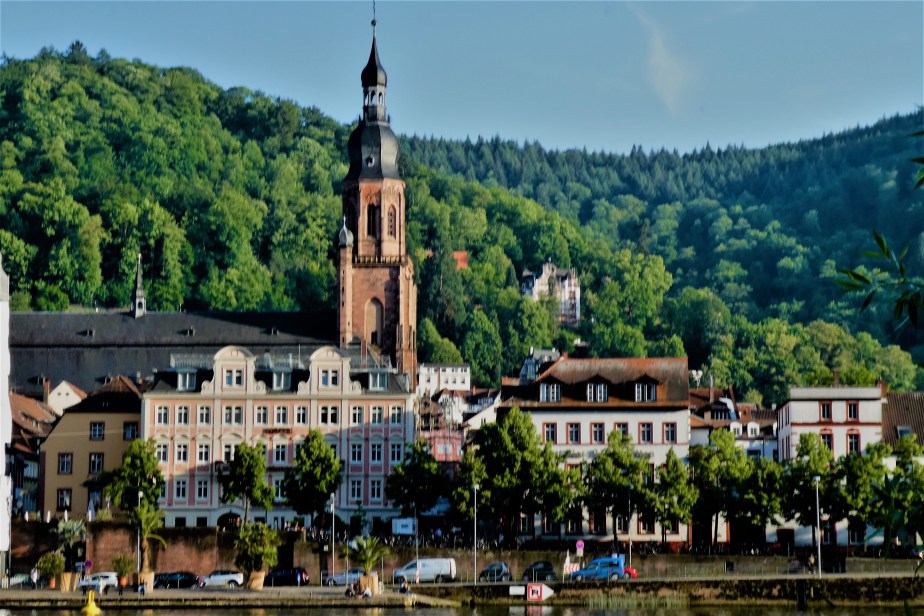
The castle, a romantic ruin of seemingly endless staircases and corridors taking you here, there, and sometimes nowhere, stands 330-feet above the Alstadt, Heidelberg’s wonderful old town. Towers and battlements protect stone facades, their decorative features still intact though the rooms behind them are gone. Views into the multitude of windows reveals not an interior but woods and the Neckar River below.
“Deserted, discrowned, beaten by the storms, but royal still, and beautiful,” is how Mark Twain described the Gothic-Renaissance castle. He was one of many poets and writers who spent time in what they considered the most romantic city in the world.
Photo Jane Simon Ammeson
The castle is also home to the Heidelberg Tun, a 58, 124 gallon wine barrel said to be the largest in the world. It was built in 1751 on orders from Prince Elector Karl Theodor to store the wine paid in taxes by the region’s wine growers. We should all be so lucky to have too much wine.
Brews and Pork Knuckles
Taking the funicular down to the old town, I meet friends at Vetter’s Alt Heidelberger Brauhaus on Steingasse, Europe’s longest carless street. It’s one of those baronial style Germanic places with high ceilings, large wood beams, long tables and a lot of dark highly polished wood.
Famed for their Vetter’s 33, which they say is the strongest beer in the world, its alcohol content is—you guessed it—33%. But it isn’t all beer her, they’re famed for their traditional German food and so I decide to go full German, ordering the pork knuckle, sauerkraut and dumpling with gravy. Skipping the 33, I opt for the Hubier—a mix of the lager and elderberry syrup.
History, Luxury and a Family Touch
Courtesy of Hotel Europaischer Hof Heidelberg.
My love affair with the city began several years before when I checked into the five-star Hotel Europäischer Hof Heidelberg. The hotel, one of the few five-star family run hotels in Europe, opened in 1865 and has been owned by von Kretschmann family since around the turn of the last century.
Courtesy of Hotel Europaischer Hof Heidelberg.
I’d heard that Sylvia von Kretschmann, who with her husband Ernst-Friedrich, ran the hotel for a half-century before their daughter Dr. Caroline von Kretschmann took over, regularly did the hotel’s large floral arrangements. So it was no surprise when I ran into this very elegant woman doing just that in Die Kurfürstenstube, the hotel’s opulent dining room that opened in 1866. Such a romantic place and romantic tradition—how could I not fall in love?
Courtesy of Hotel Europaischer Hof Heidelberg
Chocolate Kisses
My romance continued at Chocolaterie Knosel where owner Liselotte Knosel talked about studentenkussor or student kiss, a chocolate covered nougat created by her great grandfather Fridolin Knosel in 1863. His Café Knosel was frequented by male university students who admired women from a local finishing school who were, alas, chaperoned by their governesses. A gift of student kisses was a sly way to start a flirtation.
We don’t know how well it turned out for the students but these confections, still hand crafted, remain best sellers more than 150 years later. Café Knosel—the city’s oldest café—is my go to spot for coffee and a pastry at one of their outdoor tables overlooking the church on Marktplatz.
At dusk, on my last night, I boarded Patria, a 1930s ship for dining and a cruise along the Neckar River. Watching the city lights sparkle in the calm water, I knew that though my visit was ending, the romance was just beginning. I would be back.
Penguins, Bourbon, Art, & Haute Southern Cuisine come together in Louisville.
Much more than a place to lay your head, 21c Museum Hotel with locations in Louisville, Cincinnati, Des Moines, Chicago, St. Louis, Lexington, Kansas City, Oklahoma City, Nashville, Durham, and Bentonville, Arkansas, is a total immersion into art or, maybe better put, it’s a night in the art museum.
Penguin Love. Photo of 21c Museum Hotel Louisville.
In Louisville, it started when I spied a 4-foot penguin at the end of the hall as I headed to my room but 30 minutes later when I opened my door, the rotund red bird was there in front of me. “Don’t worry,” said a man walking by. “They’re always on the move.”
Proof on Main. Photo courtesy of 21c Museum Hotel Louisville.
The migratory birds, sculptures first exhibited at the 2005 Venice Biennale and now part of the collection of 21c Museum Hotel in Louisville add a touch of whimsy. But with 9,000 square feet of gallery space and art in all corridors and rooms, three-fourths coming from the owners’ private collection valued at $10 million, 21c is a serious museum.
Proof on Main. Photo of 21c Museum Hotel Louisville.
Carved out of five former 19th-century bourbon and tobacco warehouses, 21c is both part of the revitalization of Louisville’s delightful downtown and a transformation of art from backdrop into upfront and thought-provoking.
The sleek, minimalist interior — uber-urbanism with linear white walls dividing the main lobby and downstairs gallery into cozy conversational and exhibit spaces — is softened with touches of the buildings’ past using exposed red brick walls and original timber and iron support beams as part of the decor. Named by Travel + Leisure as one of the 500 Best Hotels in the World, 21c is also the first North American museum of 21st-century contemporary art.
Photo courtesy of 21c Museum Hotel Louisville.
I find more whimsy on a plate at Proof on Main, the hotel’s restaurant, when the waiter plops down my bill and a fluff of pink cotton candy — no after-dinner mints here. For more about the cotton candy, see the sidebar below. But the food, a delicious melange of contemporary, American South, and locally grown, will please even the most serious foodinista. It’s all creative without being too over the top. Menu items include charred snap peas tossed with red chermoula on a bed of creamy jalapeno whipped feta,
Bison Burger. Photo and recipe courtesy of 21c Museum Hotel Louisville.
And, of course, the Proof on Main staple since first opening. 8 ounce patty, char grilled to your preferred temp (chef recommended medium rare), served with smoky bacon, extra sharp cheddar and sweet onion jam to compliment the game of the meat nicely. Local Bluegrass bakery makes our delicious brioche buns. The burger comes house hand cut fries. For the ending (but it’s okay if you want to skip everything else and get down to the Butterscotch Pot De Créme, so very luxuriously smooth and rich pot de creme with soft whipped cream and crunchy, salty pecan cookies.
Mangonada at Proof on Main. Photo and recipe courtesy of 21c Museum Hotel Louisville.
House-cured pancetta seasons the baby Brussels sprouts, grown on the restaurant’s 1,000-acre farm. Local is on the drink menu as well with more than 50 regional and seasonal Kentucky bourbons.
A meal like this demands a walk, so I step outside (more art here) on Main, a street of 19th-century cast-iron facades, the second largest collection in the U.S. Once known as Whiskey Row, it’s refined now as Museum Row on Main. To my left, a 120-foot bat leans on the Louisville Slugger Museum and Factory, across the street is the Louisville Science Center, and nearby are several more including the Muhammad Ali Center.
Heading east, I take a 15-minute stroll to NuLu, an emerging neighborhood of galleries, restaurants and shops. I’ve come for the Modjeskas, caramel-covered marshmallows created in 1888 in honor of a visiting Polish actress and still made from the original recipe at Muth’s Candies. On the way back to 21c, I detour through Waterfront Park, a vast expanse of greenway on the Ohio River, taking time to bite into a Modjeska and watch boats pass by.
21C MUSEUM HOTEL, 700 W. Main St., Louisville, Ky., 502-217-6300, 21chotel.com
Pink Cotton Candy for Dessert. Photo courtesy of 21c Museum Hotel Louisville.
As an aside, the idea for the cotton candy originated with co-founder Steve Wilson. Here’s the story, from the restaurant’s blog, Details Matter. “A memory that sticks with Steve from his younger years is the circus coming to town. Steve grew up in a small town in far Western Kentucky along the Mississippi River called Wickliffe He distinctly remembers the year the one striped tent was erected on the high school baseball field. Certainly not the large three ringed circus many others may remember, but the elephants, the handsome people in beautiful costumes…they were all there. When Steve sat through the show he got a glimpse into a fantasy world he didn’t know existed. A departure from reality. Oftentimes, after his trip to the circus, when he was sad or frustrated, he would daydream about running away to the circus. In fact, he’ll tell you he used to pull the sheets of his bed over his head, prop them up in the middle and pretend to be the ringmaster in his own crazy circus tent! In his eyes, the circus was where everything was beautiful, and no one would cry.
There’s that darn penguin again. Photo courtesy of 21c Museum Hotel Louisville.
“Fast forward many years later, Steve met Laura Lee Brown at a dinner party in Louisville. He was immediately smitten and wanted to impress her. SO naturally one of his first dates was a trip to the circus at the KY Expo Center. Whether she was impressed or not, it seems to have worked.
“Years later, as Steve and Laura Lee were working on the development of 21c Louisville, they took a trip to Mexico City. At the end of one particularly memorable dinner, the server ended the meal with pink cotton candy served on a green grass plate. It was sticky, messy, and immediately brought back memories from Steve’s childhood. It was a feel good memory he wanted to last.
“Steve often says 21c makes him actually FEEL like the ringmaster in his own circus, so as the restaurant plans were getting finalized, he wanted to incorporate cotton candy as an homage to that feeling. As we opened up each new restaurant, the cotton candy continued, each time with a color and flavor to match the color of the hotel’s resident penguins. Eight operating restaurants later, the hope is that each and every diner ends their meal a little sticky, a little messy, and feeling nostalgic about good childhood memories.”
And again! Photo courtesy of 21c Museum Hotel Louisville.
Recipes courtesy of Proof on Main
Buttermilk Biscuits
2 cups self-rising flour
½ tsp kosher salt
1 tbsp light brown sugar
1 cup buttermilk
¼ heavy cream
6 tbsp butter
2 tbsp Crisco
Pre-heat oven to 350F. Grate butter on the coarse side of the grater and put butter in the freezer along with the Crisco. Mix all dry ingredients together in a bowl. Mix cream and buttermilk in a separate bowl. Once butter is very cold combine with the dry ingredients with hands until a coarse meal is made. Add the cold dairy to the mixture and fold until just combined. Roll out dough on a floured clean surface and cut biscuits with a ring mold cutter. Layout on sheet trays 2 inches apart. Bake for 8 minutes and rotate set timer for 8 more minutes. Once out of the oven brush with melted butter.
SMOKED CATFISH DIP
Smoked Catfish Dip. Photo and recipe courtesy of 21c Museum Hotel Louisville.
This recipe makes a lot, but you can easily divide it—or put the extra in a mason jar and give to a friend as a holiday gift.
YIELD: 1 QUART
1 lb. Smoked catfish 1 teaspoon Dijon mustard 1 cup sour cream 3 Tablespoons small diced celery 3 Tablespoons small diced white onion Juice and Zest of One Lemon 1 Tablespoon chopped fresh parsley 2 Tablespoons mayonnaise Salt and black pepper to taste
TO SERVE
Lemon wedges Hot sauce Pretzel crackers Fresh dill for garnish
Flake the fish with your hands until it is fluffy. Combine the mustard, sour cream, celery, onion, parsley, lemon juice and zest and the mayonnaise together. Combine with the catfish and mix until it is well incorporated. Season to taste with salt and freshly ground black pepper. Serve cold with fresh dill and lemon wedges, your favorite hot sauce and pretzel crackers.
Mangonada
“This is a slightly complex variation of a margarita, adding smoky mezcal, bright cilantro and tangy mango-tamarind syrup. It was created as a play on the Mexican sweet treat, the Mangonada, with mango, a tamarind candy stick, and Tajin seasoning.” – Proof on Main Beverage Director, Jeff Swoboda.
3/4 oz Banhez 3/4 El Jimador Blanco 1/4 oz Cynar 70 1 oz mango-tamarind syrup 3/4 oz lime juice big pinch of cilantro
Shake together with ice, strain over fresh ice and garnish with a Tamarrico candy straw.
Proof on Main’s Mint Julep
1 cup mint leaves, plus a sprig or two for garnish
1 ounce sugar syrup
2 ounces bourbon
Crushed ice to fill glass
In a rocks glass, lightly press on mint with a muddler or back of a spoon. Add the sugar syrup. Pack the glass with crushed ice and pour the bourbon over the ice. Garnish with an extra mint sprig.
Saxony Engages Travelers with Compelling Microsite www.saxonytraveldreams.com is the new microsite from Saxony Germany where lovers of history, castles, classical music, art museums and charming towns can experience Saxony at its most beautiful. A perfect antidote to the stay at home corona virus regulations, this microsite takes you there, to Saxony, creating an immersive visual and audio experience.
” We are making sure that memories of Saxony are kept alive in the minds of our international guests,” says TMGS managing director Veronika Hiebl.Whether you love history, castles, wine, charming towns and palaces, classical music or art museums, Saxony has it all so you don’t have to choose.
The land of Luther and Bach brings its charm and talents to the fore in the new #saxonytraveldreams campaign. Stocked with beautiful videos and photographs, visitors get a taste of the beauty and creativity that is alive in Saxony today. Although you may not be able to hop on a plane and travel there, this eastern state in Germany is a bastion for the arts and music and you can get a sense of these treasurers from your own home. The videos from journalists, bloggers and influencers are outstanding and objectively showcase Saxony at its most beautiful.
Two times per week the music city of Leipzig, broadcasts live stream performances from the world-famous Leipzig Gewandhaus Orchestra. Broadcasts start every Thursday and Friday at 12 pm (Europe time) and are then available for 24 hours. In Dresden, the landmark Frauenkirche (Church of our Lady) that rose from the GDR ashes produces a short“musical greetings”on the church’s YouTube channel or visitors can choose to go on a 360-degree tour. Jan Vogler, the director of the Dresden Music Festival has organized an online music festival to replace the recently cancelled Dresden Music Festival.
The spa town of Bad Elster, a hidden gem in southern Saxony, goes digital with its philharmonic and presents a range of live recordings every Wednesday and Saturday at 7.30 pm (Europe time) plus special music performances by individual orchestra members. But it’s not just music, there is art and incredible towns to explore. From the movie town of Görlitz, where The Grand Budapest Hotel among many other movies was filmed, to Radebeul, Leipzig and Torgau: Saxony’s enchanting towns and cities delight with unique architecture, fascinating history, interesting museums and character.
Truly there are many undiscovered gems and places that are not crowded and worth every penny to visit. Also, many of Saxony’s castles are off the beaten track and in this site, you will visit some of them and receive two very special immersive experiences created by local students built around famous palaces and castles in Dresden. Two sites which have been awarded UNESCO World Heritage status impressively underline Saxony’s reputation as the number one cultural tourist destination in Germany: “Muskauer Park/Park Muzakowski”, a joint Polish-German site, and the “Ore Mountains/Krusnohori Mining Region” site of German/Czech cultural heritage. You can take 360 tours of these beautiful areas.
For example, known as Saxony’s “silver town”, 800-year-old Freiberg at the foot of the “Ore Mountains has beautiful patrician townhouses, reflecting the wealth derived from the once thriving mining industry, and features a fascinating cathedral – discover the town on a 360-degree tour. These are only a few of the highlights that Saxony has to offer and they will whet your appetite for when you are able to travel again.
Following the Rueda Wine Trail, a historic route through the provinces of Valladolid and Ávila where the viticulture dates back to the 11th century, leads me this evening to Calle St. Maria, one of the main streets in the Medieval city of Tordesillas.
Helena Muelas Fernandez, one of two sisters who fun their 4th generation winery in Tordesillas, Spain.
My destination is Bodega Muelas de Tordesillas, housed in a tall and narrow stone building dating back centuries where the two Muelas sisters—Helena Muelas Fernandez and Reyes Muelas Fernandez– continue running the winery started by their great, great grandfather.
“This is where we learned to make wine,” Helena tells us as she leads us down uneven steps cut out of rock to the first level of the vast cave like cellars that lie underneath the building. It is here, she tells me, where they’re aging their Alidobas Vino Blanca in casks of French Oak.
A wine barrel deep in the cellars of Bodega Muelas de Tordesillas.
“This is very cry and crisp,” she says of the wine while we take a taste. “It was a very desert year in 2017, we had no rain which is why it has such a flavor as this.”
I like the taste and allow her to fill my glass once more. There’s a delicate light green cast to its yellow color that match its slight grassy aromas. It is amazing to me that the wines of the Rueda and nearby Ribera del Duero, two grape growing regions with harsh climates, produce such wonderful harvests of grapes. But, Helena explains, the hot summers and long cold winters create perfect growing conditions for varietals of the Verdejo grape.
The wine shop.
As she talks, we navigate the stone steps further down into the cellars which ultimately some 60 feet underground. The walls are carved out of hard stone and I marvel at how difficult it must have been to hew the rock by hand which is how they did it back in the 1700s when the house was built. Each landing is stacked with barrels and wine bottles and each as a significance to Helena who talks about the vintage and the weather conditions the year they were bottled. The caves get darker, the light less bright the further down we go. On the next level, dust covers the exteriors of unlabeled bottles, vaulted tunnels disappear into darkness and iron grates protect rare vintages. We are descending into wine history and the history of a family who has dedicated themselves to making wine.
Now we’ve explored the depths of the cellars, we follow Helena through the shop and up to the second floor. Here, sunlight streams through the lace curtained windows. We’re in the tasting room where there’s a long table, large enough to hold us all. The cabinets and furniture look original, maybe even dating back to when the house was built which only adds to the charm. Helena passes tapas, those great small plates of Spanish food—who would know I would come to love potato salad sandwiches—and samples of their wines. There’s their Velay Vermouth made from 100% tempranillo, a 2008 Grand Reserve Muedra also from tempranillo grape (that and the Verdejo used for making white wine are the predominant grapes here), a semi-sweet Alidobas and a nice dry rose.
Their vineyards include the La Josa Estate where the Verdejo varietals are planted; their tempranillo are grown at La Almendrera estate, located in La Peña. At present their production is diversified.
“We make young white wines, white on lees and generous white; rosé wines; young and aged red,” says Helena.
The sisters are totally enthralled to be working in the old family business, in the old family home, using both their great, great grandfather’s wine recipes and developing their own. For those who want to learn some of the secrets of this venerable wine house, they offer several types of visits from tastings to an initiation into understanding the nuances of the wine.
That night, after we’ve said goodbye at the doorway and traveled back along the cobbled streets to the historic Parador Nacional de Turismo de Tordesillas, where we’re spending the night, the moon glows softly over the old stones and gardens, creating a dreamlike quality. Is it the past approaching? But then maybe it was the tempranillo.