Waterfront dining takes on a whole new meaning for those arriving at restaurants often accessible only by boat. And what’s even better, you don’t even have to own a yacht or know how to captain one.
Seychelles. Photo courtesy of Dream Yacht Worldwide.
Dream Yacht Worldwide, a global leader in sailing vacations, is sharing some of its favorite boat-access-only dining spots—each offering a unique taste of local culture and cuisine. And with skippers doing the work, food lovers can skip the crowded roads and enjoy unforgettable meals in places most of us never find.
Here’s a taste – all of which are available on various DYW itineraries:
Konoba Tratinska (From Šibenik, Croatia) Nestled in a secluded bay, this dining spot offers authentic Dalmatian dishes made from locally sourced ingredients. Accessible primarily by boat, diners can enjoy fresh seafood and traditional recipes while taking in stunning views of the coastline.
La Lampara (From Naples, Italy) Known for its fresh pasta and seafood, La Lampara’s waterfront location means that arriving by boat allows guests to avoid crowded roads.
Erimitis Bar and Restaurant. Photo courtesy of Facebook.
Erimitis Bar and Restaurant (From Corfu, Greece) Located on a cliff with stunning views, Erimitis offers an authentic taste of Corfu while providing diners with a peaceful waterfront setting away from the hustle and bustle.
Tholos Restaurant. Photo courtesy of Facebook.
Tholos Restaurant (From Kos, Greece) Famous for its Symi shrimp and accessible mainy by sea, this picturesque restaurant offers diners fresh seafood with stunning harbor views.
Home-style Polynesian cooking with a front-row view of turquoise waters.
The Big Beach BBQ. Photo courtesy of Facebook.
The Big Beach BBQ at Foxy’s Tamarind (From Jost Van Dyke, BVI) This lively spot offers a vibrant atmosphere with a delicious BBQ feast on Fridays and Saturdays. Accessible by boat, it’s the perfect place for sailors to enjoy great food and live music on the beach.
Saba Rock Restaurant. Photo courtesy of Facebook.
Saba Rock Restaurant (From BVI) A culinary oasis in the Caribbean, Saba Rock features fresh seafood and local dishes. Its boat-accessible location makes it a favorite stop for sailors and travelers looking for a laid-back dining experience surrounded by breathtaking views.
Lime Out VI Floating Taco Bar. Photo courtesy of Facebook.
Lime Out VI Floating Taco Bar (From USVI) The ultimate dining experience on the water, Lime Out VI serves delicious tacos and refreshing drinks right from the water. Accessible only by boat, it’s a fun and unique way for travelers to enjoy a meal.
Tholos Restaurant. Photo courtesy of Facebook.
About Dream Yacht Worldwide
Dream Yacht Worldwide has more ways to sail than anyone else from bareboat charters for avid sailors to skippered, fully crewed and cabin charters – with no sailing experience required. The company offers the most diverse yacht fleet in terms of models and manufacturers in the world, making experiences at sea accessible to all.
Seychelles. Photo courtesy of Dream Yacht Worldwide.
Founded by Loïc Bonnet in 2000 as a six-yacht company based in the Seychelles, Dream Yacht Worldwide is now one of the world’s leading sea vacation companies, offering 30+ stunning sailing grounds. The group employs team members in more than 30 countries around the globe. www.dreamyachtcharter.com.
Rick’s new two-hour special premieres June 7, 2021 on public TV stations nationwide
A new two-hour public television special features travel expert, author, and host Rick Steves as he shares his favorite European destinations to visit as soon as travel is once again possible. From offbeat and romantic to picturesque and restorative, these locations offer inspiration to travel lovers who have spent the past year dreaming of their next vacation when the global pandemic ends. Co-produced and presented by American Public Television (APT), the leading syndicator of content to public television stations nationwide, Rick Steves Europe Awaitspremieres June 7, 2021 (check local listings).
Peleș Castle in the Carpathian Mountains of Romania. Photo: Rick Steves’ Europe
“When the time is right, Americans will rekindle their travel dreams, and Europe will greet us with a warm and enthusiastic welcome,” says Rick. “Europe Awaits is my dream itinerary: places away from the hubbub, places made for embracing life, and places that are good for the soul. It’s good to dream ̶ and once we emerge from this pandemic, it will be even better to travel.”
Journey (virtually that is) with Rick Steves as he recounts his recommended travel itineraries, a sure delight for both European travel aficionados and novices alike. As usual, Rick’s ability to immerse himself in fascinating destinations pays off for viewers as his presentations create a real understanding of what makes a place so fascinating including its history, culture, food, sights, and people.
In this show, Rick showcases:
– The rich history and cuisine of Sicily; – Mykonos, the romantic Greek island in the Aegean Sea; – Rustic and historic Porto, in Portugal’s northern region;
– Majestic English country views in the Cotswolds; – An authentic taste of la dolce vita in Tuscany; – andRomania, overflowing with vibrant traditional folk life.
“We are proud to be Rick Steves’ public media partner for more than three decades, presenting his insightful and enriching programs as he explores our world,” notes Cynthia Fenneman, President and CEO of APT. “Rick Steves Europe Awaits is a timely and relevant special that sparks our travel imagination from the safety and comfort of home.”
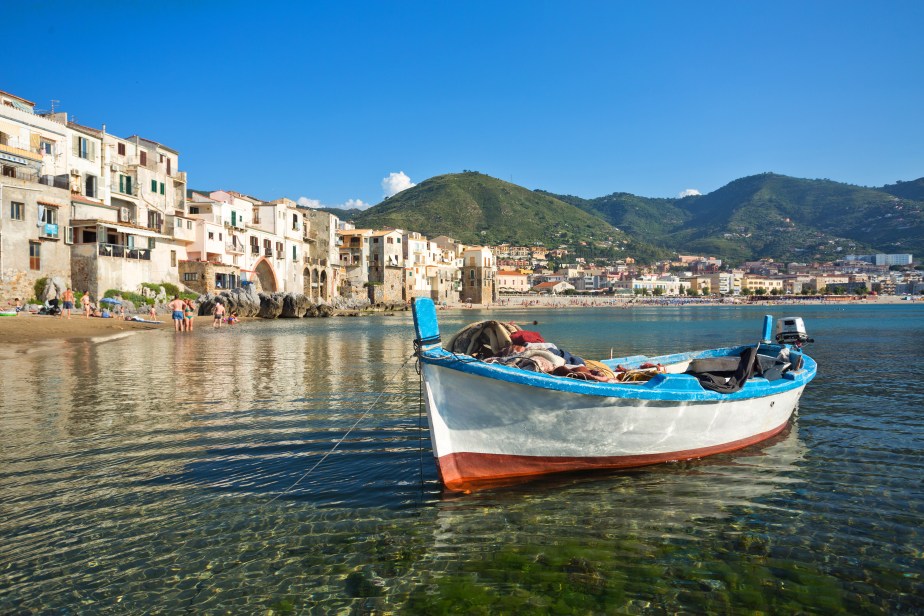
The seaside at Cefalù, on the north coast of Sicily. (Photo: Dominic Arizona Bonuccelli)
About Rick
A popular public television and radio host, a best-selling guidebook author, and an outspoken activist Rick encourages Americans to broaden their perspectives through travel. He is the founder and owner of Rick Steves’ Europe (RSE), a travel business with a tour program that brings more than 30,000 people to Europe annually.
RSE is designed to inspire, inform, and equip Americans in creating European trips that are
Rick lives and works in his hometown of Edmonds, Washington, where his office window overlooks his old junior high school.
About Rick Steves’ Europe, Inc.
TV-still-1001-rick-trinity-college.tif
Rick Steves’ Europe (RSE) inspires, informs, and equips Americans to have European trips that are fun, affordable, and culturally broadening. Guided by Rick’s value-driven vision, his company brings tens of thousands of people to Europe annually on organized tours, producing a wide range of travel content including a best-selling guidebook series, popular public television and radio shows, a syndicated travel column, and a large library of free travel information at ricksteves.com.
RSE’s mission is built around the idea of social responsibility, and it empowers several philanthropic and advocacy groups, including a portfolio of climate-smart nonprofits that it funds through a self-imposed carbon tax.
Rick Steves in his early years of exploration.
Rick Steves Europe Awaits is a production of Rick Steves’ Europe, Inc., American Public Television, and Detroit Public Television. Visit ricksteves.com for additional information.
Select pledge thank-you gifts for Rick Steves Europe Awaits include exclusive access to a live virtual event and Q&A session hosted by Rick from his home in Seattle, WA; DVDs of Rick’s speaking engagements; anthology sets of the Rick Steves’ Europe series; “For the Love of Europe,” a 400-page collection of Rick’s favorite people, places and experiences; and the “Europe’s Top 100 Masterpieces: Art for the Traveler” coffee table book.
Mykonos by Rick Steves.
About American Public Television American Public Television (APT) is the leading syndicator of high-quality, top-rated programming to the nation’s public television stations. Founded in 1961, APT distributes 250 new program titles per year and more than one-third of the top 100 highest-rated public television titles in the U.S. APT’s diverse catalog includes prominent documentaries, performance, dramas, how-to programs, classic movies, children’s series and news and current affairs programs. Doc Martin, Midsomer Murders, America’s Test Kitchen From Cook’s Illustrated, AfroPoP, Rick Steves’ Europe, Pacific Heartbeat, Christopher Kimball’s Milk Street Television, Legacy List with Matt Paxton, Front and Center, Lidia’s Kitchen, Kevin Belton’s New Orleans Kitchen, Simply Ming, The Best of the Joy of Painting with Bob Ross, James Patterson’s Kid Stew and NHK Newsline are a sampling of APT’s programs, considered some of the most popular on public television. APT also licenses programs internationally through its APT Worldwide service and distributes Create®TV — featuring the best of public television’s lifestyle programming — and WORLD™, public television’s premier news, science and documentary channel. To find out more about APT’s programs and services, visit APTonline.org.
About Detroit Public Television Serving Southeast Michigan, Detroit Public TV (DPTV) is Michigan’s largest and most watched television station, with the most diverse public television audience in the country. DPTV is the state’s only community-licensed station, meaning it operates independent of any educational, government or other institution. Its funding comes solely from the community. Each week, more than two million people watch DPTV’s four broadcast channels, and nearly 200,000 people listen to its radio station, WRCJ 90.9 FM for classical days and jazzy nights. In addition, DPTV is building the next generation of public media with a rapidly growing digital presence, which now reaches more than half a million unique visitors through its website, YouTube channels and social media platforms each month. Visit DPTV.org.
Where’s Rick?
Join Rick as he travels across the world and web with an exciting itinerary of virtual events.
MAY 24: Iran: Won’t You Be My Neighbor? 5:30 p.m. and 7:00 p.m. Pacific | Register for Free
MAY 26: Bellingham City Club: Rick Steves on the Future of Travel 12:00 p.m. Pacific | Register for Free
MAY 31: Monday Night Travel: Europe’s Eccentric Art 5:30 p.m. and 7:00 p.m. Pacific | Register for Free
JUNE 7: Monday Night Travel: Europe Awaits! 5:30 p.m. and 7:00 p.m. Pacific | Register for Free
JUNE 15: World Affairs Council of Tennessee: A Conversation with Rick Steves 7:00 p.m. Central | Buy Tickets
JUNE 17: WJCT: An Evening with Rick Steves 7:00 p.m. Eastern | Register for Free
This February is the celebration of Purim, the Jewish holiday honoring Queen Esther of Persia who in 5th century BCE stopped the massacre of the Hebrew population by acknowledging to her husband, King Xerxes that she was Jewish and asking him to save her people.
Luckily she had beauty and youth on her side and the King still liked her because she’s credited with stopping the planned entire massacre of Jews.
Thus Purim is a happy holiday and part of the celebration is eating such traditional foods as hamantaschen, a triangular shaped pastry typically filled with fruit, large rounds of braided challah bread said to be a reminder of the rope used to hang Haman, the King’s grand vizier or as we would say these days, advisor, who came up with the idea of the executions.
Jewish cookbook author Leah Koenig shares recipes commonly eaten during Purim as well as other desserts in “Little Book of Jewish Sweets.” But Koenig isn’t afraid to jazz up old recipes, a type of reinvention of Jewish foods. The author of six cookbooks including “Modern Jewish Cooking: Recipes & Customs for Today’s Kitchen” and her Little Book series, her recipe for challah (which by the way is available at Bit of Swiss Bakery on certain days of the week), becomes a bread pudding with raspberries and chocolate
“From breadcrumbs and grilled cheese sandwiches to French toast, there are many ways to transform leftover challah into something new—a luscious bread pudding studded with chocolate and juicy raspberries is a particularly delicious one,” she writes in her introduction to the recipe. “Challah has a soft and tender crust, which means there is no need to remove it before tossing the bread into the custard.”
With baklava, the classis Middle Eastern and Greek dessert of phyllo dough layered with walnuts and honey, she goes beyond the typical by adding figs, making, in her words, a confection that is at once familiar and new.
Koenig does the same for hamantaschens by adding a touch of lemon zest and cinnamon to an apricot and walnut base.
Over the years as she’s researched her cookbooks, Koenig says she came to realize how global Jewish cuisine is.
‘Jews have lived and cooked pretty much everywhere in the world, maybe barring Antarctica,” she says. “So really the inspiration behind the book was to try to capture how Jews eat today across the world and capture a little bit of the history of how Jews used to eat.”
Apricot-Walnut Hamantaschen
Makes about 3 dozen cookies
Dough
21/2 cups all-purpose flour, plus more as needed
1 tsp baking powder
1/2 tsp kosher salt
1/2 cup unsalted butter or nonhydrogenated margarine, at room temperature
3/4 cup sugar
2 eggs
1 1/2 tsp vanilla extract
Water, as needed (optional)
Filling
3/4 cup apricot jam
11/2 cups walnut halves
1/2 tsp ground cinnamon
1/2 tsp finely grated lemon zest
1/4 tsp kosher salt
Make the dough: Sift together the flour, baking powder, and salt into a medium bowl.
In a stand mixer or with a handheld electric mixer, beat the butter and sugar on medium speed until pale and fluffy, about 3 minutes. Add the eggs and vanilla and beat to fully combine. Add the flour mixture in three additions, beating on low speed and scraping down the sides of the bowl as necessary, until a firm but pliable dough comes together. If the dough looks too dry, add water, 1 tsp at a time, until the desired consistency is reached. If the dough looks too wet, add additional flour, 1 Tbsp at a time. Knead the dough a few times in the bowl to bring it together, then form into a flat disk. Wrap tightly in plastic wrap and refrigerate for at least 2 hours, or up to overnight.
Make the filling: Place the jam, walnuts, cinnamon, lemon zest, and salt in a food processor and pulse, scraping down the sides of the bowl as necessary, until a chunky paste forms. Set aside.
Preheat the oven to 350° and line two large, rimmed baking sheets with parchment paper. Remove half of the dough from the fridge (keep the other half wrapped and chilled). On a lightly floured surface, using a lightly floured rolling pin, roll the dough until it’s 1/4 inch thick. Using a 3-inch round cookie cutter or glass, cut out as many circles as possible and carefully transfer them to the prepared baking sheets. Gather the dough scraps, reroll the dough, and cut out additional circles.
Spoon 1 rounded teaspoon of apricot-walnut filling into the center of each dough circle. Fold the left side over on an angle, followed by the right side. Fold the bottom flap up, tucking one end under the side flap to make a pocket (the filling should still be visible in the center); pinch the corners firmly to seal. Repeat the rolling and filling process with the remaining dough.
Bake the cookies until lightly golden and browned at the corners, 15 to 18 minutes. Remove from the oven. Set the baking sheets on wire racks to cool for 5 minutes, then transfer the cookies to the wire racks to cool completely. Serve at room temperature. Store covered in the fridge for up to 5 days or in the freezer for up to 3 months.
Challah Bread Pudding with Raspberries and Chocolate
Serves 8 to 10
8 oz challah, cut into 1-in cubes
4 large eggs, lightly beaten
2 cups whole milk
1/2 cup heavy cream
3/4 cup packed light brown sugar
11/2 tsp vanilla extract
1/4 tsp kosher salt
1 cup fresh or thawed frozen raspberries
1 cup semisweet chocolate chips
Confectioners’ sugar for serving
Preheat the oven to 350°F. Grease a 2-qquart baking dish. Spread the cubed challah in a single layer on a large-rimmed baking sheet. Bake, stirring once or twice, until toasted and dry, about 10 minutes. Remove from the oven and let cool.
Whisk together the eggs, milk, cream, brown sugar, vanilla, and salt in a large bowl. Layer half of the bread into the prepared baking dish, and sprinkle evenly with half of the raspberries and half of the chocolate chips. Top with the remaining bread, raspberries, and chocolate chips. Pour the cream mixture over the top, gently pressing down the bread to encourage soaking. Cover the dish with a kitchen towel and let stand for 30 minutes to allow the custard to soak into the bread. Check that the oven is still set to 350°F.
Bake until puffed and golden brown, 30 to 40 minutes. If the top is browning too quickly, loosely drape a piece of aluminum foil over the dish partway through baking. Remove from the oven and let cool for 10 to 15 minutes. Serve the pudding warm or at room temperature, dusted lightly with confectioners’ sugar. Store leftovers covered in the fridge for up to 3 days.
Fig Baklava
Serves 8
Baklava
1 pound walnut halves
1 1/2 cups dried mission figs, stemmed and coarsely chopped
2 tbsp light brown sugar
2 tsp ground cinnamon
1/4 tsp kosher salt
1-lb package frozen phyllo dough, thawed
1 cup unsalted butter, melted, or coconut oil or vegetable oil
Syrup
1 1/4 cups granulated sugar
3/4 cup water
1/4 cup honey
1 cinnamon stick
2 tbsp fresh lemon juice
1 tsp rose water
Make the baklava: Preheat the oven to 350°F and lightly grease a 9-by-13-in baking dish. Place the walnuts, figs, brown sugar, cinnamon, and salt in a food processor, and mix until the walnuts and figs are finely ground.
If necessary, trim the phyllo to fit the baking dish, then place on a flat cutting board and cover with a damp kitchen towel. Fit one sheet of phyllo in the bottom of the baking dish and generously brush with melted butter. Repeat seven times, brushing with butter after each layer to make a stack of 8 phyllo sheets. Spoon half of the nut and fig mixture over the phyllo and spread evenly. Repeat the process with 4 more phyllo sheets, brushing with butter between each layer. Spread the remaining nut and fig mixture over the top and repeat the process with 8 more phyllo sheets.
Bake until the top is lightly golden and crisp, 30 to 35 minutes. Remove from the oven and let cool for 5 minutes, then use a sharp knife to cut the baklava into squares or diamonds in the pan.
Meanwhile, make the syrup: Stir together the granulated sugar, water, honey, and cinnamon stick in a medium saucepan, and set over medium-high heat. Bring to a boil, then turn the heat to medium-low and cook, stirring often, until the syrup thickens slightly, about 5 minutes. Remove from the heat and stir in the lemon juice and rose water. Let cool slightly. Discard the cinnamon stick.
Carefully spoon the warm syrup over the slightly cooled and cut baklava, taking care to pour syrup along the cut lines. Let the baklava sit for at least 2 hours before serving to allow the syrup to soften the filling. Serve at room temperature. Store covered at room temperature for up to 3 days.
The above recipes are reprinted from Little Book of Jewish Sweets by Leah Koenig with permission by Chronicle Books, 2019.