The Allure and Beauty of Southwest Germany’s Christmas Markets

Fresh air mixed with the aroma of mulled wine, roasted almonds and warm chestnuts are part of the appeal of Southwest Germany’s many Christmas Markets whether they’re big or small. Each has a special ambience and distinction, designed to capture your imagination. Medieval or modern, baroque or family fun? Southwest Germany’s Christmas markets cater to all.

Trinkhalle_CM (c) Baden-Baden Kur & Tourismus GmbH, A. Stephany

Consider the following:

The Christmas markets around Lake Constance present a variety of traditions and delicacies. The short distances between towns make it possible to visit many different Christmas markets, each memorable and eminently Instagrammable. The plethora of market offerings are varied. In the Black Forest there are 180 Christmas markets with each town’s market having its own personality, events and handicrafts. Castles and their surroundings offer yet another type of experience, such as in Stuttgart, the state capital, with its beautiful and enormous Christmas market located on a castle square–it’s a magical time featuring choirs, a children’s Christmas fair, and elaborate, beautifully decorated stalls ablaze in lights and ornaments. 

So whether you visit the markets on historic squares and in monasteries, or in castles and nestled in the woods, you will enjoy sipping mulled wine, nibbling tasty treats, and buying one-of-a-kind crafts perfect for gifts. For special tips and ideas, please visit our website and enjoy the Christmas markets in Southwest Germany.

Freudenstadt Christmas Market almost appears unreal as if the streets are paved with gold. © Jürgen Schmidt

Christmas Markets in the Black Forest Offer Are Diverse Regional, Local, Traditional, Progressive, Delicious, Artistic, & Musical

During Advent, the towns and villages of the Black Forest transform into a sparkling winter wonderland. Over 180 Christmas markets offer unique settings, handcrafted goods, and culinary delights. The Christmas market in Freudenstadt (December 4–14, 2025), home to Germany’s largest market square, is particularly atmospheric, featuring handcrafted products and a curling rink. In the historic half-timbered town of Haslach, the new “Culinary Winter Market” (December 19, 2025 – January 6, 2026) invites visitors daily to enjoy regional specialties and music, accompanied by a nativity scene exhibition.

Art lovers will find plenty to enjoy in Karlsruhe: At the “Christmas Fair for Applied Arts and Crafts” (December 11–14, 2025), 40 exhibitors present high-quality, one-of-a-kind pieces from across Europe. In Rottweil, the oldest city in Baden-Württemberg, the Christmas market (December 4–14, 2025) enchants visitors with its medieval setting, children’s workshop, and choral singing.

Against impressive architecture, the Christmas market takes place on Cathedral Square in St. Blasien (on three weekends in December 2025) – framed by the largest dome north of the Alps. Lörrach invites visitors to its Old Market Square from December 4–14, 2025, with arts and crafts, music, and delicious aromas. In Bad Säckingen, the market on Münsterplatz (December 4–7, 2025) offers regional products and a musical program amidst a historic backdrop.

A truly special experience awaits at the “Christmas Triad” in Pforzheim (November 21, 2025 – January 6, 2026): Christmas market, winter wonderland, and medieval market merge into a dazzling, glittering experience complete with an ice rink, Ferris wheel, and street performers.

Christmas Markets in the Black Forest

The half-timbered houses in the Black Forest town of Nagold are lit up especially this year for visitors. A giant ferris wheel also will be another first in the beautiful town. © Lightworkartpro, Manuel Kamuf.
Schloss Ludwigsburg just outside of Stuttgart that is still completely finished in the style in which it was built. A beautiful Baroque palace in the town of Ludwigsburg. c. SSG and Thomas Buehler

Castle Courtyards Aglow: Christmas with the SSG

The Staatliche Schlösser und Gärten Baden-Württemberg (SSG), or State Palaces and Gardens of Baden-Württemberg, sets the stage for a truly magical winter and Christmas season across its many historic sites. As the gardens and grounds enter their quieter phase, the frost-kissed landscapes, bare trees and soft winter light lend the sites a serene, festive ambience.

For example, Schloss Solitude in Stuttgart welcomes visitors for winter tours on weekends and holidays, offering both the architecture and surrounding views in a calm winter splendour. In the run-up to Christmas, many of the monuments managed by the SSG host atmospheric markets and seasonal events. The historic courtyards, cloisters and castle grounds are transformed into illuminated, festive spaces offering artisanal crafts, music and traditional treats. One highlight is the festive “Winterzauber” (winter magic) program at Residenzschloss Mergentheim, where from early November an open-air rink and themed events enliven the Schloss hof. 

The Kurfürstlicher Christmas Market at Schloss Schwetzingen about 20 minutes from Heidelberg runs from November 27 to December 21, 2025, offering a festive atmosphere with handcrafted goods, delicious treats, and family-friendly activities.

Visitors can explore beautifully illuminated tents, enjoy mulled wine, and discover unique gifts. Highlights include a nostalgic carousel, a Christmas market featuring local and international specialties, and cultural events such as Advent concerts and theater performances. The historic castle and gardens also offer special tours and winter experiences. The combination of seasonal architecture, historic gardens and festive programming makes the SSG-managed sites wonderful destinations for winter visits — whether for a quiet stroll, family outing or evening market experience.

State Palaces and Gardens of Baden-Württemberg

Ships docked in Constance Harbour are often decorated at the Christmas season.© Achim Mende

Lake Constance – Four Countries, One Magical Christmas Lake

 During Advent, Lake Constance (Bodensee) transforms into one of Europe’s most enchanting winter destinations, where Germany, Austria, Switzerland, and Liechtenstein share their traditions along one shimmering lake. This cross-border charm makes the region unique: visitors can experience four different cultures of festive joy within just a few days. In Konstanz, the largest town on the lake, the Christmas Market stretches from the medieval old town all the way to the harbour.

A true highlight is the “Weihnachtsschiff” (Christmas Ship), anchored by the waterfront and glittering with thousands of lights. Nearby, Überlingen enchants visitors with its atmospheric Christmas market, set among historic squares and festively decorated lanes. The lakeside promenade glows with lights, creating a romantic atmosphere perfect for a winter stroll. Meersburg, with its half-timbered houses and medieval castle, offers a truly magical Advent market on the castle square.

Between Christmas and New Year, the town also hosts special seasonal events and concerts, keeping the festive mood alive right into the New Year. Another highlight is the Christmas Garden on Mainau Island, where dazzling light installations transform the famous flower island into a sparkling winter wonderland for the whole family. Across the region, guests can enjoy unique Christmas markets, festive cruises on the lake, and culinary treats – from German Lebkuchen and Austrian pastries to Swiss chocolate specialities. Families, couples, and Christmas enthusiasts alike will discover the joy of exploring diverse traditions so close together. Lake Constance is more than a holiday – it is a magical journey across four countries united by one festive lake.

Lake Constance

For more information, contact

Land of Christmas: The Beauty of Saxony at Holiday Time

Saxony is Germany’s Land of Christmas, a place where tradition and craftsmanship shine year-round. Throughout the state, artisans create exquisite handmade goods, and during the holidays, their work fills markets with warmth and wonder, allowing visitors to explore a mix of history, culture, art, cuisine, and festive cheer. From Dresden’s historic Striezelmarkt, one of Germany’s oldest Christmas markets, to Leipzig’s music-filled Old Town, Saxony’s centuries old cities radiate holiday spirit and cheer.

In Seiffen, the famous “toy village” of the Ore Mountains, generations of craftspeople continue to carve nutcrackers and candle arches that are now timeless symbols of Christmas. Meanwhile, Bautzen and Görlitz enchant visitors with medieval streets and castle views steeped in history and folklore. Even after a century of challenges, Saxony’s dedication to quality and artistry endures—especially at Christmastime, when only the finest craftsmanship will do.

The Striezelmarkt in Dresden, with its many beautifully decorated stalls filled with a cornucopia of items, is a stunning spectacle during the winter and Christmas season. Photo: Sebastian Weingart (DML-BY)

View of the 588th Dresden Striezelmarkt from the tower of the Kreuzkirche. Photo: Michael Bader (DML-BY)

Dresden: One of Germany’s Oldest Christmas Markets

Dresden’s Striezelmarkt is the crown jewel of Saxony’s Christmas. By medieval right this market dates to 1434, and in 2025 Dresden celebrates its 591st anniversary. The market opens Wednesday, November 26 at 4 pm with a parade and the ceremonial lighting of the stalls. Highlights include the 40 ft high Ore Mountain pyramid and the giant candle arch (both record‐breakers), plus a historic Ferris wheel offering views over the glittering Old Town. Visitors can sip Glühwein and nibble on Dresden’s famous Stollen, which even has its own festival on Dec 6. Beneath the illuminated church towers, shoppers browse handcrafted wooden toys, ornaments and regional foods.

Dresden Striezelmarkt

Leipzig Christmas Market

Leipzig: Music, Markets, and Magic in the Old Town

An hour by train west of Dresden, Leipzig lights up for Christmas in historic style. Leipzig’s festive season begins on Tuesday, November 25, 2025, with the opening of the historic Christmas market, running through December 23. The city center will feature over 300 stalls, blending tradition, music, and culinary delights.

Highlights include the Historic Market Square with its 60 ft Christmas tree, nightly trombone performances from the Old Town Hall balcony, and a festive stage with choirs and musicians; the Naschmarkt, showcasing medieval crafts, mead, and freshly baked Handbrot; St. Nicholas Churchyard with the beloved Feuerzangenbowle pyramid for mulled wine; and Augustusplatz, featuring Finnish and South Tyrolean villages and a 125 foot Ferris wheel offering panoramic views.

Trendy districts like Connewitz and venues such as WERK2 and Feinkost host smaller markets with handmade arts, crafts, and regional foods. Music lovers can enjoy performances at St. Thomas Church, including Bach’s Christmas Oratorio, along with numerous advent concerts celebrating Leipzig’s rich musical heritage. Beyond the city, visitors can explore the medieval Christmas market at Felsenkeller, the illuminated Christmas garden walk at Park Markkleeberg, and the traditional Gänsemarkt in Werms, featuring Christmas geese, carp, handicrafts, and Nordic decorations.

Leipzig Christmas Market

Bautzen: Castles and Sword-fights

Eastward in the Lusatian Hills in an area in the east of Saxony that is the center of Sorbian culture in Saxony, the medieval town of Bautzen in Upper Lusatia, is a perfect backdrop for a fairy tale Christmas with turrets and towers and beautiful churches and buildings.

Photo courtesy of Wenzelsmarkt Bautzen Facebook.

In Bautzen’s old town, the historic Wenzelsmarkt (28 Nov – 22 Dec 2025) carries the name of King Wenceslas IV, who in 1384 granted the town market rights. Stalls line Hauptmarkt and Reichenstraße beneath the Reichenturm tower, decked with lights and a giant tree. Bakers’ guilds sell Stollen and smoked sausages, and on weekends a medieval market at the Moench Church Ruins highlight sword-fights and minstrels. Children can enjoy seasonal surprises at the library and hear Christmas tales at the Nikolaiturm (St. Nicholas Tower).

Festive rides at the Kornmarkt (Corn Market) provide extra fun, while live music fills the air throughout the city. From December 1st onward, Santa Claus will delight crowds daily on Wenceslas’s Stage beneath the Main Market tree, opening a new door of the Advent calendar.

Bautzen

Görlitz: A Silesian Christmas in Eastern Saxony

From the Napoleonic Wars to WWII, the Saxon town of Görlitz was part of the Prussian province of Silesia, which now belongs to Poland. Today, Görlitz is part of Germany right on the border with Poland and the city maintains many of the Silesian customs, traditions, costumes, cuisine and even its dialect.

The city’s historical importance is evident in its well-preserved architecture, which reflects its past as a wealthy trading town. It was never destroyed during the war and so its buildings are original and incredibly romantic. Each year the city stages the Schlesischer Christkindelmarkt (Silesian Christmas Market). From Friday, November 28 to Sunday, December 14, 2025 the Untermarkt (below the medieval hall) is transformed into a festive village. Wooden chalets brim with gingerbread, hand-carved angels and regional crafts, and the scent of mulled wine wafts past the Gothic St. Peter’s Church. There are special church services,baking, reading, singing and music, plus the “Görlitz Christkind” (christ child) which makes a daily appearance on the market. Bautzen offers a quiet, historic counterpoint to the big-city markets.

Görlitz

Seiffen: Germany’s Christmas Capital in the Ore Mountains

Nestled high in the “Erzgebirge” (Ore Mountains), the village of Seiffen is the Christmas capital of all Germany as it is where many of the beautiful Christmas treasures are created. The nutcracker and the smokers were invented in Seiffen as the woodcutters used their winter time in industrious ways to create the wooden toys, gifts, keepsakes, candles and figurines.

Here families have been making wooden toys and decorations for over 300 years. In Seiffen’s narrow lanes, workshops and shops spill out seasonal bounty: nutcrackers, smoking men, pyramids and candle arches. Local artisans say this craft is truly their passion. As one woodcarver explains, “People are amazed that we can spend so long painting a few details on a minuscule doll’s head… But we love our craft – it’s a love many of us have had since we were children.” Visitors to Seiffen can tour family workshops and the Toy Museum (Spielzeugmuseum), tasting Erzgebirge biscuits amid snow-dusted firs and candlelight. It is truly quintessential Saxon Christmas tableau.

Traditional Christmas Handicraft

Meissen – A Place of History, Legacy, and Europe’s First Porcelain

The Porcelain Disease – Maladie de Porcelaine

As early as the 13th century, porcelain was a highly coveted item at the royal courts of Europe and was imported from China at extravagant prices. Attempts were made starting from the early 18th century to reproduce the “White Gold” in Europe, with alchemist Johann Friedrich Böttger finding success in Dresden in 1708 under commission from Saxony’s royal court.

A close up of Augustus the Strong in the Procession of the Princes which is mural that runs the entire length of the stable yard of the royal palace and is composed completely of porcelain tiles. c. Saxony Tourism

That discovery marked the beginning of a legend that was sealed two years later with the founding of the manufactory by Augustus the Strong, Elector of Saxony, who claimed to have Maladie de Porcelaine, or porcelain sickness, as he was so addicted to collecting beautiful pieces. From 2014 to 2024, an international team of experts researched and catalogued the comprehensive, extant royal holdings of Augustus the Strong comprising around 8000 East Asian porcelain objects.

Saxon Service Plate given to the Duke of Wellington by the King of Saxony made by the Meissen Porcelain Factory Berlin 1818-1819 porcelain-Apsley House-London UK. Wikimedia Commons.

The results are published on ‘The Royal Dresden Porcelain Collection’, an innovative digital platform that not only showcases the objects but also focusses on the history of the collection.

Special Exhibition on Meissen Porcelain during the East German Period

From September 20 to February 22, 2026, there is a special exhibition at the Japanese Palace of the Meissen Porcelain during the East German period. The Japanese Palace—the porcelain palace built by Augustus the Strong just for his collection—offers an exciting yet fitting setting. Despite all the contradictions of the socialist system of government, the great Baroque tradition of Europe’s first porcelain manufactory remained influential.

Monumental murals for the Palace of the Republic and other central buildings of the GDR, state gifts, and a medal that Sigmund Jähn carried with him on his space flight testify to the unfailingly high prestige value of Meissen porcelain as a luxury item. Design sketches, theater costumes, film excerpts, illustrated magazines, and much more provide insight into the art and cultural-historical context of Meissen porcelain during the GDR era.

The exhibition also explores the identity-forming role of the world-renowned manufactory from the perspective of citizens in both East and West Germany, where a large portion of Meissen porcelain was exported in exchange for foreign currency. What remained in the home country, and what significance did Meissen have in everyday life and collective memory on both sides of the Wall? Artistically sophisticated photo series from the 1950s and late 1980s, as well as interviews with contemporary witnesses, tell of everyday working life in Europe’s largest porcelain manufactory.

Experiencing MEISSEN in Meissen

The quality of Meissen porcelain has its beginnings in the manufactory’s own mine near the city of Meissen, where the purest kaolin is sourced day after day. This white clay is the key to the striking radiance of Meissen porcelain.

Hard at work shaping the beautiful clay that will become a precious object at MEISSEN.
MEISSEN Tourismus Marketing

The precise blending of kaolin with native feldspar and quartz has been refined in Meissen over the past 300 years and is still completed by hand to this day. The in-house training to become a painter or shaper lasts over three years, while achieving the level of Master takes many years more. A piece created for the “Limited Masterworks” collection requires months of elaborate handicraft, learned over decades of exacting training. 

Artists at Work at the MEISSEN Manufactory. You can visit and explore, paint, and observe. Photo by Iona Dutz c. MEISSEN Marketing Tourismus

Each piece of Meissen porcelain has its beginnings in the manufactory’s archives, the oldest and largest treasury of models and molds anywhere in the world. Each new piece that bears the Meissen name is a modern interpretation of European art and cultural history. Artists from a variety of disciplines frequently collaborate with Meissen artisans on contemporary pieces, pushing the manufactory to the highest echelons of artistic accomplishment. And there are lines of beautifully designed items, including jewelry, household goods, fine art,and decorations.

There are a number of fun and experiential ways to visit the Meissen manufactory. With the “manufakTOUR” you can experience the artisanal creation of porcelain live. Our show workshop also brings the world-famous Meissen porcelain to life in 14 languages! You can ask experienced porcelain makers detailed questions about the production process.

In the creative workshops, you can learn the techniques required to design porcelain by hand and create your own work of art or fer paint your very own MEISSEN mug and create a very special souvenir of your visit. On a tour of the Meissen Porcelain Foundation Museum, you will discover a multitude of exhibits from all eras of Europe’s first porcelain manufactory. A selection of 2,000 porcelain objects and over 300 years of porcelain history await you from around 33,000 historical porcelains. And, last but not least, you can really shop! The gift store at the MEISSEN headquarters is literally mouthwatering. 

Photo courtesy of the Meiseen Porcelain Foundation Museum

The exhibition at the Meissen Porcelain Foundation Museum: “Maladie 2.0. Ten Years of the Meissen Porcelain Foundation” will be showcased until February 22, 2026. The Foundation preserves Meissen porcelain as a cultural asset, including looking after the Meissen Porcelain Manufactory’s historical collection.The exhibition sheds light on the Foundation’s work whilst also showcasing Meissen porcelains given over to the subject of collecting.

For further information, please contact Victoria Larson at victoria@vklarsoncommunications.com

Top Photo: One wing of the Zwinger Palace of the Dresden State Art Collection was designed by architect and designer Peter Marino just for the museum’s porcelain collection. c.WGaertner

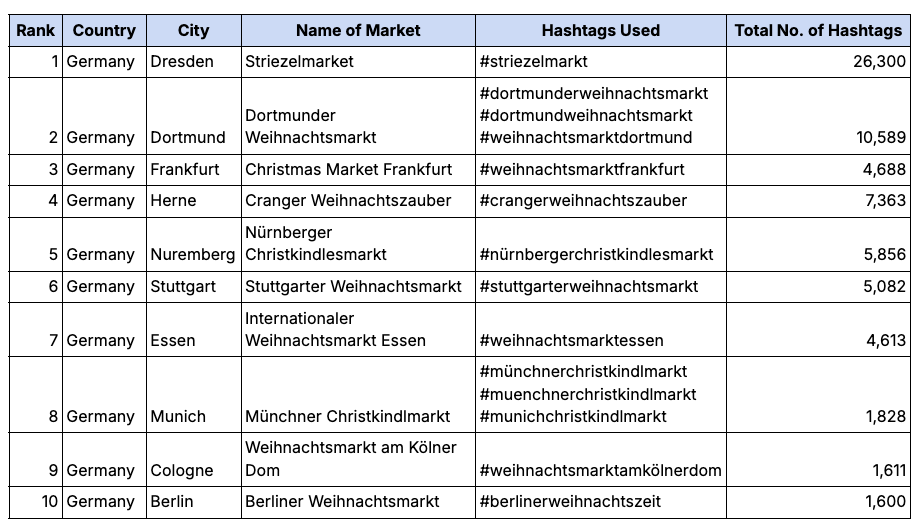
Hashtag This: Germany’s Most Instagrammable Christmas Markets

Nürnberger Christkindlesmarkt | Nuremberg Christkindlesmarkt

Striezelmarket- #striezelmarkt

Next up we have Dortmunder Weihnachtsmarkt, situated in the beautiful city of Dortmund. Being one of the markets on the list that has more than one hashtag variation, this popular market is one of the largest in Germany. With the opportunity to ice skate hand in hand or watch a spectacular live performance with your loved one, this market serves the perfect romantic scene. It would be a disservice not to speak on the market’s most famous feature—its dazzling Christmas tree. It stands more than 45 meters tall and is coined as one of the largest in the world, making a stunning proposal spot. 

Christmas Market Frankfurt– #weihnachtsmarktfrankfurt

Frankfurt’s Christmas Market attracts more than 3 million visitors per year, and it certainly doesn’t disappoint. It is a traditional winter market full of festivities, with Christmas carols and church bells ringing, located in the scenic old town centre, decorated with thousands of lights, ribbons, and bells. For a perfect proposal, the balcony of St. Nicholas Church overlooking the market is ideal—offering breathtaking views of the festive lights and perfect for those looking for a more private, intimate setting to pop the question with it being outside the market. 

Cranger Weihnachtszauber- #crangerweihnachtszauber

Up next is Cranger Weihnachtszauber, situated in Herne. The market spans across 30,000 metres of land and is home to more than 100 attractions, shows, and live acts, so it’s safe to say you’re in for a treat no matter what day you go. For those looking to propose, why not take it on the ice? With a beautifully illuminated ice rink, it creates the perfect magical backdrop, and one your loved one will definitely not forget.

Nürnberger Christkindlesmarkt- #nürnbergerchristkindlesmarkt

Photo courtesy of Nürnberger Christkindlesmarkt


Nürnberger Christkindlesmarkt takes place during Advent in the Hauptmarkt, the central square in Nuremberg’s old town. Reaped with history and activities for all, from live performances to adventure tours, it’s perfect for families, couples, and friends. The perfect proposal spot here is the balcony of the Frauenkirche (Church of Our Lady). This balcony overlooks the market and exudes timeless historical charm. 

The above information is courtesy of Diamonds Factory

17 Spas in the Black Forest

Southwest Germany, also known as the state of Baden-Wuerttemberg, is home to thermal springs and spas, places of healing and relaxation, some of which are famous and others you may not recognize. No less than 17 of the total of 34 spas in the “Bäderland” Baden-Württemberg are located in the Black Forest.

Baden-Baden_Friedrichsbad. Copyright RavenChen

In addition to hotels with wellness offerings, there are thermal baths and thermal springs, certified climatic health resorts, 3-day wellness hikes through the region, forest bathing, and natural relaxation in fragrant fir forests. On the German shore of Lake Constance, two spa towns include Radolfzell which is synonymous with nature, and wellbeing and the town of Überlingen which has a long history as a health spa town, where guests have been ‘taking the cure’ for more than 100 years. Charming towns, such as medieval Meersburg and puzzle-rich Ravensburg, add to the spa experiences on Lake Constance with busy old towns with cobble-stone streets lined with shops, unusual museums, wineries and restaurants, castles and terraces.

Lakeside Towns with Healing Qualities

Photographer: Achim Mende
Internationale Bodensee Tourismus GmbH

Überlingen has a long history as a health spa town, where guests have been ‘taking the cure’ for more than 100 years. The modern thermal baths are one of three of the Lake Constance region with saunas, pools of varying temperatures and lake access. What makes Überlingen extra special are the garden parks for long walks and dramatic scenes along ivy towers, plunging cliffs and memories of ancient struggles along the defense wall. The waterfront promenade is a sunset destination where the wine flows. Over some 2.5 miles, the Überlingen garden culture path connects the most attractive parks and gardens. Überlingen

The town of Untersee is home to a stretch of largely unspoiled nature with sanctuaries of reedy marsh land, forest, natural lakes, and wildflower meadows. At the heart of this unique landscape lies the official health resort of Radolfzell. It has a charming old town on the lake with great outlet shopping, the longest shoreline, and outstanding transport connections. Radolfzell is synonymous with nature, wellbeing, and a healthy holiday experience. Here you will find the spa hotel of Bora HotSpa Resort among many other tranquil and healing facilities. Bora Hotspot Resort

Lake Constance

Black Forest Herbal Spa Just Like 200 Years Ago

Bergdorf Bader Alm

The mountain village Bader Alm in Oppenau-Ibach near Freudenstadt, is a bit out of this world. A few more or less small rustic wooden huts are grouped around a historic farm. There is no WiFi, the rooms are furnished as they were about 200 years ago – with wooden beds, thick feathers and objects that at best, only the grandparents still know how to use. Outside there is a village square, a pond and a greenhouse. And in the middle of it, the bathing station with several wooden tubs. Here, as 200 years ago, you can bathe in a hot tub alone, in pairs or with up to five people in the open air. The bath tubs are filled with hot water and a secret recipe of herbs, flowers and essential oils. Guests are dressed in medieval linen bathing costumes. 

Herbal Spa in the Black Forest

Baden-Baden Offers an Unparalleled Escape

Spa
Caracalla Spa in Baden-Baden, c. Jan Buergermeister/Caracalla Baeder-Betriebe GmbH

The best-known spa destination in SouthWest Germany is Baden-Baden, a UNESCO World Heritage site since 2021 and one of the eleven “Great Spa Towns of Europe.” It offers an unparalleled escape by combining the spa experience with museums, concerts, art exhibits, cultural events and shopping interspersed with visits to the spas and an unhurried pace of life. Until the 20th century, aristocrats and high society traveled to the “summer capital of Europe.”

Baden-Baden_Caracalla-Spa.

The world heritage can be experienced in the spa town, for example, on one of the five “World Heritage Walks,” during a carriage ride along Lichtentaler Allee or during a wellness break in the Friedrichsbad. At the time, the Friedrichsbad was considered the most important thermal spa in Europe. Today, the Caracalla Spa with its Roman mosaics is ultra-modern with a freshly renovated indoor pool and new steam bath. 

Baden-Baden

Black Forest Spa Quartet: Four is More

Spa in
Palais Vital in Bad Wildbad in the northern Black Forest c. Patrick Kunkel

Palais-thermal-bath-Bad-Wildbad_1_cTMBW_Dupper

In the densely wooded northern Black Forest, four towns form a “Black Forest spa quartet.” The spas of Bad Wildbad, Bad Teinach-Zavelstein, Bad Liebenzell and the health resort of Bad Herrenalb are so conveniently located that their thermal baths can be easily reached from one location: The “Palais Thermal” in Bad Wildbad brings a piece of the Arabian-Moorish Orient to the Black Forest.

Palais-thermal-bath-Bad-Wildbad_2_cTMBW_Dupper

The “Vital Therme” in Bad Wildbad offers regionally specific wellness facilities. The “Paracelsus Therme” in Bad Liebenzell has a generous sweating area with the “Sauna Pinea” and, thanks to the panorama sauna, wonderful infusions in the style of the region. In keeping with this, the “Siebentäler Therme” in Bad Herrenalb has a rustic herbal steam bath with its “Black Forest Sauna,” which is reminiscent of a rural “Badehäusl”: the floor is covered with fir branches, and fir cones in the “Tschurtschenkorb” on the ceiling exude a piney Black Forest scent. 

Black Forest Escapes

Charming Towns Add to Spa Experience on Lake Constance

Meersburg, Germany
The town of Meersburg on the shores of Lake Constance, c. A.Mende

Charming towns, such as medieval Meersburg or puzzle-rich Ravensburg, also add to the experience of visitors to the spa towns on Lake Constance. Meersburg is a picturesque small town directly at the lake shore. With a historic center, small cafes and amazing views of the lake a visit is truly unique. There are many historic buildings to discover such as the Old Castle, which towers over the lake, and the New Castle, which impresses with its amazing staircase, statues, ornate ceiling paintings and a beautiful terrace overlooking Lake Constance with views of the Alps.  

 If you play puzzles, you surely recognize the name Ravensburg. This “City of Towers and Gates” is a 30-minute drive from Bodensee and the modern home of Ravensburger publishing company. Trading has always been its tradition. Germany’s first paper was manufactured here in 1336, and centuries ago, clever merchants sold textiles and linen throughout Europe and invested great wealth into beautifying their town. This same medieval district is the region’s favorite shopping destination. You can climb the watch tower for views of rolling farmlands, the lake and the Alps.

The Bodensee Card PLUS makes a visit to the museums or guided city tours very easy and gives guests access to over 160 attractions in the four country region of Lake Constance. After a visit to the German small towns, you can book a boat trip across the lake to visit one of the lakeside towns in Switzerland such as Stein am Rhein or Romanshorn or Austria such as Bregenz or Hard. 

Lake Constance

The Christmas Markets in the Black Forest, Lake Constance and Stuttgart

Courtesy of Victoria Larson; Principal, VKLarsonCommunications; Publisher, www.sideofculture.com

What captures your imagination? Medieval or modern, baroque or family fun? Southwest Germany’s Christmas markets cater to all. Find them on historic squares and in monasteries, in castles and nestled in the woods. Sip mulled wine, nibble tasty treats, buy one-of-a-kind crafts that are perfect for gifts. For many people, the Advent season is one of the most beautiful times of the year. No matter where you are in Southwest Germany, fresh air mixes with the aroma of mulled wine, roasted almonds and warm chestnuts. In addition to the large Christmas markets, there are also numerous smaller markets with a special atmosphere to discover. The Christmas markets around Lake Constance combine traditions and delicacies from Germany, Austria, Switzerland and the Principality of Liechtenstein.

The short distances between the different places make it possible to visit many different Christmas markets across national borders. The Black Forest has 150 Christmas markets alone and each town’s market has its own personality, events and handicrafts. Stuttgart, the state capital, has a beautiful and enormous Christmas market complete with choirs, Christmas fair for children, and beautifully decorated stalls. 

Musical and Artistic Advent Delights in the Black Forest 

Nicknamed the “Singing Christmas Tree,” the choir members will stand on several levels of an approximately 60 foot high “Christmas Tree” in front of the historic Abbey backdrop between the Elztal Museum and in the Organ City” of from December 8 to 17, 2023 www.singender-weihnachtsbaum.de

In the town of Gengenbach, the town hall is transformed into the “world’s largest Advent calendar house.” This year, they will present from November 30 to December 23, the “paradisiacal” motifs of Olaf Hajek, one of the most renowned contemporary German illustrators at 6 pm every day. www.gengenbach.info 

In Karlsruhe, an interplay of artistic light figures, fairytale-like light scenarios and dreamlike illuminations creates the “Christmas Garden.” This special creation is a just over one mile long circular route through the park landscape of the Zoologischer Stadtgarten from November 23, 2023 to January 7, 2024 from 5 to 10 pm.www.christmas-garden.de/karlsruhe

Gorges and Waterfalls of the Black Forest Highlands

Opening on November 24, the Christmas market in the Ravenna Gorge, at the foot of the Höllental Viaduct, is surrounded by mystical forests. Close by, the Triberg Waterfalls will also be transformed into a romantic winter setting from December 25 to 30, 2023 (2 p.m. to 9 p.m.): One million lights will shine on the “Triberg Christmas Magic.”

Five times each day, a spectacular fire show with music is put on show for visitors. The crowning glory is a breathtaking fireworks display, full of light and accompanied by music – from December 27 to 30, daily at 9 p.m. www.triberger-weihnachtszauber.de 

Also, on December 10 and 17, 2023 (each at 2 p.m.), a guided tour starts at the Kurhaus Hinterzarten and leads over small root paths and wooden walkways into the deep gorge. www.original-landreisen.de  

Lakeside Christmas Markets, Christmas Cruises and Botanical Garden Delight


Fairytale Christmas markets directly on the lakeshore or in historic old towns, Christmas experiences in festively decorated castles or on exclusive ships – all this and much more awaits visitors to the four-country region of Lake Constance (aka the Bodensee). White passenger ships sail back and forth connecting visitors to different Christmas markets around the Bodensee. “Cast off” is the motto for the numerous winter boat tours, which can be ideally combined with a visit to the Christmas market around Lake Constance. During the cruise passengers can enjoy the wintry landscape and enjoy a cup of coffee and a delicious cake.

From November 30 to December 23, the Lakeside Christmas Market Constance and the Christmas ship located in the harbour invite you to enjoy the shoreline scene and ambience from the water. The winterscape on the garden island of Mainau is unparalleled and supported by the local traditions and the

from Nov 21, 2023 to Jan 7, 2024. The New Castle in Tettnang offers traditional delicacies and live Christmas music in front of a historic castle. The Christmas market is open from 01 to 03 December and from 08 to 10 December. The Lindau Harbor Christmas market has a beautiful backdrop of the Alps shimmering in the distance. https://www.bodensee.eu/en/what-to-do/culture/christmas-markets

Southwest Germany’s Christmas Cookies to Make at Home

 It is well-known that Baden-Württemberg is a great place for culinary delights. This is especially true during the Christmas season. In the winter months, the bakeries are very busy places: Kneading and shaping, rolling and cutting are the order of the day. And the sweet flavour of star anise and cinnamon wafts over everything.

The Spitzbuben, also known as Hildabrötchen, have a long tradition. They originally come from southern Germany and are named after the Grand Duchess Hilda von Nassau, the last Grand Duchess of Baden. Springerle are the hard aniseed-flavoured biscuits that can be eaten but are also used as decoration in cafés, restaurants and even on Christmas trees! The dough is made of eggs, flour and sugar; wooden moulds, carved in medieval patterns, scenes and figures. Moulds are sold in the Christmas markets and make a nice souvenir.

Hutzelbrot is a traditional Christmas pastry and used to be prepared especially in farmer families. Hutzeln are the halved, dried fruits of an old pear variety, also called Hutzel pear. The term “hutzelig” means something like “wrinkled” in Swabia and thus aptly describes the appearance of the dried pears. Dambedei: he is tan and has many names but he is made of yeast and every child recognizes it immediately by its characteristic appearance. With a pointed head, raisin eyes, almond mouth and the button placket made of nuts. 

Christmas cookie recipes

Last but Definitely not Least: Lebkuchen and Gluehwein/Mulled Wine

Lebkuchen has a nice story in SouthWest Germany. Of course, everyone eats Lebkuchen in Germany (recipes vary from region to region) especially at the holiday time. What is interesting however is that there is a Lebkuchen trail in the Black Forest and it is part of the culinary tradition of a little village called Todtmoos. In the past, in addition to the bakers, it was the local women who earned extra income with Lebkuchen. The Todtmoos women baked the delicious and durable gingerbread in their home ovens and sold it at the pilgrimage stands next to the steep climb to the church. The so-called gingerbread women then bought hundreds of gingerbreads from the local bakers and brought them to the poor areas of the Black Forest. They were welcome there, because they brought the Christmas scent as well as the popular Christmas biscuits into the house. 

Mulled wine is very popular drink during the winter season in Southwest Germany. Try out our recipe to enjoy it yourself or with friends and family as it is a delicious holiday treat! There are many different versions, so you may want to add some ingredients of your own and call it your home brew.

Ingredients

  • 500ml wine
  • 4 cinnamon sticks
  • 1 orange sliced
  • ½ lemon sliced
  • 5 juniper berries
  • 2 star of anise
  • 10 cloves
  • 1 cup/200g sugar

Preparations

  • Combine all ingredients in a pot and give them a quick stir.
  • Heat until the wine just barely reaches a simmer over medium-high heat. (Don’t cook too hot — you don’t want to boil off the alcohol.)
  • Reduce heat to low, cover, and let the wine simmer for at least 15 minutes.
  • Use a fine mesh strainer, remove and discard the orange slices, cloves, cinnamon sticks, star anise and ginger.
  • Serve warm in heatproof mugs, topped with your favorite garnishes. Enjoy!

Mulled wine and more

For more information visit tourism-bw.com

Eight Great Restaurants and Food Artisans Feed the Soul: Slow Food in Southwest Germany

In tranquility lies good flavor.

Love, time, and wonderful ingredients are the heart of Southwest Germany’s Soul Food and Slow Food–a movement defined by local chefs creating traditional regional specialties It’s a way to honor the past as well as transport us from our hectic daily lives and into the sublime with meals made to be savored, slowly, of course.

Artisan Unpasteurized Cheese: Langenburg Sheep’s Cheese

Deutschland Baden Wuerttemberg Langenburg Hohenlohe – Langenburger Schafskaeserei Demeterhof von Norbert Fischer Slow Food Schafskaese

Norbert Fischer’s Demeter-Hof, nestled between meadows and fields in the Hohenlohe-Langenburg region, began in the early 1980s as a small, self-sufficient farm with a couple of sheep and now has grown into a substantial operation with a huge barn, a cheese dairy, farm shop and home. Everything is made from wood and glass accented with colorful flowering plants on the roof tops. Over 250 sheep live here under the care of Fischer, their shepherd. He uses their milk to hand produce fine sheep’s milk cheeses ranging from tangy Pecorino, to mouth-watering Camembert, and strong “Roque blue” cheese. Other products include organic ice cream and meat, sheepskins and the farm’s own picture book.

Lemon Ricotta Cake

  • 3.2 cups (400 grams) flour
  • 2 teaspoons of baking soda
  • 1 3/8 (340 grams butter), melted
  • 1 cup (200 grams) of sugar
  • 2 eggs

> Knead everything and spread the dough on a baking tray

Bake for 15 minutes at 170 degrees

  • 3.3 cups (800g) ricotta
  • 6.76 fluid ounces (200ml) cream
  • 4 eggs
  • 4 tbsp grated lemon zest
  • 6.76  fluid ounces (200ml) lemon juice

Mix everything and pour over the dough

Bake for 30 minutes at  325°F.

Put in the fridge and before serving, sprinkle with fresh mint.

schafkaese.com

Deutschland Baden Wuerttemberg Langenburg Hohenlohe – Langenburger Schafskaeserei Demeterhof von Norbert Fischer Slow Food Schafskaese

Fragrant bubbly: Blütenzauber Manufaktur in Bächlingen

The Jagst is one of the Neckar River’s largest tributaries. It winds its way from the Eastern Alb, over the Hohenloher and Haller Plain into the Heilbronn district. On the way, it meanders through the little village of Bächlingen. This is where Bernulf Schlauch lives, the Slow Food regional coordinator for Hohenlohe and inventor of blossom champagne. He uses a laborious process to produce sparkling wines from elder, acacia, rose blossom, and meadowsweet – deliberately taking things slowly.

“These sparkling wines need time for their flavors to unfold”, says Schlauch. For him, Slow Food does not just mean allowing time for the products themselves, but also taking time for guests and delicious food.

holunderzauber.de

Love of the Loaf: Eselsmühle Mill in Musberg

Eight donkeys, a shop, the Mühlenstube restaurant, a garden bistro, and a wood oven where the Demeter bread is baked. Sounds like the good old days and real proper bread, luckily at the Eselsmühle this is all on offer right now. The mill’s history goes back over 600 years, when the local millers supplied surrounding villages with food.

In 1937, the mill was acquired by the Gmelin family, who are still working passionately to preserve it and have created a genuine feel-good location in the extensive grounds surrounding the site, a place where everyday stress is banished. All the products here are certified organic and most come from this beautiful bucolic region.

eselsmuehle.com

Organic Fine Dining Pioneer: “1950” in Hayingen

Located in the heart of the Swabian Alb biosphere is the world’s first Demeter & Bioland fine dining restaurant. The “1950” is a new addition to the Tress family’s gastronomic offerings and honours the legacy of Grandfather Johannes, with the name marking the year he laid the foundation for the sustainable company philosophy that is still upheld today. The key feature: for every course on the vegetarian “CO2 menu” served here, guests also get comprehensive information about the ingredients. From CO2 emissions, to the distance involved between the producer and restaurant. To avoid producing waste in the kitchen, Simon Tress and his team strictly follow the principles of “leaf to root” and “nose to tail”.

tress-gastronomie.de

Holistic Gamekeeping: Schussental Game Products in Fronreute

“Once upon a time, there were three hunters …” – it sounds like the start of a Brothers Grimm fairy tale, but in fact this is how the success story began for the Schussentaler Wildmanufaktur game company in Fronreute near Ravensburg. Their mission: to convince the residents of Upper Swabia to eat game. Game lives in a natural habitat, it is sustainable and largely free from harmful influences, offering the finest quality meat with a favourable environmental impact. Nonetheless, many people have reservations about the taste and are unsure how to cook it. The Wildmanufaktur hunters are doing their bit to restore its image by selling local, freshly hunted game that is ready to cook as a roast or goulash, grilled sausage or meat loaf.

schussentaler-wildmanufaktur.de

Copper pan cherries: Faller jams from Utzenfeld

Whether it’s black cherries from Baden, forest blueberries or Bühler damsons: ever since the company was founded in 1913, Faller jams have been cooked in small quantities using traditional, open copper pans and stirred by hand to preserve the natural, original taste of the fruit for the finest possible results. Short transportation distances also contribute to the quality of these jams.

Following this tradition, Faller continues to source large quantities of fruit and berries from the nearby Kaiserstuhl and Markgräflerland regions. This family-run Slow Food business has links with farmers that often go back many years. Their produce can be sampled in the “Therese” jam café. Or order jars of these sweet temptations straight from the online shop to enjoy for breakfast at home.

shop.fallerkonfitueren.de

Slow brewing amidst the pines: Rothaus Grafenhausen, Baden’s district brewery

Baden’s district brewery, Rothaus, demonstrates how you can capture the essence of the Black Forest in a bottle. All you need is tranquillity, care and time. The raw materials also come entirely from the surrounding area: the brewing water bubbles up from local springs in the nearby forest, native spring barley is used as the brewer’s malt, the aromatic hops are sourced from Tettnang and Hallertau, and the yeast comes from the company’s own pure culture. The “Slow Brewing” seal of approval confirms the exceptional quality and full-bodied, mature flavour of the Rothaus beers. This final feature is undoubtedly also owed to the brewery’s special location, up at an altitude of around 1,000 metres, between the Black Forest pines and spruce trees.

rothaus.de

Café Goldene Krone in St. Märgen

The “Golden Crown” has welcomed numerous guests over its centuries-long history. From 1753, it operated as a pilgrims’ refuge, later it became a grand hotel. Famous people called by here: from Heidegger to Adenauer. When the hotel was closed in 1990, a hush descended. A citizens’ action group halted the threatened demolition and, a good ten years later, went on to rescue this historically significant building and revive the village centre.

Tuniberg im Sommer 2008

Hugely successful, today the “Golden Crown” is once again a popular meeting place. This “countrywoman’s café” with a small shop is a fine example of social, economic and environmental sustainability. Instead of trained professionals, the shop and kitchen facilities is run by 20 committed local women, all adding their own special flavour to the regional dishes with their personal recipes.

Cafe Golden Krone

cafe-goldene-krone.de

For more information:

State Tourist Board Baden-Württemberg

Esslinger Strasse 8

70182 Stuttgart, Germany

ausland@tourismus-bw.de

Great Value and Premium Winter Sports in the Black Forest Highlands

Skiing, snowshoeing, tobogganing, relaxing spas in the Black Forest Highlands holiday region create serious fun for great value with the brand new digital Red Inclusive Card.

In the winter months, situated at an altitude of approximately 2,700 to almost 5,000 feet, the Black Forest Highlands holiday region offers visitors many winter attractions. The skiing area in the vicinity of the Feldberg mountain promises winter sports enthusiasts guaranteed snow. On the region’s sunny peaks, it is possible to enjoy unique views of the Alps and the Rhine valley as the region is so close to France and Switzerland.

With 74 ski lifts, skiers and snowboarders can take to more than 50 miles of slopes. The “highest peak” in Baden-Wuerttemberg, the Feldberg, offers superbly prepared runs at every difficulty level from the challenging FIS World Cup piste and the more straightforward family slope on the Seebuck.

For cross-country skiers, the Black Forest Highlands are home to 150 cross-country trails totaling 560 miles. At an altitude of over 3,000 feet, the Thurnerspur trail at St. Märgen offers optimal conditions for ambitious sports enthusiasts and beginners alike: Suitable for both the classic and skating technique, two cross-country trails, almost 10 miles long, wend their way over snowy expanses and woodland, while the 1.5 mile night trail offers floodlit skiing several times a week.

The Thurnerspur trail is also part of the Schonach-Belchen long-distance skiing trail which is just over 60 miles long, and approximately half of it makes its way through the Black Forest Highlands, passing Waldau at Titisee-Neustadt and on to Notschrei. The Nordic Center Notschrei, with cross-country trails of 2 miles to 12 miles in length, are suitable for both the classic and freestyle techniques. Cross-country skiing courses are on offer and equipment is available to hire at the Ski Nordisch sports base, which features biathlon facilities and evening floodlit opening.

The 466 miles of winter hiking trails on the sunny uplands of the Black Forest Highlands provide unique views of the Alps and the Rhine valley. Several premium winter hiking trails are specially signposted and are checked and maintained on a daily basis. They have been designed so that they offer especially attractive views and are easy to walk along. The entire network of trails, which has been created in collaboration with the Southern Black Forest Nature Park, provides for both a safe and eco-friendly winter hiking experience.

Along the 13 signposted snowshoe trails, those who love the great outdoors can enjoy the free and authentic landscape. The trails are signposted especially and reserved for snowshoe walkers. A variety of different difficulty levels and offers promise varied experiences – whether it is a short tour of the peaks, around Hinterzarten, or a guided walk on the Feldberg as the sun sets.

The Black Forest Highlands are also famous for their excellent toboggan runs. The longest downhill tobaggan runs are the Hasenhorn (2 miles), the Todtnauer Hüttenweg (2 miles), and the toboggan run from Saig to Titisee (just under one mile). Several of the runs are floodlit and open in the evening.

After an action-packed day in the snow, the spas and swimming pools in the Black Forest Highlands, not to mention several hotels with day spa facilities, are a great place to relax and stock up on energy. Seven hotels in the holiday region have the Wellness Stars Germany seal of approval, which guarantees the independently verified quality in the area of wellness.

With the brand new digital Red Inclusive Card, guests can take advantage of more than 70 basic leisure offerings in the region every day, free of charge, including for example, free entrance to in-and outdoor swimming pools, museums, and free rental of cross-country equipment. In addition, the Red Inclusive Card offers many attractions a discount of at least 20%. The Red Inclusive Card is available as a free added benefit at approximately 500 hotels for guests staying for at least two nights. For further information, please visit www.hochschwarzwald.de/Card.

Over 25 Reasons to Follow the Saxon Wine Trail


Hiking the Saxon Wine Trail is divided into 6 daily stages averaging 8 miles, or 5 to 6 hours of walking per day. 2022 is 30th Anniversary.

The Saxon Wine Trail, a 50 mile walk and wine tasting experience through more than 850 years of wine making, is easily divided into six stages with an average of eight miles or five to six hours of walking a day. This region of German, nicknamed the Saxon Rivera, follows parts of the Elbe River as it winds its way through countryside near such historic Saxon towns as Pirna, Meissen and Dresden, all renowned for their porcelain, art, architecture, history and castles. With temperatures averaging about 75 degrees during summer and orchards and vineyards brimming with fruit, the trail is also lovely in autumn when the leaves are ablaze of colors. For those who’d rather drive, it’s 34 miles by car.

Either way, according to Victoria Larson, USA Press Representative, State Tourist Board, visitors can sample over 60 grape varieties – including Riesling, Pinot Blanc, Pinot Gris and Pinot Noir, but also Traminer, Scheurebe and the Goldriesling, which is only grown on the Elbe.

“You will pass beautiful villas and magnificent castles,” says Larson. “A detour into the old town of Dresden leads to the Zwinger, Semper Opera and Frauenkirche. In Radebeul, you can take time to visit the Saxon Wine Museum Hoflößnitz and the beautiful 850-year old winery in Europe at Wackerbarth Castle where you can treat yourselves to fabulous tours, meals and a great gift shop. The journey continues to Meissen: the imposing castle hill with the cathedral and Albrechtsburg Castle can be seen from afar. The WineExperienceWorld of the Saxon Winegrowers’ Cooperative Meissen offers information and insights into the history and current practices of winegrowing in the area.”

In the last 40 years, Saxony has experienced a true renaissance of wine growing with young and experimental vintners leading the way. Although Saxony is still Germany’s smallest and northernmost wine region, currently there are not only many professional growers but also about 1000 hobby winemakers. Typically grapes are grown on hillside terraces requiring that most tending and harvesting be done by hand.

The northern starting point of the Saxon Wine Route is the charming village of Diesbar-Seusslitz with its beautiful baroque castle surrounded by formal gardens.

The most prominent winery of the route is Schloss Proschwitz housed in a baroque-style castle built by one of Saxony’s oldest families who lost their home after WWII but bought it back after reunification. With dedication, labor and love, they recreated one of Saxony’s leading and largest privately owned wineries. Their wine production includes a range of wines from Pinot Gris and Pint Blanc to Müller-Thurgau and Goldriesling, a Saxony speciality. The castle and vineyard are year-round destinations for events and weddings as well as the concerts that are part of Dresden’s famous music festivals.  

Not far away, Meissen, once the seat of the Saxon electors which gives it a special prominence in this historic land, also has extensive vineyards.

“Two trademarks of this 1000-year-old city on the Elbe are the Albrechtsburg, an enormous Gothic cathedral, and the well-known Meissen porcelain manufactory, MEISSEN, a must-visit destination for anyone interested in design and craft, jewelry, art and architecture,” says Larson.

The capital city of Dresden with its magnificent skyline is notable for the dome of the Protestant Church of Our Lady (Frauenkirche), the smaller dome of the Catholic Palace Church (Hofkirche), the roof line of the Semper Opera and the ornate gates to the museums in the Zwinger Palace.

Just down the river, the next highlight is Castle Pillnitz, the summer palace of the Wettin kings and Saxon electors. The baroque palace is home to the Arts and Crafts Museum of the Dresden State Art Collection as well as a castle museum and has an extensive formal garden and park. The most spectacular way to get to the palace is by paddle boat from Dresden as the riverbank is lined with beautiful villas and castles built by noble families who wanted to be near the king.

A magnificent winery in Pillnitz with views over the Elbe River Valley is Weingut Klaus Zimmerling, where visitors can stay for a wine tasting and view the fields and the outstanding sculptures by Malgorzata Chodakowska.

The last stop on Saxony’s Wine Trail is the medieval town of Pirna, the gateway to Saxon Switzerland. Pirna is famed beyond the borders of Saxony due to the paintings by Venetian artist Bernardo Bellotto, the nephew of the famous Italian painter, Canaletto, who often took his uncle’s name to further his own reputation. The medieval town is much as it has always been and features winding streets, leading visitors in between town houses, charming courtyards and numerous fountains, and taking you on a journey through the past.

Every autumn, towns like Pirna and Radebeul host wine festivals where visitors get to taste the local wines and meet regional growers. Saxony and Dresden is an easy car or train ride from Berlin or Frankurt both of which have many direct flights from the U.S. and Canada.

Traveling Through Time: Cruising the Danube Narrows to Weltenburg Abbey

Weltenburg Abbey was more than four centuries old before the monks first began brewing ale—or at least ale worth noting–in 1050. Now vying for the title of the oldest monastic brewery in the world (Weihenstephan Abbey also claims the honor), they set their claim on maintaining the original brewing process. Like the beer, much is as it was remains at the Abbey, the somewhat plain exterior of the cathedral opens onto an elaborately ornate and gilded interior. Services are still held regularly, and monks still live and work on the premises. And just as abbeys were places for gatherings for a millennium and more, Weltenburg also remains a destination. Located 25 miles west of the charming Bavarian city of Regensburg, a UNESCO World Heritage City and just three miles from Kelheim, it is accessible by car. But I totally like immersing myself in history and my goal today is to replicate—as much as I can—the 1050 experience.

default

Long Wall and St. Nepomuk

On the ferry from Kelheim, I watch as the boat’s wake cuts through waters reflecting the dark greens of dense woods and whites of limestone rocks of the Fränkische Alb mountains, some rising 300-feet high. Winds, water and time have carved caves and nooks in the limestone and in one of these crannies on an expansive stretch of stone called the Long Wall someone has tucked a statue of St. Nepomuk, the patron saint of water and bridges who was drowned when he refused to reveal the confessions made to him by the Queen of Bavaria. Her husband must have really wanted to know what she was up to.

The Danube Narrows

Today it will take 40 minutes to travel the Danube Narrows, an ancient waterway to and from Weltenburg Abbey or if you want to be really German about it, Weltenburger Klosterbrauerei, a sprawling complex of Baroque stone buildings surrounded by the lush rural beauty of Southern Bavaria.

There are times when the river is a lively place with small boats passing by and bicyclists and hikers making their way along the riverbank. Then suddenly, navigating a bend, it’s all calm waters and quiet.  I imagine this is how it was when pilgrims and tradesmen (and hopefully tradeswomen as well) came to the abbey to retreat from the world, rest or conduct business. It was a time when travel was mainly by water as roads barely existed and their trip would have taken much longer without our gas powered engines. But the sight they saw when making the final curve is much the same as today—Weltenburg’s blue tower roof and the washed pink walls.

Weltenburger Klosterbrauerei

The abbey sits on a bend of the river and in front is a small sandy beach and shallow waters where people play. It’s hot today—a heat wave is moving across Europe—and I envy them as the water looks cool and refreshing. But history calls and instead I move up the walk leading from the dock to the entrance already awed by the size and beauty of the place.

There are always hard choices and today I need to decide whether to tour first (there are self-guided and guided tours available) or take a seat in the sun at the biergarten, It appears that most people have chosen the latter and rather than wait for a table or sit inside the restaurant, I enter the church.

St. Georg Church

We’re talking seriously rococo inside, an overdrive of theatrical flourishes mixed with more Gothic elements. Paintings date back to the 1300s, a statue of the church’s namesake St. George or St. Georg as its spelled here, sculpted in smooth, sleek marble, rides his horse most likely on his way to slay the dragon. The main room, its ceiling 65-feet high, has alcoves off to the sides, each one just as ornate. It’s hard to take in everything at once, the artistry, pageantry and craftsmanship are so amazing.  Standing near a group tour, I hear phrases like “eight ionic columns, Weltenburg marble and gold fresco” and hurriedly write the words down as it helps sort out this wonderment of riches.

Bavarian Fare

Back outside, I spot an empty table and grab it. Addicted to German fare (yes, really), I order pigs’ knuckle known as schweinshaxe, schnitzel and even though I’m in Bavarian and not the Black Forest (hey, it’s nearby) the famous cake from that region. Of course, I need a glass of their Kloster Barock Dunkel—an almost black in color ale which is still made on site in a rock cave and then sent by pipeline to the monastery taps. Also available—to drink or take home, there is a gift store of course–are other brews and such medicinal spirits as their Weltenburg monastery bitters and liqueurs. And if you want to go full abbey, there’s their klosterkas and monastery sausage both based on ancient Weltenburg recipes.

Maybe I shouldn’t have eaten that last schnitzel and definitely not the cake. To assuage my conscience, I climb the mountain path as it winds past the Stations of the Cross. It’s steep but the gaps in the woods offer commanding views of the valley, abbey and gorge below. I briefly contemplate spending the night at the St. Georg Guest House to be able to walk the abbey grounds late at night when all the visitors are gone but I don’t have a reservation. Next time for sure.

The Oldest Wheat Beer Brewery in Bavaria

          Returning to Kelheim isn’t exactly like entering the 21st century. In the old town I wander the narrow streets snapping photos of perfectly maintained Medieval-era buildings just a short walk from the docks and on the way to where I parked my car, I let my friends talk me into stopping at Weisses Bauhaus Kelheim.

It’s a beautiful place, all wood, vaulted ceilings and archways leading from room to room. Outside we sit in, yes another beer garden, this one next to a small stream, and order a round of their wheat beer. Really, I had to since they’ve been brewing beer here since 1607, making the Weisses Brauhaus the oldest wheat beer brewery in Bavaria.


I’m not typically a beer lover but both the Kloster Barock Dunkel at the abbey and the TAP7 here, made from the original 1872 recipe, are robust and flavorful without bitterness or an overly hoppy taste. I’m driving so instead of more beer, I listen to the live music, enjoy the myriad of colorful blooms cascading from window boxes, baskets and containers and contemplate how I’ve spent the day moving through history and only now have reached the 17th century.