For those who have never been, the San Juans, an archipelago of islands off the coast of Washington State and easily accessible by ferry, are a magical combo of natural beauty, nature’s bounty found in farms, orchards, wineries, a cultural dedication to sustainability, land stewardship, and small food producers as well as delightfully charming small towns and villages set against the backdrop of Puget Sound.
Now, after a year of pandemic and social distancing, it’s time to celebrate to return to the island and experience in real time the food and farm culture of Lopez, Orcas, and San Juan islands, the largest of archipelago’s 170 islands.
And what better time to do so than during the 14th Annual Savor the San Juans? It’s a fine time to taste and tour with so many special events going on such as harvest dinners, film festivals, farm tours, wine tastings, demonstrations, and more. And of course, there’s plenty to explore on your own as well.
Can’t make it this year, then bring a little of the island into your kitchen with the following recipe.
Cook Like a Coho Restaurant Chef: Roasted Garlic, Pear, and Goat Cheese Flatbread
Ingredients for Flatbread Dough
1 tsp active dry or instant yeast 1 tsp granulated sugar 3/4 c warm water 2 c (250g) all-purpose flour or bread flour 1 Tbsp olive oil, plus 1 tsp for brushing the dough 1 tsp salt
How to Make Flatbread Dough
Mix the ingredients together by hand or use the dough hook of a stand mixer.
If making by hand, place dry ingredients in a large bowl, make a well in the middle, and add wet ingredients. Incorporate the wet with the dry and knead for ten minutes. If using an electric mixer, place all ingredients in the bowl and beat for five minutes, until all the ingredients come together into a smooth ball.
Place dough in a greased mixing bowl and cover tightly with plastic wrap. Let rise in a warm, draft-free place for 45 minutes.
Punch down the dough and separate in half. Form each half of the dough into rounds. Sprinkle the countertop with flour.
Take your rounds and roll them out to a football shape and length. Press your fingers lightly into the dough and dimple. This helps prevent any large air bubbles. Brush with olive oil to keep the crust crisp.
For best results, especially if this is your first time making flatbread, bake the flatbread before topping it. Transfer dough to a baking sheet. There is no need for parchment paper with this dough.
Bake at 450°F for 15 minutes or until lightly browned.
Top with goat cheese, garlic, and pear. Bake for another 5 minutes.
Top with arugula and balsamic reduction.
Balsamic Reduction
1 cup balsamic vinegar
How to Reduce Vinegar
Pour balsamic vinegar in a shallow pot over medium heat and bring to a simmer. Let reduce until your balsamic is a thick consistency and coats the back of your spoon.
Roasted Garlic
4 cloves of garlic
How to Roast Garlic
Peel four cloves of garlic and place in oil until submerged, cover with aluminum foil and roast at 450°F for fifteen minutes or until golden brown. You will be able to smell the garlic when it’s ready.
Whipped Goat Cheese
1/3 cup goat cheese 2 tsp water
How to Whip Goat Cheese
Place goat cheese and water in a blender or food processor. Blend for two minutes until it is smooth and easy to spread.
Call it the cheese of autumn. Gouda, the classic cheese of the Netherlands, is perfect for crisp autumn days. Old AmsterdamCheese, a versatile cheese which adapts itself well to all types of food from salads to burgers to great toasted cheese sandwiches or toasties, is a top leader in the Branded Aged Gouda Market in Holland and now in the U.S. That popularity is now translating to the U.S.
. As Americans up their cheese game to full-flavored tastes, Old Amsterdam has just the right line-up.
Old Amsterdam Aged Gouda known as The Classic, is the #1 Aged Gouda in Holland. The Classic Gouda is aged for a minimum of 8 months creating a perfect balance between sweet and savory. It has rich butterscotch undertones and a dense, smooth texture sparked with fine ripening crystals. This popular and well-loved favorite from Holland has won numerous awards and is loved internationally. It is ideal for cheese platters, recipes, and other pairings such as almonds, jam, fruit chutney, fruits, raisin nut bread, and crackers. The Classic also pairs well with a favorite wine, beer, or cocktail.
Old Amsterdam Goat Gouda has been voted the #1 Hard Goat’s Milk cheese in the world. The Goat Gouda is aged for a minimum of 8 months and has a very surprisingly and pleasant flavor profile: refreshingly sweet with caramel undertones and a smooth, creamy texture with fine ripening crystals. The sweetness and texture make this great to top on salads, with sandwiches, and in many popular recipes. It pairs well on a platter with hazelnuts, figs, fruits, and your favorite IPA.
With their deep, rich, and nutty flavors, Old Amsterdam pairs perfectly with fall foods such as apples, late harvest grapes, pumpkin, pears, Balsamic vinegar, Spanish paprika, and others.
Old Amsterdam can be purchased through e-commerce at https://shop.norseland.com/old-amsterdam and at such retailers as King’s, Raley’s, ShopRite, Albertsons, Trader Joes, Gelson’s, HEB, Hy-Vee, Lunds & Byerlys, Mariano’s, Pavilions, Safeway, Sprouts.
· 1.6 lbs. minced beef (ask the butcher to coarsely mince beef shoulder, or use a mix of pork and beef meat)
· 2 tablespoons soy sauce
· 2 tablespoons Worcestershire sauce
· 4 tablespoons olive oil
· 8 slices pancetta
· 4 slices Old Amsterdam
· 1 big tomato
· 8 slices of rustic, heavy bread
· 4 lettuce leaves, rinsed
Slice the onion into rings.
Melt the butter and use this to fry the onion rings with the sugar. Caramelize the rings, then add balsamic vinegar and fry for another 5 minutes on low heat. Season with salt and pepper.
Next, mix the mayonnaise and the Spanish paprika. Take the meat from the fridge and let it come to room temperature. Mix the meat with the soy sauce and the Worcestershire sauce and add salt and pepper to taste.
Roll balls of approximately 6 oz. each and flatten these to form burgers. Coat the burgers with olive oil and fry in a frying pan for 4 to 5 minutes on each side until browned. Meanwhile, fry the pancetta in another pan until they are slightly crispy.
Lay pancetta and a slice of Old Amsterdam on top of each burger. Cover with the lid and let the cheese melt for about 30 seconds. Cut the tomato into four thick slices. Spread a thick layer of the spicy mayonnaise on 4 slices of bread. Add a slice of tomato, a burger, and finally a good helping of the caramelized onion rings and top it with another slice of bread each.
Old Amsterdam Rustic Toastie Sandwich
5 minutes – Serves 1
· 8 slices rustic bread
· 4 tablespoons mayonnaise
· 8 slices Old Amsterdam
· 8 slices shoulder ham
· ½ leek
Preheat the oven to 350 F.
Place the slices of bread on a bread board and spread a generous layer of mayonnaise over them. Turn four slices over and place cheese and ham on top. Slice the leek into very fine rings and put these on the toasties.
Then place the other slices of bread on top, with the mayonnaise side upwards. Warm a frying pan and fry two toasties until they have nice brown crusts. Flip over and repeat. Do the same with other two toasties, while keeping the first two warm in the preheated oven. Serve with spicy mustard.
Salad with Shaved Old Amsterdam, Radicchio, and Chicken
60 minutes – Serves 4
· 2 chicken thighs
· 5 tablespoons olive oil
· 4 radicchio stalks
· 2 sticks of celery
· 1 tablespoon mustard
· 1 tablespoon mayonnaise
· 1 tablespoon vinegar
· Salt and pepper
· 1 head of curly endive
· A few sprigs of flat parsley
· 2 handfuls of seedless black grapes
· A piece of Old Amsterdam
Season the chicken. Heat 2 tablespoons of olive oil in a thick-bottomed pan and fry the drumsticks so they are brown all over. Put the heat down to a low setting, add a splash of water and leave the chicken to cook for 30 minutes (you may need to add more water if the chicken gets dry). Leave it to cool and cut the meat into pieces.
Cut the radicchio stalks lengthways down the middle and remove the core. Then cut them into strips. Remove the strings from the celery sticks and slice them diagonally into thin rings. Make a vinaigrette with the mustard, mayonnaise, vinegar, and a pinch of salt and pepper.
Add the rest of the olive oil and beat it into a smooth dressing. In a bowl, mix the radicchio, curly endive and celery and then add the dressing. Divide this between 4 plates, put the chicken and grapes on top, sprinkle with finely chopped parsley and finish with shavings of Old Amsterdam
Old Amsterdam Grazing Board
· Your favorite Old Amsterdam cheeses, cut and sliced as you wish
· Charcuterie (e.g., prosciutto, salami, chorizo), if desired
Cade Carmichael doesn’t want us to drink what he calls “supermarket wines” but he also isn’t advocating we take out a loan for an expensive bottle of wine. That’s why when he opened Lighthouse Wine Shop last year in St. Joseph, Michigan he decided to feature value wines.
“I didn’t want to start off with big wine names,” he says. “Good wine doesn’t have to be expensive. Value wines are those that taste like they should cost more than they do.”
It’s all about knowing where to look and for those of us who don’t want to begin the laborious process of understanding the intricacies of every wine region and producer, Carmichael is willing to do the hard work for us. His fascination with wines came not from living in Southwest Michigan where we have a wonderful abundance of wineries but when he moved with his wife to Frankfurt, Germany where they lived for five years before returning to this area. From Frankfurt, it was easy to explore the wine regions of such countries as France and Italy as well as Germany.
In the wine appellation of Côte de Nuit Villages in Burgundy, a historic region of France that produces some of the most expensive wines in the world. Appellation or appellation d’origine contrôlée or AOC which stands for “controlled designation of origin” is certification granted by the government that refers to the area’s agriculture products—a list that includes not only wines, but other categories such as cheeses and butters.
But the thing is, Carmichael tells me, is there are some value wines from the Côte de Nuit Villages that are very affordable if you know where to look. He shows me bottles from Domaine Faively, a winery founded in 1825 in the Nuits-St. Georges.
“Right next to Nuits-St. Georges is a small village called Vosne-Romanee,” says Carmichael. Another historic village like Nuits-St. Georges, Vosne-Romanee is known as having some of the most expensive burgundies in the world.
“Vosne-Romanee literally shares a border with Nuits- St. Georges, so they have the same soil and growing conditions- the vineyards facing east get the morning sun and shade in the evening,” says Carmichael. “But there’s a huge difference.”
That means instead of spending a small fortune for a bottle from Vosne-Romanee, you can enjoy the wines of the Côte de Nuit Villages by choosing those produced by wineries in Nuits-St. Georges.
In an interesting aside, Carmichael tells me that China is now producing Bordeaux style wines, using five Noble varietals— Cabernet Sauvignon, Merlot, Cabernet Franc, Malbec, and Petit Verdot—which comprise the best for making that type of wine. How is it working out? Well, the 2013 vintage from Ao Yun—the name means flying above the clouds as the winery is 8,500 feet above sea level, in the foothills of the Himalayas that has similar growing conditions to the Bordeaux region of France—was awarded a score of 93 by Wine Advocate and sells for around $300. But that’s an aside.
When sourcing his wines Carmichael looks, of course, for value but also the unique such as those made from indigenous or natural yeast rather than cultivated yeast. Sometimes, through diligent searching he’s able to score big.
“I bought the last three cases of Terreno Vitigno,” he says about a wine from Monleale, a sub region of Piedmont in the Tortonese hills of Italy. “It’s all that’s available.”
He also has (or maybe had as Lighthouse’s specials sell out very quickly) Piccolo Derthona made from Timorasso, a varietal grape that’s nearly extinct.
“I try to find things—they’re not weird—but unique,” he says.
The Lighthouse Wine Shop is in the small mall on the corner of Glenlord Road and Red Arrow Highway and right across the street from Coach’s Bar & Grill in Stevensville. In keeping with Carmichael’s vow not to be a cookie cutter type place, he and his father-in-law built display boxes, used wine barrels as tables for showcasing wines. His wines are divided by country and there’s a good representation of Italy, Spain, France, South America, and California to name a few.
He also sells wine accoutrements like corkscrews, gift baskets and boxes. A major focal point on the store is the large white board or what Carmichael calls “a lyric board” that changes. He uses vinyl records for the music that plays in the background. The groups performing are modern and include Phoebe Bridgers & Waxahatchee as well as classics such as Johnny Cash, the Beatles and Chicago. Speaking of the latter, Carmichael says that his Chicago patrons seem to prefer French wines while those from this area choose Italian. He thinks that might a reflection of Whirlpool Corp. having manufacturing plants in Cassinetta, Naples, and Trento in Italy. Coincidentally as he’s saying this, Doug Washington walks in to buy a bottle of Italian red wine. A Whirlpool employee he says he worked for the company in Italy.
When I started working on this column, I received an email from Janet Fletcher, who lives in Napa Valley, California where she develops and tests recipes for cookbooks and magazine features, evaluate cheeses for her classes and columns, does extensive gardening, and prepares dinner nightly with her winemaker husband. I’ve talked to her frequently in the past and wrote about several of her cookbooks including Wine Country Table and Cheese and Beer. I also follow her blog Planet Cheese.
Fletcher, who has won three James Beard Awards and the International Association of Culinary Professionals Bert Greene Award, has a new cookbook out called Gather: Casual Cooking from Wine Country Gardensand I asked her if she would share recipes. She agreed, including recipes easily made at home and the California wines she suggests using when serving them.
The following are recipes she shared along with anecdotes about their origins and Fletcher’s wine recommendations. These wines are necessarily easily available but when a Merlot is called for you can substitute a local Merlot or one from another area though keep in mind that Fletcher paired her food and wines very carefully.
Maggie’s Ranch Chicken
Serves 4
Ranch chicken has nothing to do with ranch dressing, says Katie Wetzel Murphy of Alexander Valley Vineyards. “It’s what we called this dish as kids,” she recalls. “It seems that my mother, Maggie, only made it when we came to ‘The Ranch,’ which is what we called the vineyards before we had a winery.” Baked with honey, mustard, and tarragon, the quartered chicken emerges with a crisp brown skin, and the sweet aroma draws everyone to the kitchen. “Kids like it and adults like it,” says Katie, “and most of the food we make has to be that way.”
1 whole chicken, 4 to 4 1/2 pounds, backbone removed, then quartered
Sea salt and freshly ground black pepper
1/3 cup honey
4 tablespoons salted butter
1 tablespoon Dijon mustard
4 fresh tarragon sprigs, each 6 inches long
Wine: Alexander Valley Vineyards Merlot
Preheat the oven to 350°F. Season the chicken quarters all over with salt and pepper. Put the quarters into a 9-by-13-inch baking dish.
In a small saucepan, combine the honey, butter, and mustard over low heat and stir until the butter melts. Pour the honey mixture evenly over the chicken. Place a tarragon sprig on each quarter.
Roast the chicken for 30 minutes, then remove the dish from the oven, spoon the dish juices over the chicken, and return the dish to the oven for 30 minutes more. The chicken will be fully cooked, with beautifully browned skin. Let rest for at least 15 minutes before serving to allow the juices to settle.
Antipasto Platter with Southern-Style Pickled Okra
When creating the antipasto platter use the pickled vegetables along with alongside figs, salami, other charcuterie meats, and marinated veggies like artichokes.
Suggested Wine: Regusci Winery Rosé
Have ready six sterilized pint canning jars and two-part lids. Trim the okra stems if needed to fit the whole pods upright in the jars. Otherwise, leave the stems intact.
In a saucepan, combine the vinegar, water, salt, and sugar and bring to a simmer over medium-high heat, stirring to dissolve the sugar. Keep hot.
Into each of the six jars, put the mustard seeds, dill seeds, peppercorns, cumin seeds, garlic, oregano, bay leaf, coriander, and chile flakes. Fill the jars with the okra, packing it in upright—alternating the stems up and down if needed—as tightly as possible. Fill the jars with the hot liquid, leaving 1/4-inch headspace, and top each jar with a flat lid and screw band. Process the jars in a boiling water bath for 15 minutes, then cool on racks without disturbing.
Refrigerate any jars that failed to seal and use within 2 weeks. Store sealed jars in a cool, dark place for up to 1 year. Wait for at least 1 week before opening a jar to allow the flavor to mellow.
Nestled on a peninsular formed where the curve of the Galien River is intersected by a small unnamed creek, Goldberry Woods Bed & Breakfast is definitely off the beaten path even for those who know their way around the backroads of Southwest Michigan.
“Yet we’re close to Lake Michigan and Red Arrow Highway,” says Julie Haberichter who with her husband Eric own and operate the inn.
You wouldn’t guess that by looking around at the surrounding woods and lack of traffic sounds. And, of course, that’s part of the charm. Here on 30 acres of woods, old and new orchards, grapevines, and gardens, the Haberichters have re-imagined an old time resort albeit one with all the modern twists—swimming pool, farm-to-table cuisine, kayaks ready to go on the banks of the Galien, walking trails, and cottages and their Innkeeper’s Inn with suites for large groups or individual stays.
Goldberry Woods is the story of how a couple painstakingly restored a resort that had fallen into disrepair, creating a major destination for those who want to get away from it all.
But this is also a story about how two engineering majors from the Chicagoland area met in college, discovered they lived just towns apart, married, honeymooned at a B&B that was a working flower farm in Hawaii and decided that quirky inns were the type of places they wanted to stay.
That is, until, while vacationing in Harbor Country in 2011 they happened upon what had been the River’s Edge B&B in Union Pier and decided that unique places were instead where they wanted to live. By 2012, Julie and Eric had bought the property, restored it and had opened Goldberry Woods B&B.
A little more explaining is needed here. If you’re like me and are thinking goldberries are some rare, antique type fruit like say lingonberries, marionberries, or gooseberries, you’d be very wrong. It turns out that Goldberry, also known as the River Woman’s Daughter, was a minor character in Christopher Tolkien’s The Lord of the Rings, though she never made it into the movie series. An ethereal blonde with a penchant for green velvet gowns, she was from the Withywindle River in the Old Forest and certainly seems as though she’d be at home here surrounded by ripening fruit and veggies.
It’s obvious that the Haberichters are more familiar with The Lord of the Rings than I am but then Julie also knows someone who learned to speak Elvish, the language of the elves. If that sounds unique, consider this. According to some sources, there are more people now who speak Elvish as it is spoken in The Lord of the Rings movies than Irish.
Whether that’s true or not, I’m not sure but the name Goldberry does speak to the charm of this place where the Haberichters forage and grow old fashioned foods, plant organic, practice sustainability, and harvest the eggs from the heirloom chickens, ducks, and quail that at times run free range in Goldberry’s gardens.
Julie brims with excitement as she takes me on a tour, pointing out the novelty and heritage produce she grows. There are pumpkin eggplants also known as pumpkin-on-a-stick which indeed look like miniature pumpkins, ground cherries which she uses in her Jasmine and lemon tea, Malabar spinach with its rich glossy oversized leaves, and cucumelons (tiny little veggies that can be eaten straight from the vine) among many others.
Because what’s in season changes quickly as does the weather, there’s always something different or a variation of a favorite at Goldberry Woods.
“The oatmeal we serve at Goldberry Woods is constantly changing from season to season, served hot or chilled based on the outdoor weather and the availability of seasonal fruit,” says Julie, who shared the summer version of her Chilled Coconut Steel Cut Oatmeal (see below).
There’s also some serious forging going on.
“We started looking for as many fun and unusual ways to use the wild plants growing throughout our flower beds and woods as possible,” says Julie. “ We have experimented with dandelions, violets, spruce tips, and sassafras to name a few.”
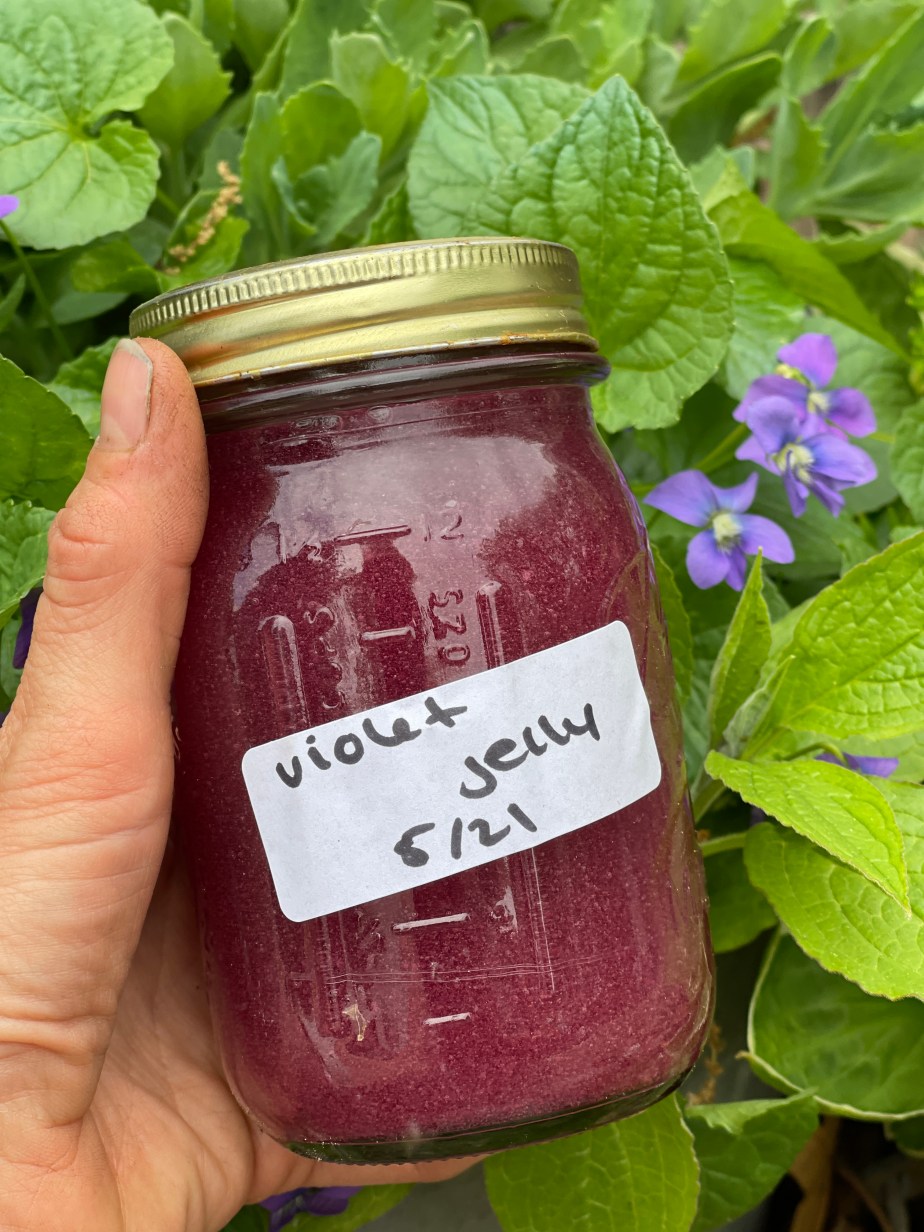
While she’s talking, Julie brings out glass jars of jam. I try the spruce tips—made from the new tips of the spruce tree at the beginning of spring. Scooping up a small teaspoon to try, I note a definite evergreen taste, refreshing and somewhat woodsy with just a touch of sweetness. It would work on buttered biscuits, toast or even as sauce for lamb and pork. The violet jam is a deep purple and there’s an assortment of pepper jams such as habanero gold pepper jelly with chopped sweet apricots. Unfortunately, Julie didn’t any have jars of the dandelion jam or the pear lime ginger jelly she makes—it goes fast. But she had a large bushel basket full of colorful peppers which would soon become a sweet and spicy jam.
August, she told me as we walked into the old growth orchard, was begging her to make a yellow floral jelly from goldenrod flowers. So that was the next chore of many on her list.
Having learned to determine the edibility of certain mushrooms she forages the safe ones from where they grow in the woods, frying up such fungi as puff balls which she describe as having a custard-like interior. In the spring, there are fiddlehead greens easily available, but Julie has to trade for ramps which though they seem to grow wild every place where there are woods, don’t appear anywhere within Goldberry’s 30 acres.
Now focused fully on running Goldberry Woods and raising their three daughters, Julie previously worked as a chemical engineer in a food processing plant that used a million gallons of corn syrup per day. Now she teaches classes in how to harvest honey–there are, naturally, bee hives on the property. If all this sounds like a real divergence from a career in corn syrup and a degree in chemical engineering, Julie started an environmental club in high school and gardened in college.
Unfortunately, you can’t eat at Goldberry Woods unless you’re an overnight guest. But you can stop and visit as the couple has set up their Goldberry Market in a 1970s trailer. It’s very cute plus they have an outdoors stand on the property. They also take their produce to the New Buffalo Farmer’s Market which is held on Thursday evenings. As for what to do with the unique produce they sell, there are recipes on their website and Julie will always take the time to give ideas. It’s her passion to share the best of what Southwest Michigan produces.
¼ cup of seeds such as quinoa, chia, flax or amaranth
¼-1/2 cup sugar
1 teaspoon cinnamon
½ teaspoon cardamom
Drizzle of honey
Fresh sliced peaches
Bring coconut milk, 2 cups of water, salt, and the steel cut oats to full boil in an 8-cup microwaveable bowl, approximately 6 minutes. Do not let the oats boil over as this makes a sticky mess.
Remove bowl to the counter and stir. Allow the concoction to cool down a bit, stirring occasionally, maybe 30 minutes (this is to keep from heating up your fridge!) Cover and refrigerate overnight.
In the morning, add the old fashioned oats, seeds, sugar and spices.
You may need to add more liquid at this time to reach your desired consistency. We find this recipe to be refreshing and like the oatmeal to be a bit thin. Adjust sweetness to your taste.
If it’s chilly out, reheat in the microwave.
Here’s the fun part. Stir in whatever looks good to your taste. Here are some ideas:
Use coconut milk and stir in vanilla, shredded coconut, bananas, honey, dried apricots, almonds….
Use apple cider and stir in applesauce, sautéed apples, raisins, nuts, maple syrup, walnuts
Goldberry Woods Egg Rollup
Makes about 8 servings
Egg Mixture
4 ounces cream cheese, softened
¾ cup milk
2 tablespoons corn starch
¼ teaspoon salt
12 eggs
Salt and pepper
Filling
12 ounces precooked meat and veggies of your choosing (Malabar Spinach, sausage, ham, bacon, asparagus, peppers, greens, mushrooms…..)
2 cups shredded cheese (we usually use a good sharp cheddar and a shredded Monterey Jack that melts well—feta is great, too)
Preheat oven to 375 degrees
Combine all the Egg Mixture Ingredients in a blender and blend until smooth.
Spread parchment over a 11×17 jelly roll, tucking into the corners. Pour the egg mixture onto the parchment paper.
Bake the eggs for 15-20 minutes. Wait until the top sets completely.
Remove the egg roll pan and spread the filling over the eggs evenly.
Use a towel and the parchment paper to tightly roll up the eggs. Leave the seam side down and cover the whole rollup with the parchment paper so that it doesn’t dry out.
Return to the oven for 10 more minutes to allow the cheese to melt and the filling to heat up.
Make a goldenrod tea. Put the flowers in a stainless steel pot and add just enough cool water to cover. Bring to a gentle simmer for 3 minutes. Turn off the heat and allow the flowers to steep for at least an hour or overnight in the refrigerator. Strain the flowers through a fine metal sieve. Gently squeeze excess liquid from the flowers. Measure 5 cups of liquid. Add water if necessary.
Place goldenrod tea back into pot and add lemon juice. Add the pectin, stir, and bring to a boil until pectin is fully dissolved.
Add sugar and bring to a full boil for one minute. Remove from heat and pour into sterile canning jars. Keep jelly in the fridge for up to one month.
What to do in Union Pier
While visiting Goldberry Woods, take time to stop at St. Julian Winery’s tasting location in Union Pier. St. Julian is the oldest winery in the state. There’s also the Round Barn Tasting Room next door.
Stop at Union Pier Market for a great selection of gourmet goods, beer, and wine. Next door, also on Townline Road, is the Black Currant Bakehouse for made from scratch pastries as well as sandwiches and such distinctive beverages as their Rose Quartz Latte, Chaga Chai, and Honey Lavender Latte. Milda’s Corner Market next to Union Pier Market features foods from over 40 countries and freshly made Lithuanian fare including “Sūreliai” Mini Cheesecake bars, Koluduna (dumplings), and Kugelis.
Still cursing at yourself for the extra helping of potato salad and sweet tea not to mention the second piece of blueberry pie at the family picnic last week? Well, imagine how you’d feel after attending this 1450 banquet, held in England for the enthronement of an archbishop where guests munched on 104 oxen, six ‘wylde bulles,’ 1,000 sheep, 400 swans and such game birds such as bustards (larger than a turkey), cranes, bitterns, curlews and herons.
“Our ancestors had gastronomic guts,” Anne Willan tells me as we chat on the phone, she in Santa Monica, California where there’s sunshine and me in the cold Great Lakes region. I find it fascinating to read old menus and descriptions of banquets and feasts and for that Willan, founder of famed French cooking school École de Cuisine la Varenne, recipient of the IACP Lifetime Achievement Award and author of more than 30 cookbooks, is the go to person.
“Seals were eaten on fast days along with whale, dolphin, porpoise and thousands of other fish,” says Willan. Hmmm…that’s different than the macaroni and cheese and fish sticks I used to eat at the homes of my Catholic friends on Fridays.
Here we peruse four centuries of gastronomy including the heavily spiced sauces of medieval times (sometimes employed because of the rankness of the meat), the massive roasts and ragoûts of Sun King Louis XIV’s court and the elegant eighteenth-century chilled desserts. One for the interesting detail, Willan also tells the story of cookbook writing and composition from the 1500s to the early 19th century. She highlights how each of the cookbooks reflects its time, ingredients and place, the recipes adapted among the cuisines of Germany, England, France, Italy and Spain as well as tracing the history of the recipe.
Historic cookbooks can be so much different than ours, ingredients unfamiliar and instructions rather vague. For example, Willan points out the phrase “cook until” was used due to the difficulty of judging the level of heat when cooking a dish over the burning embers in an open hearth. It wasn’t until the cast-iron closed stoves of the 19th century that recipes writers begin were finally able to give firm estimates for timing.
For food historians and even those just appreciative of a good meal, the book is fascinating. For me as a food writer, I wonder about covering a dinner where birds flew out of towering pastries, seals were served and eels baked into pies and it was often wise to have a taster nearby in case someone was trying to poison you.
Duxelles is a classic French preparation of butter-cooked chopped mushrooms flavored with shallots. It is said to have been created by François Pierre de la Varenne. La Varenne’s book, Le Cuisinier Francois (The French cook, 1651), was one of two books Willan says strongly influenced the evolution of French classical cuisine. You can use the duxelles to make mushroom tarts, as a stuffing for fish and even put it in spaghetti sauce.
1⁄2 pound mushrooms, rinsed, patted dry
11⁄2 teaspoon butter or vegetable oil
1 small shallot, minced salt and freshly ground pepper
Chop mushrooms in food processor with pulsing motion so they are chopped in fine pieces but are not pureed. In a medium-size skillet heat butter over low heat. Add shallot and sauté about 1⁄2 minute until soft but not brown. Add mushrooms and sprinkle with salt and pepper. Cook over high heat, stirring, for 3 to 5 minutes or until mixture is dry. Serve hot.
Rich Seed Cake with Caraway And Cinnamon
This recipe is based on a cake in The Compleat Housewife by Eliza Smith, published in London in the 1700s. Willan, ever the purist, suggests mixing the batter by hand as it was done 300 plus year ago.
“The direct contact with the batter as it develops from a soft cream to a smooth, fluffy batter is an experience not to be missed,” she says. “If you use an electric mixer, the batter is fluffier but the cake emerges from the oven less moist and with a darker crust.”
At times, Willan needs to substitute ingredients. The original recipe listed ambergris as an option for flavoring the cake. “Ambergris,” writes Willan, “a waxy secretion from a sperm whale, was once used to perfume foods. As it is now a rare ingredient, I’ve opted for Mrs. Smith’s second suggestion, of cinnamon, which marries unexpectedly well with caraway.”
1 pound or 3 1⁄2 cups) flour
1 2⁄3 cups sugar
6 tablespoons caraway seeds
5 eggs
4 egg yolks
1 pound or 2 cups butter, more for the pan
11⁄2 tablespoon rose water or orange-flower water
2 teaspoon ground cinnamon
Heat the oven to 325ºF. Butter a 9-inch springform pan. Sift together the flour and sugar into a medium bowl, and stir in the caraway seeds. Separate the whole eggs, putting all the yolks together and straining the whites into a small bowl to remove the threads.
Cream the butter either by hand or with an electric mixer fitted with the paddle attachment. Add the yolks two at a time, beating well after each addition. Beat in the rose water. Whisk the egg whites just until frothy, then beat them, a little at a time, into the egg yolk mixture. Beat in the cinnamon. Finally, beat in the flour mixture, sprinkling it a little at a time over the batter. This should take at least 15 minutes by hand, 5 minutes with a mixer. The batter will lighten and become fluffier. Transfer the batter to the prepared pan.
Bake until the cake starts to shrink from the sides of the pan and a skewer inserted in the center comes out clean when withdrawn, 1 1⁄4 to 1 1⁄2 hours. Let the cake cool in the pan on a rack until tepid, then unmold it and leave it to cool completely on the rack. When carefully wrapped, it keeps well at room temperature for several days and the flavor will mellow.
One Small Garden: Over 300 Delicious, Nutritious Recipes by Lillian and Dave Brummet is a timely collection of recipes now as more and more fresh produce is coming on to the market. Described as the ultimate guide to using fresh fruit and vegetables from backyard gardens to farmer’s markets, the book is guide to using what’s in season to create wholesome meals, the recipes here use the freshest and purest sources of food available.
“I hope to inspire others to buy fresh local food and to cook it in ways that are even better than going out to a restaurant,” says Dave Brummet of Brummet Media who with his wife has also authored the Trash Talk series about green living and saving money and time through better waste and resource management. “We want to inspire people to spend more time feeding themselves quality, nutritious food instead of the lure of expensive over-packaged convenience foods. In your car, which can be rebuilt with numerous replaceable parts, would you try to run it with dirty kerosene? No, so why do we put junk in our system when we have no hope of replacing those parts we might ruin by doing so. How we eat has an impact on our world – it affects equality, poverty, farming practices, the health of the soil, the purity of the water and air – and of course your own personal well-being.”
The book, loaded with lots of interesting tidbits of historical and nutritional information, is more than just a collection of recipes, it’s also a way of learning how to treat yourself to the healthy, delicious rewards of one small garden.
“The most important thing for me is to have a general feeling that I used the time I was given to create a positive legacy–be it through writing, supporting others, donating, sharing garden harvests, greening our property and making a more eco-friendly home, or daily actions such as dedicated recycling and so on,” says Lillian. “Part of being conscious includes self-sufficiency – not being reliant on aid programs, or living in heavy debt to others, looking after one’s health the best one can, etc. So I try to live proactively in my home life, but also in business – with the idea that what I choose to do now will have a ripple effect on the direction our world takes tomorrow. What I choose to buy now, whether I grow organically, what I choose to write about and blog about all has an impact on tomorrow.”
STRAWBERRY WHEAT GERM MUFFINs
Authors’ note: “Perfect strawberries when in season, frozen strawberries can also be used– just chop, thaw and drain before using. This will yield between 18-22 muffins depending on how large your muffin tins are. I prefer to use muffin cup liners that are compostable, which will help reduce the amount of waste heading to the landfill. Feel free to experiment, I have used reconstituted powder milk, rice milk and almond milk for this recipe with great results. White chocolate chips work well with this combination, however I personally prefer dark, flavonoid-rich chocolate.”
3 eggs
1 cup brown sugar
2 cups milk
1 tablespoon apple cider vinegar
1/2 cup oil
1 teaspoon pure vanilla
1 cup bran
1 cup wheat germ
2 teaspoon baking powder
1 teaspoon baking soda
1/4 teaspoon salt
2 cup white flour
1 1/2 cups chopped strawberries
1 cup chocolate chips (optional)
Beat eggs briefly then add sugar and beat for 3 minutes. Add remaining liquid ingredients and then use a wooden spoon to stir in the germ and bran. Allow to rest for 10 minutes while you tidy the kitchen and prep the next step. In a separate bowl, combine all the dry ingredients together, and when the timer goes off – combine all the ingredients together, including the strawberries and chips.
Preheat oven to 400˚.
Place 22 paper liners in 2 muffin tins and spoon out the batter evenly. Bake for 20-25 minutes or until an inserted knife comes out clean, and the top has a light golden color. Cool completely before serving.
Follow the Cajun Bayou Food Trail: A REAL Taste of Louisiana Cajun Country
Just 45 minutes from New Orleans, the Cajun Bayou Food Trail is a journey through the heart of Lafourche Parish and the ultimate road trip for those wanting to explore Louisiana’s food scene. Known as the Louisiana’s Cajun Bayou, this region of the state takes its culinary delights so seriously that the name Lafourche is French for the fork. While some will explain, patiently, the term is a geographical reference to a split in the Mississippi River, we’re thinking that any place with a name synonymous with an eating utensil surely knows its way around a menu.
So grab your car keys and your sunglasses—but you won’t need to bring your own Lafourche as any place on the parish’s Cajun Bayou Food Trail have their own—and hit the road. There are currently 18 restaurants on the trail including the recently added Cinclare Southern Bistro.
“We’re thrilled to be included on the Louisiana Cajun Bayou Food Trail,” says Michael Dalmau, the owner of Cinclare Southern Bistro. “The restaurants that span this historic waterway might be different in what they do and how they do it but know this …. they all do it well. In South Louisiana – and especially up and down the Bayou – feeding and serving friends and family is not only what we do to pass a good time, but it’s how we show our love and support. It’s part of our DNA and that’s why we’re so good at it.”
All the stops on the trail feature authentic food accompanied by the unparalleled Southern hospitality.
According to my friend Mindy Bianca, chefs down this way tell how their favorite recipes feature the finest local ingredients along with a true love of their surroundings and heritage. The latter means treating guests the same as family–well, almost, you don’t have to clean up after dinner like you would at your mom’s. All this makes navigating the Cajun Bayou Food Trail an unparalleled culinary and travel experience.
The lives of the people of Lafourche Parish are fully intertwined with the bodies of water that are accessible throughout the region, most notably Bayou Lafourche, a 100-mile waterway that bisects the parish, and the Gulf of Mexico. Residents of the area view the Bayou and Gulf as their personal pantries, finding seafood and other delicacies within and along their waters. If you live here, you’re most likely not going to get kicked you out of the parish for not knowing how to whip up a tasty gumbo (though we can’t promise that’s true) but fortunately most if not all figure it out from an early age using recipes passed down through the generations. That’s why those following the trail get to taste dishes authentic traditional foods that are part of the Parish’s gastronomic heritage–prepared and served as they have been for as long as some can remember. But that doesn’t mean some chefs don’t do their own riff with added ingredients or other ways to make them uniquely their own.
Celebrating not only the restaurants and local food purveyors that honor the culinary customs of the region, the parish also hosts six festivals and events dedicated to honoring and preserving its distinctive traditions. Think La Fete Des Vieux Temps in Raceland, Louisiana
Calling it a cultural gumbo, Mindy says that “restaurants lean toward plenty of fresh seafood and run the gamut from mom-and-pop operations to sophisticated dining rooms.
“The unifying element is that whether it’s fried shrimp at Spahr’s, a restaurant that now has three locations and that has been a staple here for more than 50 years, or an elegant and savory alligator-and-andouille sausage cheesecake appetizer at Kincare, which offers craft beverages and a more upscale dining experience in the heart of downtown Thibodaux, your meal is going to be both delicious and memorable.”
Visitors and locals alike are encouraged to pick up a Food Trail passport and map from any of the participating restaurants or download it from this website, then eat their way through the parish. Collect enough passport stamps and you’ll earn your way into a comfy Food Trail T-shirt. Trust us and order one size larger before hitting the trail. In these ever-changing and unpredictable times, requirements for completing a passport have been modified and the Food Trail can now be experienced more “virtually,” meaning that participating Trail restaurants offer curbside service.
For more information about the dining scene in Louisiana’s Cajun Bayou, to download your passport and map, or to check out some pictures and start dreaming of crawfish and crabs, gumbo and gator, please visit http://www.lacajunbayou.com. The local businesses up and down the Bayou are ready to fill up your plate and offer you a lafourche to use.
You can’t eat all the time, right? In between meals check out some or all of the following stops:
Swamp Tours
Described as an otherworldly experience, like time travel into the state’s prehistoric past by touring Lafourche Parish’s swamplands. Tour options includes the 2 Da Swamp Bayou Tours & Museum trips to Bayou Des Allemands with traditional Cajun music, and museum displays of artifacts Des Allemands’ early years. Airboat Tours by Arthur Matherne, open seasonally, is a high-octane thrill rides on its fleet of airboats. Torres Cajun Swamp Tours’ guides takes visitor the history and ecology of wetlands’ Bayou Boeuf.
The White family was once among the Louisiana’s political elite. Patriarch Edward Douglas White was the state’s governor in the 1830s; his son and namesake became a U.S. Supreme Court Justice in the 1890s. The elder White’s home is now a Louisiana State Museum site and is a step back into the past showcasing the state’s history. Built from cypress in the Creole Plantation style in 1825, White purchased the home, re-imaging it as a Greek Revival mansion. Learn about the White family, the history of both the home’s history along with that of Chitimacha Indians and Cajun settlers, sugar plantation owners and the slaves that worked the fields in service of them by taking a tour of the E.D. White Historic Site in Thibodaux.
Restaurants in Thibodaux
Thibodaux’s restaurants and fresh markets reflect the local culture and cuisine. Top-rated restaurant spots include Fremin’s Restaurant, where you can take in the architecture of Thibodaux’s downtown area. The food is prepared with a view into the kitchen and the duck-and-andouille gumbo is like heaven in a bowl. Head to Off the Hook, a down-home spot with awesome po-boys, fried seafood and more gumbo! And try something different at the Cajun Potato Kitchen, a quirky and casual restaurant serving huge baked potatoes loaded with Cajun toppings. It’s fun and different and popular with the university crowd. Get a full list of locals’ favorite restaurants.
You’d be hard pressed to find another museum in the U.S.—or really anywhere—that’s a Cajun-themed children’s museum. At Bayou Country Children’s Museum in Thibodaux brings together Cajun history, education and fun, making it a great stop for family fun. Here children can play on a full-size sugar harvester, toss beads from a Mardi Gras float, climb aboard a shrimp boat and more.
The wetlands flowing through Southern Louisianna are a distinct part of Lafourche Parish where more than 100 miles of bayou meander throughout the parish. The Center for Traditional Louisiana Boat Building, located in Lockport is the place to learn how traditional Cajun boats were constructed, including their iconic pirogue boats and flat-bottomed vessels known locally as putt-putts that once common in the region’s bayous.
Part of Jean Lafitte National Historical Park & Preserve in Thibodaux, the center’s mission is to preserve Cajun tradition and offers such programs as their free Cajun music jam sessions every Monday afternoon, a Cajun-French meetup on Tuesdays, historical Thibodaux walking tours and boat tours of Bayou Lafourche. While there, stop at the Center’s museum store, which has Cajun music recordings, crafts and books for sale.
The trail, made up of 22 parishes includes Lafourche which is part of the Grand Isle Loop. The loop includes sections of Louisiana’s best-known barrier island as well as inland birding destinations teeming with shorebirds and seabirds. Download more information about the Grand Isle Loop on the Wetland Birding Trail.
They really know how to celebrate the two weeks leading up to Mardi Gras Day or as it is also known—Fat Tuesday. Typically there are more than a dozen parades roll through the towns of Golden Meadow, Galliano, Larose, as well as the parish seat of Thibodaux. Learn more about the parade schedules.
Shrimp and Tasso Pasta
Recipe courtesy of Bourgeois Meat Market, a stop on the Cajun Bayou Culinary Trail
1 lb. Bourgeois Tasso
2 lb. shrimp
1 large onion
1 large bell pepper
1 talk of celery
1 can Rotel
1 qt. heavy whipping cream
1 cup grated Monterey Jack cheese
1 bag bow tie pasta
Boil Bourgeois Tasso in a pot with just a little water until tender.
Add onion, celery, bell pepper, Rotel, and shrimp and smother down.
Add heavy whipping cream and let mixture come to a rolling boil.
“It’s hard work but it’s good work,” says Molly Muchow about co-managing the 230-acre Verdant Hollow Farmhttps://www.verdanthollowfarms.com/ on Garr Road in Buchanan with her husband Brett.
It’s also a big change in lifestyle for the couple who until a few years ago were living in Chicago with their three children and Molly was working as a personal chef and Brett as a certified teacher on the city’s South Side. But they like the vision that owner Susan Flynn had when she purchased the land in 2016.
Her goal was to create an Animal Approved Welfare by AGW farm for producing certified grass fed lamb, goat milk, pasture raised pork, vegetables, and eggs.
The AGW designation is the only label guaranteeing that animals are raised outdoors on pastures or ranges for their entire lives on an independent farm using truly sustainable, high-welfare farming practices. It’s an independent, nonprofit farm certification program. one of the top five fastest growing certifications and label claims in the country. Welfare Approved farm using regenerative practices to produce seasonal vegetables,
Obtaining these certifications was a goal not just for raising animals to bring to market but also to create a place to host visitors for retreats, education, and to carry forth the concept of regenerative practices in raising the best produce possible. It’s a type of farming designed to reverse climate change by rebuilding soil organic matter and restoring degraded soil biodiversity with the end result of reducing carbon output.
It is a beautiful piece of land, with hollows, woods, pastures, and an 1860s-era barn repurposed by Stanley Tigerman, an award winning architect whose work incorporates an urban whimsicalness to rural structures.
“We plan to build six cabins—it will be a place for people for relaxation and detach from technology, returning to the pace of what farm life was,” says Flynn who though she’s from Chicago knows the area well because she has had a home in nearby in the area for the last two decades.
I tell him that as an urban dweller, the concept of no-tilling evades me. Brett explains that tilling upsets the ecosystem of the soil. No-tilling also provides protection from soil erosion. To further protect the soil, in the winter they cover crop, using plants to protect and nourish the soil.
“We also don’t use any treated wood here,” says Brett.
“Our animals are pasteurized year round,” says Molly, noting that the goats have seven acres to roam.
As part of their educational outreach, they also invite school groups out to visit, showing them the rhythms of what farm life was list long ago.
“The kids really liked the chickens,” says Flynn.
They also liked the goats and sheep and the two Colorado Mountain dogs—June and Case—who protect them.
“Two of them can take out a mountain lion or cougar and are always on the alert to protect the other animals,” says Brett.
I must have passed some unspoken Colorado Mountain Dogs’ test because today they’re just friendly as can be, letting the goats come up to the fencing so I can pet them.
But while I’m doing so, I come under the watchful eye of a llama who is also a guardian animal and seems less disposed to accept me than the dogs. Indeed, he stares from within what looks like a guard box that allows a wide open view of the animals in the large pen. The latter encloses a large, wooded area where the animals can munch away to their hearts delight. That also includes the Katahdin Hair Sheep, prized for the taste of their meat and heritage hogs who are allowed to run free through the woods as well. What’s raised here is sold to local restaurants and can be purchased by anyone at the farm.
It’s all still a work in progress. Besides building guest cabins, they also laying out new roads, erecting a welcome pavilion and expanding green and hoop houses, ensuring a longer growing season for microgreens and starting vegetables earlier in the spring as well as the medicinal herbs they grow. There is are solar panels, a system for collecting rainwater, big areas for composting, yurts, and meditation platforms. The farm is also part of pilot project for Cannabidiol (CBD) which is an active ingredient in cannabis derived from the hemp plant that’s can be used to help reduce pain, insomnia, and anxiety and features CBG (cannabigerol) which is more potent for healing as well as beneficial in treating such conditions as inflammatory bowel disease, Crohn’s disease, and cancer.
In all, they’ve come a long way and there’s still so much they want to do. But living on the farm yields a sense of satisfaction, of accomplishment, and of producing from the land, food that is good, healthful, and helpful.
Verdant Hollow Farms Recipes
Slow Cooker Bone Broth
1 whole pasture raised chicken (stew or soup bird)
2 whole carrots, skin on, scrubbed, and quartered
1 whole onion, skin on, clean and cut in half
3 stalks celery, clean, and quartered
1 whole head of garlic, clean, and cut in half horizontally
Place all ingredients in a slow cooker and cover with cold water.
Set to low and let simmer for 12-24 hours (the longer the better). Strain through a cheese cloth and add salt to taste.
Drink on its own, as a base for soups, or stir in some cooked rice and winter greens for a quick lunch.
Molly’s Notes:
I always freeze a couple containers to have on hand when someone gets the sniffles or just needs a warm cup of goodness!
*I keep a baggie in the freezer to collect any carrot peels, veggie scraps, or chicken bones while cooking other meals. Add these scraps to your slow cooker for extra flavor and a way to reduce kitchen waste.
Carnitas
1 3-4 pounds bone in or boneless pork shoulder or butt roast
1 tablespoon chili powder
1 tablespoon ground cumin
1 tablespoon salt
1tablespoon ground pepper
2 tablespoons bacon fat, olive oil, or avocado oil
¼ cup fresh lime juice
¼ cup fresh orange juice
Fresh lime juice and salt to taste
Chopped cilantro
Taco toppings: shredded lettuce or cabbage, queso fresco, salsa, pickled or raw red onions
Warm tortillas (Molly Muchow prefers the corn, but flour works also)
Season your pork shoulder roast with the chili powder, cumin, salt, and pepper. Heat your oil in a large sauté pan. Once it is hot enough to sizzle with a drop of water, add your shoulder roast. Brown on both sides and transfer to your slow cooker. Add your lime, orange juice, and a ½ cup of water. Cook on low for 8-10 or until it starts to fall apart from the bone.
Preheat your oven to 425. While the roast is still hot, shred with two forks, discarding the bone. Spread the shredded meat and a cup of the juices on a large sheet pan. Sprinkle an additional 2-3 tsp of salt over the pork and place in the oven. Stirring every five minutes until slightly crispy, but still tender.
Squeeze additional lime juice (to taste) over the shredded pork and serve with warm tortillas, chopped fresh cilantro, and any of your favorite taco toppings.
*The pork roast can also be slow cooked in the oven. Once seared on all sides, place in a deep roasting pan with the juices/water, cover with foil and cook at 325 for 3.5-4.5 hours.
Lamb Curry
½ medium onion, diced
3 medium carrots, peeled and diced
½ head cauliflower, diced
1 tablespoon fresh garlic, chopped
1 tablespoon fresh ginger, chopped
1 tablespoon ground lamb
3 tablespoons ground curry powder
2 tablespoons coconut oil (can substitute with other oil you have on hand)
1-2 handfuls of chopped greens (kale, chard, or spinach)
Chili flakes (optional)
2 teaspoons salt
Cooked rice (I prefer jasmine or basmati)
Sauté the onion, carrot, cauliflower, garlic, and ginger over medium heat until soft. Season with salt and add the ground lamb. Sauté the lamb and vegetables until the lamb is browned (5-10 minutes). Add the curry powder (and chili flakes to taste) and continue cooking until it is well incorporated into the lamb and vegetables. Remove from heat and fold in your chopped greens, letting them wilt in the pan. Serve over rice with a side of warm naan on a cold winter day!
*This recipe is a great way to use up any veggies you have in your fridge. Feel free to add any other chopped vegetables you have on hand (zucchini, fennel, peppers, etc.)
For more information: 773-882-4431; verdanthollowfarms.com
An archipelago of islands off the coast of Washington State, there are 172 named islands and reefs in San Juan County but the main three–all with ferry service–are San Juan Island (with the county seat Friday Harbor), Orcas Island, and Lopez Island. Not only are they the most populous but each offers a myriad of lodging, dining, and activities for visitors.
The 13 defining tastes of the San Juan Islands are salmon, heritage fruit, foraged botanicals, shellfish (think oysters and clams), crab, lamb, Mangalitsa Pork, seaweed and salt, lavender and hops, cider and apple brandy, grains, goat cheese and white wines.
Here’s a sampling of what visitors can find:
Spiced apple with chocolate and pumpkin cream-filled doughnuts. Cardamom buns. Buckwheat tahini chocolate cookies. Savory brioche tarts with leek, chevre, and kabocha squash. All of the ingredients for these mouth-watering pastries? Entirely sourced locally by creator and owner of new Seabird Bakeshop, Brea Currey, from Orcas Island farm stands like West Beach and Maple Rock, eggs from neighborhood chickens, and flour from Fairhaven Mills in Burlington. Since September, Seabird Bakeshop has been thriving on Orcas Island where chefs are thinking creatively about how to bridge food and entrepreneurism during the time of coronavirus. Thus far, Currey’s success is, among other things, a testament to the power of baking as a 2020 survival strategy on Washington’s farm-to-table captivated island. Find Seabird on Facebook and Instagram: @seabirdbakeshop
Myers Creamery on Orcas Island, Quail Croft on San Juan Island, and Sunnyfield Farm on Lopez Island all are expect at making fresh chevre, herbed cheeses, washed-rind and aged cheeses, all of which can be found at each island’s farmers’ markets, and at the Orcas Island Food Co-op and the San Juan Island Food Co-op. Following the seasons, goat cheeses start out fresh and creamy in springtime when the goats graze on spring grass. As the grass matures, so does the flavor of the cheese, until at the end of fall, the cheeses are more intense, earthy and, dare we say, “goaty.”
Cold pressed cider. Small batch granola. A box full of farm-fresh greens. Locavores, look no further: the newly aggregated Washington Food and Farm Finder features 1,700 farms, farmers markets, and food vendors with offerings “grown, caught, raised, or made” across the state. Find San Juan Islands favorites like Ursa Minor, Madrone Cellars, and Buck Bay Shellfish Farm. The guide has filters for pickup or delivery services, markets, food trucks, or specialty food and beverage locales. Icons designate sustainable fishing or animal welfare certifications, as well as veteran-, woman-, and BIPOC-owned businesses. For more information: https://eatlocalfirst.org/wa-food-farm-finder/
Island makers Girl Meets Dirt and Madrone Cellars & Ciders are winners in the annual Good Food Awards for 2021. Madrone’s Barrel-Aged Currant took top prize in the Cider category. Girl Meets Dirt has winners in both the Preserves and Elixirs category. Their Rhubarb Lavender Spoon Preserves are a great choice for charcuterie. The Rhubarb shrub and Shiro Plum Tree bitters give some extra oomph to your signature cocktails. Shop Girl Meets Dirt winners here: www.girlmeetsdirt.com/shop and Madrone Cellars here: https://madronecellars.com/
Local favorite San Juan Sea Salt is rolling out a new line of flavored salts: the Deli Series, starting with Everything but the Bagel. All the yum of everything bagels, none of the carbs! Try this on avocado toast, mixed with your breading for fried chicken, and snacking on it straight from the jar! Everything but the Bagel joins the Dill Pickle Salt as an homage to class deli flavors. The Dill Pickle Salt is a tangy, dilly, zesty, garlicky salt with just the right magic to give your mouth the déjá vu feeling of crunching into a darn fine pickle. Find these and others here: www.sanjuanislandseasalt.com/online-store/NEW-c48889151
Buck Bay Shellfish Farm
Buck Bay Shellfish Farm on Orcas Island is a hidden gem where you can stop in for a couple of pounds of fresh clams or oysters, or you can while away a whole afternoon shucking oysters and drinking wine (BYOB) while looking out over the serenity of Buck Bay just yards away.
New owners Eric and Andrea Anderson rebuilt the docks and oyster shack at Westcott Bay Shellfish Farm on the north end of San Juan Island. They’ve also linked the property to trails connecting to English Camp, making their shellfish farm a destination for hikers and bicyclists as well.
Island wineries produce light, refreshing whites that pair well with seafood and other San Juan specialties. Owners Yvonne Swanberg of San Juan Vineyards, and Brent Charnley of Lopez Island Vineyards grow and makes Siegerrebe and Madeleine Angevine from their estate vineyards.
OLYMPUS DIGITAL CAMERA
Westcott Bay Cider, one of the oldest cideries in the state of Washington, ferments three types of ciders from the “bitters” and “sharps” from their orchard, from traditional dry to medium-sweet styles. The cider is then distilled into a clear eau-de-vie and aged in wine barrels.
Local farmer Brady Ryan started San Juan Island Sea Salt, made by collecting salt water from the Salish Sea and drying it in special bins to retain the fluffy white crystals that are then flavored with such botanicals as smoked madrona bark, dried kelp, lemon peel and various dried herbs.
In any list of definitive island flavors, lavender deserves its own category, partly because it is a cultivated botanical rather than a forged one. But it’d also an important part of island culture.
Pelindaba Lavender Farm has been growing lavender and creating lavender products for almost 20 years. At the farm, you can stroll the lavender fields, learn about how lavender oil is extracted and distilled into almost 250 products made onsite, including many food products such as lavender teas, salad dressings, ice cream and herbal rubs.
Island grown hops are used in the beers made by Orcas Island’s Island Hoppin’ Brewery, adding floral and bitter notes and a local touch to these tasty beers. You can visit the brewery and tasting room just outside of Eastsound.
Chef Geddes Martin, owner of the Inn at Ship Bay, raises his own Mangalitsa hogs in partnership with his friend and farmer, John Steward of Maple Rock Farm and Hogstone’s Wood Oven. Mangalitsa is a breed that’s known as the “hairy pig that is the Kobe beef of pork,” with more flavor and marbled fat than standard industrial-raised pork, and makes for amazing pork belly or pork loin.
You buy the ingredients, maybe spending a little more than you should – but the recipe looks great and you’re having friends over you want to impress. Back home in your kitchen you start cooking following the recipe step-by-step. It should be perfect but it’s not. There’s too much liquid in the cake batter, not enough flavor in the soup and despite the amount of time cited for cooking the duck, it’s done and getting dry in half the time. In other words, the meal is a mess. That’s one reason why Ina Garten, the Barefoot Contessa of Food Network fame and accomplished cookbook author, has always been one of my favorites. And so I was glad when my friend cookbook publicist Carrie Bachman who represented Barefoot Contessa Foolproof: Recipes You Can Trust (Clarkson Potter $35), sent me a copy and set up a phone interview so I could chat with Garten about the book. That was back in 2013 and Garten now has added even more cookbooks to her list including the recently released Modern Comfort Food, but I still rely upon Foolproof to ensure that my time and groceries don’t go to waste.
“People look at a recipe and think if you just follow it, it’ll come out perfectly every time,” says Garten, who interestingly, majored in economics in college. “But every time you make something, the ingredients are a little different or you have another way you want to try it. So it’s a lot like driving a car; you have to make small adjustments along the way.”
That’s why Garten often tests each of her recipes 25 times and also has an assistant try them as well. She wants those who watch her shows or buy her cookbooks to always a meal they’re proud to serve and, even better, enjoy eating. Indeed, Garten wants her recipes to be foolproof.
Foolproof was her eighth cookbook and anyone who owns one or more of her Contessa books such as Barefoot in Paris: Easy French Food You Can Make at Home and Cook Like a Pro, is used to the style – sleek pages, vivid photographs (150 in this book), and flavorful and creative recipes written in a clear easy-to-follow prose. As on her TV shows, Garten doesn’t just present recipes perfect for recreating successfully at home, she also shares how to plan a menu, coordinating food times so everything is done at once as well as notes on where a recipe can go wrong and how to make a dish in advance.
“I want recipes that I know will come out perfectly every time,” says Garten. “Cooking is hard, it takes a lot of ingredients, you go shopping, you cook, you clean up. a lot of ingredients, you go shopping, you cook, you clean up. You can get free recipes anywhere, so why should anyone want to buy a cookbook? What makes it worthwhile and worth the price? It’s the level of confidence in the writer. One of the things I’ve always strived for is recipes that work every time. You feel confident that this recipe is good, but also that you trust it.”
Balsamic Roasted Brussels Sprouts
Serves 6
1½ pounds Brussels sprouts, trimmed and cut in half through the core
4 ounces pancetta, sliced ¼ inch thick
¼ cup good olive oil
Kosher salt and freshly ground black pepper
1 tablespoon syrupy balsamic vinegar (see note)
Preheat the oven to 400 degrees.
Place the Brussels sprouts on a sheet pan, including some of the loose leaves, which get crispy when they’re roasted. Cut the pancetta into ½-inch dice and add to the pan. Add the olive oil, 1 ½ teaspoons salt, and ½ teaspoon pepper and toss with your hands. Spread out the mixture in a single layer.
Roast the Brussels sprouts for 20 to 30 minutes, until they’re tender and nicely browned and the pancetta is cooked. Toss once during roasting. Remove from the oven, drizzle immediately with the balsamic vinegar, and toss again. Taste for seasonings and serve hot.
Note:
You can buy aged balsamic vinegar that’s syrupy—and very expensive—or you can boil good balsamic vinegar until reduced to half its volume and it will become syrupy as well.
Ultimate Pumpkin Pie with Rum Whipped Cream
Serves 8 to 10
“Pumpkin pie can be boring and dense so I set out to make a better pumpkin pie,” writes Garten in her introduction to this recipe and we are totally behind that having eaten way too many boring and tasteless pumpkin pies. “Pumpkin has a distinct squash flavor that you want to enhance without overpowering it. I’ve filled the prebaked crust with a lightly spiced pumpkin mixture that tastes more like a mousse than a dense custard. Dark rum and grated orange zest are my secret ingredients.”
1 unbaked Perfect Pie Crust (recipe follows)
Dried beans, for blind baking
FILLING
1 (15-ounce) can pumpkin purée (not pie filling)
½ cup light brown sugar, lightly packed
¼ cup granulated sugar
½ teaspoon ground cinnamon
¼ teaspoon ground ginger
¼ teaspoon ground nutmeg
½ teaspoon kosher salt
2 teaspoons grated orange zest
3 extra-large eggs, lightly beaten
1 cup heavy cream
½ cup whole milk
2 tablespoons dark rum, such as Mount Gay
Rum Whipped Cream (recipe follows)
Preheat the oven to 425 degrees.
Line an 11-inch pie pan with the unbaked pie crust and place it on a sheet pan. Line the crust with parchment paper. Fill the paper threequarters full with the beans and bake the crust for 15 minutes, until the edges start to brown. Remove the beans and paper (save the beans for another time), prick the crust all over with the tines of a fork, and bake for another 5 minutes.
Reduce the oven temperature to 350 degrees.
Meanwhile, in a large bowl, whisk together the pumpkin, brown sugar, granulated sugar, cinnamon, ginger, nutmeg, salt, orange zest, eggs, cream, milk, and rum. Pour the filling into the baked pie shell.
Bake for 55 to 65 minutes, until the filling is just set in the middle and a knife inserted in the center comes out clean. Set aside to cool completely. Serve with the rum whipped cream.
Rum Whipped Cream
Serves 8 to 10
A dollop of mascarpone or crème fraîche in whipped cream stabilizes it so you can make it in advance and store it in the fridge without it separating.
1 cup cold heavy cream
3 tablespoons sugar
1 tablespoon mascarpone or crème fraîche
1 tablespoon good dark rum, such as Mount Gay
1 teaspoon pure vanilla extract
Place the cream in the bowl of an electric mixer fitted with the whisk attachment and beat on medium speed for 1 minute. Add the sugar, mascarpone, rum, and vanilla and beat on medium-high until it forms soft peaks. Serve with the pumpkin pie.
NOTE: If you overwhip the cream and it looks curdled, just add a little more cream and whip it until it forms soft peaks.
Perfect Pie Crust
Makes two ( 9- to 11-inch ) crusts
There are a few tricks to making perfect pie crust. First, the butter, shortening, and water need to be ice cold. When you roll out the dough, you want to see bits of butter throughout. Second, allow the dough to relax in the fridge for at least thirty minutes before rolling it out. And third, don’t stretch the dough at all when you ease it into the pan. Perfect pie crust every time!
12 tablespoons (1½ sticks) very cold unsalted butter
3 cups all-purpose flour
1 tablespoon sugar
1 teaspoon kosher salt
¹⁄³ cup very cold vegetable shortening, such as Crisco
½ cup ice water
Cut the butter in –inch dice and return it to the refrigerator while you prepare the flour mixture. Place the flour, sugar, and salt in the bowl of a food processor fitted with a steel blade and pulse a few times to mix. Add the butter and shortening. Pulse 8 to 12 times, until the butter is the size of peas. With the machine running, pour the ice water down the feed tube and pulse the machine until the dough begins to form a ball. Dump out onto a floured board and roll into a ball. Wrap in plastic wrap and refrigerate for 30 minutes.
Cut the dough in half. Roll each piece on a well-floured board into a circle at least 1 inch larger than the pie pan, rolling from the center to the edge, turning and flouring the dough so it doesn’t stick to the board. (You should see bits of butter in the dough.) Fold the dough in half, ease it into the pie pan without stretching at all, and unfold to fit the pan. With a small sharp paring knife, cut the dough 1 inch larger around than the pan. Fold the edge under and crimp the edge with either your fingers or the tines of a fork.
NOTE: I store the shortening in the refrigerator so it’s always cold. You can store the prepared pie crust in the fridge for up to a day.
Sticky Toffee Date Cake with Bourbon Glaze
Makes one 9 -inch cake
For the cake
¾ pound dates, pitted and chopped
1 teaspoon baking soda
¼ pound (1 stick) unsalted butter, at room temperature
¹⁄³ cup granulated sugar
2 extra-large eggs, at room temperature
1 teaspoon pure vanilla extract
1¼ cups all-purpose flour
1 teaspoon kosher salt
1½ tablespoons baking powder
For the sauce
12 tablespoons (1½ sticks) unsalted butter
1 cup light brown sugar, lightly packed
½ cup heavy cream
¼ teaspoon kosher salt
2 tablespoons good bourbon, such as Maker’s Mark
2 teaspoons pure vanilla extract
Sweetened whipped cream, for serving (see note)
Preheat the oven to 350 degrees. Butter and flour a 9 x 2-inch round cake pan.
Place the dates in a deep saucepan with 1: cups of water. Bring to boil, stirring a little to break up the dates. Allow to simmer for 1 minute. Off the heat, stir in the baking soda (it will bubble up!). Set aside.
Meanwhile, in an electric mixer fitted with the paddle attachment, cream the butter and granulated sugar on medium speed for 3 minutes, until light and fluffy. With the mixer on low, add the eggs, one at a time, and then the vanilla, scraping down the bowl. (The mixture may look curdled.) Combine the flour and salt and, with the mixer still on low, slowly add it to the batter. With the mixer on low, add the hot date mixture in two batches to the batter, scraping down the bowl. The batter will be runny but don’t worry! Stir in the baking powder, which will also bubble up. Pour into the prepared pan. Bake for 30 to 35 minutes, until a toothpick inserted in the center comes out clean.
Meanwhile, combine the butter, brown sugar, heavy cream, and salt in a medium saucepan and bring to boil. Reduce the heat and simmer for 1 minute. Off the heat, stir in the bourbon and vanilla and pour into a 2-cup heat-proof glass measuring cup. Set aside. As soon as the cake is done, poke holes all over it with a toothpick. Pour three-quarters of the sauce evenly over the cake while still warm and allow it to soak in for 30 minutes. Turn the cake out bottom side up onto a flat serving plate and pour the remaining sauce on top. Cool completely.
Serve at room temperature with sweetened whipped cream.