The Modern Table: Kosher Recipes for Everyday Gatherings

This Passover, which is celebrated from April 15th and April 23rd , Kim Kushner shows us how to create memorable meals with her latest cookbook The Modern Table: Kosher Recipes for Everyday Gatherings.

         A culinary educator as well as mother of four and author of three other bestselling cookbooks on kosher food, Kushner is one of the leaders in redefining kosher cuisine. The term kosher means fit and is used to describe any foods that comply with a strict set of dietary rules called kashrut. Not all Jewish people follow a kosher diet but for those that do, Kushner works at making the cuisine vibrant and tasty. She does this by emphasizing seasonal and fresh Mediterranean-style dishes.

Modern Table: Kosher Recipes for Everyday Gatherings

Kosher

         As she noted in a previous cookbook, “if the title didn’t say kosher, nothing in this book would make you think it was kosher. This isn’t a kosher cookbook that happens to be great–think of it as a really awesome cookbook that just happens to be kosher.”

         Kushner’s cooking background is complicated which contributes to the many ingredients and flavors found in the recipes she’s created. She was raised in Montreal and taught to cook by her mother who was from Morocco. She spent summers with family in Israel which added another level to her culinary influences. Overall, her cultural identity and heritage is Ashkenazi-Canadian.

Kim Kushner Cuisine

         A graduate of the Institute of Culinary Education in Manhattan, Kushner worked at developing recipes for both Food & Wine and Chile Pepper magazines and has appeared on the Today Show and been featured in numerous newspapers and on TV. 17 years ago, she launched Kim Kushner Cuisine and now teaches cooking around the globe.

Modern Table: Kosher Recipes for Everyday Gatherings

Passover Meals

         “When it comes to Passover cooking, I stick to bright and seasonal ingredients and keep it simple and modern,” she says about her approach to kosher holiday cooking. “Fresh, colorful salads, simply grilled fish and slow cooked meats using garlic, lemons and fresh herbs can take you a long way. “

         Whether we celebrate Purim or Passover or not, incorporating some of Kushner’s recipes into our own cooking repertoire is a way of expanding another cuisine into our daily lives and an entrée into the flavors and traditions of a different cuisine and culture.

         Kushner makes it easy to do just that. Each of the instructions for her dishes offers an introduction as well as tips in the cooking process making these easily accessible recipes even more so for home chefs.

Modern Table: Kosher Recipes for Everyday Gatherings

Recipes

Berry Frosé

Serves 4–6 people

  • 2 cups assorted berries
  • 1 (750-ml) bottle rosé wine
  • 2 cups ice
  • Fresh mint or basil leaves, for garnish

Place the berries, rosé, and ice into a blender. Blend on high speed, until ice is slushy and ingredients are well incorporated. Transfer to chilled glasses and garnish with mint or basil.

Tips

Get Organized Chilling the glasses in the refrigerator or freezer for 30 minutes before serving keeps the frosé slushy and cool.

Optional Frosé can be served in chilled shot glasses as a fun party treat.

Substitutions Frosé can be made with white wine or Moscato.

Sliced Citrus with Pistachio Dust

What in God’s name is pistachio dust? Exactly as it sounds. Pistachios are chopped ultrafine until they transform into a bright green magical dust that adds incredible flavor to ordinary foods such as oranges and grapefruit. Sometimes the simplest desserts are the most loved.

Serves 6

1/4 cup shelled and unsalted roasted pistachios, finely ground

6–8 assorted citrus fruits (oranges, clementines, tangerines, grapefruit, or pomelos)

Using a sharp knife, slice off the top and bottom of the citrus fruit, just far enough to expose the flesh. Place the fruit, cut-side down, so that it is sturdy on your cutting board. Cut away the peel and as much of the white pith as possible by following the citrus’s shape. Turn the fruit on its side and slice into 1/8-inch-thick slices. Repeat with the remaining citrus.

Arrange the citrus on a large platter, slighting overlapped. Sprinkle 1–2 tablespoons of pistachio dust over the citrus slices. Serve immediately.

Tips

Make It Ahead The citrus fruit can be sliced in advance, covered, and stored for up to 3 hours in the refrigerator. Sprinkle the pistachio dust just before serving.

Storage Pistachio dust can be stored in a small glass jar in your pantry or freezer for up to 3 months.

Garlic-Confit Chicken with Lemon and Thyme

“Confit” comes from the French word confire, meaning “to preserve.” Slow-cooking garlic in oil creates a rich yet mellow flavor. For this recipe, you’ll need to first prepare the garlic confit with lemon and thyme, and then add the chicken to cook in the confit.

Garlic confit can be used as a condiment, so I always keep a jar of it in my refrigerator. Once you have the garlic confit on hand, you can have a delicious meal on the table in a fraction of the time.

Ready in 1 hour and 50 minutes

Serves 4–6

  • 20 cloves garlic, peeled
  • 1 lemon, very thinly sliced and pips removed
  • 5–6 sprigs thyme
  • 1/2 cup extra-virgin olive oil
  • 1 (3-lb) whole chicken, cut into 8 pieces, skin on and bone in, trimmed of excess skin and fat
  • Kosher salt and freshly ground black pepper
  • 2 tablespoons balsamic vinegar
  • 2 teaspoon honey

Preheat oven to 325ºF.

Combine garlic, lemon, and thyme into a baking dish that is large enough to hold the chicken. Pour in olive oil and bake, uncovered, for 35 minutes, until garlic has softened. Set aside for 10 minutes to cool slightly. Increase the oven temperature to 375ºF.

Generously season chicken with salt and pepper. Using your hands, rub vinegar and honey over the chicken.

Using a wooden spoon, move the garlic mixture to the sides of the baking dish to create a space in the center. Add the chicken to the center of the dish and spoon the garlic mixture on top of the chicken.

Cover with an ovenproof lid or aluminum foil. Bake for 40 minutes. Uncover the dish and bake for another 20 minutes, until the chicken is cooked through. Discard thyme and serve.

Tips

Get Organized To save time, use store-bought peeled garlic.

Substitutions You can experiment with different herbs.

Omissions Garlic confit can be prepared with or without the lemon and thyme.

Make It Ahead Garlic confit with lemon and thyme can be prepared, cooled, and stored in a glass jar with a tight-fitting lid for up to 2 weeks in the refrigerator. Before use, bring the confit to room temperature to liquify the oil.

Make It Ahead Garlic-Confit Chicken with Lemon and Thyme can be assembled, marinated, and stored in the refrigerator for up to 24 hours. Bring to room temperature before cooking.

Reheat Garlic-Confit Chicken with Lemon and Thyme can be reheated, uncovered, in a 350ºF oven for about 10 minutes.

Mashed Potatoes with Onion Crème

Some of the best mashed potatoes are loaded with butter and heavy cream, but you can make an equally delicious dairy-free version that won’t compromise flavor. The star of this show is the caramelized onion. Laced in mashed potatoes, the puréed “onion crème” imparts an intense creaminess and a pronounced depth of flavor.

Ready in 40 minutes

Serves 6

  • 2 tablespoons light olive oil
  • 3 yellow onions, thinly sliced
  • 8 Yukon Gold potatoes, scrubbed, peeled, and quartered
  • 1/2 teaspoons kosher salt, plus extra to taste
  • 2–3 tablespoons extra-virgin olive oil
  • Freshly ground black pepper

Heat the light olive oil in a large nonstick skillet over medium-high heat. Add onions and reduce heat to medium. Sauté for 10–15 minutes, until softened and caramelized. Set aside to cool.

Transfer onions to a food processor or blender and purée for 1–2 minutes, until smooth. Transfer to a small bowl and set aside.

Place potatoes and salt in a medium saucepan and cover with cold water. Bring to a boil over high heat, then reduce heat to medium. Cover and cook for 15–20 minutes, until they can be easily pierced with a fork. Drain.

Return potatoes to the saucepan and cook over medium heat for 2 minutes. This is called “pan-drying.” Stir in the onion crème, then mash the potatoes and onions together. Season generously with salt and pepper and mix.

Drizzle the extra-virgin olive oil over the mashed potatoes and serve immediately.

Tips

Get Organized “Pan-drying” is a cooking technique where boiled potatoes are cooked in a dry pot for a few minutes to remove moisture and “dry out” the potatoes.

Make It Ahead Onions can be sautéed and puréed in advance and stored in the refrigerator for up to 7 days or in the freezer for up to 1 month.

Make It Ahead Potatoes are best mashed just after cooking and can be mashed 2 hours in advance of serving.

Reheat mashed potatoes in a saucepan over medium heat for 5–10 minutes. You may need to drizzle a little extra-virgin olive oil for added creaminess.

Chewy and Nutty Flourless Chocolate Chip Cookies 

Ready in 20–25 minutes

Makes about 2 dozen cookies

  • 1 cup finely chopped walnuts
  • 1 cup finely chopped pecans
  • 3/4 cup sugar
  • 1 egg
  • 1 tablespoon vanilla extract
  • Pinch of kosher salt
  • 1/2 cup mini chocolate chips or finely chopped chocolate

Preheat oven to 350ºF. Line two baking sheets with parchment paper.

In a medium bowl, combine nuts, sugar, egg, vanilla, and salt and mix well. Stir in the chocolate.

Using a small ice-cream scooper, scoop small mounds of the mixture onto the prepared baking sheets, evenly spacing them two inches apart. Bake for 15–20 minutes until lightly golden. Set aside to cool completely. The cookies will harden as they cool.

The above were excerpted from The Modern Table: Kosher Recipes for Everyday Gatherings by Kim Kushner. Photography by Kate Sears. Copyright © 2022 by Kim Kushner. Excerpted with permission from Figure 1 Publishing. All rights reserved. No part of this excerpt may be reproduced or reprinted without permission in writing from the publisher.

Dorie Greenspan: “The most unusual cake recipe I’ve ever made.”

I love receiving Dorie Greenspan’s newsletter every week and thought I’d share the link so you can subscribe as well as try out her recipe for this week. The great thing about Dorie–well, really there are many things that are great about Dorie including her wonderful cookbooks including the latest Baking with Dorie is that she includes extensive notes for each recipe to help make it as perfect in your kitchen as it is in hers–though I have to believe that anything the comes out of Dorie’s kitchen has to be much more sublime than what I do. But still if I can even get close, I’d delighted and so are my guests.

Now let’s read what Dorie had to say this week:

Hello! Hello!

I find myself thinking of my family more as the news from Ukraine keeps getting worse. I want to hold my little family closer, hug them tighter and feed them more. There’s no proof that cookies are a cure, but there’s no proof that they aren’t, so I choose to believe in the power of baking and sharing. And the sweetness of it.

Since I made the Goose Feet Cookies (you can find the recipe here, in last week’s newsletter), I’ve been cooking and baking recipes from Russia and Ukraine. Someone commented that the people of Ukraine don’t need me to bake cookies, they need help. And of course, that’s true. I am continuing to donate to organizations that provide vital help, but I am also continuing to bake and to share what I bake because it helps people I love. This week, I pulled two cookbooks off my shelf and made something from each.

Cookbooks

Black Sea: Dispatches and Recipes Through Darkness and Light by Caroline Eden, is about six places on the Black Sea, including Odessa, where my father-in-law was born. I read about the cafés of Odessa, about the richness of its literary history and the bustle of life, and I made a soup that brought back a flood of memories. I’ll tell you about it in a coming post.

And I reread Darra Goldstein’s Beyond the North Wind and baked Sasha’s Grated Apple Cake from it. Darra is a professor emerita of Russian at Williams College and a cookbook author I’ve admired for years. Still, as I set out the ingredients to make this cake, I wasn’t at all sure it would work and I had barely an inkling of what it might be like.

NO BATTER? REALLY?

All of the liquid in this recipe comes from grated apples and the bit of lemon juice you use to keep the apples from darkening. There are no eggs, no milk and no reason to think that by mixing together flour, farina (yep, Cream of Wheat cereal), sugar, baking powder, salt and some spice, you’ll end up with “cake”. But you do! You sprinkle this dry mixture between layers of apple, dot the top with tiny pieces of cold butter, bake for an hour and then marvel at the transformational magic of heat.

Is it cake as we usually think of cake? Not really. You don’t have thick fluffy layers of sponge, but you do have a very moist cake with the full flavor of spiced apples and a texture that’s reminiscent of great pie. Just as the farmer’s cheese dough for the Goose Feet Cookies reminded me of the bow ties my aunt made decades ago, this recipe made me think of my Russian Grandmother’s apple cake, a recipe I tried to recreate in Baking From My Home to Yours.

My mother had told me that my grandmother made the cake with the same dough that she used for her cookies. I remember her cookies as being a bit crisp and I remember her cake as being a bit soft. Of course, I was very young and memory plays tricks on us through the years. But tasting this recipe, I had an instant in which I thought I’d unlocked the secret to my grandmother’s cake: Perhaps she grated the apples! The texture of this cake and the softness of the fruit filling seemed so like the cake of my childhood.

After Mary Dodd tested the recipe, she told me that it reminded her of simple recipes that her great-grandmother made. She called the cake “humble but perfect” and said she would be making it often. Just as I will.

You don’t need fragments of memory to love this cake. It may just make memories of its own. Please let me know. I love to hear your stories.

Bake for yourself. Bake for the people you love. I’ll see you on the other side of the weekend.

XOXO Dorie

Sasha’s Grated Apple Cake

Serves 8

Notes:

Pan size: The recipe calls for an 8-inch springform pan, a pan that’s not very common. So while I used an 8-inch springform for my cake, Mary Dodd used an 8-inch cake pan for hers. Both worked perfectly. Don’t be tempted to use a 9-inch pan – there isn’t enough batter for it.

The butter: You’ll need about 7 tablespoons of butter to dot the top of the cake, but it’s good to have another tablespoon at the ready. Check the cake after it’s baked for about 30 minutes – if you see a few dry spots, cover them with more bits of butter.

Farina: You’ll find farina – the best-known brand is called Cream of Wheat – in the hot cereal aisle of your supermarket. It’s an old-fashioned breakfast cereal – it’s like porridge when it’s boiled – and there isn’t a substitute for it here.

The spice: Cardamom is what Darra calls for. If your cardamom is fresh (I know, it’s supposed to be, but if you’re like me, you might sometimes forget to replace older spices), then 1/2 teaspoon will provide robust flavor and fragrance. I love it, but it may be too much for you. Or cardamom might not be your spice of choice. Pick the spice you love and decide how much of it you’d like.

The dried fruit: Darra suggests dried apple rings. I don’t usually have those, so I used dried cranberries. Mary used golden raisins. Really, any dried fruit that you like and that you think will go with apples, will be fine here. Just remember to snip (or chop) the fruit into small pieces and to make sure that the fruit is soft. I “plump” the fruit by putting it in a bowl of very hot (or boiling) water for a couple of minutes, then draining and patting it dry.   

INGREDIENTS

  • 7 to 8 tablespoons (100 to 113 grams; 3 1/2 to 4 ounces) very cold unsalted butter (see above)
  • 3/4 cup (102 grams) all-purpose flour
  • 1/2 cup (90 grams) fine farina or Cream of Wheat, not instant (see above)
  • 1/2 cup (100 grams) sugar
  • 1 teaspoon baking powder
  • 1/2 teaspoon ground cardamom, cinnamon, ginger or the spice of your choice; less to taste (see above)
  • 1/4 teaspoon fine sea salt
  • 1 1/2 pounds (680 grams), 3 to 5 (depending on size), tart apples, such as Granny Smiths, halved and cored, but not peeled
  • 2 tablespoons freshly squeezed lemon juice
  • 3/4 cup (100 to 125 grams) moist, plump dried apple rings, finely chopped, dried cranberries or raisins (see above) 

DIRECTIONS

Center a rack in the oven and preheat it to 400 degrees F. You need either an 8-inch springform or cake pan (see above). If you’re using a springform, butter the pan and place it on a baking sheet lined with parchment paper or a silicone baking mat (just to catch any drips). If you’re using a cake pan, butter the pan, line the bottom with parchment and butter the parchment. (Mary had parchment with little handles – if you have those kinds of parchment rounds that’s nice, but the cake is very fragile, so pulling it up by the handles is iffy business. It’s better to invert it – see below.)

Cut 7 tablespoons of the butter into tiny pieces and keep them in the refrigerator while you put the cake together. Keep another tablespoon at the ready in the fridge (see above).

In a medium bowl, mix together the flour, farina, sugar, baking powder, cardamom (or other spice) and salt. Set aside.

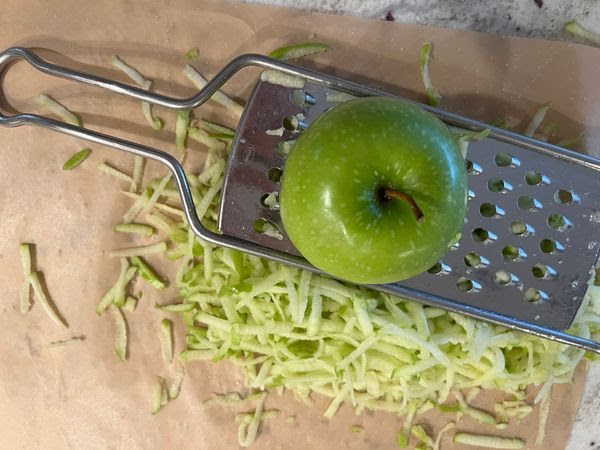
Coarsely grate the apples. You can do this in a food processor with the grating attachment or use the large holes on a box or other grater. (I used the processor and had a few chunks of apples left on the top and in the bowl – I picked those out and ate them!) Transfer the apples to a bowl. Stir in the lemon juice to mix well, then stir in the dried apples (or whatever dried fruit you’re using).

Evenly sprinkle one-third of the flour mixture over the bottom of the pan. Top with half of the apples, then cover with half of the remaining flour mixture. Spoon on the remaining apples. If you’ve got a little liquid from the apples in the bowl, add it – if you’ve got a lot (unlikely, but …), just add a spoonful or two of it. Cover with the last of the flour mixture.

Scatter the bits of butter evenly over the top, being careful to cover the entire surface. 

Place the cake in the oven, then immediately lower the temperature to 350 degrees F.

Bake for 30 minutes and then take a peek at the cake. If you notice some dry spots, cut the reserved butter into bits and pop them on top of the dry patches. Continue to bake the cake for 30 minutes more – the total baking time is 1 hour – or until golden. Transfer the pan to a rack (it won’t get very dark) and let the cake cool for about 20 minutes. If you’ve made the cake in a springform, run a table knife between the pan and the cake, then remove the outer ring of the pan. If you’ve made the cake in a regular cake pan, place a piece of parchment on a cooling rack or cutting board and have a serving plate or another rack or board covered with paper at hand. Run a table knife between the pan and the cake, unmold the cake onto the covered rack or board, peel away the round of parchment and then gently invert the cake onto your plate or the other parchment-covered rack or board. The cake is ready to serve when it is slightly warm or reaches room temperature. 

Storing: Darra says that the cake is best the day it is made and she’s right – it’s delicious then. But if you have cake leftover, cover and refrigerate it – it’s very good cold the next day. 

The Unofficial Disney Parks Drink Recipe Book: From LeFou’s Brew to the Jedi Mind Trick, 100+ Magical Disney-Inspired Drinks,

         Ashley Craft is living the life. The Disney life that is. Craft, who grew up in Anaheim just 15 minutes from Disneyland, was so close to the park that she fell asleep listening to the fireworks at night and knew the park layout so well she didn’t need a map.    

         “We’d always get passes and we’d go about once or twice a week so that was my life,” says Craft, author of The Unofficial Disney Parks Drink Recipe Book: From LeFou’s Brew to the Jedi Mind Trick, 100+ Magical Disney-Inspired Drinks, the follow up to her first cookbook, The Unofficial Disney Parks Cookbook, both released by Adams Media, an imprint of Simon & Schuster.

         But all things Disney didn’t end when she grew up. During college Craft interned at Disney World in Florida two separate times including a stint as a concierge.

She was hooked.

         “I couldn’t get Disney out of my life and so I started blogging about Disney just to have it in my life,” says Craft, who now lives in Kansas City far away from Disneyland and Disney World with her husband a radiology physicist and three children as well as a cat and a dog.

         But even impediments as living in Kansas City doesn’t stop her deep dive into all things Disney. For those who don’t know, there are numerous Disney focused blogs and Craft not only has her own, http://www.ashleycrafted, but also follows many others as well as makes frequent trips to keep up with the world of Disney parks.

All Things Disney

“I try to keep a pulse on the parks and be in tune with what’s going on today,” she says, noting she is working on other books. “I go to the parks, usually with a rough outline of foods that I am looking for. I don’t want people to be reading about stuff they heard a while ago but what they saw on Instagram yesterday.”

         All her recipes are her own creation, developed after tasting the drinks in the park and then trying to replicate them at home through lots of trial and error.

         “Everything in the book is from my own kitchen and my own mind, these are not recipes from Disney,” she says, noting that none of the recipes in her book were sanctioned by Disney. This truly is an “unofficial” book.

         “I’m not culinary trained” says Craft. “I’m just a home cook with a lot of practice and I’m trying to get as close as I can to the taste of the food, the look of the food as well as keep within a budget and being sure that people can make it with ease. Those are my four pillars of developing these recipes. If I realize that a dirnk has some complicated ingredient or uses some complicated machinery, I don’t try to recreate it. It’s more important to me that people can make it, that’s how my cookbooks evolved.”

Creating the Cookbook

         Her book contains 130 recipes culled from divided into libation categories including Coffees and Teas where you’ll find out how to make Frozen Cappuccino from Joffrey’s and Teddy’s Tea from Jock Lindsey’s Hangar Bar: Fruity Drinks and Slushies such as the Goofy Glacier from Goofy’s Candy Company. There are also Mocktails and Cocktails including the Sparkling No-Jito from the Tambu Lounge and Dessert Drinks such as Peanut Butter and Jelly Milkshake from 50’s Prime Time Café and the Dole Whip Float from Aloha Isle.

         The only one drawback for Craft when it comes to creating recipes for alcohol-based drinks is that she doesn’t consume alcohol. But like her recipe development, it’s all about taste and honesty to what she’s trying to accomplish and that is drinks that help capture the magic of visiting the parks, even for those who can’t be there.

         Craft has advice for those first using her book.

“If you’ve been to Disney before, start with a drink you have had there and then branch out,” she says.

As for her own life, she couldn’t be happier. The original run for her first book was 5000.

“They bumped it up to 20,000, and sold out the first day,” she says, noting that she was shocked by those sales numbers. “Now it’s sold about quarter a million of copies. I’m literally living my dream life, I’m so lucky. I eat Disney, drink Disney, go there often for research.”

The following recipes are reproduced courtesy of The Unofficial Disney Parks Drink Recipe Book by Ashley Craft.

Jedi Mind Trick

Oga’s Cantina, Disneyland and Disney’s Hollywood Studios

“The grapefruity drink was named after the mystical protectors and practitioners of the Force, whose one great desire was to balance the powers of the galaxy,” writes Craft in her introduction to this recipe.

To Make Jedi Mind Trick:

  • 2 ounces grapefruit-rose vodka
  • 1 1⁄2 ounces Falernum (see recipe below)
  • 1 ounce white grape juice
  • 1⁄2 ounce blue curacao
  • 1⁄4 ounce lime juice
  • 1⁄8 teaspoon grapefruit bitters

Add all ingredients to a cocktail shaker filled with ice. Seal and shake, then strain over crushed ice in a large martini glass.

To Make Falernum:

  • 1 cinnamon stick
  • 2 Tablespoons whole cloves
  • 2 Tablespoons ground allspice
  • 1 teaspoon ground nutmeg
  • 4 Tablespoons lime juice
  • 2 Tablespoons minced ginger
  • 2 cups granulated sugar
  • 1 cup water
  • 1/2 teaspoon almond extract

In a small saucepan over medium heat, toast cinnamon stick, cloves, and allspice until aromatic, about 5 minutes. Place in a blender and blend until ground.

In same saucepan over medium-high heat, combine blended spices, nutmeg, lime juice, ginger, sugar, and water. Bring to a boil, then reduce heat to low and simmer 1 minute. Remove from heat, strain into a small sealable container, discarding solids, and allow to cool about 1 hour. Once cooled, squeeze through a cheesecloth into a separate medium sealable container.

Add almond extract to mixture. Store in refrigerator up to 2 weeks.

Lava Smoothie

Leaping Horse Libations, Disney’s BoardWalk Villas

“The combination of raspberry and pineapple in this smoothie is a delightful surprise,” writes Craft. “Both are known for their tartness, and blending them together with coconut flavors creates a super-refreshing beverage. Imagine you are sitting next to the incredible Disney’s BoardWalk Inn roller coaster water slide while sipping this drink.”

  • 1⁄2 cup fresh or frozen raspberries
  • 1/2 cup granulated sugar
  • 1 Tablespoon lemon juice
  • 8 ounces nonalcoholic pina colada mix
  • 2 ounces pineapple juice
  • 3 cups crushed ice
  • 2 pineapple wedges

Mash raspberries, sugar, and lemon juice in a small saucepan over medium heat. Once mixture just begins to boil, remove from heat. Strain into a small sealable container, discarding solids, and chill 1 hour.

In a blender, combine pina colada mix, pineapple juice, and ice. Blend until slushy. Split between two 16-ounce drinking glasses or plastic cups. Divide raspberry puree evenly between glasses, pouring on top of the pina colada slush. Gently blend with a spoon, while keeping visible swirls, and serve garnished with pineapple wedges.

Dole Whip Float

Aloha Isle, Magic Kingdom

“The debate rages on: Dole Whip cup, or Dole Whip Float?” asks Craft. “The only difference is the addition of liquid pineapple juice to the float. Some find this refreshing and an added bonus on a hot day. Others think the juice makes the Dole Whip too sweet, too acidic, or too watered down. Give both a try and see which camp you are going to pitch your tent in.”

For Dole Whip

  • 1 cup water
  • 1.5 cups granulated sugar
  • 2 cups chilled pineapple juice
  • 1 Tablespoon lime juice

To make Dole Whip: In a medium microwave-safe bowl, combine water and sugar. Microwave 1 minute, stir, then microwave 1 more minute and stir to create a syrup. Cover and refrigerate at least 2 hours up to overnight.

Pour pineapple juice into a medium bowl and add 1⁄2 cup chilled syrup. Refrigerate remaining syrup up to 2 weeks. Add lime juice and stir. Pour into an ice cream machine. Follow manufacturer’s instructions and run about 20 minutes or until creamy.

Scoop mixture into a medium sealable container and chill in freezer about 30 minutes or until slightly firm.

To make Float: Pour pineapple juice into a float glass and top with piped Dole Whip. Serve immediately.

Celebrating Mardi Gras 2022

Even if you can’t make it down for Mardi Gras this year, there’s no reason to miss out on the fun. Here are our options for celebrating the holiday in person or from home. So start planning so you don’t miss out on the fun.

Mobile, Alabama

Mobile is THE birthplace of Mardi Gras in the United States, with the American celebration dating back to 1703. In this city, where MoonPies are the most coveted parade “throw” and beads hang from trees year-round, Mardi Gras is truly a way of life.

Planned Events:

A full listing of planned events can be found at Mobile.org. All events are subject to change.

  • The 2022 parade schedule extends from January 29 to March 1.
  • A tradition that started in 2021 is continuing to roll into the 2022 Carnival season. The Mobile Porch Parade is a socially distanced way for Mobilians to join in the fun by decorating their homes and registering to be on the official parade map. Everyone is invited to follow the “parade routes” – by way of foot, car or bike – at their leisure.

Celebrate at Home

  • To help get you in the spirit of the season, Toomey’s Mardi Gras features one of the largest inventories of Mardi Gras supplies anywhere in the world. Headquartered in a 70,000-square-foot facility is overflowing with beads, costumes, masks, and decorations. And that’s just the start. They even have MoonPies.
  • Local women-owned business ellenJAY offers a seasonal Mardi Gras Combo Box, Inside are four beautifully decorated mask sugar cookies, four chocolate chip sammies with vanilla buttercream and Mardi Gras sprinkles, and four cinnamon teacakes. The 12-count combo box is $59.95.

Gulf Shores and Orange Beach, Alabama

Head to  Gulf Shores and Orange Beach and celebrate Mardi Gras on the beach.

Planned Events:

A full listing of planned events can be found at gulfshores.com

. All events are subject to change.

  • Don’t miss the Orange Beach Mardi Gras Parade. Organized each year by the City of Orange Beach, this year’s parade is scheduled for Saturday, February 26.
  • They all love a parade. That’s why the city of Gulf Shores offers both land and sea parades on Mardi Gras With the oldest parading order in Baldwin County, the Gulf Shores Mardi Gras Parade will take place at 10 a.m. on March 1. Later that day, the Mardi Gras Boat Parade, organized by Lucy Buffett’s LuLu’s, sets sail. 

Celebrate at Home

  • Possibly the most famous of all Mardi Gras dishes is gumbo, and we’ve got a great recipe to share. Excerpted from Lucy Buffet’s “Gumbo Love” recipe book, Summer Seafood Gumbo. Ignore the name, this gumbo is good year round.

Coastal Louisiana

Coastal Louisiana epitomes the Cajun French expression “Laissez les bon temps roulez,” or as we would say “Let the good times roll.” Historically, New Year’s celebrations overlap the Carnival season kickoff starting on the Epiphany (January 6) and continuing on through Mardi Gras beginning this year on Tuesday, March 1.

Planned Events:

A full listing of planned events can be found on each destination’s website. All events are subject to change.

  • Lafourche Parish is recovering from the impact of Hurricane Ida last summer, but Mardi Gras is giving residents of Louisiana’s Cajun Bayou some reasons to celebrate. Here’s a complete list of the festivities scheduled for this year.
  • Located a short 40 minutes from the French Quarter, St. Tammany Parish is home to such quirky and unforgettable Mardi Gras parades as the Carnival in Covington Parade on March 1.
  • In Southwest Louisiana, the famed Iowa Chicken Run, an event that winds its way through the small town of Iowa to collect ingredients for a celebratory gumbo, is scheduled for March 1.

Celebrate at Home:

Nom Nom Paleo Let’s Go! Simple Feasts + Healthy Eats

Michelle Tam and Henry Fong, the James Beard Award nominated creators of Nom Nom Paleo, a website and award-winning cooking app, newest cookbook, Nom Paleo Let’s Go! Simple Feasts + Healthy Eats (Volume 3) features more keto-friendly, Whole30, and plant-based recipes.  Published by Andrews McMeel Publishing, it’s a fun book but serious as well, with 2000 step-by-step instructions, lots of photos and illustrations, and a dash of snarky humor.

It’s the third in their series of cookbooks, the first two of which were both New York Times bestsellers. Tam, who holds a doctorate in pharmacy from the University of California, develops recipes based upon the Cantonese meals her mother cooked for the family when she was growing up and the immigrant cuisine of the San Francisco Bay area where she grew up as well as such American teen basics as cheeseburgers and French fries.

Tam and Fong operate on the premise that weeknight suppers should be healthy and flavor-packed as well as fast and simple. Weekends and celebrations, on the other hand, are the perfect excuse to craft elevated (but easy) crowd-pleasers. Nom Paleo Let’s Go! offers crazy-delicious recipes for all occasions, and every single one is free of grains, gluten, dairy, and refined sugar.

Fong is an attorney who does the photography and illustrations for their books as well as the over all design. In all, they both seem to have a lot of fun in the kitchen and in writing their cookbooks.

All three books coordinate with a multitude of specialty diets—paleo, keto-friendly, vegan, nut-free, Whole30, and plant-based and every single recipe is free of grains, gluten, refined sugar, and dairy. But if it all sounds too healthy, no one you’re cooking for needs to know how nutritious the dishes are. And they won’t know based on the taste either as it’s all seriously yummy.

As always, Nom Nom Paleo’s recipes reflect the diverse cuisines Michelle grew up with and culinary ideas from her travels. Often Asian-inspired, Michelle’s unfussy recipes maximize flavor, optimize whole foods, and are presented with photos of each step so they’re absolutely foolproof–even for novice cooks! New recipes include: Cantonese Roast Duck, Nom Nom Chili Crisp, Bacon Cheeseburger Casserole, Chicken Karaage, Instant Pot Balsamic Beef Stew, and Paleo-Friendly Cream Puffs.

Hash Brown Fish

Umami Stir Fry Powder

  • ⅔ cup dehydrated chopped scallions
  • 6½ tablespoons kosher salt
  • ¼ cup dried shiitake mushroom powder
  • 1 tablespoon garlic powder
  • 1 tablespoon onion powder
  • 1 tablespoon ground ginger
  • ½ teaspoon ground white pepper

Hash Brown Fish

  • 1 pound Russet potatoes, peeled
  • ½ cup scallions, thinly sliced
  • ¼ cup avocado oil or ghee, divided
  • 2 teaspoons umami stir fry powder or kosher salt, divided
  • Four 5-ounce skinless sea bass or cod fillets, each about ¾-inch thick
  • 1 lemon, cut into wedges

MAKE THE UMAMI STIR FRY POWDER (IF DESIRED): Toss all of the ingredients into a mini food processor or spice grinder. Blend to make a fine powder, scraping down the sides occasionally to make sure the dehydrated green onions are totally powderized. (This seasoning will keep in an airtight container in a cool, dry place for up to 6 months.)

MAKE THE HASH BROWN FISH: Grate the potatoes with a food processor or by using the large holes of a box grater.

Bundle the shredded potatoes in a clean kitchen towel. Then, wring out the potatoes and discard the liquid.

In a large bowl, toss together the shredded potatoes, scallions and 1 teaspoon of umami stir fry powder or kosher salt.

Pat the fish dry with paper towels. Sprinkle the other teaspoon of umami stir fry powder or kosher salt on the fish fillets.

Heat a large cast iron or nonstick skillet over medium heat, and then add 2 tablespoons of oil or ghee to the hot pan.

Add two ⅓-cup mounds of potatoes to the pan and flatten them into rectangles, approximating the size of your fish fillets.

Smush a fish fillet onto each potato layer and cover each one with a thin layer of shredded potatoes.

Fry for 5 to 8 minutes or until the bottom layer of potatoes is crisp and golden brown.

Carefully flip the fillet packets over with a fish spatula and cook for another 5 to 8 minutes on the other side.

Once the other potato layer is nicely browned and the center of the fish registers 135°F on an instant-read thermometer, transfer to a plate.

Repeat steps 6 to 11 with the remaining fish and potatoes and serve with lemon wedges.

Ginger Scallion Sauce

This salty, herbaceous condiment is exponentially greater than the sum of its parts. It’s traditionally served with whole poached chicken, but growing up, I would put it on everything! This sauce is transformative, lending massive flavor to any savory dish.

Makes 1 cup

Ingredients:

  • 1 cup finely minced scallions
  • 3 tablespoons finely minced fresh ginger
  • 2 teaspoons Diamond Crystal kosher salt
  • ¼ teaspoon ground white pepper
  • ½ cup avocado oil

Method:

Toss the scallions, ginger, salt, and white pepper in a large heat-proof bowl or 2-cup measuring cup.

Stir it all together.

In a small saucepan over high heat, warm the oil until it’s shimmering but not quite smoking. 

Add a tiny piece of scallion to test the heat of the oil. If you see lots of little bubbles, the oil’s ready. (Or just check that the oil reaches 375°F on an instant-read thermometer.)

Pour the hot oil into the scallion and ginger mixture a little at a time. It’ll sizzle and boil, so be careful!

Stir well and let the sauce cool to room temperature. The sauce can be refrigerated in a sealed jar for up to 2 weeks or frozen in an ice cube tray for up to 3 months.

All-Purpose Stir-Fry Sauce

Despite its name, my All-Purpose Stir-Fry Sauce isn’t just for stir-fries: it’s a fundamental component in recipes of all kinds. This ultra-versatile sauce keeps in the refrigerator 

Makes 2 cups

Ingredients:

  • 1 cup coconut aminos
  • ½ cup fresh orange or pineapple juice
  • ¼ cup paleo-friendly fish sauce
  • 2 tablespoons rice vinegar
  • 2 teaspoons garlic powder
  • 2 teaspoons ground ginger
  • 1 teaspoon toasted sesame oil

Method:

Combine all the ingredients in a measuring cup or jar. Mix it all together.

Char Siu (Chinese Barbecue Pork)

Makes 8 servings

  • ½ cup plum, peach, or apricot jam, sweetened only with fruit juice
  • ¼ cup coconut aminos
  • 3 tablespoons tomato paste
  • 1 tablespoon almond butter
  • 1 tablespoon honey (optional, not Whole30)
  • 1 teaspoon paleo-friendly fish sauce
  • ½ teaspoon Chinese five-spice powder
  • ½ teaspoon ground ginger
  • 3 pounds boneless pork shoulder roast
  • 2  teaspoons Diamond Crystal kosher salt 
  • 2 scallions, thinly sliced (optional)

Pour the jam into a small saucepan. To stay paleo-friendly, be sure to use a high-quality, 100% fruit jam.

Next, toss in the coconut aminos, tomato paste, almond butter, honey (if desired), fish sauce, Chinese five-spice powder, and ground ginger.

Whisk the marinade as you heat it to a simmer over medium heat.

Once the marinade is bubbling and smooth, transfer it to a measuring cup and let it cool to room temperature. (Not ready to roast the pork? You can store the sauce in the fridge for up to 4 days.)

Next, prepare the pork. Blot the pork shoulder with a paper towel. Then, slice the pork shoulder into 2-inch strips of even thickness.

The pork strips should be roughly uniform in size. It’s fine to have fatty pieces of pork because: (1) it’s tasty, and (2) you don’t want to end up with dry char siu. Sprinkle 2 teaspoons of kosher salt all over the pork pieces.

Place the pork in a large bowl or in a zippered food storage bag. Pour all except ⅓ cup of the cooled marinade onto the pork. Cover and refrigerate the reserved marinade.

Use your hands to coat the marinade all over the pork strips. Cover the bowl and refrigerate it for 2 to 24 hours.

When you’re ready to roast the pork, heat the oven to 350°F with the rack in the middle position. Arrange the pork on an oven-safe wire rack in a rimmed baking sheet. Roast for 30 minutes, flipping the pork pieces at the halfway point. Take the pork out of the oven and increase the temperature to 400°F.

Brush half of the reserved marinade on the tops of the pork pieces. Pour enough water into the bottom of the pan so that you have a thin layer coating the bottom. This will keep the drippings from burning while the pork cooks.

Roast for 25 minutes. Then, flip the pork pieces over and brush on the remaining marinade. Cook for another 20 to 30 minutes or until the pork is slightly charred on the edges. Rest the pork for 10 minutes, and then slice against the grain into bite-size pieces.

Arrange the pork on a serving dish and garnish with 2 sliced scallions, if desired.

Sheet Pan Pineapple Chicken

Serves 4

This easy sheet pan meal is my riff on Huli Huli Chicken, a classic Hawaiian barbecue staple featuring a sweet and savory sauce made with pineapple juice, ketchup, and soy sauce. Believe me: no one can resist a pan of sticky chicken and pineapple, especially when it’s re-imagined with healthier, paleo-friendly ingredients. Don’t substitute fresh pineapple and ginger for canned pineapple and ground ginger! The fresh stuff contains enzymes that break down proteins, so if you use ’em, they’ll make your chicken mushy!

Ingredients

  • 1 (13.5-ounce) can pineapple rings in pineapple juice
  • ½ cup paleo-friendly ketchup
  • ½ cup coconut aminos
  • 2 tablespoons rice vinegar or apple cider vinegar
  • 2 tablespoons honey
  • 1 tablespoon paleo-friendly fish sauce
  • 1 teaspoon sesame oil
  • 1 teaspoon ground ginger
  • 5 garlic cloves, minced
  • 1½ pounds boneless, skinless chicken thighs
  • ¾ teaspoon Diamond Crystal kosher salt
  • 1 teaspoon toasted sesame seeds 
  • 2 scallions, thinly sliced

Method:

Open up the pineapple can and set aside the pineapple rings.

Pour ½ cup of the pineapple juice from the can into a large measuring cup. (We won’t be using the rest.)

Add the ketchup, coconut aminos, rice vinegar, honey, fish sauce, sesame oil to the pineapple juice in the measuring cup. Toss in the ground ginger and minced garlic. Whisk it all together to form a marinade.

Place the chicken in a medium bowl and sprinkle with the salt. Pour in ½ cup of the marinade. Set aside the remaining marinade.

Toss the chicken well. Cover and marinate for 30 minutes or up to a day in the fridge.

In the meantime, pour the remaining marinade into a small saucepan and bring it to a boil over high heat. Then, decrease the heat to maintain a simmer for about 20 minutes until the liquid has thickened into a sauce. Remove from the heat and set aside. You should now have about 1 cup of sauce. 

Set aside about ¼ cup of the sauce to baste the chicken, and save the rest to serve with the finished dish.

Heat the oven to 400°F on convection mode or 425°F on regular mode with the rack in the middle.

Arrange the chicken thighs and the pineapple rings in a single layer on a rimmed, greased or parchment-lined baking sheet. 

Bake for 15 minutes. Then, rotate the tray and brush the reserved ¼ cup of cooked sauce onto the chicken thighs and pineapple rings. 

Bake for an additional 5 to 10 minutes or until the thickest part of the thighs register 165°F on a meat thermometer.

Garnish the chicken and pineapple with sesame seeds and scallions. Serve with the reserved sauce!

Excerpted from Nom Nom Paleo: Let’s Go!  © 2022 written & photographed by Michelle Tam & Henry Fong.  Reproduced by permission of Andrews McMeel Publishing. All rights reserved.

Japanese Farm Food: An Award Winning Cookbook

              “Our life centers on the farm and the field. We eat what we grow,” says Nancy Singleton Hachisu, author of Japanese Farm Food which won the Gourmand World Cookbook Awards 2012: USA Winner for the Best Japanese Cuisine Book. It’s a fascinating take on Japanese cuisine from Hachisu, a native Californian who moved to a small village in rural Japan more than 30 years ago, intending to live there for a year.  Describing herself as coming for the food, but staying for love, she met and married Tadaaki, an organic farmer, moved to the rural Saitama Prefecture. There she raised a family in an 80-year-old traditional Japanese farmhouse  and immersed herself in both the culture and cooking. The book is so very niche that it’s almost like being in her kitchen and on her farm, giving us an amazing insight into a tiny slice of Japanese farm culture.

              Hachisu also has written Japan: The Cookbook which she describes as not an examination of regional cooking traditions, as much as a curated experience of Japan’s culinary framework from a specific moment in time. Using both fine and generous strokes, I have put together what I hopes a broad and rich picture of the food of this island nation.”

              Her other books include Preserving the Japanese Way: Traditions of Salting, Fermenting, and Pickling for the Modern Kitchen It’s a book offering  a clear road map for preserving fruits, vegetables, and fish through a nonscientific, farm- or fisherman-centric approach. Ruth Reichl, author of Tender at the Bone and former editor-in-chief of Gourmet Magazine writes  “Even if you never yearned to make your own miso or pickle your own vegetables, this beautiful book will change your mind. It’s almost impossible to flip through these pages without wanting to join Nancy Singleton Hachisu in the lovely meditation of her cooking. This book is unlike anything else out there, and every serious cook will want to own it.”

              Food Artisans of Japan, another of her wonderful books, offers us a look into Japan’s diversely rich food landscape and includes 120 recipes from 7 compelling Japanese chefs and 24 stories of food artisans.

Pork and Flowering Mustard Stir-Fry

Buta to Nanohana Itame

Serves 4

            “Tadaaki made this one night when we had fields of flowering mustard and komatsuna. The flowering tops of brassicas, particularly rape (natane), are called nanohana in Japanese and are similar to rapini. Tadaaki tends to throw some meat into his stir-fries because he feels it gives the dish more depth,” writes the author in this simple recipe that is delicate and delicious. “I’m more of a purist, so prefer my vegetables without meat. But this dish really won me over, and I quickly became a convert (almost). Japanese stir-fries can be flavored with soy sauce, miso mixed with sake, or even salt. In this dish, I like the clarity of the salt.”

  • ½ tablespoon organic rapeseed oil
  • Scant ½ pound (200 g) thinly sliced pork belly
  • 1 tablespoon finely slivered ginger
  • 1 (10 ½-ounce/300-g) bunch flowering mustard or rapini, cut into 2-inch (5-cm) lengths
  • ½ teaspoon sea salt

Fill a pot with water and bring to a boil.

Heat a wide frying pan or wok over high heat. Add the oil quickly followed by the pork belly slices and ginger slivers. Sauté until the fat sizzles and there is some minimal browning, but don’t overdo it.

Place the flowering mustard in a mesh strainer with a handle and lower into the pot of boiling water. Cook for about 30 seconds, or until no longer raw. Keep the strainer at the top of the water surface in order to scoop the mustard greens out in one brisk pass. Shake off the hot water and toss into the cooked pork belly. Toss a few minutes more over high heat and season with the salt. Cook for about 30 seconds more, then serve.

Variations: Substitute soy sauce for the salt or chopped ginger for the slivered ginger.

—From Japanese Farm Food, by Nancy Singleton Hachisu/Andrews McMeel Publishing, LLC

Prevention.com: 15 Best Air Fryer Cookbooks to Buy 2022 – Best Air Fryer Cookbook for Beginners

Prevention.com: 15 Best Air Fryer Cookbooks to Buy 2022 – Best Air Fryer Cookbook for Beginners. https://www.prevention.com/food-nutrition/healthy-eating/g38749295/best-air-fryer-cookbooks/

Watch “1929 Scottish Tantallon Cakes Recipe – Old Cookbook Show – Glen And Friends Cooking” on YouTube

Yumna Jawad: Feel Good Foodie

          Spoiled by her mom’s cooking and too tired to cook herself after working all day Yumna Jawad decided after getting married to change all that. Calling her mom—there was no Facetime back then–Jawad would have her stay on the phone and tell her step by step how to make a meal. It took just two weeks and from there Jawad, who moved to Kalamazoo, and now lives in Grand Rapids, used her new skills not only to cook for her family but as a springboard to creating Feel Good Foodie, her healthy, quick, and creative food blog. She also keeps an active Instagram account with three million followers.

          I came across her blog when researching healthy recipes since I’ve moved on during the pandemic from trying all those dessert recipes I’ve been clipping and saving for years and was very impressed. Besides recipes, she also offers nutritional information, substitutions, how to videos, how long does it take to make the recipe and links to similar recipes. So I emailed Jawad and she responded within ten minutes even though it was late at night but then judging by how often she updates her blog, she may not sleep much if at all.

          It turns out that she worked in Branding and Research & Marketing for consumer packaged foods and the retail food industry and eight years ago began sharing recipes on her Instagram account. She now has over two million followers which is pretty amazing. I have like 2000. Her blog has 400,000 visitors a month. So I asked her why she thought she was so successful.

          “When I first started sharing recipes on social media, my photos were all taken on an iPhone and it was always the meals I made that day for myself or my family,” she says. “The food wasn’t styled or edited, but it was easy and approachable. I think it resonated with a lot of people seeking ways to eat healthier that was attainable and easy-to-manage. And when others tried recreating my recipes, they had similar results without ‘Pinterest fails’. That encouraged them to try more and share more, which I believe helped me establish credibility in my brand and recipes. And all of that was before I even knew that I was even building a health and wellness brand.”

The Flavors of the World

           Jawad has an international background that adds to the creativity of her recipes. She was born in what is now the Democratic Republic of the Congo and also lived in Sierra Leone until age 11. When Civil War broke out there, the family moved to Dearborn, Michigan. After marrying, she and her husband, a cardiologist, moved several times as well before ending up in Kalamazoo and now Grand Rapids  She first learned to cook traditional Lebanese food but now has exponentially expanded her repertoire but there’s often a Middle East/Mediterranean aspect to her recipes because of their focus on vegetables and healthy ingredients.

          Her culinary inspirations, besides her mother include Ina Garten of Barefoot Contessa fame.      

          “While not all of Ina’s recipes are low calories/low fat, I love her realness, approachability, and passion for cooking,” says Jawad. “She inspires me to be who I am and allow that passion to come through with my recipes without any fluff.”

          Curtis Stone is also another food idol because, she says, he is all about eating unprocessed and unpackaged foods as much as possible, which is actually healthier and cheaper.

          “This is something that I focus so much on with my wholesome home-cooked meals,” she says.

          And because, as the mother of two children, she likes meals that are quick to prepare, she’s a fan of Rachel Ray.

          “Rachel rally popularized the idea of 30 minute meals that made home cooking so accessible for so many people; and that is directly in line with my thinking,” says Jawad.

          Currently she adds three recipes a week to her blog—meals she’s been making for her family since she learned to cook 12 years ago. Some are inspired by tradition, others by watching cooking shows, reading food magazines, and following social media and focuses on new approaches creating healthy wholesome meals.

          “This includes, for example, trends like quinoa crust breadsticks, or cauliflower pizza or sweet potato toast,” says Jawad. “I keep up with the latest trends and test new ideas myself and then add my own twist to them, usually by making the prep easier or by swapping some ingredients to personalize the recipe.”

Recipe Data Base

          She’s also adding to the recipe data base on her blog.

          For those who wonder how to incorporate new foods into their kitchen repertoire, she has some tips. When she used to discover new produce at farmers’ markets, she’d ask the grower for suggestions. Now, Jawad uses the vegetables or fruits in a way that makes it more connected to what  she knows.

          “I recommend experimenting with it in a way that you normally eat other similar foods,” she says. “For instance, since rutabaga is a root vegetable, I would prepare it similar in a similar way to other root vegetables by roasting it because I know I would naturally enjoy that more than steaming it. I would also recommend trying something new in smaller quantities and having others to share it with. It makes the process more enjoyable to try a new ingredient or recipe with other taste testers. When it comes to kids, the same advice applies. But also, I strongly recommend having kids help in the purchase and preparation of ingredients. It gets them more excited about what they make because they feel more invested in the process. When all else fails, mask it in a smoothie or blended soup.”

The following recipes are courtesy of Yumna Jawad.

Chicken Lemon Orzo Soup

  • 1 pound boneless skinless chicken thighs
  • 1 onion diced
  • 3 large carrots peeled, halved lengthwise and finely sliced
  • 3 celery stalks small diced
  • 2-3 bay leaves
  • 1 Tablespoon butter or olive oil
  • 2 garlic cloves minced
  • 1 teaspoon dried rosemary
  • 3/4 cup orzo pasta
  • 1/8 teaspoon turmeric optional
  • Juice of 1-2 lemons to taste
  • Fresh parsley

Place chicken and scraps from the outer layers and end of the onions, carrots, and celery along with a couple bay leaves in a large stock pot. Add bay leaves and 8-10 cups water and season with salt and pepper. Bring to a boil; reduce heat and simmer until chicken is fork-tender, about 30 minutes.

Remove chicken and shred; then strain the chicken broth using a fine-mesh sieve and discard the vegetable scraps and bay leave

Heat oil in the same pot over medium heat. Add the chopped onions, carrots, celery, garlic and cook until tender, about 4-5 minutes. Stir in the shredded chicken, orzo, rosemary, and turmeric (if using). Then return the broth to the stockpot and bring a boil.

Reduce the heat and simmer until the orzo is cooked, about 20 minutes.

Stir in the lemon juice and season with salt and pepper. Serve immediately with fresh parsley or mint, if desired.

Air Fryer Sweet Potato Fries

  • 2 medium sweet potatoes peeled
  • 2 teaspoons olive oil
  • ½ teaspoon salt
  • ¼ teaspoon garlic powder
  • ¼ teaspoon paprika
  • ⅛ teaspoon black pepper
  • Preheat the air fryer to 380°F. Peel the sweet potatoes, then slice each potato into even 1/4 inch thick sticks.

Place the sweet potatoes in a large mixing bowl, and toss with olive oil, salt, garlic powder, paprika and black pepper.

Cook in 2 or 3 batches, depending on the size of your basket without overcrowding the pan until they’re crispy. I recommend 12 minutes, turning halfway. This may vary based on your air fryer.

Serve immediately with your favorite dipping sauce

Quinoa Patties

  • 1 cup cooked quinoa
  • 2 eggs beaten
  • Salt and pepper to taste
  • ½ red onion finely chopped
  • ½ cup mozzarella cheese
  • 2 cloves garlic crushed
  • 1 cup breadcrumbs
  • Water as needed add moisture
  • 1 tablespoon canola oil

For the Avocado Yogurt Dip

  • 2 tablespoons cilantro chopped
  • ½ cup yogurt
  • ½ avocado extra ripe
  • Salt and pepper to taste

Combine quinoa, eggs, and salt in a medium bowl. Stir in onions, cheese, garlic, and cilantro. Add the breadcrumbs, stir, and let sit for a few minutes so the crumbs can absorb some of the moisture. Feel free to add water if the mixture feels too dry. Form the mixture into 6-8 patties.

Frying Instructions:Heat the oil in a large, heavy skillet over medium-low heat. Place add quinoa on the heated pan, making sure not to overcrowd the pan and cook until the patties are golden color, about 7 – 10 per side minutes.

Baking Instructions:Place the quinoa patties on a baking sheet lined with parchment paper. Brush the oil on top of the patties. Bake in a preheated oven at 400°F for 15 minutes, until golden.

To make the avocado yogurt sauce, whisk together the cilantro, avocado and yogurt. Season with salt and pepper and serve with the cooked quinoa patties.

 Notes

Storage: Store any leftovers in an airtight container. They will last up to 5 days in the fridge.

Freezing Instructions: You can also freeze the patties before or after cooking them.

  • To freeze them prior to cooking, lay them on a flat baking dish in the freezer for at least 4 hours. When frozen, place them in an airtight bag. Thaw in the fridge overnight and cook per instructions.
  • To freeze them after cooking, simply store them in an airtight bag after they’ve cooled. To re-heat, thaw in the fridge overnight and bake in a 350°F oven until heated through.

Substitutes: For best results, follow the recipe as is. However here are some common substitutes that would work well in this recipe.

  • Instead of eggs, you can use a flax eggs. For each regular egg, use 1 tablespoon ground flaxseed + 3 tablespoons water.
  • Any type of shredded cheese can be used in place of mozzarella.
  • If you prefer not to use breadcrumbs, you can use a gluten-free flour like almond flour or oat flour, or you can also use panko breadcrumbs.

“Satisfy your sweet tooth with a plant-based treat in under 10 minutes,” Jawad says about the following recipe. “3-ingredient chia pudding is the perfect pick-me-up. High in fiber, protein, and healthy fats, this recipe is as good for you as it tastes.”

3-Ingredient Chia Pudding

  • 2 tablespoons chia seeds
  • ½ cup almond milk or milk of choice
  • 1 teaspoon honey or other sweetener
  • Strawberries, blueberries, or other fruit

Pour all ingredients into a Mason jar and mix well. Let sit for a few minutes and then stir again until it is smooth and there’s no clumping.

Cover the jar and store in the refrigerator for at least two hours.

When you’re ready to eat, top with your favorite fruit and serve.

Spilling the Beans: Abra Berens Dishes on Legumes, Beans, and More in Her Latest Cookbook

         A much maligned vegetable belonging, along with peas and lentils, to the vegetable class called legumes, beans are about as low on the food chain as you can go in terms of respect. Kids snicker at rhymes about beans and the gas they produce and sayings like “not worth a hill of beans” signifies their, well, insignificance.

         Once Abra Berens, the former co-owner of Bare Knuckles Farm in Northport, Michigan and now the executive chef at Granor Farm in Southwest Michigan, was like most of us. She didn’t give a bean about beans. That is until she became intrigued by the bean and grain program at Granor, a certified organic farm in Three Oaks, a charming historic village with its own burgeoning food culture.

         Now she’s all about legumes and grains and for anyone who knows Abra that means a total passionate immersion in the subject which resulted in her latest cookbook, a 464-page door stopper with 140 recipes and over 160 recipe variations titled Grist: A Practical Guide to Cooking Grains, Beans, Seeds, and Legumes. Just published by Chronicle Books on October 26th, the demand for Grist is so high it was hard to get a copy at first.

         Now, that’s worth more than a hill of beans.

         Berens, a James Beard semifinalist for Outstanding Chef: Great Lakes, also authored  Ruffage. That book, which came out in 2019, was named a Best Cookbook for Spring 2019 by the New York Times and Bon Appétit, was a 2019 Michigan Notable Book winner, and was also nominated for a 2019 James Beard Award. She puts the same energy into her Grist.

         “We are told over and over again to eat a diet rich in whole grains and plant-based protein,” writes Berens in the book’s introduction. “The science is there—high in soluble fiber, low glycemic index, healthy fatted protein—but the perception of whole grains seems to still be of leaden health food, endless cooking times, and cud-like chewing at the end of it all.”

         Indeed. Consider this. A cup of cooked black beans has 245 calories and contains approximately the following percentage of the daily values needed in an average diet—74% folate, 39% manganese, 20% iron, 21% both potassium and magnesium, and 20% vitamin B6.

         “But we all know that they’re good for you,” says Berens, who describes herself as a bean-evangelist.  “I want people to understand these ingredients and you can’t understand these ingredients until you know them.”

         And so, she introduces us to 29 different grains, legumes, and seeds. Some like lentils, lima beans, split peas, quinoa, rice, and oats we know something about. Others are more obscure such as cowpeas, millet, teff, fonio, and freekeh are mysteries. That is until you read her book and learn not only how to cook them but also about their history. There’s a cheat sheet of the health benefits of each. Berens also conducted interviews with farmers  including her cousins Matt and John Berens, third-generation farmers in Bentheim, Michigan who have transitioned into growing non-GMO corn and edible beans and Jerry Hebron, the manager of Oakland Avenue Urban Farm, a nonprofit, community-based organization dedicated to cultivating healthy foods, sustainable economies, and active cultural environments. Hebron has been raising crowder beans for almost a decade.  

         We also get to meet Carl Wagner, a farmer and seed cleaner in Niles, Michigan. Berens said she wanted to include “invisible” farming jobs and this certainly is one. She didn’t know what a seed cleaner was until a few years ago and figured that most of us don’t know either. Wagner, with his wife Mary, run C3 Seeds, a company that provides seed cleaning for grains and seed stock.  When Berens asked him what he’d like people to know about his job, his response was that they would know that seed cleaning “is part of buying a bag of flour or a bottle of whiskey.”

         “The biggest thing is that if people are interested in cooking with beans, it’s an easy entry point it’s not like buying $100 tenderloin,” says Berens.

         Of course, you can buy beans in the grocery store. Berens recommends dried beans not canned. But Granor Farm also sells black, red, and pinto beans at their farm store which is open Friday and Saturday. For information on the times, visit granorfarm.com

         Berens is already working on her next book, tentatively titled Fruit, due out in 2023. When I ask her how she does it all, she laughs and replies, “I don’t have any hobbies.”

         And she takes things very seriously.

         “Every author has to think about why they’re putting something in the world,” she says, “and what is the value of it and makes these books worthwhile.”

         With Grist, we’re learning the value of tasty and healthy foods that taste good.

The following recipes are reprinted from Grist: A Practical Guide to Cooking Grains, Beans, Seeds, and Legumes by Abra Berens with permission from Chronicle Books, 2021. Photographs © EE Berger.

Seared Chicken Thighs W/Buckwheat, Smashed Cucumbers + Tajín Oil

The angular mouthfeel of the buckwheat plays well with the crunch of the cucumber and against the crisp of the chicken thigh. Serve the buckwheat warm or chilled, depending on your preference. If you aren’t eating meat, the salad is a great lunch on its own or pairs well with an egg or fried tofu.

  • 1 cup buckwheat groats, toasted or not
  • Olive oil
  • 2 medium cucumbers (about 1 lb. total), washed
  • 1/4 cup Tajín Oil
  • Salt and freshly ground black pepper
  • ¾ cup plain yogurt, Greek or traditional
  • 1 lemon (about 1½ oz) zest and juice
  • 10 sprigs parsley, roughly chopped
  • Any additional herbs you want, roughly chopped (mint, tarragon, thyme, cilantro)
  • Pinch of chili flakes (optional)
  • 4 to 6 chicken thighs

Bring a large pot of salted water to a rolling boil over high heat. Toss in the buckwheat groats and give the pot a stir. Return to a boil, lower to a simmer, and cook the grains until tender, 8 to 15 minutes.

Drain the groats, toss with a glug of Tajín oil, and set aside.

Trim the ends of the cucumbers and place on a cutting board. Using the widest knife (or frying pan) you have, press down on the cucumbers until their skin cracks and they break into irregular pieces. Dress the cucumbers with the Tajín oil and a pinch of salt.

Combine the yogurt with the lemon zest and juice, chopped herbs, chili flakes (if using), a pinch of salt, and two big glugs of olive oil. Set aside.

Blot the chicken skin dry and season with salt and pepper.

Heat a large frying pan over high heat until the pan is starting to smoke. Add a glug or two of oil, lower the heat to medium, and fry the thighs, skin-side down, until golden brown, 5 to 7 minutes. Flip the

chicken and sauté until cooked through, 5 to 7 minutes more.

To serve, dish the buckwheat onto serving plates. Top with the chicken thighs and then the dressed cucumbers. Garnish with a thick spoonful of the herbed yogurt.

Tajín Oil

  • 1 cup neutral oil
  • 2 Tbsp Tajín

In a medium sauce or frying pan, heat the oil over medium heat until it begins to shimmer, about 1 minute. Remove from the heat, add the Tajín, and let steep for 5 minutes.

Whole Roasted Leeks w/Chickpeas, Lemon Vinaigrette, Ricotta + Chard

  • 4 large leeks (about 2 pounds), trimmed and cleaned of dirt
  • 4 sprigs thyme (optional)
  • ¼ teaspoon chili flakes (optional)
  • Salt and freshly ground black pepper
  • 1 orange (about 3 ounces), peel stripped, juiced, or ¼ cup white wine or hard cider
  • 3/4 cup olive oil
  • 2 cups cooked or canned chickpeas, rinsed
  • 1 bunch chard (8 ounces), cut into ribbons (or spinach, kale, or arugula)
  • 2 lemons (about 3 ounces), zest and juice
  • 4 ounces ricotta

Preheat the oven to 350°F. Place the whole, cleaned leeks, side by side, in a roasting pan.

Scatter the thyme (if using), chili flakes (if using), and 2 large pinches of salt evenly over the leeks.

Scatter the orange peel strips over the leeks and drizzle them with the orange juice and ¼ cup of the olive oil to coat.

Cover with foil and bake until the leeks are tender, 35 to 45 minutes.

Combine the chickpeas, chard ribbons, lemon zest and juice, and remaining ½ cup of olive oil with a big pinch of salt and a couple of grinds of black pepper.

When the leeks are tender, transfer from the roasting pan to plates or a serving platter. Top with the chickpea and chard salad. Dot ricotta over the top and serve.

Spoon Pudding with Pork Chops and Cabbage Salad

For the spoon pudding:

  • ¾ cup cornmeal
  • 1 teaspoon salt
  • 4 tablespoons butter, melted
  • 2 eggs, beaten
  • 1 cup milk
  • 2 teaspoons baking powder

For the salad:

  • About 1 pound red cabbage, shaved into thin strips
  • ¼ cup olive oil
  • 10 sprigs parsley, roughly chopped
  • 1 lemon zest and juice
  • ½ teaspoon chili flakes
  • ½ teaspoon paprika
  • Salt

4 pork chops, seasoned with salt and pepper and grilled

To make the spoon pudding:

Preheat the oven to 350°F. Grease an ovenproof baking dish or frying pan that can hold 2 quarts total volume.

Combine the cornmeal, salt, 1 cup of boiling water, and the melted butter and whisk out any lumps. Combine the eggs, milk, and baking powder and add to the cornmeal batter. Pour into the prepared baking dish and bake until the edges of the spoon bread are just set and lightly browned, 30 to 40 minutes.

To make the salad: Combine the cabbage with the olive oil, chopped parsley, lemon zest and juice, chili flakes, paprika, and a couple pinches of salt. Toss to combine and adjust the seasoning as desired.

Serve the spoon bread alongside the grilled pork chops and cabbage salad.