“Bourbon is a legacy of blue grass, water and Kentucky limestone,” Carol Peachee tells me when I ask what makes Kentucky bourbon so prized.
Limestone? Water? Bluegrass? What’s that have to do with fine bourbon?
Turns out it’s quite simple. According to Peachee, the limestone filters the iron out of the water as it flows through the rock, producing a sweet-tasting mineral water perfect for making the greatest tasting liquor. Limestone, with its heavy calcium deposits, also is credited with the lush blue grass the state’s prize-winning horses gaze upon — making their bones strong.
It’s been a long time since I took geology in college, but I do like the taste of good bourbon and the sight of stately horses grazing in beautiful pastures and the more I can learn about it all, the better. Which is why I love Peachee’s entrancing photographs.
Carol Peachee
I first met Peachee, an award-winning professional photographer, when she was autographing copies of her latest book, Straight Bourbon: Distilling the Industry’s Heritage (Indiana University Press 2017; $28). Creating beauty as well as a sense of yearning, her books, including The Birth of Bourbon: A Photographic Tour of Early Distilleries, take us on a wanderlust journey of lost distilleries and those now re-emerging from the wreckage of Prohibition. At one time, Kentucky had over two hundred commercial distilleries, but only sixty-one reopened after the repeal of Prohibition in 1933. Now, as Kentucky bourbon becomes a driving force throughout the world, once barely remembered and long closed distilleries are being restored and revamped and are opening again for business.
Using a photographic technique known as high-dynamic-range imaging ― a process that produces rich saturation, intensely clarified details, and a full spectrum of light ― Peachee hauntingly showcases the vibrancy still lingering in artifacts such as antique tools, worn cypress fermenting tubs, ornate copper stills some turning slightly green with oxidation and age, gears and levers —things we would never typically think of as lovely and compelling.
Traveling with the Book
Keeping copies of her books in my car when I travel to Kentucky, I love visiting some of the places and sites she’s photographed.
Her passion for bourbon may also have come about, in part, because she lives in Lexington, Kentucky which is rich in the history of bourbon making (and, we should say, sipping).
To get a taste of how bourbon connects to the land, when in Lexington, Peachee suggests a stop at the Barrel House Distilling Co. including the Elkhorn Tavern located in the old James B. Pepper barrel plant. It’s part of Lexington’s happening Distillery District. But fine bourbon doesn’t just stop in Lexington.
“There are so many bourbon distilleries now,” she says, noting that the heritage of good bourbon making is more than the equipment and the water.
“The cultural heritage of distilling also lays in the human culture,” she writes in the Acknowledgements section of her latest book, “the people who learned the crafts of milling, copper welding and design, barrel making and warehouse construction and then passed them on through the generations down to today’s workers and owners.”
And now Peachee has passed them down to us so we can fully appreciate the art of distilling
Town Branch Bourbon Bramble
2oz Bourbon
3/4oz Fresh squeeze lemons
3/4oz Simple syrup
5 Fresh blackberries muddled
Shake with ice, strain and pour over fresh ice in rock glass with blackberry garnish.
Town Branch Bourbon Mint Julep
2 oz Bourbon
8 mint leaves
1/4oz simple syrup
Dash of bitters
Muddle ingredients.
Add crushed ice with mint garnish and straw.
The above recipes are courtesy of the Lexington Brewing & Distilling Company.
When it comes to bourbon, it’s never too early to start making plans. So even though we have to wait until September, mark your calendars for celebrating Bourbon Heritage Month in Paducah, Kentucky. Paducah, a river town with rich past, is a UNESCO Creative City. And when it comes to bourbon, that creativity is on display at several of the city’s restaurants.
Barrel and Bond is a bourbon-centric bar in Historic Downtown Paducah, recently named one of the Best Bars in Bourbon Country according to Bourbon Review. The new bourbon and cocktail bar features one of largest selections in the United States, boasting more than 1,400 Bourbons and American whiskeys. Expertly curated cocktails and charcuterie boards offer a perfectly paired introduction to Kentucky food and drink. Take the bourbon experience to the next level by attending a meeting of the Paducah Bourbon Society.
Freight House, a farm-to-table restaurant in Paducah, serves up traditional Southern flavors, paired with locally sourced meats and garden-fresh fare. Freight House Paducah features a full bar and with a staggering selection of bourbons, as well as a seasonal rotation of cocktails and craft beer. Named one of America’s Best Bourbon Bars by The Bourbon Review and Buffalo Trace.
This cocktail, which has been a year in the making, is inspired by the Kentucky Buck cocktail. FoxBriar takes this ginger beer-based cocktail and combines it with the ratios of a French 75 to create something new and special.
While you’re waiting, here are some recipes to make.
The following recipes are courtesy of the Freight House in Paducah.
Freight House Fried Chicken
marinade
1 pt buttermilk
1/4 c hot sauce
1 T granulated garlic
1 T granulated onion
1 T granulated salt
breader
4 c flour
2 T smoked paprika
2 T salt
1 T cayenne pepper
for the marinade
mix ingredients together, then add chicken to marinate. marinate for about 4 hours.
to fry chicken
mix all breader ingredients into a bowl.
remove chicken from marinade and shake of extra liquid. dredge pieces one by one, shaking excess. make sure to coat chicken well.
let rest at room temperature for 10 min while you heat your oil.
heat oil on stove top to 360 degrees.
slowly lower chicken into oil and fry for about 5-8 minutes (depending on thickness. longer if you have a chicken that has the bone in it) to reach a temp of 160-165f. breading will have a golden brown color.
season with salt.
Champagne Chess Pie
ingredients
1 9 in pie crust (rolled, crimped, and chilled in refrigerator)
2 1/4 c sugar
1/2 t kosher salt
1 1/3 T yellow corn meal
4 1/2 eggs beaten well
1 1/2 T champagne reduction (see below)
1/2 T white wine vinegar
1 1/2 t vanilla extract
6 oz melted butter
Instructions
Preheat your oven to 325 F. combine the sugar, salt, and cornmeal in a medium size bowl and mix. add your eggs, champagne, vinegar, and vanilla and whisk to combine. add the butter and whisk again. make sure everything is well mixed with no lumps. it should be kind of thick.
Pour the mixture into your pie crust.
Bake the pie for 55-60 minutes on the bottom rack of your oven. the pie should have golden brown crust and be pretty firm when done cooking. You only want a little jiggle when you give it a wiggle.
Let it cool for at least 4 hours before serving. it can be cooked the day before and kept in the fridge. bring to room temperature before serving.
For champagne reduction: reduce 1 bottle (25.4 oz) of champagne to 3/4 cup. will hold in the fridge for months.
Freight House Deviled Eggs
1 dozen eggs
hard boil, chill, and split eggs in half (we cut ’em horizontally). remove yolks and set aside.
ingredients
3 e yolks
2 T salt
1 t granulated onion
1/4 c caramelized onion should be dark
4 T red wine vinegar
1 c vegetable oil
1/4 c sour cream
instructions
add all ingredients but the veg oil and sour cream to food processor.
process for about 1 minute.
slowly add oil. taste for seasoning. the base will be highly seasoned.
add the egg yolk and process until smooth.
add the sour cream and pulse to incorporate.
pipe into egg whites. garnish with caramelized onions.
Penguins, Bourbon, Art, & Haute Southern Cuisine come together in Louisville.
Much more than a place to lay your head, 21c Museum Hotel with locations in Louisville, Cincinnati, Des Moines, Chicago, St. Louis, Lexington, Kansas City, Oklahoma City, Nashville, Durham, and Bentonville, Arkansas, is a total immersion into art or, maybe better put, it’s a night in the art museum.
Penguin Love. Photo of 21c Museum Hotel Louisville.
In Louisville, it started when I spied a 4-foot penguin at the end of the hall as I headed to my room but 30 minutes later when I opened my door, the rotund red bird was there in front of me. “Don’t worry,” said a man walking by. “They’re always on the move.”
Proof on Main. Photo courtesy of 21c Museum Hotel Louisville.
The migratory birds, sculptures first exhibited at the 2005 Venice Biennale and now part of the collection of 21c Museum Hotel in Louisville add a touch of whimsy. But with 9,000 square feet of gallery space and art in all corridors and rooms, three-fourths coming from the owners’ private collection valued at $10 million, 21c is a serious museum.
Proof on Main. Photo of 21c Museum Hotel Louisville.
Carved out of five former 19th-century bourbon and tobacco warehouses, 21c is both part of the revitalization of Louisville’s delightful downtown and a transformation of art from backdrop into upfront and thought-provoking.
The sleek, minimalist interior — uber-urbanism with linear white walls dividing the main lobby and downstairs gallery into cozy conversational and exhibit spaces — is softened with touches of the buildings’ past using exposed red brick walls and original timber and iron support beams as part of the decor. Named by Travel + Leisure as one of the 500 Best Hotels in the World, 21c is also the first North American museum of 21st-century contemporary art.
Photo courtesy of 21c Museum Hotel Louisville.
I find more whimsy on a plate at Proof on Main, the hotel’s restaurant, when the waiter plops down my bill and a fluff of pink cotton candy — no after-dinner mints here. For more about the cotton candy, see the sidebar below. But the food, a delicious melange of contemporary, American South, and locally grown, will please even the most serious foodinista. It’s all creative without being too over the top. Menu items include charred snap peas tossed with red chermoula on a bed of creamy jalapeno whipped feta,
Bison Burger. Photo and recipe courtesy of 21c Museum Hotel Louisville.
And, of course, the Proof on Main staple since first opening. 8 ounce patty, char grilled to your preferred temp (chef recommended medium rare), served with smoky bacon, extra sharp cheddar and sweet onion jam to compliment the game of the meat nicely. Local Bluegrass bakery makes our delicious brioche buns. The burger comes house hand cut fries. For the ending (but it’s okay if you want to skip everything else and get down to the Butterscotch Pot De Créme, so very luxuriously smooth and rich pot de creme with soft whipped cream and crunchy, salty pecan cookies.
Mangonada at Proof on Main. Photo and recipe courtesy of 21c Museum Hotel Louisville.
House-cured pancetta seasons the baby Brussels sprouts, grown on the restaurant’s 1,000-acre farm. Local is on the drink menu as well with more than 50 regional and seasonal Kentucky bourbons.
A meal like this demands a walk, so I step outside (more art here) on Main, a street of 19th-century cast-iron facades, the second largest collection in the U.S. Once known as Whiskey Row, it’s refined now as Museum Row on Main. To my left, a 120-foot bat leans on the Louisville Slugger Museum and Factory, across the street is the Louisville Science Center, and nearby are several more including the Muhammad Ali Center.
Heading east, I take a 15-minute stroll to NuLu, an emerging neighborhood of galleries, restaurants and shops. I’ve come for the Modjeskas, caramel-covered marshmallows created in 1888 in honor of a visiting Polish actress and still made from the original recipe at Muth’s Candies. On the way back to 21c, I detour through Waterfront Park, a vast expanse of greenway on the Ohio River, taking time to bite into a Modjeska and watch boats pass by.
21C MUSEUM HOTEL, 700 W. Main St., Louisville, Ky., 502-217-6300, 21chotel.com
Pink Cotton Candy for Dessert. Photo courtesy of 21c Museum Hotel Louisville.
As an aside, the idea for the cotton candy originated with co-founder Steve Wilson. Here’s the story, from the restaurant’s blog, Details Matter. “A memory that sticks with Steve from his younger years is the circus coming to town. Steve grew up in a small town in far Western Kentucky along the Mississippi River called Wickliffe He distinctly remembers the year the one striped tent was erected on the high school baseball field. Certainly not the large three ringed circus many others may remember, but the elephants, the handsome people in beautiful costumes…they were all there. When Steve sat through the show he got a glimpse into a fantasy world he didn’t know existed. A departure from reality. Oftentimes, after his trip to the circus, when he was sad or frustrated, he would daydream about running away to the circus. In fact, he’ll tell you he used to pull the sheets of his bed over his head, prop them up in the middle and pretend to be the ringmaster in his own crazy circus tent! In his eyes, the circus was where everything was beautiful, and no one would cry.
There’s that darn penguin again. Photo courtesy of 21c Museum Hotel Louisville.
“Fast forward many years later, Steve met Laura Lee Brown at a dinner party in Louisville. He was immediately smitten and wanted to impress her. SO naturally one of his first dates was a trip to the circus at the KY Expo Center. Whether she was impressed or not, it seems to have worked.
“Years later, as Steve and Laura Lee were working on the development of 21c Louisville, they took a trip to Mexico City. At the end of one particularly memorable dinner, the server ended the meal with pink cotton candy served on a green grass plate. It was sticky, messy, and immediately brought back memories from Steve’s childhood. It was a feel good memory he wanted to last.
“Steve often says 21c makes him actually FEEL like the ringmaster in his own circus, so as the restaurant plans were getting finalized, he wanted to incorporate cotton candy as an homage to that feeling. As we opened up each new restaurant, the cotton candy continued, each time with a color and flavor to match the color of the hotel’s resident penguins. Eight operating restaurants later, the hope is that each and every diner ends their meal a little sticky, a little messy, and feeling nostalgic about good childhood memories.”
And again! Photo courtesy of 21c Museum Hotel Louisville.
Recipes courtesy of Proof on Main
Buttermilk Biscuits
2 cups self-rising flour
½ tsp kosher salt
1 tbsp light brown sugar
1 cup buttermilk
¼ heavy cream
6 tbsp butter
2 tbsp Crisco
Pre-heat oven to 350F. Grate butter on the coarse side of the grater and put butter in the freezer along with the Crisco. Mix all dry ingredients together in a bowl. Mix cream and buttermilk in a separate bowl. Once butter is very cold combine with the dry ingredients with hands until a coarse meal is made. Add the cold dairy to the mixture and fold until just combined. Roll out dough on a floured clean surface and cut biscuits with a ring mold cutter. Layout on sheet trays 2 inches apart. Bake for 8 minutes and rotate set timer for 8 more minutes. Once out of the oven brush with melted butter.
SMOKED CATFISH DIP
Smoked Catfish Dip. Photo and recipe courtesy of 21c Museum Hotel Louisville.
This recipe makes a lot, but you can easily divide it—or put the extra in a mason jar and give to a friend as a holiday gift.
YIELD: 1 QUART
1 lb. Smoked catfish 1 teaspoon Dijon mustard 1 cup sour cream 3 Tablespoons small diced celery 3 Tablespoons small diced white onion Juice and Zest of One Lemon 1 Tablespoon chopped fresh parsley 2 Tablespoons mayonnaise Salt and black pepper to taste
TO SERVE
Lemon wedges Hot sauce Pretzel crackers Fresh dill for garnish
Flake the fish with your hands until it is fluffy. Combine the mustard, sour cream, celery, onion, parsley, lemon juice and zest and the mayonnaise together. Combine with the catfish and mix until it is well incorporated. Season to taste with salt and freshly ground black pepper. Serve cold with fresh dill and lemon wedges, your favorite hot sauce and pretzel crackers.
Mangonada
“This is a slightly complex variation of a margarita, adding smoky mezcal, bright cilantro and tangy mango-tamarind syrup. It was created as a play on the Mexican sweet treat, the Mangonada, with mango, a tamarind candy stick, and Tajin seasoning.” – Proof on Main Beverage Director, Jeff Swoboda.
3/4 oz Banhez 3/4 El Jimador Blanco 1/4 oz Cynar 70 1 oz mango-tamarind syrup 3/4 oz lime juice big pinch of cilantro
Shake together with ice, strain over fresh ice and garnish with a Tamarrico candy straw.
Proof on Main’s Mint Julep
1 cup mint leaves, plus a sprig or two for garnish
1 ounce sugar syrup
2 ounces bourbon
Crushed ice to fill glass
In a rocks glass, lightly press on mint with a muddler or back of a spoon. Add the sugar syrup. Pack the glass with crushed ice and pour the bourbon over the ice. Garnish with an extra mint sprig.
Ignore the snow outside because inside Timothy’s Restaurant in Union Pier, Michigan, it’s New Orleans during Mardi Gras season, purple, green and yellow beads and all.
As he does every year, owner/executive chef Timothy Sizer kicks it up several notches, does a few Emeril “bams” and goes all out for this Louisiana celebration. He mixes up the menu each year but there are always such staples as gumbo, etouffee and jambalaya.
This year the menu also includes Fried Louisiana Oysters, Red Beans and Rice, Fried Green Tomatoes with Crawfish Sauté and Cajun Remoulade, Blackened Red Fish Meunier served with Pecan Butter and, my new favorite, Warm Crawfish Cheese Dish. Regarding the latter, our server told us they all wait eagerly for this time of year so they can eat it up. There’s also a selection of desserts such as King Cake, pecan pie and beignets all served with house made praline ice cream.
Tim, who is originally from St. Joseph, moved to Florida after graduating from Johnson & Wales University College of Culinary Arts in Rhode Island and worked at several Florida restaurants and owned one as well, specializing on fish and Cajun/Creole cuisine. When I asked him why he returned about 15 years ago—it was really cold out that night and Florida sounded very good—he said it was the pull of being back home.
Lucky for us.
Timothy’s Mardi Gras celebration ends on February 23.
The following recipes are courtesy of Timothy’s Restaurant.
Sazerac
Yield 2 cocktails
2 ounces cognac
2 ounces Rye whiskey
Juice of ½ lemon, fresh
1 ounce Pernod
Lemon peel for garnish
2 large square or round ice cubes
Mix cognac, rye, lemon juice and Pernod. Place ice cube in each glass, Pour drink mixture evenly. Garnish each glass with lemon peel.
Crawfish Dip
3 ribs celery, diced
1 onion, diced
1 tomato, diced
1 tablespoon, minced
2 cups olive oil
8 ounces cheddar cheese
8 ounces sour cream
1 ounce Worcestershire sauce
2 ounces horseradish sauce
2 teaspoons cayenne
2 teaspoons black pepper
1 ounce salt
8 ounces crawfish tail meat
Heat skillet add olive oil and sauté garlic and vegetables. Add cheese, cream, Worcestershire sauce, horseradish, cayenne, black pepper and salt and cook for ten minutes on low heat. Blend and then add crawfish tail meat.
Serve with buttered toast points seasoned with Paul Prudhomme Blackening Seasoning.
Etouffee
Serves 6
16 ounces fish stock (can substitute vegetable or chicken stock)
½ teaspoon or more, to taste for each: cayenne, black pepper, thyme and salt
1 bay leaf
Can use cooked shrimp (21/25 grade), crawfish (one pound package frozen) or chicken (2 large chicken breasts, diced and sautéed until not longer pink but not thoroughly cooked)
Parsley, for garnish
3 to 4 cups cooked rice.
Sauté vegetables in olive oil until vegetables are soft. Dust all ingredients with flour, add sherry and stock.
Add cayenne, black pepper, basil, thyme, bay leaf and salt. Bring to a boil then reduce heat to a simmer and cook for 10 minutes. Add shrimp and crawfish or chicken if using instead. Next line place rice in the middle of each serving bowl. Add etouffee. Garnish with parsley.
Jane Ammeson can be contacted via email at janeammeson@gmail.com .
The dazzling 1893 World’s Columbian Exposition brought 27 million people to Chicago which was no small feat given that the first gas powered automobile is credited to Karl Benz in Germany in 1886 and Henry Ford’s 1908 Model T was the first car easily accessible to people other than the wealthy.
The crowds came to see all the newest inventions like the Ferris Wheel, the zipper and Cracker Jacks, diet carbonated soda, Aunt Jemima syrup and pancake mix and Wrigley’s Juicy Fruit gum. Plus it was at the Exposition that Pabst Select won the Blue Ribbon in the beer competition and hence forth became known as Pabst Blue Ribbon beer.
But there were other attractions less awe inspiring or recognizable but as important if not more so.
1500 botanicals (a term used to describe seeds, berries, roots, fruits and herbs and spices) were brought from around the world to the exposition to the Field Columbian Museum (now the Field Museum). Among the 40 million objects belonging to the museum—only 1% of which are on display—the majority of these botanicals remain.
Megan Williams, Director of Business Enterprises for the Field Museum, started a beverage program around seven years ago in celebration of the museum’s 125th anniversary. Her idea was to use some of these botanicals as a way of connecting the museum’s past and present.
“I am not a researcher here,” says Williams discussing her background, “though I used to teach environmental science. I joined the Field museum as an account manager and then took over the restaurant. I wanted to create a sense of community, a place for people to sit and talk and what better place for that than a bar.”
Combining the communal ambience of a bar with the awesome history of the museum was one of the reasons Williams started the beverage program.
“I wanted to educate people through taste and smell, to be able to taste or smell something that has a historic significance,” she says.
Williams described it as an opportunity to bring people together who love spirits and love learning.
“It’s not just putting a museum label on something though there’s a legitimacy in that,” she continues, noting she’s worked with brewers and wine makers as well in developing Field branded drinks. “But we wanted to take it another step further, working with people who have a passion and understand the museum’s language and mission.”
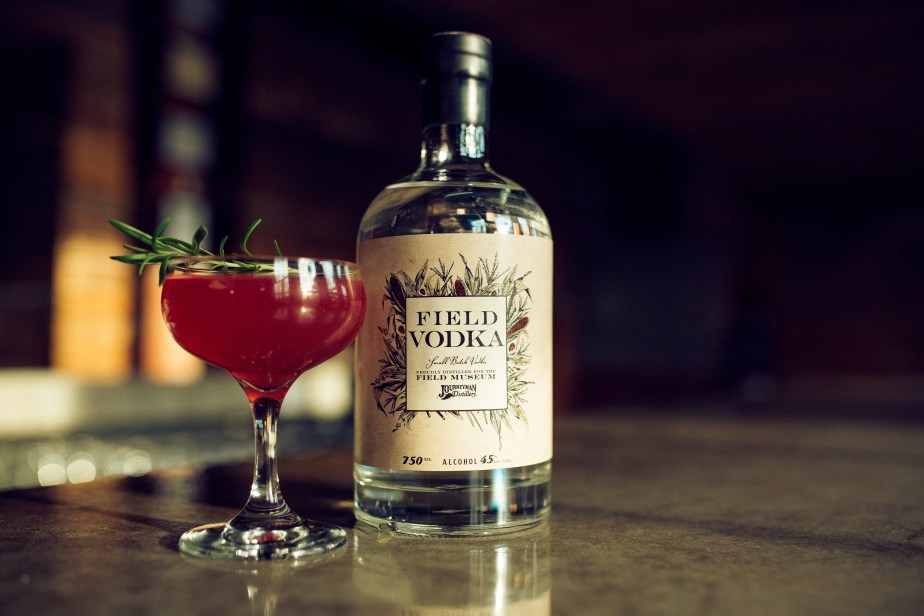
Contacting the Journeyman Distillery in Three Oaks, she invited Matt McClain, Journeyman’s lead distiller and owners Bill and Johanna Welter to view the botanicals to look at the botanicals.
“The first spirit we talked about was rye, that ended up as the last one made,” says Williams. “We asked questions such as what would work well in making gin—what could–out of these 1500 botanicals—and where could we source them.”
McClain spent several months researching the botanicals that were at the museum, to determine their history as well as their availability.
“I found that a lot of them were not considered safe or even poisonous,” he says. “Standards were different back then.”
From there, he and Bill Welter chose those they thought would be a good fit for the spirits they wanted to create.
The first product they created was their Field vodka using Bloody Butcher Corn, an heirloom variety often used for making bourbon. The vodka then served as a base for the next distilled spirit, their Field Gin
“We wanted to make a global gin,” says McClain. “So we were pulling species from around the world. We narrowed it down to around 50.”
But once they had the botanicals and began developing recipes, they had to cross off a few more from the list.
“A lot of botanicals that look and taste good, don’t work where you put them in in alcohol, others that I wanted to use were hard to get or arrived too late, I still have agave in the cooler,” says McClain, noting they used other criteria as well in the selection process. “Bill and I wanted the gin to be lavender focused. Obviously gin also has to have a heavy juniper taste as well. We wanted the gin to have tropical undertones and had to figure out those as well.”
Then they were down to 27 including not only lavender and juniper berries but also prickly ash, anise, mango, ginger, coconut palm sugar, pineapple, papaya, Valerian Root, cinnamon, coriander, Horehound, star fruit and Charoli nuts which are sourced from India.
For their Field Rye Whiskey, they tried several types of figs which McClain describes as the world’s oldest sweeteners, finally deciding that Black Mission figs worked the best. The figs were macerated or soaked in alcohol for three months, a process that brought out subtle and all-natural flavors of bananas, sweet melons and strawberries.
“It’s an incredible whiskey,” says McClain. “It has heavy caramel notes and soft marshmallow like palate.”
Bottles of the Field distilled spirits are available for sale. For those who would like to learn more about their taste, they’re also used in some of the cocktails served at the Staymaker, Journey’s restaurant.
Sidebar: Brews
Beer, which is so Chicago given its rich German heritage, was the first partnership Megan Williams embarked upon when she started her beverage program. Two Chicago breweries, Off Color Brewing and Two Brothers Brewing were among the first to use the botanicals to create beers for the museum. researchers at the Field Museum have spent years excavating and studying the Wari site in Peru. Toppling Goliath introduced PseudoSue pale ale, a nod to the museum’s famous 40 feet long and 13 feet tall at the hip, Tyrannosaurus rex. Physically SUE is the largest specimen T. rex specimen that’s been discovered so far.
Off Color’s introduced Wari, their artisan beer based on the Peruvian chicha, a purple corn beer native to areas of Central and South America. One of its other tie-ins with the museum is that Field scientists have spent years leading excavations at Cerro Baúl, a remote mountaintop citadel which was the only contact point between the Tiwanaku and the Wari, considered two great kingdoms whose dynamic relationship ultimately contributed to the rise of the Incan Empire. According to Off Color’s website, an essential sacrament shared by both cultures revolved around chichi. It seems that both tribes liked to consume massive quantiles of chicha served in ornately inscribed drinking cups called keros that were discovered during the archaeological expeditions at Cerro Baúl. In this way, Wari and Tiwanaku cemented their relationships. In other words, next time you see a bunch of heavy alcohol consumers at bars, understand they’re just continuing a thousand year ritual similar to that of the Wari and Tiwanaku.
The following recipes are courtesy of the Journeyman Distillery.
Journeyman Fig Old Fashioned
1.5 oz Field Rye
0.5 oz Fresh Orange Juice
0.25 oz Journeyman Bourbon Maple Syrup
Dash of Journeyman Barrel-Aged Balsamic Vinegar
Dehydrated Orange Wheel
Stir ingredients and pour into a rocks glass, over ice. Garnish with dehydrated orange wheel.
Field Vodka Gimlet
1.5 oz Field Vodka
.75 oz Fresh Lime Juice
.5 oz Simple Syrup
Fresh Lime Wheel
Shake ingredients well and strain into a tall glass over ice. Garnish with a fresh lime wheel.
Field Gin Fizz
1.5 oz Field Gin
.75 oz Fresh Lemon Juice
.5 oz Pear Simple Syrup
1 oz Aquafaba or Egg White
Soda
Star Anise
Combine ingredients and dry shake before adding ice to the shaker. Wet shake until froth has built up. Strain into a Collins glass and top with soda. Garnish with Star Anise.