ROCK SPRINGS CAFE: A TASTE OF THE OLD URBAN WEST

         At one time a stagecoach stop because of its natural springs creating the ideal place for watering horses and passengers as they crossed the Sonoran Desert, Rock Springs, a chunk of land just north of Maricopa County off Interstate-17, is the site of one of Arizona’s oldest restaurants as well as an iconic salute to the old west.

         It started in 1918 when Ben Warner erected a canvas tent and started selling mining equipment for those digging for gold and silver in the Bradshaw Mountain range. One of the mines, the Tip Top, ultimately yielded over $4,000,000 worth of silver. Now a ghost town with some buildings remaining, at one time the population reached 500.

  Ranching was also big and so even though the stagecoach era was ending, Warner soon had gas pumps and a building that functioned as a hardware store and café with hotel rooms on the top floor. Early Silver Screen actress Jean Harlow—known for her platinum hair—stayed so frequently (why we don’t know but it may be because of the still found on the property signifying that despite Prohibition alcohol could be had here as well as water) that the room where she stayed is now a museum. Cowboy movie star Tom Mix was also said to spend the night.

         I-17 was a sheep trial back then and herds of 20,000 sheep were driven up the dirt trail to Flagstaff. The Rock as it was called had the only telephone in the area. The number, if you needed to call, was Yavapai County #93. The post office was housed in the hotel and Warner was the postmaster until it closed in 1955. There were no tanker trucks delivering gas and so Warner brought it in five-gallon cans. Because cars used a lot of water back then, there were canvas bags that could be filled with water to take along for when the radiator went dry.

         “Cars going up the incline which was made of gravel and dirt would stop here to add water to their radiators,” says Augie Perry who owns the Rock Springs Café outside of Black Canyon City.

         Now you can buy all the hardware you want at one of the big box stores in Phoenix, everyone has cell phones, the hotel is closed, and the rooms where people stayed are now used to sell arts and crafts but much of Warner’s original store remains. The original flooring, timber, and staircase remain as does the reputation for traditional American diner food—steak and eggs, chicken fried steak, liver and onions, fried chicken, and grind the meat for the hamburgers and meat loaf they serve. 

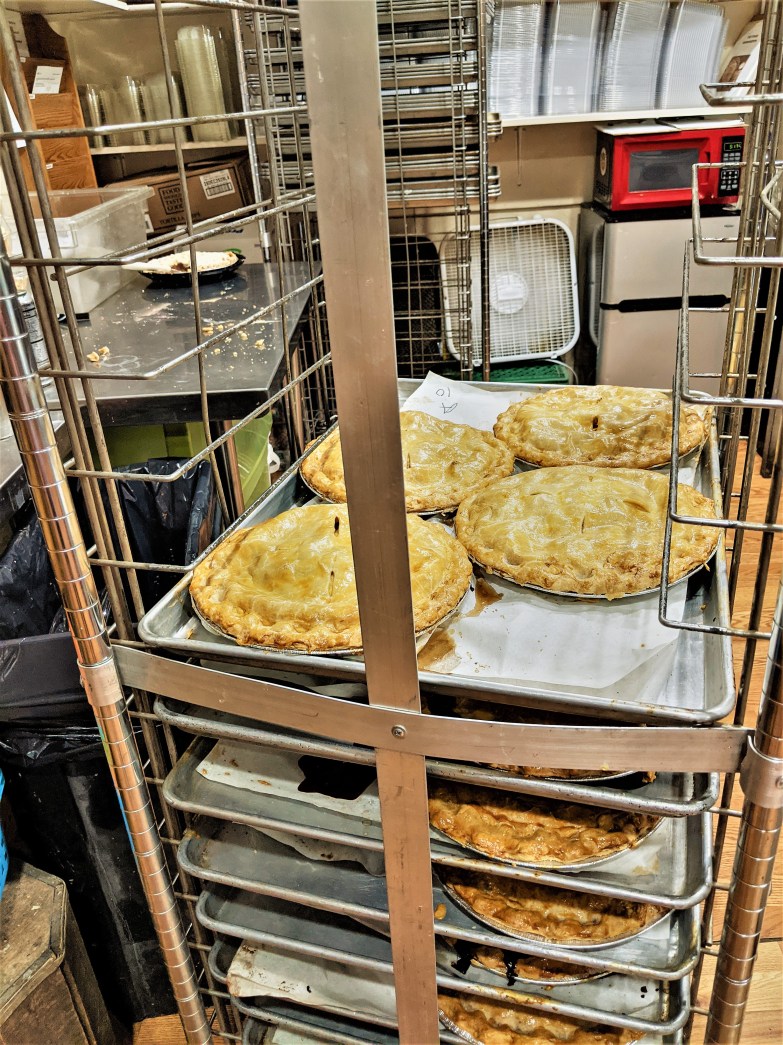
 Mrs. Warner made pies and Perry has kept up that tradition as well but on steroids. Rock Springs Café sells about 120,000 handmade pies a year—their busiest times being around the Thanksgiving and Christmas holidays. During the regular non-holiday week, they sell 250 to 350 pies daily and 500 each day of the weekend. The demand was so high that they started shipping pies about six years ago.

Their most popular pie is the Jack Daniels Bourbon Pecan Pie which Sean Penn ordered when he stopped by a few years back. My favorite is the Tennessee Lemon Pie, but for whatever taste, there’s a pie—chocolate silk, lemon meringue, banana cream, mixed berries, you name it. Their cream pies have a signature top to them—beehive cones that twists up and has been lightly given a pass over with a torch for a slight touch of golden brown atop the peaks. The pie business is so good that Perry, who has a long history as a consultant for large restaurant groups and also owns another eatery in Prescott, Arizona, has just renovated the old stone building where the Warners lived into The Pie Box. It had fallen into disrepair but now will sell pies and other pastries and feature seating areas both inside and out. Another plus, instead of crowding the restaurant and gift shop, people can come and get their pies here.

The property—about 60 acres—is private and it’s a free-range place. For Great Lakes people like me, that doesn’t mean much but in Arizona that translates to cows getting to roam free—which they do. Typically, in the morning they come around to drink from the spring. We haven’t heard of any ordering a pie to go but may be that’s next. They usually are gone by afternoon, maybe because they don’t want to be in vicinity when it comes time to make hamburgers. Because there’s a spring here, the gardens are pretty and lush with flowering plants, grass, and leafy trees. A small collection of historic buildings sells Native American art, organic and freshly grown produce, and specialty foods. There’s a wide selection of foods in the gift shop area of the café as well including cactus candies and other cactus goodies. Another room contains a huge Brunswick Bar built in 1856 and other artifacts from its early history.

Rock Springs in the 1920s and 1930s was what Perry describes as being an “urban western” place with a mix of cars and horses. That’s in comparison to Tombstone which was “frontier western”—pretty much just horses.  Whichever you stumble upon, it’s a refreshing reminder of what the west once was like.
Chicken Fried Steak

1 1/2 cups whole milk

2 large eggs

2 cups all-purpose flour

2 teaspoons seasoned salt

Freshly ground black pepper

3/4 teaspoon paprika

1/4 teaspoon cayenne pepper

3 pounds cube steak (tenderized round steak that’s been extra tenderized)

Kosher salt

1/2 cup canola or vegetable oil

1 tablespoon butter

Gravy:

1/3 cup all-purpose flour

3 to 4 cups whole milk

1/2 teaspoon seasoned salt

Freshly ground black pepper, to taste

 Mix the milk with the eggs. In another bowl, flour with the seasoned salt, 1 1/2 teaspoons black pepper, paprika and cayenne.

 Sprinkle both sides of each steak with kosher salt and black pepper, then place it in the flour mixture, coating on both sides.  Dip in the milk/egg mixture, again coating each side and then dip on both sides in the flour.

Heat the oil in a large skillet over medium heat. Cook the steaks three at a time making sure not to crowd them until their edges turn golden brown, about 2 minutes each side. Drain on paper towels and cover with another plate or tin foil to keep warm. Repeat with the next batch..

After all the meat is fried, pour off the oil/butter/dredgings into a heatproof bowl. Without cleaning the skillet, return it to the stove over medium-low heat. Add 1/4 cup of the oil back to the skillet and heat.

 Sprinkle the flour evenly over the hot oil. Mix the flour using a flour and stir until it turns a deep golden brown color.

Pour in the milk, whisking constantly. Add the seasoned salt and black pepper to taste and cook, whisking, until the gravy is smooth and thick, 5 to 10 minutes. Be prepared to add more milk if it becomes overly thick.

Jack Daniel’s Pecan Pie

 6 servings

1 cup granulated sugar

4 tbsp melted butter

1/2 cup dark corn syrup

3 large eggs, beaten

1 1/2 cup Pecan halves

2 1/2 tbsp Jack Daniel’s

1-9 inch pie shell, unbaked

Preheat oven at 375.

In a bowl, add sugar, melted butter, Jack Daniel’s and stir well.

Then add dark corn syrup, beaten eggs, pecans and stir well.

Place filling into pie shell. Transfer pie onto cookie sheet and place in oven.

Bake at 375 for 10 minutes. Then lower to 350 and bake for additional 25 minutes or until pie has set.

Tennessee Lemon Pie

3 eggs, separated

Zest of 1 lemon

1/4 cup fresh lemon juice

1/4 teaspoon salt

1 teaspoon vanilla extract

1 cup extra-fine sugar, divided

1 9-inch Pure Butter Pie Crust, pre-baked (see recipe below)

In a medium-sized bowl, beat egg yolks for 2 minutes. Add lemon zest, lemon juice, salt and 1/2 cup granulated sugar.

Transfer mixture to a double boiler and cook, stirring constantly, until very thick and a thermometer reads at least 182°F, about 10 minutes. Remove from heat, stir in vanilla and let cool for 15 minutes.

Preheat oven to 350°F.

In a large bowl, beat egg whites with a hand mixer or stand mixer, until stiff peaks form. Add remaining 1/2 cup granulated sugar and beat until just combined.

Fold egg whites into the custard, until just combined. Pour into pre-baked pie crust and then bake for 15 minutes, until pie is set. Top will lightly brown.

Pure Butter Pie Crust

2 1/2 cups all-purpose flour, preferably unbleached

1 cup (2 sticks) butter, unsalted and very cold

1/4 cup buttermilk or ice cold water

1 teaspoon salt

1 teaspoon extra fine granulated sugar

1 teaspoon vanilla extract

Place flour in a bowl of an electric mixer and place in freezer along with mixer’s paddle attachment for at least 20 minutes.

Cut butter quickly in small cubes and place in freezer for 15 minutes.

Combine buttermilk with salt, sugar and vanilla extract and place in refrigerator.

Remove cold flour bowl from the freezer and add butter. With paddle attachment mix mixture on medium speed until butter pieces become smaller than peas and mixture feels like coarse meal.

With machine mixing on low speed add buttermilk mixture very fast and mix just until dough forms. Do not overmix. Chill dough in refrigerator for at least one hour.

Roll dough into desired thickness of about 1/8 inch and use for baking pie. Shapes of leaves can be cut out for pies if desired.

For more information about Rock Springs Café, (623) 374-5794; rocksprings.cafe

IRELAND’S ROMANTIC CASTLES: A LUXURIOUS TRIP INTO HISTORY

Frequented by showbiz royalty and actual royalty alike, Irish castles have long been famous for their ancient history and heritage, their beauty and romance, and with many also offering the ultimate in five-star luxury. What better way to explore Ireland’s past then with an ultimate road trip visiting the following wonderful castles and their gardens.

Dunluce Castle, County Antrim

North Coast Sept 2011

The sprawling ruins of the medieval castle sitting at a cliff edge are all that is left of the fortress that was once the seat of the earls of Antrim. Dunluce Castle was home to rebellion and intrigue over centuries and is said to have inspired CS Lewis to create Cair Paravel, capital of Narnia. Here you might have to share the space with banshees (fairy ghosts) that are said to haunt the ruins.

Glenarm Castle, County Antrim

Since 1636 Glenarm Castle has been an important centre along the spectacular Causeway Coastal Route in Northern Ireland. Here you could relax in the sumptuously decorated lounge while viewing portraits that date from the early 17th century. Imagine strolling through the walled garden and then ending the day with a restful sleep in a four poster bed dating from 1754.

Tullynally Castle, County Westmeath

Tullynully

Overlooking the lake where the legendary Children of Lir were said to swim when they were turned into swans, Tullynally is a beautiful gothic-style castle. With over 120 rooms including the magnificent Great Hall, you would have plenty of space to roam. Outdoors the grounds include a grotto, a walled flower garden, two ornamental lakes and a llama paddock.

Birr Castle, County Offaly

Birr Castle, County Offaly

Indoors and outdoors you’d be surrounded by splendour at Birr Castle. The opulent interior rooms include a Victorian dining room and octagonal Gothic saloon. The gardens are some of the most stunning in Ireland with exotic flowers, waterfalls and lakes and in the grounds sits the fascinating Leviathan telescope, once the largest in existence.

Blackrock Castle, County Cork

Originally built to protect Cork Harbour, imposing Blackrock Castle with its towers and turrets is today home to the astronomical research centre of the Cork Institute of Technology. The castle offers splendid views over the water and you could amuse yourself by spending time at the award-winning interactive astronomy exhibition, Cosmos at the Castle.

Ballynahinch Castle, County Galway

This fairytale castle set against the gorgeous backdrop of Connemara’s Twelve Bens mountain range has been home to some of the most infamous figures of Irish history, among them the pirate queen and chieftain, Grace O’Malley, and the ‘Ferocious O’Flaherty Clan’. The extensive grounds provide an ideal walking area and the evening could be spent curled up in front of an open fire.

www.ireland.com

Hummingbird Lounge: Appalachia cooking Meets New American Cuisine on Michigan’s Sunset Coast.

         Raised in Southern Appalachia in Stagg Creek, a slip of a town tucked in a corner of North Carolina hills and hollows near the Tennessee state line, Shane Graybeal describes the region as “food heaven” and the beginning of his fascination with food.

         “Both my grandparents had farms,” says Graybeal, who after graduating from culinary school at Johnson & Wales University in Charleston, South Carolina worked in France, Italy, Washington D.C. and spent seven years in Chicago working at such well known restaurants as  Bin 36 and Sable Kitchen & Bar. Along the way he was inducted into Chaîne des Rôtisseurs, the world’s oldest, largest and most prestigious food and wine society.

         But he missed small town living and being close to the farms where he sourced his foods.

          “I’ve been a fan of Southwest Michigan for many years,” says Graybeal who now is executive chef at the recently opened Hummingbird Lounge in New Buffalo. “When I was living and working in Chicago, I  sourced a lot from Southwest Michigan.”

         Among the local food producers they use are the Mick Klug Farm in St. Joseph and Kaminski Farms Meats in Three Oaks.

         Another plus for Graybeal was being back in a small town.

         “Though compared to Stagg’s Creek, which has a population of about 300, New Buffalo seems like a big city,” Graybeal adds with a laugh.

         Graybeal describes his food as a “cheffy take on American classics, comfortable food all dressed up.” I loved the description but was surprised to learn that “cheffy” is an actual word meaning relating to or characteristic of a chef.

         His take on food matches the overall philosophy of Hummingbird’s owner and operator Ben Smock who wanted to create a cocktail bar and restaurant that was comfortable and “served food you want to eat.” The lounge opened in April and is located in what had been a grand home built in 1901 that once housed a creperie in  New Buffalo.

         Smock has an extensive background in the food industry starting when he worked at his grandfather’s bowling alley in Davison, Michigan where he grew up. He graduated from Michigan State University’s hospitality program, worked at McCormick Place, Levy Restaurant group and the Ravinia Music Festival and started his own consulting business where he provided food service planning and events. He’s also opened a number of venues.

         The menu changes frequently, depending on what’s in season. Graybeal was excited because the first peaches were hitting the market along with blueberries and raspberries.

         “I’m thinking fruit cobblers,” he says.

         He also brings a bit of Appalachia to the menu.

         “Food is very important there,” he says, making one want to jump in a car and head south to see what he’s talking about. “And I think in the right context—pickling, charcuterie, foraging–it comes across very well.”

Earlier in the season, he took ramps, cut them into a tiny matchstick size and flash fried the garlicky wild greens to add to an asparagus dish. We’re guessing that the round super thin pickled with cherry Kool-Aid hails from the mountains as well—and they’re delicious.

Graybeal also made ramp vinegar which he now uses in some of his dishes. Now with fresh Michigan peaches available, he makes a jam to pair with pork, but kicks it up a notch with the addition of jalapeno peppers.

But, he notes, the food is a side note to the cocktails and what’s on the menu are more like a tapas bar—nibbles that are share,able. The Lounge’s cocktail team takes what Graybeal is preparing in the kitchen and concocts drinks to accent his flavors.

The cocktails—which also change frequently—have in the past included a Smoked Pineapple Margarita, a tequila based drink with seasoned and smoked pineapple and salted foam, The HRG Manhattan using Traverse City Whisky Company blend along with sweet Vermouth, Angostura bitters and a fancy cherry and A Real Dandy Old Fashioned with rum, demerara syrup, bitters and expressed orange. For those who don’t drink, there are spirit-free cocktails. There’s also a small wine list offering by the glass or bottle and local brews.

         Why did they name the place Hummingbird? Smock says they chose it because hummingbirds drink all day and it just fit because they are open throughout the season. For warm weather dining, there’s a large back porch and garden area. The garage has been redone and is now an inviting event space. The interior of the restaurant itself is very cozy with a curated antiquated feel to go with the history of the home including a fireplace flanked by columns, its mantel topped with a large mirror and coach lanterns, cozy rooms, polished wood floors, and the deep gray walls are accented with lots of white woodwork. The bar is sleek—less Victorian and more urban trendy which makes for a nice contrast.

Chef Graybeal’ s Pork and Peaches

Rub pork belly with salt, sugar, and vanilla powder. Place in pot. Cover and marinate overnight. The next day cover with lard and cook on low heat for three to four hours. Cool and then crisp up in a hot pan until golden brown and tender.

Peach Jam

Cook together for two hours, them finish with a squeeze of lime juice. Puree in blend until smooth and cool.

To serve—crisp the pork belly, put two ounces of jam on a warmed plate, top with the pork belly, slice a peach and toss with aged sherry vinegar, basil, parsley and mint and a little olive oil. Place on top of the pork.

Beef Skewers with Whipped Feta

For the Beef Skewers:

Grind the brisket, combine with the other ingredients and whip with the paddle attachment. Form into balls and then into long rolls, place each roll on a skewer.  Grill for six minutes on both sides.

For the Whipped Feta:

Combine in the mixer, whip using the the whip attachment until light and fluffy-like similar to icing.

Just for fun, I thought I’d include a recipe for Kook-Aid brined veggies.

Trish Yearwood’s Fruit Drink Pickles

Drain the brine from the pickles into a bowl. Add the fruit drink packet and sugar into the brine and stir until dissolved. Pour the brine back to the jar, discarding any that’s leftover. Refrigerate at least 2 days and up to 1 month.     

Historic Swiss Journeys

 Travel back into the past by car or aboard the Treno Gottardo, a VIP train trip along an ancient trade route that crosses the fantastical Gotthard Pass, a north south journey connecting the German speaking region of Uri to the Ticino, the Italian speaking area of Switzerland.

Prehistoric Pile Dwellings in the Alps

In 2011, the UNESCO World Heritage Committee added the remains of prehistoric pile-dwelling also known as stilt house settlements in and around six Alpine countries that were built from around 5,000 to 500 B.C. on the edges of lakes, rivers or wetlands to their list.

The sites provide glimpses into what life was like in prehistoric times during the Neolithic and Bronze Age in Alpine Europe as well as the way communities interacted with their environment. In an exciting new find, archaeologists diving in Lake Lucerne discovered pile dwellings from the Bronze Age.

Exploring Roman History           

Augusta Raurica near Augst/Kaiseraugst, a 2000-year-old settlement on the southern bank of the Rhine, is located near the beautiful city of Basel. Named after the Celtic Rauriker tribe and the Roman Emperor Augustus, the city at its peak had a population of around 20,000 with workshops, commercial enterprises, taverns, temples and public baths closely strung together. Because no new towns were established during the Middle Ages or our modern area, Augusta Raurica is amazingly  well-preserved.

Visitors can view the myriad of wonders discovered here like the largest silver treasure dating from Late Antiquity, a Roman domestic animal park with ancient animal species, and the architectural remnants of the city, the museum offers great insights into the daily lives of the people who lived here around the time of Christ’s birth.

1821—Napoleon’s End

On May 5 was the 200th anniversary of the death of Napoleon I on the island of St. Helena, where he was placed in exile. His stepdaughter Hortense des Beauharnais also lived in exile at Arenenberg Castle and Napoleon Museum in Switzerland.

As the only German-speaking museum on Napoleonic history, a special exhibition during the “Année Napoléon 2021” will take place from October 10-24, 2021, showing the long lasting influence of Napoleon on Switzerland even today.

Inventing Milk Chocolate

Food and beverages reflect a country’s culinary traditions and customs. Many of today’s Swiss cheese brands go back to the 12th century, but Daniel Peter’s much newer creation in 1875 really took the world by storm—a passion that continues today. Peter was able to solve the problem of how to combine chocolate and milk. Most Swiss cities offer chocolate tours and several chocolate brands features visitor experiences.

Newly Restored LGBT Pioneer’s Spectacular Painting Returns to Monte Verità

After a lengthy restoration, the super large circular painting “Il Chiaro Mondo dei Beati” or “The Clear World of the Blessed”  by Estonian artist and LGBT pioneer Elisàr von Kupffer (1872-1932) is on display at the Monte Verità museum complex located in southern Switzerland near Ascona.

Ballenberg

Instead of destroying more than one hundred historic buildings, many of them farmhouses, were instead carefully taken dismantled and rebuilt at the Ballenberg Swiss Open-Air Museum.

The museum is nestled in the beautiful pastoral landscape of the Bernese Oberland and can be reached by bus from Brienz. The many hands-on activities were created to provide insight in old traditional crafts like forging, weaving, and herbal medical treatments

Destination Kohler Opens The Baths of Blackwolf Run

Destination Kohler–one of the world’s foremost golf resorts and home to four Pete Dye championship courses–unveils The Baths of Blackwolf Run, the resort’s unique and entertaining 10-hole, par-3 course.

Spread across 27 acres between the first and 11th holes of  Meadow Valleys, The Baths of Blackwolf Run offers holes ranging from 60 to 160 yards and four strategic water features, or “Baths,” situated throughout that are not forced carries unless desired. Although the course will play as a 10-hole course, The Baths’ imaginative routing allows for flexible alternatives for shorter or longer golf experiences.

Adding to the atmosphere, The Baths features a two-acre putting course, plus a log cabin food-and-beverage station with outdoor seating and a firepit surrounding the opening Bath.

Chris Lutzke and Herb Kohler designed the Baths. Lutzke spent over 30 years working alongside Pete Dye as he constructed many of his courses, including the two at Whistling Straits. Over the past three years, Lutzke prepared The Straits  for the Ryder Cup, which will be contested Sept. 21-26, 2021.

Mr. Kohler, Executive Chairman of Kohler Co., has over 200 product design patents. He helped bring the course to life by calling upon his many years playing the game’s great courses in the U.S., U.K., and Europe. He also recognized a larger trend occurring within the sport of creating short layouts that promote more enjoyment for golfers of all skill levels.

“We look for ways to enhance the golf experience and grow the game for all golfers” Kohler says. “The Baths complement our four world-renowned championship golf courses while also honoring Kohler Co.’s 130-year history of bathing design. We are delighted to officially open this exciting and unique course.”

“The Baths will be a new twist for our resort guests, regardless if they are a serious player wanting to hone their game or someone yearning for an extraordinary closer to an amazing day on one of our 18-hole golf courses,” adds Dirk Willis, Vice President of Golf for Kohler Co. “Our continued mission is to find new and innovative ways to grow the game and make it more inviting and accessible to all. The Baths of Blackwolf Run allows us to do just that.”

Kohler Golf ushered in championship golf in the state of Wisconsin when it hosted the 1998 and 2012 U.S. Women’s Open at Blackwolf Run, along with the 2004, 2010, and 2015 PGA Championships at Whistling Straits.

The historic American Club is the Midwest’s only Forbes Five-Star and AAA Five-Diamond resort hotel. The nearby boutique Inn on Woodlake  recently launched new two- and four-bedroom suites that are well-appointed for group and buddy travel.

Tee times at The Baths can be reserved by calling 800-344-2838 or visiting the resort’s golf booking page. For golf package information, call 855-444-2838. Visit DestinationKohler.com for more information.

About Kohler Co.’s Hospitality & Real Estate Group
The Kohler Co. Hospitality & Real Estate profile includes The American Club and world-renowned championship golf venues Whistling Straits and Blackwolf Run. The Inn on Woodlake in the Village of Kohler is a three-diamond property. Their sister property, the Old Course Hotel, Golf Resort & Spa in St. Andrews, Scotland, is located at the birthplace of golf literally alongside the 17th fairway of the Road Hole, the most famous and difficult par-4 hole in golf.

Herb Kohler created Kohler Co.’s Hospitality & Real Estate Group with the reclamation of The American Club and then built world-renowned championship golf courses, The Straits and The Irish at Whistling Straits, and The River and Meadow Valleys at Blackwolf Run. Kohler Waters Spa is the only five-star spa in Wisconsin and has four locations elsewhere in the world. The resort features 12 dining establishments from the remarkable Immigrant Restaurant and Winery Bar to pub fare at The Horse & Plow. And then there is River Wildlife. Herb Kohler believes River Wildlife, located in a forest next to a river on an early Winnebago Native American encampment, has the best country gourmet dining in the United States.

The resort is located in the Village of Kohler, Wisconsin, one hour south of Green Bay, one hour north of Milwaukee and two and a half hours north of Chicago, just off of I-43.

Recipes

Kohler’s is known for the wonderful food served at its many restaurants. Here are two recipes from Kohler chefs Paul Smitala and Evan Wallerman that showcase the creativity of their foods.

Bloody Mary Eggs Benedict

  • 4 slices of English Muffins
  • 8 slices applewood bacon (cooled and chopped)
  • 1 cup mushroom duxelles (recipe below)
  • 1 cup Bloody Mary Hollandaise Sauce (recipe below)
  • 4 poached eggs

Toast English muffin and cover with 1/2 cup mushroom duxelles that has been warmed.

Top with poached eggs, cover with hollandaise sauce and finish with chopped bacon.

Bloody Mary Hollandaise

  • 4 egg yolks
  • 1/2 pound butter (melted and warm)
  • 1 shallot, minced
  • 1 clove garlic, minced
  • 2 teaspoons celery salt
  • 1 1/2 teaspoons horseradish
  • 1 tablespoon Worcestershire Sauce
  • 1 teaspoon Tabasco
  • ½ juice of one lemon juice
  • 2 cups + 2 teaspoons horseradish vodka
  • 1/4 cup tomato paste
  • Salt and pepper

In a 2 quart sauce pan, combine shallot, garlic, horseradish, Worcestershire sauce, tabasco sauce, tomato paste and vodka. Heat on medium, allow to flame and reduce to one cup and strain through a fine mesh sieve.

In a separate pan, melt the butter and keep warm.

In a 2 quart sauce pan bring 1 inch of water to a simmer, place a bowl on top of pan to make a double boiler. Add the 4 egg yolks and reduced liquid to the bowl and whisk until the mixture thickens slightly. Do not let the water boil.

Slowly stream the melted butter into the yolk mixture while whisking constantly until all the butter is incorporated.

Add the 2 tablespoons of vodka, celery salt, lemon juice, season to finish with salt, tabasco and Worcestershire to taste.

Mushroom Duxelles

  • 2 ounces olive oil
  • 2 ounces shallot, chopped
  • 1 1/2 pounds button mushrooms ( 1/2 diced, 1/2 finely chopped)
  • Salt and pepper

Melt butter in pan. Add the shallots and sweat. Add the mushrooms to the pan and cook until they are browned and dry. Add salt and pepper to taste.

Poached Eggs

  • 4 fresh eggs
  • 1 quart water
  • 2 teaspoons vinegar
  • 1 teaspoon salt

Bring water, vinegar and salt to boil and reduce to simmer.

Break eggs into separate cups. Carefully pour eggs into water. Cook for 3 minutes or until whites set up. Serve immediately or cool in ice water bath.

Sweet Potato, Beer and Bacon Waffles

  • 2 cup all-purpose flour, sifted
  • 1/2 cup white sugar
  • 1 1/2 teaspoon baking powder
  • 1 teaspoons salt
  • 2 eggs, beaten
  • 2 cups beer
  • 4 teaspoons butter, melted
  • 1 cup Neuske’s bacon,
  • 1/2 cup sweet potato puree

In a large bowl, stir together the flour, sugar baking powder and salt. Pour in the sweet potatoes, egg, beer and melted butter; stir with a whisk just until blended, a few lumps are okay. Fold in cooked bacon.

Heat a waffle maker to desired temperature. Follow directions on your specific waffle maker. Coat with vegetable oil or cooking spray. Spoon about 1/4 cup of batter onto the hot surface for each specific waffle maker.

Chipotle Maple Butter Sauce

  • 2 cups chicken stock
  • 6 teaspoons roux (3 teaspoons butter, 3 teaspoons flour
  • 1 teaspoon garlic cloves, chopped
  • 1 cup heavy cream
  • 1 teaspoon chipotle peppers, chopped
  • 1/4 cup Wisconsin maple syrup
  • 1/4 cup butter

In a sauce pan over medium heat, melt 3 tablespoons butter and stir in 3 tablespoons flour.

Cook for 2 minutes. Whisk in chicken stock and heavy cream, bring to a boil and reduce heat to a simmer. Add Chipotle Peppers and Wisconsin Maple syrup, simmer for 20 minutes.

Whisk in 1/4 cup butter.

Use on waffles.

View Point: HISTORY AND LUXURY AT NEW HAMPSHIRE’S MOUNTAIN VIEW GRAND RESORT

Tucked in New Hampshire’s White Mountains, the Mountain View Grand Resort waits as a classic place to slow down.

When I was young, my family and I traveled along back roads that twisted through rolling hills and historic hamlets as we made our way to grand hotels dating back to the late 1800s. Once there, we’d swim, ride horses and play games such as horseshoes and croquet. But as I grew, these journeys to sprawling old resorts gave way to trips by airplane to big cities, sleek hotels, museums and shows.

And so those distant days seemed irretrievable, a way of vacationing that belonged to a different time. That is until I once again followed a winding country road through the small towns of the White Mountains and arrived at the Mountain View Grand in Whitefield, New Hampshire.

In the late 1800s, the U.S. had more than 1,000 summer resorts, many like this wood-framed escape with its towers, porches and neatly clipped green lawns. Now the 144-room Mountain View Grand, where luminaries such as Mark Twain, Teddy and Franklin Roosevelt, and Babe Ruth stayed, is just one of a handful remaining.

Its luxury is based on old-fashioned style: the attendant-operated elevator, the uniformed bellmen, the arched doorways, the long veranda. Always supercharged, I grow at ease sitting there while I sip Apple Blossoms, fresh cider mixed with local honey, and watch the night mists gather over the mountains. It’s easy to slow down among details that bespeak a time gone by.

The activities that attracted visitors long ago are still part of the resort’s offerings as well. The nine-hole golf course was designed in 1900. The clubhouse was built in 1939. The heated pool was dug in 1946, and the tennis courts were added about the same time.

I opt for taking walks through the extensively landscaped gardens and kayaking on Martin Meadow Pond, where loons provide the day’s soundtrack. And while on a trail ride through the hills, I look for wild turkey, deer, moose and black bears.

Before Mountain View Grand became a hotel, in 1865, it was the Mountain View Farm. And even after the transition, the original owners still relied on their farm to feed guests. Harkening back to those days, the menus in the resort’s four restaurants reflect what is raised here as well as from food producers nearby.

And in another throwback to the resort’s farm heritage, wool is spun from the hair of Mountain View Barn’s alpacas, goats and angora rabbits and sold at the front desk.

Although there’s reverence for the past, there’s respect for the present, too. A wind turbine supplies some of the resort’s electricity. There’s not one stoplight between here and the Canadian border an hour away, but my cell phone signal is strong.

Each day I order a latte, sit in the antique-filled lobby and tap away on my laptop while using the free Wi-Fi. And I get a deep-cleaning facial at the resort’s Tower Spa with its panoramic view of the mountains, one of the many amenities that  has resulted in the resort being award the AAA Four Diamond status since 2002.

On my last day as I drive down Mountain View Road, I turn for a final look at the expansive resort with its green shuttered windows that offers a way to span the centuries and feel at home all in one.

>> Mountain View Road, Whitefield, N.H., 866-484-3843, mountainviewgrand.com

 Depending Upon the Season

Fall | When the 1,700 acres of rolling hills become a confetti of jewel colors, saddle up for a guided trail ride on horseback.

Winter | Become a musher as snow blankets the pine forests, or travel like days of yore in a horse-driven sleigh.

Spring | As the sap rises in the spring, learn about tapping trees and making maple syrup, one of the agricultural programs.

Summer | Head out on the property to search for moose with an experienced guide as dusk falls on a soft evening.

If It Was Good Enough for P.T.

Travel to the top of the mountain the old-fashioned way aboard The Mount Washington Cog Railway, the first mountain-climbing cog railway in the world.  “The Second Greatest Show on Earth!” proclaimed P.T. Barnum who rode to the highest point in the Northeast in 1869 when it first opened.

Close By and Not to Be Missed

Voted one of the America’s Best Little Small Town, Littleton, located on the banks of the Ammonoosuc River, is a delight of history, trendy shops, great green spaces, and public art as well as lots of walking paths within town including its River District, along the Ammonoosuc of course, that encompasses the multi modal bridge on Bridge Street through the Apthorp District on Union Street and beyond into Bethlehem via the Rail Trail. Eleanor Porter, author of Pollyanna, lived here and a statue of her title character celebrates her books and the joy of always looking on the good side of life–making Littleton a happy city.

The Littleton Grist Mill, established at the end of 1700s, is now home to Schilling Beer Co. Located right on the flowing river, it’s a step back into history.

While walking through the historic downtown, make sure to take time to check out Thayer’s Inn, built in 1850 and located on Main Street. Candy lovers will love Chutters, a candy store dating back to the late 1800s with the original 112 feet of the original Guinness World Record candy counter.

Dinner is Served

Considered to be one of the most popular menu items at the Mountain View Grand. This recipe serves 6 people.

Ingredients for the Beef Ribs

  • 12 lbs of bone-in beef short ribs, cut between the bones into 6 ribs
  • 4 tbsp Kosher Salt
  • 4 tbsp ground black pepper
  • 2 cups blended olive oil

Cooking Instructions

Preheat oven to 375*F. Heat oil in a large sauté pan until shimmering. Season beef ribs heavily with salt and black pepper and sear ribs, one or two at a time, on all four sides until well browned. Arrange ribs evenly in a deep oven proof pan.

Ingredients for the Braising Liquid:

  • 46 oz V-8 juice
  • 20 oz tomato juice
  • 32 oz beef broth
  • 12 oz tomato paste
  • 4 cups of cabernet sauvignon wine
  • ½ cup cornstarch mixed with cold water
  • ¼ cup chopped garlic
  • 1 Spanish onion, cut into chunks
  • ½ bunch of celery, cut into chunks
  • 2 carrots, cut into chunks
  • 4 bay leaves
  • ½ oz fresh thyme

Cooking Instructions

Combine the liquids into a large stockpot with a wire whisk. Add the cornstarch slurry and the chopped garlic, along with the tomato paste and mix well. Pour over the beef ribs, until they are almost covered. Any extra liquid can be reserved for later. Top the rib mixture with the chopped vegetables, bay leaves and fresh thyme. Add a sheet of parchment paper to the top of the ribs and wrap with aluminum foil. Place in preheated oven for approximately 3 hours. Check ribs with a pair of tongs. The meat attached to the ribs should be almost falling off the bones and very tender to the touch. Remove beef ribs to a platter and keep warm.

To make the sauce; strain the liquid through a sieve or colander lined with cheese cloth, pressing down on the vegetables to extract as much flavor as possible (you can discard vegetables, or eat them, they too are delicious!). Heat the sauce with any reserved braising liquid in a saucepan on the stove and reduce until the sauce is thickened and coats the back of a spoon. Season to taste with additional salt and black pepper as needed.

Ingredients for the Red Onion Straws

  • 1 large red onion, thinly julienned
  • 1 ½ cups buttermilk
  • 1 ½ cups of flour
  • 2 tsp salt
  • 1 tsp black pepper
  • ½ tsp paprika
  • 3 cups vegetable oil for frying

Cooking Instructions

Slice red onions thinly and soak in buttermilk for at least 1 hour (this step can be done a day before you need them).

To fry onions, heat oil to 350*F on the stove with a frying thermometer. Combine flour, salt, black pepper, and paprika in a bowl until well combined. Flour should have a pinkish hue to it (if not, add more paprika). Drain red onions and add to flour and mix well. Sift carefully and add to the hot oil in small batches. Remove golden brown onions with a wire skimmer and drain on a plate lined with paper towels. Repeat the process until you have fried all the onions.

To serve the beef ribs, set up warm plates with your choice of starch and vegetables. Top each plate with a hot beef rib, cover with the cabernet sauce and top with onion straws. For some color you can garnish with your choice of parsley, rosemary, thyme, or pea tendrils.

SAVOR THE SAN JUANS: A TASTE OF THE PACIFIC

An archipelago of islands off the coast of Washington State, there are 172 named islands and reefs in San Juan County but the main three–all with ferry service–are San Juan Island (with the county seat Friday Harbor), Orcas Island, and Lopez Island. Not only are they the most populous but each offers a myriad of lodging, dining, and activities for visitors.

The 13 defining tastes of the San Juan Islands are salmon, heritage fruit, foraged botanicals, shellfish (think oysters and clams), crab, lamb, Mangalitsa Pork, seaweed and salt, lavender and hops, cider and apple brandy, grains, goat cheese and white wines.

Here’s a sampling of what visitors can find:

Spiced apple with chocolate and pumpkin cream-filled doughnuts. Cardamom buns. Buckwheat tahini chocolate cookies. Savory brioche tarts with leek, chevre, and kabocha squash. All of the ingredients for these mouth-watering pastries? Entirely sourced locally by creator and owner of new Seabird Bakeshop, Brea Currey, from Orcas Island farm stands like West Beach and Maple Rock, eggs from neighborhood chickens, and flour from Fairhaven Mills in Burlington. Since September, Seabird Bakeshop has been thriving on Orcas Island where chefs are thinking creatively about how to bridge food and entrepreneurism during the time of coronavirus. Thus far, Currey’s success is, among other things, a testament to the power of baking as a 2020 survival strategy on Washington’s farm-to-table captivated island. Find Seabird on Facebook and Instagram: @seabirdbakeshop

 Myers Creamery on Orcas Island, Quail Croft on San Juan Island, and Sunnyfield Farm on Lopez Island all are expect at making fresh chevre, herbed cheeses, washed-rind and aged cheeses, all of which can be found at each island’s farmers’ markets, and at the Orcas Island Food Co-op and the San Juan Island Food Co-op. Following the seasons, goat cheeses start out fresh and creamy in springtime when the goats graze on spring grass. As the grass matures, so does the flavor of the cheese, until at the end of fall, the cheeses are more intense, earthy and, dare we say, “goaty.”

Cold pressed cider. Small batch granola. A box full of farm-fresh greens. Locavores, look no further: the newly aggregated Washington Food and Farm Finder features 1,700 farms, farmers markets, and food vendors with offerings “grown, caught, raised, or made” across the state. Find San Juan Islands favorites like Ursa Minor, Madrone Cellars, and Buck Bay Shellfish Farm. The guide has filters for pickup or delivery services, markets, food trucks, or specialty food and beverage locales. Icons designate sustainable fishing or animal welfare certifications, as well as veteran-, woman-, and BIPOC-owned businesses. For more information: https://eatlocalfirst.org/wa-food-farm-finder/

Island makers Girl Meets Dirt and Madrone Cellars & Ciders are winners in the annual Good Food Awards for 2021. Madrone’s Barrel-Aged Currant took top prize in the Cider category. Girl Meets Dirt has winners in both the Preserves and Elixirs category. Their Rhubarb Lavender Spoon Preserves are a great choice for charcuterie. The Rhubarb shrub and Shiro Plum Tree bitters give some extra oomph to your signature cocktails. Shop Girl Meets Dirt winners here: www.girlmeetsdirt.com/shop and Madrone Cellars here: https://madronecellars.com/

Local favorite San Juan Sea Salt is rolling out a new line of flavored salts: the Deli Series, starting with Everything but the Bagel. All the yum of everything bagels, none of the carbs! Try this on avocado toast, mixed with your breading for fried chicken, and snacking on it straight from the jar! Everything but the Bagel joins the Dill Pickle Salt as an homage to class deli flavors. The Dill Pickle Salt is a tangy, dilly, zesty, garlicky salt with just the right magic to give your mouth the déjá vu feeling of crunching into a darn fine pickle. Find these and others here: www.sanjuanislandseasalt.com/online-store/NEW-c48889151

Buck Bay Shellfish Farm

Buck Bay Shellfish Farm on Orcas Island is a hidden gem where you can stop in for a couple of pounds of fresh clams or oysters, or you can while away a whole afternoon shucking oysters and drinking wine (BYOB) while looking out over the serenity of Buck Bay just yards away.

New owners Eric and Andrea Anderson rebuilt the docks and oyster shack at Westcott Bay Shellfish Farm on the north end of San Juan Island. They’ve also linked the property to trails connecting to English Camp, making their shellfish farm a destination for hikers and bicyclists as well.

Island wineries produce light, refreshing whites that pair well with seafood and other San Juan specialties. Owners Yvonne Swanberg of San Juan Vineyards, and Brent Charnley of Lopez Island Vineyards grow and makes Siegerrebe and Madeleine Angevine from their estate vineyards.

OLYMPUS DIGITAL CAMERA

Westcott Bay Cider, one of the oldest cideries in the state of Washington, ferments three types of ciders from the “bitters” and “sharps” from their orchard, from traditional dry to medium-sweet styles. The cider is then distilled into a clear eau-de-vie and aged in wine barrels.

Orcas Island Cider and Mead Festival has drawn two dozen cider and mead producers from throughout the region.

Local farmer Brady Ryan started San Juan Island Sea Salt, made by collecting salt water from the Salish Sea and drying it in special bins to retain the fluffy white crystals that are then flavored with such botanicals as smoked madrona bark, dried kelp, lemon peel and various dried herbs.

In any list of definitive island flavors, lavender deserves its own category, partly because it is a cultivated botanical rather than a forged one. But it’d also an important part of island culture.

Pelindaba Lavender Farm has been growing lavender and creating lavender products for almost 20 years. At the farm, you can stroll the lavender fields, learn about how lavender oil is extracted and distilled into almost 250 products made onsite, including many food products such as lavender teas, salad dressings, ice cream and herbal rubs.

Island grown hops are used in the beers made by Orcas Island’s Island Hoppin’ Brewery, adding floral and bitter notes and a local touch to these tasty beers. You can visit the brewery and tasting room just outside of Eastsound.

Chef Geddes Martin, owner of the Inn at Ship Bay, raises his own Mangalitsa hogs in partnership with his friend and farmer, John Steward of Maple Rock Farm and Hogstone’s Wood Oven. Mangalitsa is a breed that’s known as the “hairy pig that is the Kobe beef of pork,” with more flavor and marbled fat than standard industrial-raised pork, and makes for amazing pork belly or pork loin.

CHURROS AND CHOCOLATE: THE PERFECT END TO AN EVENING IN MADRID

In Madrid, we take a cobblestone street down a narrow street between Plaza Mayor and Puerta del Sol to El Pasadizo San Gines and happen upon Chocolatería San Gines, the oldest churro shop in the city, having opened in 1894. There are two shops, just across the way from each other and both have long lines. But it’s our last night in Madrid and we are willing to wait. Ordering our churros and chocolate along with cups of coffee we find a outdoor table and sit down to wait–impatiently–for our treats. The churros when they are arrive are thick ropes of sugar coated dough fried to a golden brown and hot to the touch. We tear off chunks and dip them in deep bowls of thick rich chocolate and then taste. Sublime.

I think of churros as originating in Spain where they may have first been by shepherds, their name coming from the horns of the Churra sheep they tended. In turn the Spaniards, when they invaded Mexico, brought along their foods including churros and  buñuelos–a similar dish. Churro and chocolate shops are now common throughout Mexico. But their history may be more complicated as Portuguese sailors returning from China may have carried the recipe for youtiaos, another fried bread snack.

It’s close to midnight when we finally finished but this being Madrid the streets were just a lively and people still stood in line for their churros and chocolate.

Back in the U.S., I was desperate for my churro fix. Fortunately, there’s Take & Bake Churro Kit from San Diablo Artisan which beats making these treats from scratch. The company says they’re the only churro kit maker in the country making it a one-of-a-kind gift. There’s no messing with dough, making your own filling or frying them up. Instead, the kit contains 13 pre-made and chilled mini churros already fried to a golden brown and dusted with sugar and cinnamon as well as a selection of fillings such as Nutella, dulce de leche or sweet cream already packaged in squeeze bottles. Just fill the churros and pop in the oven or air fryer to reheat.

For the real foodie who wants to do a deep dive into churro making, San Diablo Artisan, a Utah based company, also sells churro dough so you can roll your own. And if you want to go all out when it comes to making churros, you can buy their recently introduced kit with a churro maker and nine different shapes of interchangeable nozzles.

San Diablo Artisan Churros specializes in creating artisan-filled churros for special events and celebrations. The proprietary, award-winning churro dough recipe is made from scratch and fried on-demand. The fried golden brown, hollow-centered churros are filled with “happiness”—gourmet fillings of choice. In a relentless search for churro perfection, the menu has expanded to include seasonal flavors, savory churro offerings, and nationwide at-home delivery. San Diablo members enjoy outstanding quality artisanal food that is undeniably fresh, delicious, and delivered with a unique style of fun. Like their Artisan Churros, San Diablo is filled with social good: supporting local, national, and international non-profit causes. 

Barefoot Contessa Foolproof: Recipes You Can Trust

You buy the ingredients, maybe spending a little more than you should – but the recipe looks great and you’re having friends over you want to impress. Back home in your kitchen you start cooking following the recipe step-by-step. It should be perfect but it’s not. There’s too much liquid in the cake batter, not enough flavor in the soup and despite the amount of time cited for cooking the duck, it’s done and getting dry in half the time.  In other words, the meal is a mess. That’s one reason why Ina Garten, the Barefoot Contessa of Food Network fame and accomplished cookbook author, has always been one of my favorites. And so I was glad when my friend cookbook publicist Carrie Bachman who represented Barefoot Contessa Foolproof: Recipes You Can Trust (Clarkson Potter $35), sent me a copy and set up a phone interview so I could chat with Garten about the book. That was back in 2013 and Garten now has added even more cookbooks to her list including the recently released Modern Comfort Food, but I still rely upon Foolproof to ensure that my time and groceries don’t go to waste.

“People look at a recipe and think if you just follow it, it’ll come out perfectly every time,” says Garten, who interestingly, majored in economics in college. “But every time you make something, the ingredients are a little different or you have another way you want to try it. So it’s a lot like driving a car; you have to make small adjustments along the way.”

That’s why Garten often tests each of her recipes 25 times and also has an assistant try them as well. She wants those who watch her shows or buy her cookbooks to always a meal they’re proud to serve and, even better, enjoy eating. Indeed, Garten wants her recipes to be foolproof.  

Foolproof was her eighth cookbook and anyone who owns one or more of her Contessa books such as Barefoot in Paris: Easy French Food You Can Make at Home and Cook Like a Pro, is used to the style – sleek pages, vivid photographs (150 in this book), and flavorful and creative recipes written in a clear easy-to-follow prose. As on her TV shows, Garten doesn’t just present recipes perfect for recreating successfully at home, she also shares how to plan a menu, coordinating food times so everything is done at once as well as notes on where a recipe can go wrong and how to make a dish in advance. 

 “I want recipes that I know will come out perfectly every time,” says Garten. “Cooking is hard, it takes a lot of ingredients, you go shopping, you cook, you clean up. a lot of ingredients, you go shopping, you cook, you clean up. You can get free recipes anywhere, so why should anyone want to buy a cookbook? What makes it worthwhile and worth the price? It’s the level of confidence in the writer. One of the things I’ve always strived for is recipes that work every time. You feel confident that this recipe is good, but also that you trust it.”

Balsamic Roasted Brussels Sprouts

Serves 6

  • 1½ pounds Brussels sprouts, trimmed and cut in half through the core
  • 4 ounces pancetta, sliced ¼ inch thick
  • ¼ cup good olive oil
  • Kosher salt and freshly ground black pepper
  • 1 tablespoon syrupy balsamic vinegar (see note)

Preheat the oven to 400 degrees.

Place the Brussels sprouts on a sheet pan, including some of the loose leaves, which get crispy when they’re roasted. Cut the pancetta into ½-inch dice and add to the pan. Add the olive oil, 1 ½ teaspoons salt, and ½ teaspoon pepper and toss with your hands. Spread out the mixture in a single layer.

Roast the Brussels sprouts for 20 to 30 minutes, until they’re tender and nicely browned and the pancetta is cooked. Toss once during roasting. Remove from the oven, drizzle immediately with the balsamic vinegar, and toss again. Taste for seasonings and serve hot.

Note:

You can buy aged balsamic vinegar that’s syrupy—and very expensive—or you can boil good balsamic vinegar until reduced to half its volume and it will become syrupy as well.

Ultimate Pumpkin Pie with Rum Whipped Cream

Serves 8 to 10

“Pumpkin pie can be boring and dense so I set out to make a better pumpkin pie,” writes Garten in her introduction to this recipe and we are totally behind that having eaten way too many boring and tasteless pumpkin pies. “Pumpkin has a distinct squash flavor that you want to enhance without overpowering it. I’ve filled the prebaked crust with a lightly spiced pumpkin mixture that tastes more like a mousse than a dense custard. Dark rum and grated orange zest are my secret ingredients.”

  • 1 unbaked Perfect Pie Crust (recipe follows)
  • Dried beans, for blind baking

FILLING

  • 1 (15-ounce) can pumpkin purée (not pie filling)
  • ½ cup light brown sugar, lightly packed
  • ¼ cup granulated sugar
  • ½ teaspoon ground cinnamon
  • ¼ teaspoon ground ginger
  • ¼ teaspoon ground nutmeg
  • ½ teaspoon kosher salt
  • 2 teaspoons grated orange zest
  • 3 extra-large eggs, lightly beaten
  • 1 cup heavy cream
  • ½ cup whole milk
  • 2 tablespoons dark rum, such as Mount Gay
  • Rum Whipped Cream (recipe follows)

Preheat the oven to 425 degrees.

Line an 11-inch pie pan with the unbaked pie crust and place it on a sheet pan. Line the crust with parchment paper. Fill the paper threequarters full with the beans and bake the crust for 15 minutes, until the edges start to brown. Remove the beans and paper (save the beans for another time), prick the crust all over with the tines of a fork, and bake for another 5 minutes.

Reduce the oven temperature to 350 degrees.

Meanwhile, in a large bowl, whisk together the pumpkin, brown sugar, granulated sugar, cinnamon, ginger, nutmeg, salt, orange zest, eggs, cream, milk, and rum. Pour the filling into the baked pie shell.

Bake for 55 to 65 minutes, until the filling is just set in the middle and a knife inserted in the center comes out clean. Set aside to cool completely. Serve with the rum whipped cream.

Rum Whipped Cream

Serves 8 to 10

A dollop of mascarpone or crème fraîche in whipped cream stabilizes it so you can make it in advance and store it in the fridge without it separating.

  • 1 cup cold heavy cream
  • 3 tablespoons sugar
  • 1 tablespoon mascarpone or crème fraîche
  • 1 tablespoon good dark rum, such as Mount Gay
  • 1 teaspoon pure vanilla extract

Place the cream in the bowl of an electric mixer fitted with the whisk attachment and beat on medium speed for 1 minute. Add the sugar, mascarpone, rum, and vanilla and beat on medium-high until it forms soft peaks. Serve with the pumpkin pie.

NOTE: If you overwhip the cream and it looks curdled, just add a little more cream and whip it until it forms soft peaks.

Perfect Pie Crust

Makes two ( 9- to 11-inch ) crusts

There are a few tricks to making perfect pie crust. First, the butter, shortening, and water need to be ice cold. When you roll out the dough, you want to see bits of butter throughout. Second, allow the dough to relax in the fridge for at least thirty minutes before rolling it out. And third, don’t stretch the dough at all when you ease it into the pan. Perfect pie crust every time!

  • 12 tablespoons (1½ sticks) very cold unsalted butter
  • 3 cups all-purpose flour
  • 1 tablespoon sugar
  • 1 teaspoon kosher salt
  • ¹⁄³ cup very cold vegetable shortening, such as Crisco
  • ½ cup ice water

Cut the butter in –inch dice and return it to the refrigerator while you prepare the flour mixture. Place the flour, sugar, and salt in the bowl of a food processor fitted with a steel blade and pulse a few times to mix. Add the butter and shortening. Pulse 8 to 12 times, until the butter is the size of peas. With the machine running, pour the ice water down the feed tube and pulse the machine until the dough begins to form a ball. Dump out onto a floured board and roll into a ball. Wrap in plastic wrap and refrigerate for 30 minutes.

Cut the dough in half. Roll each piece on a well-floured board into a circle at least 1 inch larger than the pie pan, rolling from the center to the edge, turning and flouring the dough so it doesn’t stick to the board. (You should see bits of butter in the dough.) Fold the dough in half, ease it into the pie pan without stretching at all, and unfold to fit the pan. With a small sharp paring knife, cut the dough 1 inch larger around than the pan. Fold the edge under and crimp the edge with either your fingers or the tines of a fork.

NOTE: I store the shortening in the refrigerator so it’s always cold. You can store the prepared pie crust in the fridge for up to a day.

Sticky Toffee Date Cake with Bourbon Glaze

Makes one 9 -inch cake

For the cake

  • ¾ pound dates, pitted and chopped
  • 1 teaspoon baking soda
  • ¼ pound (1 stick) unsalted butter, at room temperature
  • ¹⁄³ cup granulated sugar
  • 2 extra-large eggs, at room temperature
  • 1 teaspoon pure vanilla extract
  • 1¼ cups all-purpose flour
  • 1 teaspoon kosher salt
  • 1½ tablespoons baking powder

For the sauce

  • 12 tablespoons (1½ sticks) unsalted butter
  • 1 cup light brown sugar, lightly packed
  • ½ cup heavy cream
  • ¼ teaspoon kosher salt
  • 2 tablespoons good bourbon, such as Maker’s Mark
  • 2 teaspoons pure vanilla extract
  • Sweetened whipped cream, for serving (see note)

Preheat the oven to 350 degrees. Butter and flour a 9 x 2-inch round cake pan.

Place the dates in a deep saucepan with 1: cups of water. Bring to boil, stirring a little to break up the dates. Allow to simmer for 1 minute. Off the heat, stir in the baking soda (it will bubble up!). Set aside.

Meanwhile, in an electric mixer fitted with the paddle attachment, cream the butter and granulated sugar on medium speed for 3 minutes, until light and fluffy. With the mixer on low, add the eggs, one at a time, and then the vanilla, scraping down the bowl. (The mixture may look curdled.) Combine the flour and salt and, with the mixer still on low, slowly add it to the batter. With the mixer on low, add the hot date mixture in two batches to the batter, scraping down the bowl. The batter will be runny but don’t worry! Stir in the baking powder, which will also bubble up. Pour into the prepared pan. Bake for 30 to 35 minutes, until a toothpick inserted in the center comes out clean.

Meanwhile, combine the butter, brown sugar, heavy cream, and salt in a medium saucepan and bring to boil. Reduce the heat and simmer for 1 minute. Off the heat, stir in the bourbon and vanilla and pour into a 2-cup heat-proof glass measuring cup. Set aside. As soon as the cake is done, poke holes all over it with a toothpick. Pour three-quarters of the sauce evenly over the cake while still warm and allow it to soak in for 30 minutes. Turn the cake out bottom side up onto a flat serving plate and pour the remaining sauce on top. Cool completely.

Serve at room temperature with sweetened whipped cream.

Fairbanks, Alaska Hosts Annual World Eskimo-Indian Olympics

Fairbanks, Alaska (AK) – The annual World Eskimo-Indian Olympic Games (WEIO) will take place at the Big Dipper in Fairbanks from July 21 through 24, 2021. A four-day series of traditional Alaska Native athletic competitions, WEIO draws Native athletes and dancers from around the state, the United States, Canada and Greenland, as well as visitors, fans and media from around the globe. In addition to athletic competitions, WEIO also offers indigenous dances, authentic arts and crafts for sale, a Miss WEIO pageant and other cultural activities.

The competitions at WEIO give men and women the chance to test their strength, agility and endurance—all qualities that are needed to survive in the circumpolar north. Competitive games include high kick, knuckle hop, ear pull, two-foot high kick and Eskimo stick pull. WEIO offers a chance to meet with old friends and distant relatives, to entertain and be entertained, to challenge one another and to engage in friendly competition. For many competitors, WEIO is a way athletes and artists can showcase their skills and crafts and ensure that their culture is celebrated.

WEIO was created in 1961 in response to the rapidly spreading impact of western culture into rural areas. Two bush pilots, along with village elders and athletes, helped organize the first Olympics, which included a blanket toss, a seal-skinning contest and a Miss Eskimo Olympics Queen contest. The event has since grown to over 50 games with an ever-increasing number of athletes.

In addition to athletic events, WEIO is a time to don parkas, moose hide dresses and vests, mukluks and moccasins to compete in parka and Indian dress contests and to dance and tell stories through songs and motion. Dressed in kuspuks—traditional summer parkas—complete with feathered fans and drums, dancers perform throughout the four-day Olympics. Spectators and participants can browse through booths of authentic Alaska Native crafts and meet the artisans who carved, sewed or beaded the items. WEIO provides visitors the rare chance to experience a culture alongside those who live within it.

The WEIO games are held in Fairbanks on traditional Athabascan land. We respect this truth with the following Land Acknowledgement crafted by Denakkanaaga elders.

“We respectfully acknowledge the Dena people on whose traditional lands we reside. We honor the Dena who have been the stewards of Interior lands and waters for centuries, the elders who lived here before, the Dena people of today, and future generations to come. We also recognize that Alaska Native people would traditionally gather here and harvest Native foods.”

To learn more about the World Eskimo-Indian Olympics, visit weio.org. For more information on Fairbanks, request a free copy of the Fairbanks Visitors Guide and Winter Guide from Explore Fairbanks at 1-800-327-5774 or (907) 456-5774 or by writing to 101 Dunkel Street, Suite 111, Fairbanks, Alaska 99701. You can also order or view the guides online, get information about the aurora borealis and see a robust schedule of events and activities online at www.explorefairbanks.com.

About Explore Fairbanks

Explore Fairbanks is a non-profit destination marketing and management organization whose mission is to be an economic driver in the Fairbanks region by marketing to potential visitors and optimizing the visitor experience. Explore Fairbanks markets Fairbanks as a year-round destination by promoting local events, attractions and activities to independent travelers, group tour operators, travel agents, meeting planners and the media as well as by developing public policy and infrastructure to achieve marketing objectives. Find out more at explorefairbanks.com.

The photos used are courtesy of Explore Fairbanks and credit goes to the following photographers: Michael Dinneen, Sherman Hogue, and Andy Witteman. Archive photos courtesy of World Eskimo Indian Olympics,