Tickets for the event are now available for its “Hemingway Centennial Wedding Reception” on Friday, September 3 at the Talcott Center. The event, benefitting the Michigan Hemingway Society, is being held on the 100th anniversary of Ernest Hemingway’s wedding to Hadley Richardson. A special appearance by the newlyweds Ernest & Hadley is one of the highlights of this commemorative evening.
The evening begins at 6 p.m. with a Hemingway themed Happy Hour that features a cash bar and such spirits as wine from Walloon Lake Winery, Two Hearted Ale from Bell’s Brewery and spirits from Michigan’s Wise Men Distillery and Papa’s Pilar, a brand endorsed by the Hemingway Foundation.
Dinner, featuring foods from the Pinehurst Inn in Horton Bay (the same place the real Ernest and Hadley said “I do) will be served by Wine Guys Catering in Petoskey at 7 o’clock. Menu items the inn’s famous fried chicken, poached local fish, cabbage salad, tomato pudding, sweet potatoes with apples, Parker House rolls and Velvet cake for dessert.
Throughout the evening, attendees are invited to bid on a variety of unique Hemingway and Walloon Lake themed items and experiences, with live auctioneer Scott MacKenzie of Boyne City.
For those interested in an after-hours party, a cash bar with signature cocktails as well as cigars – available for purchase on-site from Ernesto’s in Petoskey – will be offered on the Talcott patio until 11 o’clock.
Tickets for the “Hemingway Centennial Wedding Reception” are $125 per person, $200 per couple or $1000 for a VIP sponsored table for eight guests (with space limited to 200). Tickets can be purchased online here: https://hemingwayweddingreception.eventbrite.com.
On Saturday, September 4, village officials will dedicate a series of historical signs in Circle Park downtown, which tell the story of early visitors and residents to Walloon Lake (first called Bear Lake, then Tolcott/Talcott) – from the trains, passenger steamboats and resorts – as well as several pieces specific to Hemingway, in partnership with the Michigan Hemingway Society.
Ernest Hemingway was just three months old when he made his first trip from his hometown of Oak Park, IL to Walloon Lake where his parents – Clarence and Grace (Hall) – had purchased property along the North Shore. He spent time each and every summer until 1922 at the family’s beloved Windemere cottage (including his 1921 honeymoon). The cottage is still owned by descendants of the Hemingway family.
We don’t know if Ernest drank these at his first wedding, but they are said to be one of his favorites so in case you want to toast this great American author, celebrate with one of his cocktails.
Hemingway Daiquiri
Ice
2 ounces white rum
¾ ounce fresh lime juice
½ ounce fresh grapefruit juice
½ ounce maraschino liqueur
1 lime wheel, for garnish (optional)
Fill a cocktail shaker with ice. Add all of the remaining ingredients except the lime wheel and shake well. Strain into a chilled coupe and garnish with the lime wheel
At one time a stagecoach stop because of its natural springs creating the ideal place for watering horses and passengers as they crossed the Sonoran Desert,Rock Springs, a chunk of land just north of Maricopa County off Interstate-17, is the site of one of Arizona’s oldest restaurants as well as an iconic salute to the old west.
It started in 1918 when Ben Warner erected a canvas tent and started selling mining equipment for those digging for gold and silver in the Bradshaw Mountain range. One of the mines, the Tip Top, ultimately yielded over $4,000,000 worth of silver. Now a ghost town with some buildings remaining, at one time the population reached 500.
Ranching was also big and so even though the stagecoach era was ending, Warner soon had gas pumps and a building that functioned as a hardware store and café with hotel rooms on the top floor. Early Silver Screen actress Jean Harlow—known for her platinum hair—stayed so frequently (why we don’t know but it may be because of the still found on the property signifying that despite Prohibition alcohol could be had here as well as water) that the room where she stayed is now a museum. Cowboy movie star Tom Mix was also said to spend the night.
I-17 was a sheep trial back then and herds of 20,000 sheep were driven up the dirt trail to Flagstaff. The Rock as it was called had the only telephone in the area. The number, if you needed to call, was Yavapai County #93. The post office was housed in the hotel and Warner was the postmaster until it closed in 1955. There were no tanker trucks delivering gas and so Warner brought it in five-gallon cans. Because cars used a lot of water back then, there were canvas bags that could be filled with water to take along for when the radiator went dry.
“Cars going up the incline which was made of gravel and dirt would stop here to add water to their radiators,” says Augie Perry who owns the Rock Springs Café outside of Black Canyon City.
Now you can buy all the hardware you want at one of the big box stores in Phoenix, everyone has cell phones, the hotel is closed, and the rooms where people stayed are now used to sell arts and crafts but much of Warner’s original store remains. The original flooring, timber, and staircase remain as does the reputation for traditional American diner food—steak and eggs, chicken fried steak, liver and onions, fried chicken, and grind the meat for the hamburgers and meat loaf they serve.
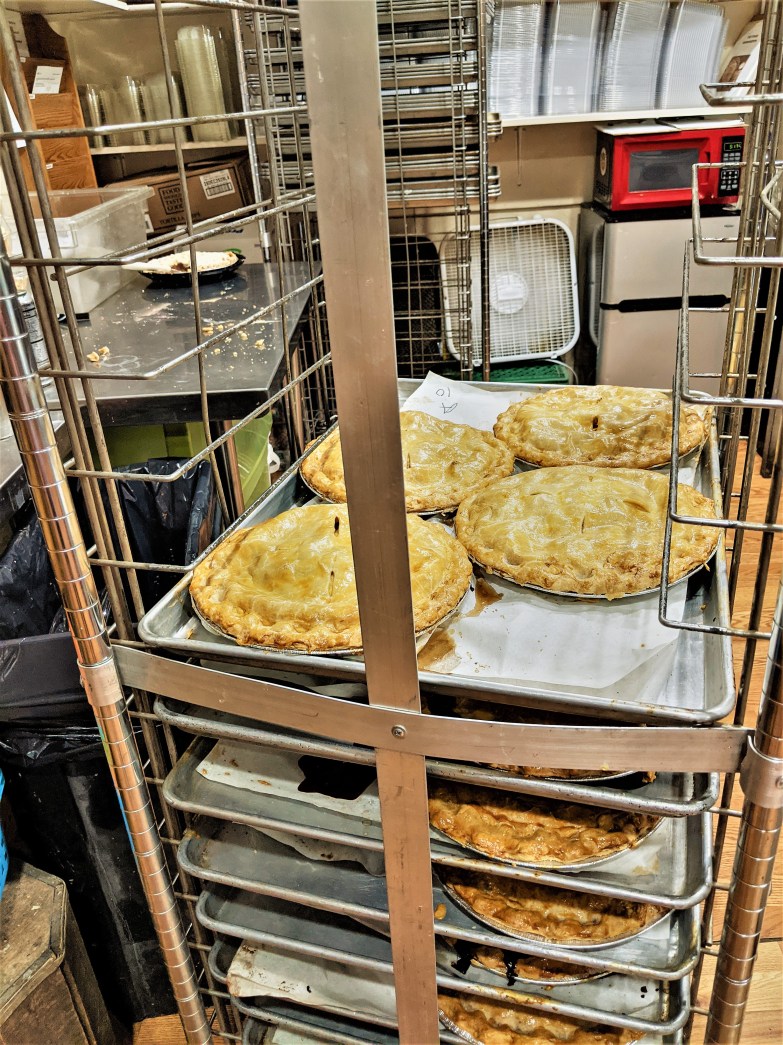
Mrs. Warner made pies and Perry has kept up that tradition as well but on steroids. Rock Springs Café sells about 120,000 handmade pies a year—their busiest times being around the Thanksgiving and Christmas holidays. During the regular non-holiday week, they sell 250 to 350 pies daily and 500 each day of the weekend. The demand was so high that they started shipping pies about six years ago.
Their most popular pie is the Jack Daniels Bourbon Pecan Pie which Sean Penn ordered when he stopped by a few years back. My favorite is the Tennessee Lemon Pie, but for whatever taste, there’s a pie—chocolate silk, lemon meringue, banana cream, mixed berries, you name it. Their cream pies have a signature top to them—beehive cones that twists up and has been lightly given a pass over with a torch for a slight touch of golden brown atop the peaks. The pie business is so good that Perry, who has a long history as a consultant for large restaurant groups and also owns another eatery in Prescott, Arizona, has just renovated the old stone building where the Warners lived into The Pie Box. It had fallen into disrepair but now will sell pies and other pastries and feature seating areas both inside and out. Another plus, instead of crowding the restaurant and gift shop, people can come and get their pies here.
The property—about 60 acres—is private and it’s a free-range place. For Great Lakes people like me, that doesn’t mean much but in Arizona that translates to cows getting to roam free—which they do. Typically, in the morning they come around to drink from the spring. We haven’t heard of any ordering a pie to go but may be that’s next. They usually are gone by afternoon, maybe because they don’t want to be in vicinity when it comes time to make hamburgers. Because there’s a spring here, the gardens are pretty and lush with flowering plants, grass, and leafy trees. A small collection of historic buildings sells Native American art, organic and freshly grown produce, and specialty foods. There’s a wide selection of foods in the gift shop area of the café as well including cactus candies and other cactus goodies. Another room contains a huge Brunswick Bar built in 1856 and other artifacts from its early history.
Rock Springs in the 1920s and 1930s was what Perry describes as being an “urban western” place with a mix of cars and horses. That’s in comparison to Tombstone which was “frontier western”—pretty much just horses. Whichever you stumble upon, it’s a refreshing reminder of what the west once was like.
Chicken Fried Steak
1 1/2 cups whole milk
2 large eggs
2 cups all-purpose flour
2 teaspoons seasoned salt
Freshly ground black pepper
3/4 teaspoon paprika
1/4 teaspoon cayenne pepper
3 pounds cube steak (tenderized round steak that’s been extra tenderized)
Kosher salt
1/2 cup canola or vegetable oil
1 tablespoon butter
Gravy:
1/3 cup all-purpose flour
3 to 4 cups whole milk
1/2 teaspoon seasoned salt
Freshly ground black pepper, to taste
Mix the milk with the eggs. In another bowl, flour with the seasoned salt, 1 1/2 teaspoons black pepper, paprika and cayenne.
Sprinkle both sides of each steak with kosher salt and black pepper, then place it in the flour mixture, coating on both sides. Dip in the milk/egg mixture, again coating each side and then dip on both sides in the flour.
Heat the oil in a large skillet over medium heat. Cook the steaks three at a time making sure not to crowd them until their edges turn golden brown, about 2 minutes each side. Drain on paper towels and cover with another plate or tin foil to keep warm. Repeat with the next batch..
After all the meat is fried, pour off the oil/butter/dredgings into a heatproof bowl. Without cleaning the skillet, return it to the stove over medium-low heat. Add 1/4 cup of the oil back to the skillet and heat.
Sprinkle the flour evenly over the hot oil. Mix the flour using a flour and stir until it turns a deep golden brown color.
Pour in the milk, whisking constantly. Add the seasoned salt and black pepper to taste and cook, whisking, until the gravy is smooth and thick, 5 to 10 minutes. Be prepared to add more milk if it becomes overly thick.
Jack Daniel’s Pecan Pie
6 servings
1 cup granulated sugar
4 tbsp melted butter
1/2 cup dark corn syrup
3 large eggs, beaten
1 1/2 cup Pecan halves
2 1/2 tbsp Jack Daniel’s
1-9 inch pie shell, unbaked
Preheat oven at 375.
In a bowl, add sugar, melted butter, Jack Daniel’s and stir well.
Then add dark corn syrup, beaten eggs, pecans and stir well.
Place filling into pie shell. Transfer pie onto cookie sheet and place in oven.
Bake at 375 for 10 minutes. Then lower to 350 and bake for additional 25 minutes or until pie has set.
Tennessee Lemon Pie
3 eggs, separated
Zest of 1 lemon
1/4 cup fresh lemon juice
1/4 teaspoon salt
1 teaspoon vanilla extract
1 cup extra-fine sugar, divided
1 9-inch Pure Butter Pie Crust, pre-baked (see recipe below)
In a medium-sized bowl, beat egg yolks for 2 minutes. Add lemon zest, lemon juice, salt and 1/2 cup granulated sugar.
Transfer mixture to a double boiler and cook, stirring constantly, until very thick and a thermometer reads at least 182°F, about 10 minutes. Remove from heat, stir in vanilla and let cool for 15 minutes.
Preheat oven to 350°F.
In a large bowl, beat egg whites with a hand mixer or stand mixer, until stiff peaks form. Add remaining 1/2 cup granulated sugar and beat until just combined.
Fold egg whites into the custard, until just combined. Pour into pre-baked pie crust and then bake for 15 minutes, until pie is set. Top will lightly brown.
Place flour in a bowl of an electric mixer and place in freezer along with mixer’s paddle attachment for at least 20 minutes.
Cut butter quickly in small cubes and place in freezer for 15 minutes.
Combine buttermilk with salt, sugar and vanilla extract and place in refrigerator.
Remove cold flour bowl from the freezer and add butter. With paddle attachment mix mixture on medium speed until butter pieces become smaller than peas and mixture feels like coarse meal.
With machine mixing on low speed add buttermilk mixture very fast and mix just until dough forms. Do not overmix. Chill dough in refrigerator for at least one hour.
Roll dough into desired thickness of about 1/8 inch and use for baking pie. Shapes of leaves can be cut out for pies if desired.
For more information about Rock Springs Café, (623) 374-5794; rocksprings.cafe
Travel back into the past by car or aboard the Treno Gottardo, a VIP train trip along an ancient trade route that crosses the fantastical Gotthard Pass, a north south journey connecting the German speaking region of Uri to the Ticino, the Italian speaking area of Switzerland.
Prehistoric Pile Dwellings in the Alps
In 2011, the UNESCO World Heritage Committee added the remains of prehistoric pile-dwelling also known as stilt house settlements in and around six Alpine countries that were built from around 5,000 to 500 B.C. on the edges of lakes, rivers or wetlands to their list.
The sites provide glimpses into what life was like in prehistoric times during the Neolithic and Bronze Age in Alpine Europe as well as the way communities interacted with their environment. In an exciting new find, archaeologists diving in Lake Lucerne discovered pile dwellings from the Bronze Age.
Exploring Roman History
Augusta Raurica near Augst/Kaiseraugst, a 2000-year-old settlement on the southern bank of the Rhine, is located near the beautiful city of Basel. Named after the Celtic Rauriker tribe and the Roman Emperor Augustus, the city at its peak had a population of around 20,000 with workshops, commercial enterprises, taverns, temples and public baths closely strung together. Because no new towns were established during the Middle Ages or our modern area, Augusta Raurica is amazingly well-preserved.
Visitors can view the myriad of wonders discovered here like the largest silver treasure dating from Late Antiquity, a Roman domestic animal park with ancient animal species, and the architectural remnants of the city, the museum offers great insights into the daily lives of the people who lived here around the time of Christ’s birth.
1821—Napoleon’s End
On May 5 was the 200th anniversary of the death of Napoleon I on the island of St. Helena, where he was placed in exile. His stepdaughter Hortense des Beauharnais also lived in exile at Arenenberg Castle and Napoleon Museum in Switzerland.
As the only German-speaking museum on Napoleonic history, a special exhibition during the “Année Napoléon 2021” will take place from October 10-24, 2021, showing the long lasting influence of Napoleon on Switzerland even today.
Inventing Milk Chocolate
Food and beverages reflect a country’s culinary traditions and customs. Many of today’s Swiss cheese brands go back to the 12th century, but Daniel Peter’s much newer creation in 1875 really took the world by storm—a passion that continues today. Peter was able to solve the problem of how to combine chocolate and milk. Most Swiss cities offer chocolate tours and several chocolate brands features visitor experiences.
Newly Restored LGBT Pioneer’s Spectacular Painting Returns to Monte Verità
After a lengthy restoration, the super large circular painting “Il Chiaro Mondo dei Beati” or “The Clear World of the Blessed” by Estonian artist and LGBT pioneer Elisàr von Kupffer (1872-1932) is on display at the Monte Verità museum complex located in southern Switzerland near Ascona.
Ballenberg
Instead of destroying more than one hundred historic buildings, many of them farmhouses, were instead carefully taken dismantled and rebuilt at the Ballenberg Swiss Open-Air Museum.
The museum is nestled in the beautiful pastoral landscape of the Bernese Oberland and can be reached by bus from Brienz. The many hands-on activities were created to provide insight in old traditional crafts like forging, weaving, and herbal medical treatments
Tucked in New Hampshire’s White Mountains, the Mountain View Grand Resort waits as a classic place to slow down.
When I was young, my family and I traveled along back roads that twisted through rolling hills and historic hamlets as we made our way to grand hotels dating back to the late 1800s. Once there, we’d swim, ride horses and play games such as horseshoes and croquet. But as I grew, these journeys to sprawling old resorts gave way to trips by airplane to big cities, sleek hotels, museums and shows.
And so those distant days seemed irretrievable, a way of vacationing that belonged to a different time. That is until I once again followed a winding country road through the small towns of the White Mountains and arrived at the Mountain View Grand in Whitefield, New Hampshire.
In the late 1800s, the U.S. had more than 1,000 summer resorts, many like this wood-framed escape with its towers, porches and neatly clipped green lawns. Now the 144-room Mountain View Grand, where luminaries such as Mark Twain, Teddy and Franklin Roosevelt, and Babe Ruth stayed, is just one of a handful remaining.
Its luxury is based on old-fashioned style: the attendant-operated elevator, the uniformed bellmen, the arched doorways, the long veranda. Always supercharged, I grow at ease sitting there while I sip Apple Blossoms, fresh cider mixed with local honey, and watch the night mists gather over the mountains. It’s easy to slow down among details that bespeak a time gone by.
The activities that attracted visitors long ago are still part of the resort’s offerings as well. The nine-hole golf course was designed in 1900. The clubhouse was built in 1939. The heated pool was dug in 1946, and the tennis courts were added about the same time.
I opt for taking walks through the extensively landscaped gardens and kayaking on Martin Meadow Pond, where loons provide the day’s soundtrack. And while on a trail ride through the hills, I look for wild turkey, deer, moose and black bears.
Before Mountain View Grand became a hotel, in 1865, it was the Mountain View Farm. And even after the transition, the original owners still relied on their farm to feed guests. Harkening back to those days, the menus in the resort’s four restaurants reflect what is raised here as well as from food producers nearby.
And in another throwback to the resort’s farm heritage, wool is spun from the hair of Mountain View Barn’s alpacas, goats and angora rabbits and sold at the front desk.
Although there’s reverence for the past, there’s respect for the present, too. A wind turbine supplies some of the resort’s electricity. There’s not one stoplight between here and the Canadian border an hour away, but my cell phone signal is strong.
Each day I order a latte, sit in the antique-filled lobby and tap away on my laptop while using the free Wi-Fi. And I get a deep-cleaning facial at the resort’s Tower Spa with its panoramic view of the mountains, one of the many amenities that has resulted in the resort being award the AAA Four Diamond status since 2002.
On my last day as I drive down Mountain View Road, I turn for a final look at the expansive resort with its green shuttered windows that offers a way to span the centuries and feel at home all in one.
Fall | When the 1,700 acres of rolling hills become a confetti of jewel colors, saddle up for a guided trail ride on horseback.
Winter | Become a musher as snow blankets the pine forests, or travel like days of yore in a horse-driven sleigh.
Spring | As the sap rises in the spring, learn about tapping trees and making maple syrup, one of the agricultural programs.
Summer | Head out on the property to search for moose with an experienced guide as dusk falls on a soft evening.
If It Was Good Enough for P.T.
Travel to the top of the mountain the old-fashioned way aboard The Mount Washington Cog Railway, the first mountain-climbing cog railway in the world. “The Second Greatest Show on Earth!” proclaimed P.T. Barnum who rode to the highest point in the Northeast in 1869 when it first opened.
Close By and Not to Be Missed
Voted one of the America’s Best Little Small Town, Littleton, located on the banks of the Ammonoosuc River, is a delight of history, trendy shops, great green spaces, and public art as well as lots of walking paths within town including its River District, along the Ammonoosuc of course, that encompasses the multi modal bridge on Bridge Street through the Apthorp District on Union Street and beyond into Bethlehem via the Rail Trail. Eleanor Porter, author of Pollyanna, lived here and a statue of her title character celebrates her books and the joy of always looking on the good side of life–making Littleton a happy city.
The Littleton Grist Mill, established at the end of 1700s, is now home to Schilling Beer Co. Located right on the flowing river, it’s a step back into history.
While walking through the historic downtown, make sure to take time to check out Thayer’s Inn, built in 1850 and located on Main Street. Candy lovers will love Chutters, a candy store dating back to the late 1800s with the original 112 feet of the original Guinness World Record candy counter.
Dinner is Served
Considered to be one of the most popular menu items at the Mountain View Grand. This recipe serves 6 people.
Ingredients for the Beef Ribs
12 lbs of bone-in beef short ribs, cut between the bones into 6 ribs
4 tbsp Kosher Salt
4 tbsp ground black pepper
2 cups blended olive oil
Cooking Instructions
Preheat oven to 375*F. Heat oil in a large sauté pan until shimmering. Season beef ribs heavily with salt and black pepper and sear ribs, one or two at a time, on all four sides until well browned. Arrange ribs evenly in a deep oven proof pan.
Ingredients for the Braising Liquid:
46 oz V-8 juice
20 oz tomato juice
32 oz beef broth
12 oz tomato paste
4 cups of cabernet sauvignon wine
½ cup cornstarch mixed with cold water
¼ cup chopped garlic
1 Spanish onion, cut into chunks
½ bunch of celery, cut into chunks
2 carrots, cut into chunks
4 bay leaves
½ oz fresh thyme
Cooking Instructions
Combine the liquids into a large stockpot with a wire whisk. Add the cornstarch slurry and the chopped garlic, along with the tomato paste and mix well. Pour over the beef ribs, until they are almost covered. Any extra liquid can be reserved for later. Top the rib mixture with the chopped vegetables, bay leaves and fresh thyme. Add a sheet of parchment paper to the top of the ribs and wrap with aluminum foil. Place in preheated oven for approximately 3 hours. Check ribs with a pair of tongs. The meat attached to the ribs should be almost falling off the bones and very tender to the touch. Remove beef ribs to a platter and keep warm.
To make the sauce; strain the liquid through a sieve or colander lined with cheese cloth, pressing down on the vegetables to extract as much flavor as possible (you can discard vegetables, or eat them, they too are delicious!). Heat the sauce with any reserved braising liquid in a saucepan on the stove and reduce until the sauce is thickened and coats the back of a spoon. Season to taste with additional salt and black pepper as needed.
Ingredients for the Red Onion Straws
1 large red onion, thinly julienned
1 ½ cups buttermilk
1 ½ cups of flour
2 tsp salt
1 tsp black pepper
½ tsp paprika
3 cups vegetable oil for frying
Cooking Instructions
Slice red onions thinly and soak in buttermilk for at least 1 hour (this step can be done a day before you need them).
To fry onions, heat oil to 350*F on the stove with a frying thermometer. Combine flour, salt, black pepper, and paprika in a bowl until well combined. Flour should have a pinkish hue to it (if not, add more paprika). Drain red onions and add to flour and mix well. Sift carefully and add to the hot oil in small batches. Remove golden brown onions with a wire skimmer and drain on a plate lined with paper towels. Repeat the process until you have fried all the onions.
To serve the beef ribs, set up warm plates with your choice of starch and vegetables. Top each plate with a hot beef rib, cover with the cabernet sauce and top with onion straws. For some color you can garnish with your choice of parsley, rosemary, thyme, or pea tendrils.
In Madrid, we take a cobblestone street down a narrow street between Plaza Mayor and Puerta del Sol to El Pasadizo San Gines and happen upon Chocolatería San Gines, the oldest churro shop in the city, having opened in 1894. There are two shops, just across the way from each other and both have long lines. But it’s our last night in Madrid and we are willing to wait. Ordering our churros and chocolate along with cups of coffee we find a outdoor table and sit down to wait–impatiently–for our treats. The churros when they are arrive are thick ropes of sugar coated dough fried to a golden brown and hot to the touch. We tear off chunks and dip them in deep bowls of thick rich chocolate and then taste. Sublime.
I think of churros as originating in Spain where they may have first been by shepherds, their name coming from the horns of the Churra sheep they tended. In turn the Spaniards, when they invaded Mexico, brought along their foods including churros and buñuelos–a similar dish. Churro and chocolate shops are now common throughout Mexico. But their history may be more complicated as Portuguese sailors returning from China may have carried the recipe for youtiaos, another fried bread snack.
It’s close to midnight when we finally finished but this being Madrid the streets were just a lively and people still stood in line for their churros and chocolate.
Back in the U.S., I was desperate for my churro fix. Fortunately, there’s Take & Bake Churro Kit from San Diablo Artisan which beats making these treats from scratch. The company says they’re the only churro kit maker in the country making it a one-of-a-kind gift. There’s no messing with dough, making your own filling or frying them up. Instead, the kit contains 13 pre-made and chilled mini churros already fried to a golden brown and dusted with sugar and cinnamon as well as a selection of fillings such as Nutella, dulce de leche or sweet cream already packaged in squeeze bottles. Just fill the churros and pop in the oven or air fryer to reheat.
For the real foodie who wants to do a deep dive into churro making, San Diablo Artisan, a Utah based company, also sells churro dough so you can roll your own. And if you want to go all out when it comes to making churros, you can buy their recently introduced kit with a churro maker and nine different shapes of interchangeable nozzles.
San Diablo Artisan Churros specializes in creating artisan-filled churros for special events and celebrations. The proprietary, award-winning churro dough recipe is made from scratch and fried on-demand. The fried golden brown, hollow-centered churros are filled with “happiness”—gourmet fillings of choice. In a relentless search for churro perfection, the menu has expanded to include seasonal flavors, savory churro offerings, and nationwide at-home delivery. San Diablo members enjoy outstanding quality artisanal food that is undeniably fresh, delicious, and delivered with a unique style of fun. Like their Artisan Churros, San Diablo is filled with social good: supporting local, national, and international non-profit causes.
Little did we know that when we dined at the corner restaurant near our hotel in Paris that we were eating at a place where for years there’s been a fight over the secret sauce that’s served with their steaks.
Maybe it’s a French thing.
For some background, my husband and I were on our honeymoon and had booked a Viking River Cruise on the Seine and then added some before and after stays in Amsterdam where it is more easy to get run over by a bicyclist then a car and Paris where we stayed at a little hotel near the metro in the 17th arrondissement so we could visit other parts of the city without spending a fortune on cabs. Though we didn’t plan it this way, Hotel 10 Le Bis, our hotel was near numerous little cafes and a little grocery store where we could easily—and cheaply eat or buy food for quick meals and snacks.
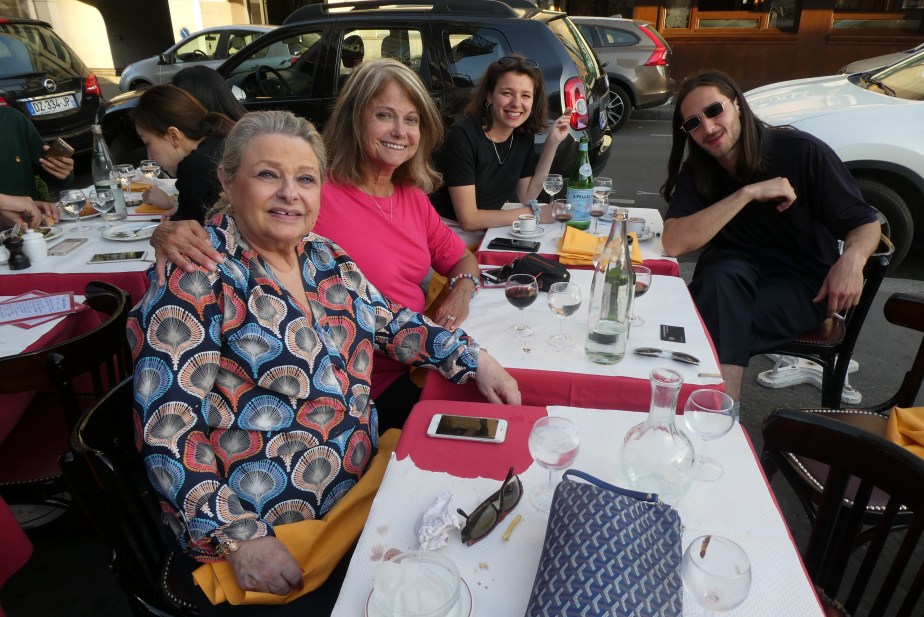
One intriguing café was Le Relais de Venise where every night we would see long lines of people waiting to eat either in their dining room or on their outdoor patio. Though the interior of the restaurant looked so French bistro with its polished dark wood, tiny tables with crisp white table cloths, and servers dressed in black uniforms, the outdoor section was right on a busy corner filled with traffic and pedestrians, noise, and the rumbled of trucks and sounds of horns honking.
What could be so great about lining up to eat there, we wondered. But one evening, after climbing up from the metro station and seeing there was no line, we decided to give it a try. The only tables available were outdoors and so we sat at a very small table next to another small table where a single woman sat, smoking a cigarette. That turned out to be a very lucky thing.
When our server arrived I asked to see a menu and she (we would find out later her name was Gertrude) abruptly told us she was the menu. Well, what could we order? Steak frites, she replied—either “bloody or well done.”
We told her “bloody”, and she gave us an approving look. But we were a little baffled. Was there really only one dish on the menu? It turns out that at this restaurant which opened in 1959, there was only one entrée and steak with French fries was it. When our waitress returned with a salad topped with walnuts (no one inquired whether we had a nut allergy—which fortunately we don’t) and a crusty French baguette, I saw there wasn’t butter on our table and asked for some. Oops, one would think I had tried to order a Big Mac.
“No butter,” Gertrude told us.
“There’s no butter?” I asked.
“No butter,” she replied.
“How about olive oil?”
“No olive oil,” she told us.
Now, I knew that in a French restaurant there had to be both in the kitchen, but I guess neither butter nor olive oil was allowed to be carried into the dining area, so we ate the bread—which was very good—without either.
This is when the woman at the table next to us decided to intervene. She lived in Paris she told us but had spent years in the United States working as a publicist for musicians in New York. Le Relais de Venise was unique, she continued, because they only served one dish—steak with French fries served with Le Venice’s Sauce de Entrecote. I guess that makes decided what to order for dinner super easy.
Since the creation of the sauce, its exact ingredients have been kept secret and that probably worked until the invention of the internet. After some type of family squabble and a going of separate ways, the sauce itself became a battleground so complex and full of intrigue that the Wall Street Journal did a lengthy article about it all six years ago. I guess when you serve only one dish and the sauce is a necessary part of it, feelings about who owns the recipe loom large.
Anyway, after we ate our salad (no choice of dressing as it already was dressed with a vinaigrette which was very good), our steak with fries arrived—with the sauce spooned over the meat. It was delicious.
What’s in it? I asked the woman next to us.
“It’s a secret,” she said. “But I’ve been eating here for decades so I know it. But it’s really better to come here.”
She promised to give me the recipe, but I think she changed her mind because she never sent it. She may have been afraid that Gertrude would get mad at her or maybe the restaurant owners wouldn’t allow her back in. Neither would surprise me.
I noticed, as we were eating, that the servers were moving through the crowded café with platters of meat and piles of French fries. And almost as soon as I had cleared my plate, Gertrude showed up again, heaped—without asking but that was okay—more French fries and slices of the sliced steak and sauce on my plate. At no charge.
“They’ll do that until you say you don’t want anymore,” the woman told us.
“Is there a charge?”
“No, it’s all part of the meal.”
Which was a deal as the tab wasn’t very high even with the addition of a glass of the house wine which is made at the family owned vineyard Chateau de Saurs in Lisle-sur-Tarn, 30 miles northeast of Toulouse. Indeed, the restaurant was opened by Paul Gineste de Saurs as a way to help market the wines but now there are at least three—the one in Paris and then another in New York and London. As for the sauce there are several stories. A rival restaurant said to serve a similar sauce says that it is not new but instead was one of the classic sauces said to be the backbone of French cuisine.
Of course, as soon as we got back to our room, I Googled the restaurant and the sauce. It took some digging, but I found recipes for both the secret sauce and the salad. Or so I think. I’m planning on trying them soon along with a French baguette or two from Bit of Swiss Bakery which I will be serving with butter.
Le Relais de Venise-Style Salad Dijon Vinaigrette
1 tablespoon Dijon mustard 1 tablespoon white wine vinegar Kosher salt to taste (nutritional info based on 1/4 tsp) Freshly cracked black pepper, to taste 2 tablespoons extra virgin olive oil (or walnut oil)
Whisk or shake in a mason jar until mixture is homogenous.
Serve on a bed of mixed salad leaves topped with some chopped walnuts and shaved Parmesan.
Serving Size: 4
Le Relais de Venise’s Steak Sauce
1 tablespoon olive oil
2 large shallots
3 cloves garlic, chopped
2 cups chicken stock
1 teaspoon pepper
2 tablespoons mustard
1 bunch tarragon
3 tablespoons red wine vinegar
1 teaspoon anchovy paste
1 teaspoon Worcestershire sauce
1 teaspoon kosher salt
Peel and slice the shallots.
Peel and roughly chop the garlic.
Add the olive oil to a small pot over medium heat.
Add the garlic and shallots and cook until soft and slightly colored.
Add the chicken stock. Simmer for three minutes.
Pull the tarragon leaves off of the stems and put them in a blender.
Add the remaining ingredients to the blender.
Carefully pour the chicken stock mixture into the blender.
Puree until completely smooth.
Pour back into the pan and bring to a boil. Cook for one minute. If the sauce is too thin simmer for a few more minutes.
Pour over slices of rare or as Gertrude calls it “bloody” or however you like your steak. Serve with potatoes or French fries.
Just in time for the summer 2021 season, the Chicago Greeter program will now showcase the city’s diverse neighborhoods through four different initiatives
Chicago, IL – June 17, 2021 – Choose Chicago announces a relaunch of the popular and world renowned Chicago Greeter program. The program now includes four different initiatives bringing the knowledge and passion of this network of 200 volunteer guides to locals and visitors alike in new ways, while remaining free to the public: the original In-Person Greeter experiences, Welcome to Our Neighborhood walks, InstaGreeter Downtown meetups and Self-Guided Greeter tours presented by Bank of America.
From Chinatown to Pilsen and Greektown to Little Italy, Chicago’s neighborhoods tell the stories of the people who made the city their home throughout history. Since 2001, Chicago Greeter has shown how these neighborhoods have remained just as vibrant today, with bustling cafes, restaurants, museums, public art and more.
“Choose Chicago is proud to relaunch and expand the renowned Chicago Greeter program this summer and share authentic Chicago neighborhoods with locals and visitors alike,” said Jason Lesniewicz, Director of Cultural Tourism for Choose Chicago. “We now have four great ways to experience fascinating histories, diverse cultural traditions, iconic landmarks and off-the-beaten-path gems.”
Chicago Greeter Experiences
A recipient of TripAdvisor’s Certificate of Excellence for over ten years, the original In-Person Chicago Greeter experiences offer deep dives of 2-to-4 hours of the Chicago neighborhood of your choice. Guests are paired with a friendly, local volunteer based on their neighborhood and subject of interest for a personalized experience. Tours are available in over a dozen languages and are available to book now.
Welcome to Our Neighborhood Walks
Explore Chicago’s neighborhoods with these new, free walks led by diverse community groups and neighborhood organizations. Walks will dive deep into the highlights of each community’s unique stories, top attractions and under-the-radar finds, all through the eyes of people deeply embedded in the community. The first of these tours to launch will be through Chinatown in collaboration with the Chicago Chinese Cultural Institute on June 19 and July 17.
InstaGreeter Downtown Meetups
The InstaGreeter downtown meetups, returning July 2nd, were designed with those who are pressed for time or looking for a more flexible option in mind. These free, hour-long tours of Chicago’s downtown Loop neighborhood operate Friday, Saturday and Sundays departing at 11:30 am. No reservation is required and InstaGreeters depart from the Chicago Cultural Center’s Welcome Center located at 77 E. Randolph Street.
Self-Guided Greeter Tours
The new Self-Guided Greeter Tours, presented by Bank of America, provide visitors and locals alike curated, virtual tours designed by local experts to showcase each neighborhood’s unique history, culture and hidden gems.
Through the power of video, blog and social content, this series will shine a spotlight on six Chicago neighborhoods by leveraging the knowledge and expertise of the Chicago Greeter volunteers. Each part will feature a different neighborhood, including a unique Chicago Greeter itinerary and logistical instructions on how to best explore the neighborhood in person.
The digital content will launch this month, with a blog post highlighting a self-guided walking tour of Chicago’s South Loop. Additional content will follow on a monthly basis, with Kenwood, Bronzeville, Bridgeport, Pullman and West Ridge to follow.
“Chicago’s neighborhoods are teeming with history and culture, and that deserves to be celebrated,” said Paul Lambert, President of Bank of America Chicago. “We’re honored to partner with Choose Chicago to spotlight communities across the city’s South and West sides, to encourage people to visit these local landmarks, and to drive economic activity where it is needed most.”
This self-guided program is an extension of the successful 2020 International Greeter Day “do-it-yourself” tours, which was created during the COVID-19 pandemic. The virtual series highlighted Ukrainian Village, Uptown, Pilsen, Hyde Park, Chinatown and the Chicago Riverwalk.
Choose Chicago is the official sales and marketing organization responsible for promoting Chicago as a global visitor and meetings destination, leveraging the city’s unmatched assets to ensure the economic vitality of the city and its member business community. For more information, visit choosechicago.com. Follow @choosechicago on Twitter and on Instagram. Like us on Facebook.
When Prince-Elector Friedrich V married Elizabeth Stuart, the daughter of King James I in 1613, it was–like the majority of royal marriages—based on political alliances and gains. Love had nothing to do with it.
Photo by Jane Simon Ammeson
But sometimes it worked out differently and so it was between Friedrich and Elizabeth who fell in love. Heidelberg Castle, where they lived, was already old, dating back to 1200s and the Prince-Elector wanting Elizabeth to love her new home added an English Palace and an elaborate Baroque garden.
But theirs was to be a tragic love story. There were battles, a throne lost, regained, and then lost forever. During all that, Elizabeth bore 13 children before Fredrich died and she sought life in exile.
Heidelberger Schloss
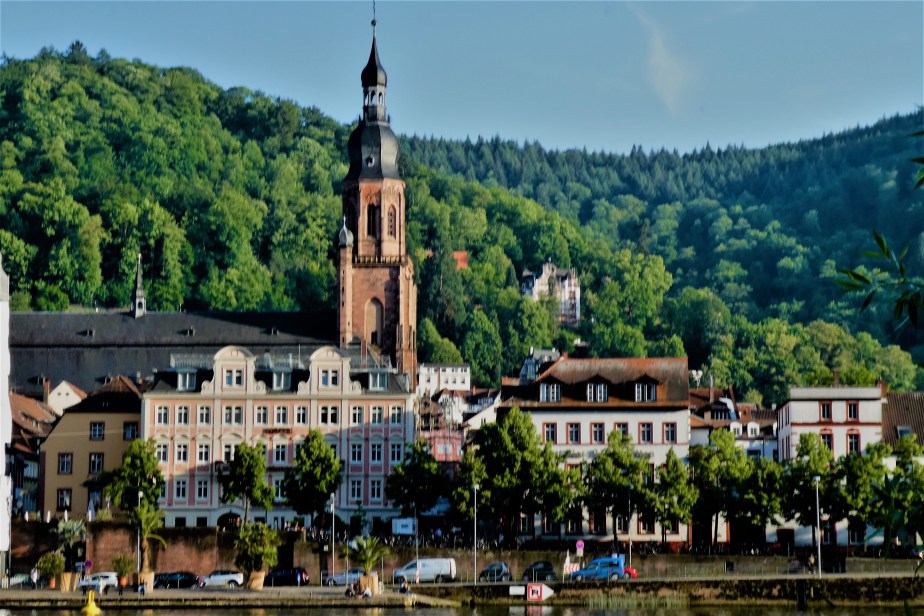
The castle, a romantic ruin of seemingly endless staircases and corridors taking you here, there, and sometimes nowhere, stands 330-feet above the Alstadt, Heidelberg’s wonderful old town. Towers and battlements protect stone facades, their decorative features still intact though the rooms behind them are gone. Views into the multitude of windows reveals not an interior but woods and the Neckar River below.
“Deserted, discrowned, beaten by the storms, but royal still, and beautiful,” is how Mark Twain described the Gothic-Renaissance castle. He was one of many poets and writers who spent time in what they considered the most romantic city in the world.
Photo Jane Simon Ammeson
The castle is also home to the Heidelberg Tun, a 58, 124 gallon wine barrel said to be the largest in the world. It was built in 1751 on orders from Prince Elector Karl Theodor to store the wine paid in taxes by the region’s wine growers. We should all be so lucky to have too much wine.
Brews and Pork Knuckles
Taking the funicular down to the old town, I meet friends at Vetter’s Alt Heidelberger Brauhaus on Steingasse, Europe’s longest carless street. It’s one of those baronial style Germanic places with high ceilings, large wood beams, long tables and a lot of dark highly polished wood.
Famed for their Vetter’s 33, which they say is the strongest beer in the world, its alcohol content is—you guessed it—33%. But it isn’t all beer her, they’re famed for their traditional German food and so I decide to go full German, ordering the pork knuckle, sauerkraut and dumpling with gravy. Skipping the 33, I opt for the Hubier—a mix of the lager and elderberry syrup.
History, Luxury and a Family Touch
Courtesy of Hotel Europaischer Hof Heidelberg.
My love affair with the city began several years before when I checked into the five-star Hotel Europäischer Hof Heidelberg. The hotel, one of the few five-star family run hotels in Europe, opened in 1865 and has been owned by von Kretschmann family since around the turn of the last century.
Courtesy of Hotel Europaischer Hof Heidelberg.
I’d heard that Sylvia von Kretschmann, who with her husband Ernst-Friedrich, ran the hotel for a half-century before their daughter Dr. Caroline von Kretschmann took over, regularly did the hotel’s large floral arrangements. So it was no surprise when I ran into this very elegant woman doing just that in Die Kurfürstenstube, the hotel’s opulent dining room that opened in 1866. Such a romantic place and romantic tradition—how could I not fall in love?
Courtesy of Hotel Europaischer Hof Heidelberg
Chocolate Kisses
My romance continued at Chocolaterie Knosel where owner Liselotte Knosel talked about studentenkussor or student kiss, a chocolate covered nougat created by her great grandfather Fridolin Knosel in 1863. His Café Knosel was frequented by male university students who admired women from a local finishing school who were, alas, chaperoned by their governesses. A gift of student kisses was a sly way to start a flirtation.
We don’t know how well it turned out for the students but these confections, still hand crafted, remain best sellers more than 150 years later. Café Knosel—the city’s oldest café—is my go to spot for coffee and a pastry at one of their outdoor tables overlooking the church on Marktplatz.
At dusk, on my last night, I boarded Patria, a 1930s ship for dining and a cruise along the Neckar River. Watching the city lights sparkle in the calm water, I knew that though my visit was ending, the romance was just beginning. I would be back.
Join food historian Francine Segan and accomplished race car driver and sportscar historian Frank Celenza for a thrilling ride through Italy’s “Motor Valley.”
Birthplace of Enzo Ferrari and home to the world’s highest concentration of sportscar brands including Dallara, Ferrari, Lamborghini, Maserati, Pagani and Ducati, Italy’s Emilia-Romagna is as well known for its fast cars as it is for its slow-cooked and savored food. Visitors can explore and discover the 11 car museums and four-day Motor Valley Fest.
Many of world’s most famed Italian foods come from Emilia-Romagna, a wondrous region in northern Italy known as the Food Valley, because its world-famous specialty edibles such as Parmigiano-Reggiano cheese, the thinly sliced Prosciutto di Parma–an Italian dry-cured ham served uncooked, Aceto Balsamico, made by cooking grape must from regionally grown wine into a syrup like vinegar that is robust in flavor and a great addition to so many dishes, and Lambrusco wine.
Moderna, one of the region’s gorgeous cities rich in art, music, fashion, and culture, is also home to Osteria Francescana, voted twice as the best restaurants in the world. But don’t expect to just walk it or even call in a day or two advance. Their first available table is seven months from now.
Owner and executive chef Massimo Bottura, born and raised in Modena, says he grew under the kitchen table at his grandmother Ancella’s knees.
“That is where appetite begins for me,” he says. “Inspiration comes from the world around me – from art, music, slow food and fast cars. Catch the flash in the dark because it only passes once. Expect the unexpected.”
Participants in this online interactive event will come away with a greater understanding of Italian culture and food traditions as well as the country’s important role in the world of car manufacturing and racing.
The event is Thursday, June 24 from 6:30 to 7:30 p.m. ET
If you do get to Emilia-Romagna, here’s a curated itinerary courtesy of Emilia-Romagna Tourism.
An ancient route running through the length of Emilia-Romagna, Via Emilia, linking the coastal city of Rimini on the Adriatic Sea with Piacenza in the north, was completed in 187 BC by Roman Consul Marcus Aemilius Lepidus.
The region is also home to 44 food and wine products with the DOP/IGP guarantee of quality, and the great automotive brands that have made Emilia-Romagna famous all over the world.
Evan Williams, Kentucky’s first distillery, is hosting “The Ideal Bartender Experience” as part of Louisville’s celebration of African American history. The distillery was founded by Evan Williams in 1783, but the experience takes visitors no further back then to the final days of Prohibition and into a secret speakeasy at the Evan Williams Bourbon Experience, a multi-million dollar artisanal distillery, immersive tourism destination and retail location on Louisville’s Whiskey Row.
The Ideal Bartender Experience, separate from the other tours available at Evan Williams, introduces guests to Tom Bullock, the first Black American to write and publish a cocktail book. Written in 1917, “The Ideal Bartender” was almost lost to history despite Bullock’s fame at the time.
Greg Boehm, owner of the New York-based company, Cocktail Kingdom, has close to 4000 books about cocktails in what is said to be the largest collection in the world. Consider the collection research as Cocktail Kingdom manufactures professional barware, reprints vintage bar literature, and a full spectrum of professional and custom barware, artisan bitters and syrups.
According to Go to Louisville, several years ago Boehm was contacted by a woman wanting to sell a first edition of The Ideal Bartender. It was the one book Boehm was missing and so he jumped at the chance to own an original copy.
“In the cocktail bar industry, unfortunately, the African American community is not very well represented at all. It is just not a diverse group, so anything that lends diversity to bartending is a good thing,” Boehm explained. “In addition, The Ideal Bartender is a little snapshot of what people were drinking pre-Prohibition, and unlike a lot of cocktail books, none of these recipes were cribbed from anyone else. This is a completely unique cocktail book.”
Bullock, a stately looking man, was known to make some powerful — and according to article in The New York Times — addictive cocktails. He was also reputed to be a great conversationalist and to have a wide range of knowledge on current events–which was expected of a bartender working in rarified places.
Though Bullock was known to the wealthy elite who sipped his cocktails he was relatively unknown until former President Theodore Roosevelt filed a libel suit in 1913 against a newspaper claiming he was not only a liar but also frequently drunk. In his testimony, Roosevelt said that one of the few drinks he’d ever had — and that didn’t happen until he had left the White House — was a mint julep mixed for him by Bullock at the St. Louis Country Club. And, Roosevelt told the court, he took only a sip or two.
The St. Louis Post-Dispatch called this out as a lie, printing an editorial opining, “Who was ever known to drink just a part of one of Tom’s juleps? Tom, than whom there is no greater mixologist of any race, was taught the art of the julep by no less than Marse Lilburn G. McNair, the father of the julep. Are the Colonel’s powers of restraint altogether transcendent?”
Marse, for those who don’t know their Missouri or mint julep history, was the grandson of Alexander McNair, the first governor of the state.
Whether he drank more than half of the mint julep or not, Roosevelt won his suit, and Bullock became famous for his bartending skills. Patrons who loved his cocktails included George Herbert Walker — you know the last name, as he was the grandfather and great-grandfather of our 41st and 43rd U.S. presidents, and August Busch Sr., CEO of Anheuser-Busch, who each helped get the book published.
“I have known the author for many years, and it is a privilege to be permitted to testify to his qualifications…” In all that time I doubt that he has erred in event one of his concoctions,” wrote Bush in the intro to Bullock’s book.
Bullock was quite creative when it came to drinks, creating a version of an Old Fashioned easily transported in a flask for those attending the matches at the St. Louis Polo Club.
The 45-minute tour at The Ideal Bartender Experience includes a taste of three premium whiskeys as well as a mint julep made from one of Bullock’s recipes, is one of several fascinating immersive experiences taking place in Louisville.
Tom Bullock’s Old Fashioned for the Polo Field
Fill one eight ounce flask with 100 proof bourbon near to the top. Shove four raw sugar cubes or pour four raw sugar packets into the mouth of your flask, dash eight times with Angostura. Shake the flask vigorously. Pour the contents over the largest ice cubes you can find.