Historic Spirits: Preserving the Past and Connecting to the Present with Journeyman Distillery & the Field Museum

The dazzling 1893 World’s Columbian Exposition brought 27 million people to Chicago which was no small feat given that the first gas powered automobile is credited to Karl Benz in Germany in 1886 and Henry Ford’s 1908 Model T was the first car easily accessible to people other than the wealthy.FieldVodka_HighGarden (1)
The crowds came to see all the newest inventions like the Ferris Wheel, the zipper and Cracker Jacks, diet carbonated soda, Aunt Jemima syrup and pancake mix and Wrigley’s Juicy Fruit gum. Plus it was at the Exposition that Pabst Select won the Blue Ribbon in the beer competition and hence forth became known as Pabst Blue Ribbon beer.

But there were other attractions less awe inspiring or recognizable but as important if not more so.Field Gin Fizz

1500 botanicals (a term used to describe seeds, berries, roots, fruits and herbs and spices) were brought from around the world to the exposition to the Field Columbian Museum (now the Field Museum). Among the 40 million objects belonging to the museum—only 1% of which are on display—the majority of these botanicals remain.

Megan Williams, Director of Business Enterprises for the Field Museum, started a beverage program around seven years ago in celebration of the museum’s 125th anniversary. Her idea was to use some of these botanicals as a way of connecting the museum’s past and present.FieldRye_FigOldFashioned (1)

“I am not a researcher here,” says Williams discussing her background, “though I used to teach environmental science. I joined the Field museum as an account manager and then took over the restaurant. I wanted to create a sense of community, a place for people to sit and talk and what better place for that than a bar.”

Combining the communal ambience of a bar with the awesome history of the museum was one of the reasons Williams started the beverage program.

“I wanted to educate people through taste and smell, to be able to taste or smell something that has a historic significance,” she says.

Williams described it as an opportunity to bring people together who love spirits and love learning.FieldGinandOysters

“It’s not just putting a museum label on something though there’s a legitimacy in that,” she continues, noting she’s worked with brewers and wine makers as well in developing Field branded drinks. “But we wanted to take it another step further, working with people who have a passion and understand the museum’s language and mission.”

Contacting the Journeyman Distillery in Three Oaks, she invited Matt McClain, Journeyman’s lead distiller and owners Bill and Johanna Welter to view the botanicals to look at the botanicals.

“The first spirit we talked about was rye, that ended up as the last one made,” says Williams.  “We asked questions such as what would work well in making gin—what could–out of these 1500 botanicals—and where could we source them.”

McClain spent several months researching the botanicals that were at the museum, to determine their history as well as their availability.

“I found that a lot of them were not considered safe or even poisonous,” he says. “Standards were different back then.”FieldVodka

From there, he and Bill Welter chose those they thought would be a good fit for the spirits they wanted to create.

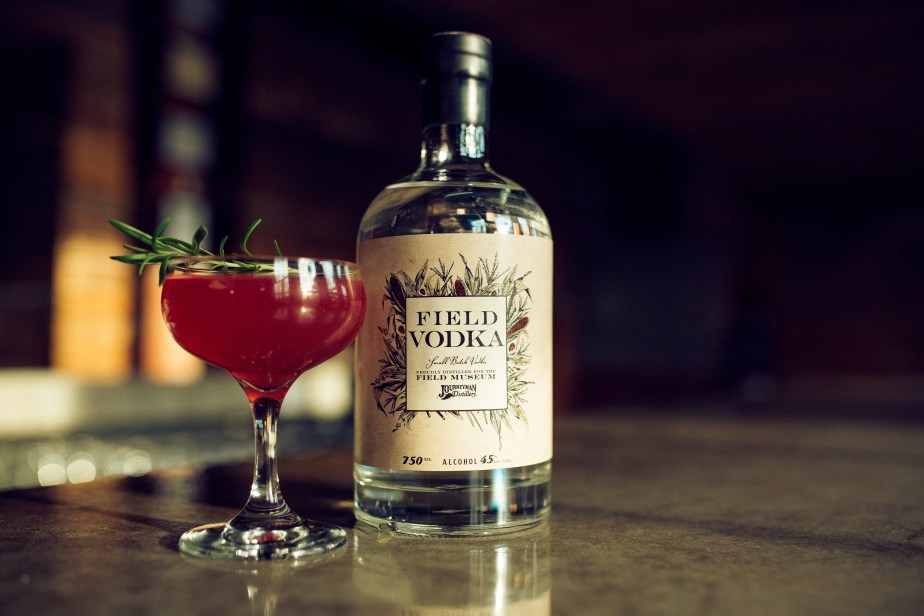
The first product they created was their Field vodka using Bloody Butcher Corn, an heirloom variety often used for making bourbon. The vodka then served as a base for the next distilled spirit, their Field Gin

“We wanted to make a global gin,” says McClain. “So we were pulling species from around the world. We narrowed it down to around 50.”

But once they had the botanicals and began developing recipes, they had to cross off a few more from the list.

“A lot of botanicals that look and taste good, don’t work where you put them in in alcohol, others that I wanted to use were hard to get or arrived too late, I still have agave in the cooler,” says McClain, noting  they used other criteria as well in the selection process. “Bill and I wanted the gin to be lavender focused. Obviously gin also has to have a heavy juniper taste as well. We wanted the gin to have tropical undertones and had to figure out those as well.”Field3Pack

Then they were down to 27 including not only lavender and juniper berries but also prickly ash, anise, mango, ginger, coconut palm sugar, pineapple, papaya, Valerian Root, cinnamon, coriander, Horehound, star fruit and Charoli nuts which are sourced from India.

For their Field Rye Whiskey, they tried several types of figs which McClain describes as the world’s oldest sweeteners, finally deciding that Black Mission figs worked the best. The figs were macerated or soaked in alcohol for three months, a process that brought out subtle and all-natural flavors of bananas, sweet melons and strawberries.

“It’s an incredible whiskey,” says McClain. “It has heavy caramel notes and soft marshmallow like palate.”

Bottles of the Field distilled spirits are available for sale. For those who would like to learn more about their taste, they’re also used in some of the cocktails served at the Staymaker, Journey’s restaurant.

Sidebar: Brews

Beer, which is so Chicago given its rich German heritage, was the first partnership Megan Williams embarked upon when she started her beverage program. Two Chicago breweries, Off Color Brewing and Two Brothers Brewing were among the first to use the botanicals to create beers for the museum. researchers at the Field Museum have spent years excavating and studying the Wari site in Peru. Toppling Goliath introduced PseudoSue pale ale, a nod to the museum’s famous 40 feet long and 13 feet tall at the hip, Tyrannosaurus rex.  Physically SUE is the largest specimen T. rex specimen that’s been discovered so far.

Off Color’s introduced Wari, their artisan beer based on the Peruvian chicha, a purple corn beer native to areas of Central and South America. One of its other tie-ins with the museum is that Field scientists have spent years leading excavations at Cerro Baúl, a remote mountaintop citadel which was the only contact point between the Tiwanaku and the Wari, considered two great kingdoms whose dynamic relationship ultimately contributed to the rise of the Incan Empire. According to Off Color’s website, an essential sacrament shared by both cultures revolved around chichi. It seems that both tribes liked to consume massive quantiles of chicha served in ornately inscribed drinking cups called keros that were discovered during the archaeological expeditions at Cerro Baúl. In this way, Wari and Tiwanaku cemented their relationships. In other words, next time you see a bunch of heavy alcohol consumers at bars, understand they’re just continuing a thousand year ritual similar to that of the Wari and Tiwanaku.

The following recipes are courtesy of the Journeyman Distillery.

Journeyman Fig Old Fashioned

1.5 oz Field Rye

0.5 oz Fresh Orange Juice

0.25 oz Journeyman Bourbon Maple Syrup

Dash of Journeyman Barrel-Aged Balsamic Vinegar

Dehydrated Orange Wheel

Stir ingredients and pour into a rocks glass, over ice. Garnish with dehydrated orange wheel.

Field Vodka Gimlet

1.5 oz Field Vodka

.75 oz Fresh Lime Juice

.5 oz Simple Syrup

Fresh Lime Wheel

Shake ingredients well and strain into a tall glass over ice. Garnish with a fresh lime wheel.

Field Gin Fizz

1.5 oz Field Gin

.75 oz Fresh Lemon Juice

.5 oz Pear Simple Syrup

1 oz Aquafaba or Egg White

Soda

Star Anise

Combine ingredients and dry shake before adding ice to the shaker. Wet shake until froth has built up. Strain into a Collins glass and top with soda. Garnish with Star Anise.

A Golden Lamb Thanksgiving: A Treat Since 1870

            I’ve spent a lot of time lately traversing Indiana, Illinois, Kentucky and Ohio following, so to speak, in Abraham Lincoln’s footsteps . And while it’s not recorded that Lincoln stayed at the Golden Lamb in Lebanon, Ohio, it’s certainly possible ashe traveled throughout the area. The connection seems apt because the GoldenLamb has been in continuous operation since it first opened in 1803 when Jonas Seaman spent four dollars on a license to open a log-cabin tavern under the sign of a golden lamb (because literacy wasn’t common, signs with images were used instead).

Sister Lizzie’s Shaker Sugar Pie
Photo courtesy of the Golden Lamb

            A host of other famous people have stayed there including, according to General Manager Bill Kilimnik, 12 presidents, Mark Twain and Charles Dickins. Harriet Beecher Stowe, author of Uncle Tom’s Cabin and an avid abolitionist was also a guest and I slept in the room she occupied and no (to the people who have asked) it’s not haunted though another room is said to be and there’s also a ghost cat that some have seen. But that’s a different holiday and the tie-in with Lincoln is that in 1870, he proclaimed the fourth Thursday of November a national holiday and the inn’s restaurant has served Thanksgiving dinner since then–which has got to be some type of record. 

            The restaurant is famed for many of their menu items including fried chicken, sauerkraut balls,Sister Lizzie’s Sugar Shaker Pie (White Water Shaker Village was once a large settlement of Shakers about three miles from Lebanon)–named by USA Today as the Best Pie in Ohio–and their yeast rolls made from a recipe first used by Robert and Virginia Jones in the early 1930s whose family still owns the inn. Their turkey dinners at Thanksgiving are very popular but if you can’t make it this coming Thursday,roast turkey is on the menu year round.

            According to several newspaper articles, back in the 1800s, the inn’s Thanksgiving menu included several oyster dishes including just plain oysters, consommé oysters as well as turkey stuffed with oysters. Other dishes were  whitefish, roast beef, chicken croquettes, wild duck, broiled quail, celery and lettuce—you could order it plain or with mayonnaise), plum pudding, mince pie, pineapple with “De Brie cheese”  and Charlotte Russe. I couldn’t find a description of the cheese, but plenty of advertisements for it in the late 1800s and early 1900s so my guess is it’s a type of creamy brie. Charlotte Russe a dessert of sweet cream and sponge cake popular during both the Victorian and Edwardian eras. 

Golden Lamb’s Mushroom Cobbler
Photo courtesy of the Golden Lamb

            The Golden Lamb may be one of the few long-time restaurants that doesn’t have a cookbook and their recipes are hard to come by, but Paige Drees who works at the inn shared their Mushroom Cobbler which she said (and I agree) would make a great Thanksgiving side dish. I also found an original handwritten recipe for Sister Lizzie’s Sugar Shaker Pie on the website of the Vintage Recipe Project, an online site founded in order to document and preserve historic recipes from the past. I’m not sure if it’s the same as what the inn serves but I tried the recipe and it seems very similar to what I had at the restaurant.  

Yeast Rolls
Photo courtesy of the Golden Lamb

Golden Lamb’s Mushroom Cobbler

1 cup Shitake mushrooms sliced

1 cup button mushrooms quartered

1 cups oyster mushrooms sliced

1 cups cremini mushrooms sliced

2 each shallot sliced

1 packet fresh poultry blend herbs

1 cup heavy cream

8 ounces goat cheese

2 ounces dry sherry

4 cooked crumbled biscuits

1 packet fresh poultry blend herbs, cleaned and chopped reserve ½ for Biscuit topping

1 cup heavy cream

 8 ounces goat cheese reserve ½ for Biscuit topping

2 ounces dry sherry

Heat a medium sized skillet add one tablespoon of vegetable oil and sauté your shallots until tender, add all mushrooms and a pinch of salt and pepper. once the mushrooms are fork tender add sherry to deglaze pan. add your cream and reduce by half, fold in your goat cheese and fresh herbs, turn off and set aside.

One of the private dining rooms at the Golden Lamb

Biscuit topping

4 cooked crumbled biscuits

2 tablespoons melted butter

Remaining goat cheese

Remaining fresh herbs

Place all ingredients into medium sized bowl mix until it resembles a crumb topping.

1 bunch chopped asparagus

2 ounces sliced sun-dried tomatoes

2 ounces pearl onions

½ cup baby spinach

Prepared mushroom mix

In a medium skillet sauté your pearl onion until caramelized, add your asparagus and sundried tomatoes and sauté for two minutes add the mushroom mix from earlier. add spinach, check seasoning and put mix into casserole dish sprinkle on biscuit topping and bake at 350 for eight minutes until bubbly and golden brown

Golden Lamb Yeast Dinner Rolls

1 ½ cup milk

4 teaspoons dry yeast

4 cups bread flour

2 teaspoons salt

½ cup sugar

5 tablespoons vegetable shortening

1 egg

Heat milk until warm, 100 degrees. Put yeast in a small bowl, add about ½ teaspoon sugar, then stir in milk. Let sit until foamy. Combine flour, salt, sugar and shortening in a mixer bowl, and mix to combine. Add the milk mixture and egg. Mix on mixer until combined, then beat for about 13 minutes.  Or, by hand, mix until combined, then turn out onto floured surface and knead until smooth and elastic.

Oil the dough ball lightly, cover the bowl with a towel and let rise for an hour, when it should be doubled in size. Punch down. Divide the dough into about 24 balls of dough. One way to do this is to divide the dough into two, then all each half of the dough into a long rope on a flour-covered counter. Cut each rope into 12 equal portions, and roll each into a ball.

Place on a flat baking sheet and cover with a towel, Preheat oven to 350. After the rolls have risen about half an hour,  bake them  until golden brown and fragrant, about 10-15 minutes. Check frequently. Serve as soon as possible after they come out of the oven. 

Yields 8-10 servings.

Sister Lizzie’s Sugar Shaker Pie

     1/4  pound butter

    1 cup brown sugar

    1 3/4  cups light cream

    1/3  cup flour

    1/2 teaspoon vanilla

    Grated nutmeg

    1  9-inch pie shell, unbaked

Thoroughly mix the flour and brown sugar and spread evenly in the bottom of the unbaked pie shell.  Pour the cream and vanilla over this.  Slice the butter into 12-16 pieces and add.  Sprinkle with nutmeg.  Bake in a 350°F oven for 40-45 minutes or until firm.

For more information, 513-932-5065; goldenlamb.com

A Castle in the Hills of a Historic Family Vineyard

Following the Muhlbach Stream as it  gently flows through downtown Oberkirch, a marvelous collection of timber-framed, multi-stories houses, cobblestone streets, brightly painted shutters and window boxes overflowing with cascading blooms, we bounce along in Martin Renner’s topless  Range Rover into the vast orchards and vineyards, climbing the ever narrowing road up the verdant hills of the Black Forest.

The journey is Renner’s Weinburg Safari, which in better weather includes both the Range Rover ride and a hike. But today it’s raining and though Renner, who is giving the tour, has handed us layers of warm clothing, I’m guessing that the reason why none of us are complaining about getting pelted by rain are the samples of wine we had earlier at Julius Renner Weinhaus & Weinkellerei, his family’s third generation business founded by his grandfather, Julius, in 1937.

The wines we tasted are made from the classic varieties such as Klingelberger, Muller-Thurgen, Ruländer and Blauer Spätburgunder that thrive in the special climate and topography that makes this part of the Black Forest perfect for growing a cornucopia of luscious fruit. As usual, I’m impressed not only by the quality of German wines but also their low cost. Indeed, their Pinot Rose Brut at the time was 9.99 euros and the dry Oberkircher Blanc de Noir, made from Blue Pinot Noir grapes, went fo for 5.99.

P1010175

To add to the picturesque scene, lovely even in rain, the Renner vineyards are nestled beneath the ruins of Schauenburg Castle, a long abandoned citadel built in the 10th century, part of the dowry that Uta, Duchess of Eberstein, the richest heiress in Germany at the time, brought to her marriage to Duke Welf VI in 1131.  

But if we’re looking for real history, Martin Renner tells me after we’ve returned to the weinhaus, housed in what was once a butcher shop built in 1708 (you can tell by the sketch of a butcher’s clever along with the date on the building’s corner edge),  you won’t find it here. After all, he says, as if the event just happened a few months ago, French troops sacked Oberkirch, burning the Medieval village to the ground in the late 1600s during one of those interminable European wars—this one lasted 30 years which is much better than the 100 year war waged by the French and British from 1337 to 1453. As an aside, if you’re wondering about the disparity between the dates and the name of that war, they took a few years off to rest before fighting again.

There’s disdain in his voice about the newness of it all and I try to explain how in America, old is anything built before 1950 and that we probably have fewer than fifty or so buildings in the entire country dating back to 1700. But then this is Germany where you can walk into the Kessler Champagne cellar in Esslingen and when you ask the guide how old the place is, there’s a nonchalant shrug accompanied with the year 1200 as if it’s no big deal. So maybe 1708 is a little too nouveau after all. Martin Renner and writer Jane Simon Ammeson

Next door to the wine store, the Renner Wine Tavern is all cozy Germanic charm. The menu is intriguing and very reasonably priced and more so when I make the conversion from Euros to dollars for such items as lamb chops with rosemary potatoes and homemade garlic sauce,  Walachian trout with creamy horseradish, Strasbourg sausage salad with Gruyere cheese and spaetzli–those wonderful German dumplings often baked with ham and cheese. There’s also bread served with either butter or Bohnert’s apple lard. Lard is frequently on menus here in southwest Germany and it is amazingly delicious. A quick fact check: Pure lard, rendered from pork, is much healthier—yes, really—than the oleos and processed shortenings we consume here.

Noticing that the restaurant doesn’t open until 6 p.m., I ask why so late?

“We’re farmers and wine makers,” Martin, a graduate engineer in viticulture and oenology, tells me. “We don’t eat until then.”

Karotten or karotten in bier gedunstet (carrots in beer) and spaetzli are both on the menu at Renner Wine Tavern. Here are Americanized versions of those dishes.

Karotten (Carrots in Beer)

4 large carrots

1 tablespoon butter

1 cup dark beer, any brand

1⁄4 teaspoon salt

1 teaspoon sugar

Peel and slice carrots into long, thin slices.

Melt butter in medium-size frypan; add beer and carrots. Cook slowly until tender, stirring frequently. Stir in salt and sugar.

Cook for another 2 minutes and serve hot.

Spaetzli

1 cup all-purpose flour

1 teaspoon salt

1/2 teaspoon ground pepper

2 large eggs

1/4 cup milk

3 tablespoons unsalted butter

2 tablespoons minced fresh chives

In a large bowl, combine the flour, salt and pepper. In a separate bowl, whisk the eggs and milk together. Making a well in the center of the dry ingredients, pour in the egg-milk mixture. Gradually mix well until the dough should be smooth and thick. Let it rest for 10 to 15 minutes.

Bring 3 quarts of salted water to a boil in a large pot, then reduce to a simmer. To form the spaetzli, hold a large holed colander or slotted spoon over the simmering water and push the dough through the holes with a spatula or spoon. Do this in batches so you don’t overcrowd the pot. Cook for 3 to 4 minutes or until the spaetzli floats to the surface, stirring gently to prevent sticking. Dump the spaetzli into a colander and rinse quickly in cool water.

Melt the butter in a large skillet over medium heat and add the spaetzli and toss to coat. Cook for 1 to 2 minutes and then sprinkle with the chopped chives.  Season with salt and pepper before serving.

For more information:

Juluis Renner Winery & Winehouse

facebook.com/WeingutJuliusRenner

facebook.com/wirsindsueden

renchtal-tourismus.de/en/Oberkirch_66.html

tourism-bw.com

twitter.com/visitbawu

instagram.com/visitbawu/#

Making Maultaschen at Maulbronn Monastery

In a room where flickering flames highlight low beamed ceilings blackened with centuries of smoke and glass windows wavy from almost a millennium of time give views onto a cobblestone courtyard bordered by half-timbered buildings. I am at Maulbronn Monastery learning to make maultaschen, a centuries old dish that originated  here.  If I succeed, I’ll earn a coveted but very little known diploma in maultaschen making.P1010274

Built in 1147 and now a UNESCO World Heritage Site, the monastery was founded by Cistercians, a religious order of the Benedictines retreating from the world to establish a simpler life and find a balance between manual labor and prayers. Located in the village of Maulbronn in the Black Forest region of southwestern Germany, the monastery was a self-sufficient, fortified city within the boundaries of what was once the Duchy of Swabia.  It’s all very charmingly Germanic, a storybook type place that has survived tumultuous times. Now Maulbronn Monastery, the best preserved medieval monastic complex north of the Alps, functions as a Protestant primary boarding school for both boys and girls. It’s most famous pupil is probably the author Hermann Hesse whose book Beneath the Wheel tells the story of a boy sent to a seminary in the village of Maulbronn.P1010313 (1)

The gates, once locking out the world, are open to visitors, the Romanesque cathedral offers services and tours and historic buildings house a restaurant, visitor center and shops. Frequent events include concerts, fairs, a farmer’s markets during warm weather and those famous Christmas markets they have in Germany. Besides that, this being Germany after all, there’s also Maulbronner Klosterbräu, a beer brewed according to an ancient recipe. Back then water wasn’t safe, so drinking beer, ale and wine started in the a.m. and continued on to night. Which may be one reason why the monks, who were given little food and often prayed for 16 hours straight in the Cathedral were able to do so.P1010302

Back in the day, all was lit by fire and in twilight I can almost sense the friendly ghosts of years past. This feel of what life was like a millennium or more ago includes making maultaschen, sometimes described as a German ravioli but so much more than that. Also, as an aside, if you think maultaschen is hard to pronounce, consider that in Swabian the term is Herrgotts-Bescheißerle, meaning “small God-cheaters.”P1010318

“It’s a dish created when two poor brothers were sent to the monastery because their father couldn’t afford to feed them,” our monastery guide, Barbara Gittinger, tells us as we roll out thin sheets of a shiny dough (note to those who don’t want to totally follow the ancient recipe—if you’re in Southwest Germany you can buy maultaschen dough at many of the markets; in the U.S., substitute egg roll wrappers instead) into perfect squares.

Seems one of the brothers took a delivery of meat during Lent. Not wanting it to go to waste, he chopped up the meat with vegetables and wrapped the mixture in dough. The idea was that God wouldn’t see the meat because of all the veggies and dough. Since that was centuries ago  and they’ve been eating maultaschen ever since the subterfuge obviously worked.P1010261

But there are other stories about the dish’s origins as well including the one about the scandalous Countess of Tyrol who earned the nickname Maultasch, meaning vicious woman (they said worse too but we won’t go there) because of her political machinations and marriage to one man before divorcing her current husband. But you know, these things happen. Anyway, said to be amazingly beautiful, the Countess was also a culinary traveler and she supposedly brought the maultaschen recipe to Maulbronn from Tyrol in the Austrian Alps.P1010342


As I listen to the origins of maultaschen, I’m busy mincing Black Forest ham, one of several “forbidden” meats typically used to make the filling, mixing it with leeks, onions and dried bread soaked in water and then squeezed dry. Gittinger says that her family makes theirs with a type of beef mixture that sounds a lot like suet, blood sausage and vegetables such as spinach.  Of course, maultaschen has gone modern and Gittinger says some substitute salmon for the meat.P1010310

I drop a tablespoonful of the mixture on the square of dough, fold it and pinch the seams tightly together (“so it doesn’t open up when cooking,” Gittinger tells me).

Originally, maultaschen would have simmered in a kettle of broth hanging over the open fire. Now, we use a gas stovetop hidden from sight.

Tasting maultaschen and schwäbischer kartoffelsalat (German potato salad), its traditional accompaniment, along with a glass of a dry red German wine) I reflect that the flavors must be different—the wheat milled for the flour to make the dough would be different from the wheat varieties we grow today. The same with the vegetables. But that’s not the case with the Black Forest ham, a variety of dry-cured smoked ham produced in this region since at least Renaissance times. Making and eating maultaschen at Maulbronn Monastery is a historic connection between past and present.

P1010345

Oh, and I received my diploma. I’m officially a maultaschen maker now.

P1010329


Swabian Maultaschen

2 2/3 cups flour (all-purpose)

1/2 teaspoons salt

2 large eggs

1 tablespoon oil

3 tablespoons water

½ pound Black Forest Ham, American ham or bacon (or a combination of all—you can also use hamburger meat), cooked and chopped

1/2 medium onion, chopped

1 clove garlic (chopped)

2 ounces day-old bread or rolls, soaked in water and then torn into small pieces

1 leek including the green stalk, chopped

2 ounces spinach, cooked and squeezed dry

1 large egg

1/4 teaspoon salt

1 pinch ​pepper (fresh, ground)

1 to 2 quarts broth (beef or other)

For the dough:

Mix flour with 1/2 teaspoon salt, 2 eggs, oil and just enough of the 3 tablespoons water to make a smooth dough.

Knead for 5 to 10 minutes, until satiny. Form dough into a ball, oil surface, wrap in plastic and let rest for at least 1 hour.

For the Filling:

Cook bacon and remove from pan. Sauté onions, garlic and leeks in bacon drippings, butter or a little vegetable oil until translucent.

Mix remaining filling ingredients together until well mixed.

For the Dumplings:

Roll out half of the dough to 1/8-inch thickness or thinner. You should have a sheet about 12 inches by 18 inches. (You also can use a noodle roller to make flat sheets with 1/5 of dough at a time.)

Score the dough with a knife, one time through lengthwise and five perpendicular cuts to make 1 dozen rectangles.

Place 1 tablespoon dough on each rectangle.

Fold rectangle over and pinch sides to close.

Repeat with the other half of dough.

Bring broth to a simmer and place 1/3 of the maultaschen in the broth. Cook for 15 to 20 minutes.

Remove and drain. Keep warm if not serving immediately. Repeat with the rest of the maultaschen.

Serve in a bowl with some broth. Serve with Schwäbischer Kartoffelsalat (recipe below).

Schwäbischer Kartoffelsalat

(Swabian Potato Salad)

3 pounds small Yukon gold potatoes of similar size, skins scrubbed and peels left on

1 medium yellow onion, chopped

1½ cups beef stock or bouillon

½ cup white vinegar

¾ tablespoon salt

¾ teaspoon freshly ground white pepper

1 teaspoon sugar

2 teaspoons mild German mustard (can use regular mustard)

⅓ cup vegetable oil

Fresh chopped chives for garnish

Boil the potatoes in their skins in lightly salted water until tender. Allow the potatoes to cool until you can handle them. Peel the potatoes and slice them into ¼ inch slices. Put the sliced potatoes in a large mixing bowl and set aside.

Add onions, beef broth, vinegar, salt, pepper, sugar, and mustard in a medium saucepan and bring to a boil. As soon as it boils, remove from heat and pour the mixture over the potatoes. Cover the bowl of potatoes and let sit for at least one hour.

After at least one hour, gently stir in the vegetable oil and season with salt and pepper to taste. If too much liquid remains, use a slotted spoon to serve. Serve garnished with fresh chopped chives. Serve warm.

For more information, visit kloster-maulbronn.de


Magnolia Springs, Alabama

On a languid afternoon after too much time in the sun in Gulf Shores, Alabama, I decided to follow the coastline along the Eastern Shore through Fairhope to  Magnolia Springs, a small town along the headwaters of the Magnolia River. With jasmine and bougainvillea in bloom, it seems like a true Southern Gothic (in the good sense of the word) type of place with historic mansions, postal delivery by boat (one of the few places in America to do so) and a great place to eat—the award winning ­Jesse’s Restaurant, in what was once the Moore Brothers General Store, which first opened in 1922. The building is on the National List of Historic Places. They’re a award winner of Wine Spectator. As for the hamlet where it’s located, Southern Living named Magnolia Springs one of The Most Charming Small Towns in Alabama.

Their specialties include unique cuts of dry and wet-aged steaks, bone-in cuts and fresh fish brought in daily. I ordered the shrimp and grits and more oysters than I should have and then headed down Oak Street, where live oak trees create a living canopy above the roadway, past the 19th­ century Episcopal Church and to the Magnolia Springs Bed and Breakfast, which dates to 1897, for a peak inside.

Oak-St.-from-yard

Co-­owner Dave Worthington quickly volunteered to take me on a tour of the place, which has been a hotel since it opened. Leafing through a guest book dating back to the early 1900s, I can see this place was a hit, even though for visitors from Grand Rapids and Lawton, Michigan as well as Chicago and other far away northern climes it took two days and three modes of transportation to get down there back then ­first by train, then by boat, and finally by horse and buggy. And there wasn’t even air conditioning when they arrived.

But the food was good, the landscape serene and the fishing, I’m told, was great. I don’t know about the fishing now, but the town is beautiful and the inn serves a wonderful breakfast.

To give you a taste, here are some recipes Dave shared.

David’s Apple Dumplings

·      1 red Delicious apple

·      1 can crescent rolls

 Cinnamon Sauce:

·      Warm the following three ingredients until
dissolved:

·      1 1/2 cup orange juice

·      3/4 cup sugar

·      1/2 stick butter

Peel, core and cut apple into quarters or thirds. (You also can use a pear, peach, blackberries or a ball of cranberries ­ anything that makes a good cobbler will be great for the filling).

Wrap 1/4 of Apple with one piece of crescent roll and seal all edges.

Place seam side down in Pyrex pan (9×13-inches).

Pour sauce over them then sprinkle with cinnamon.

Cook at 350 degrees for 20-25 min. till done.

Baste dumplings with sauce in the pan before moving to plate.

I drizzle a small amount of sweetened vanilla yogurt on top as icing.

Makes 8 dumplings cut in half to make 16 servings.

Dave also drizzles a small amount of sweetened vanilla yogurt on top as icing.

David’s Eggs

8 eggs

1 can green chilies

16­ ounce cottage cheese­ large curd

8 ounces sharp cheddar cheese

2 tablespoons flour

Shred cheese and coat with flour. Beat eggs with green chilies. Add cottage cheese, then cheddar cheese, and mix.

Pour into 9­inch pie pan and bake at 350 degrees for 55­-60 minutes.

For more on the inn, visit magnoliasprings.com