Molino Tortilleria: Making Tortillas Like a Millennium Ago

From making tortillas from scratch in their home kitchen using imported non-GMO heritage corn varieties from a milpa or small cultivated farm in Oaxaca, Mexico to the recent opening of their just recently opened 2,500 square-foot retail and production space in Sawyer, Molino Tortilleria has seen a whirlwind year or so. I met owners Aaron and Christie Harris and Christie’s teenaged son, Ethan Estes, when they were selling their tortillas at the St. Joseph Farmer’s Market where if you didn’t get there early, you might miss out. They hand make each tortilla, a lengthy process.  The first step is that the corn arrives dried, sorted by variety–Blue Bolita Corn producing a blue hued tortilla, the red corn knowns as Bolita Belatove and yellow corn tortillas using Ollotillo Armarillo corn.

Then harking back millennials, the family processes the corn by cooking the kernels, soaking them overnight in cal or powdered lime minerals. After that, the kernels are ground (by hand) using volcanic rocks and then mixed with water to create the tortillas. Christie Harris also makes Mexican style sweets (pan dulce) that were favorites at the farmer’s market.

         “We’re excited,” says Aaron, who offered thanks to those who had visited them at the St. Joseph Farmers Market and also on Friday nights in Benton Harbor when food trucks would gather during warm weather to sell street food.

Molino Tortilleria is located at 5846 Sawyer Road in Sawyer MI. You can peruse their offerings online at MolinoTortillas.com.

For those buying tortillas, they’re great just simply heated up (I do mine in a very hot cast iron skillet, flipping them after a minute or so on one side) here are a few fun recipes to try.

Spicy Chipotle Chicken Wings with Sweet Potato Wedges, Cilantro & Lime Yogurt

Serves: 4

Prep: 10 minutes

Cook: 1 hour

1 3/4 pounds chicken wings, separated into wingettes and drumettes

1 3/4 pounds sweet potatoes, peeled and cut into 1-inch [2½cm] wedges

2 teaspoons chile powder

1 teaspoon smoked paprika

1 tablespoon dark brown sugar

3 tablespoons olive oil

Sea salt

Zest and juice of 1 lime, plus lime wedges, to serve

4 to 5 tablespoons Greek yogurt

A handful of fresh cilantro leaves, chopped, plus more to serve

Preheat the oven to 350°F. Place the chicken wings and sweet potato wedges in a large roasting pan or rimmed baking sheet.

Mix together the chile powder, smoked paprika, brown sugar, olive oil, 2 teaspoons sea salt, and half of the lime zest and juice. Pour the mixture over the chicken and sweet potatoes and mix well with your hands to coat evenly. Transfer to the oven and roast for 40 minutes.

Turn the heat up to 400°F and roast for a further 20 minutes, to crisp the chicken skin.

Meanwhile, mix together the yogurt, chopped cilantro, remaining lime zest and juice, and a pinch of sea salt. Set aside.

Sprinkle the chicken wings and sweet potatoes with cilantro leaves and serve with lime wedges and the yogurt dip alongside.

The above recipe is reprinted from Dinner’s in the Oven by Rukmini Iyer with permission by Chronicle Books.

Mexican Chicken and Corn Street Tacos

4 servings

For the Kale Slaw:

Chipotle-lime Dressing

1 cup sliced kale

To make the dressing:

Solid coconut cream from 13.5 ounce can of full-fat coconut milk

1/4 cup fresh lime juice, about 2 limes

1/3 cup packed fresh cilantro, leaves and stems

3 cloves garlic

1/2 teaspoon fine sea salt

Place all the ingredients in a food processor, blender, or smaller bullet-sized smoothie blender. Blend until smooth.

Note: if the sauce is too thick, add 1 teaspoon of water or lime juice at a time until you have a consistency you like. Enjoy immediately or store in the refrigerator for later.

Store in a sealed container for up to 7 days.

In a small bowl, toss the kale with the chipotle-lime dressing (recipe below) until it is fully coated. Set aside.

Make the chicken filling:

2 tablespoons salted butter

3 cups cubed baked chicken breast

2 cups cooked fresh corn kernels or frozen corn kernels

2 tablespoons fresh lime juice (about 1 lime)

1/2 teaspoon chili powder

1/2 teaspoon garlic powder

1/2 teaspoon paprika

1 teaspoon coarse sea salt

Heat the butter in a large skillet over medium-high heat. Once melted, add the chicken and corn and cook for 2 minutes to warm through.

Add the lime juice, chili powder, garlic powder, paprika, and salt and toss to coat the chicken and corn. Sauté for 3 to 4 minutes, until the chicken is slightly browned.

To assemble the tacos:

8 regular-size corn tortillas

1 cup crumbled Cotija cheese (omit for dairy-free)

4 lime wedges, for serving

Place a small skillet over medium-high heat. Once hot, put one tortilla in the pan at a time and warm for about 30 seconds per side, until the tortilla is pliable and begins to brown slightly. Repeat with the remaining tortillas. To keep the tortillas warm while you are heating the remaining ones, you can wrap them in a kitchen towel. 5. To assemble the tacos, add the chicken and kale slaw to a warmed tortilla and garnish with Cotija cheese. Serve with lime wedges.

The above recipe is courtesy of Cook Once, Eat All Week: 26 Weeks of Gluten-Free, Affordable Meal Prep to Preserve Your Time & Sanity by Cassy Joy Garcia (Victory Belt Publishing.)

A Taste of the 11th Century: Bodega Muelas de Tordesillas

Following the Rueda Wine Trail, a historic route through the provinces of Valladolid and Ávila where the viticulture dates back to the 11th century, leads me this evening to Calle St. Maria, one of the main streets in the Medieval city of Tordesillas.

Helena Muelas Fernandez, one of two sisters who fun their 4th generation winery in Tordesillas, Spain.

My destination is Bodega Muelas de Tordesillas, housed in a tall and narrow stone building dating back centuries where the two Muelas sisters—Helena Muelas Fernandez and Reyes Muelas Fernandez– continue running the winery started by their great, great grandfather. 

“This is where we learned to make wine,” Helena tells us as she leads us down uneven steps cut out of rock to the first level of the vast cave like cellars that lie underneath the building. It is here, she tells me, where they’re aging their Alidobas Vino Blanca in casks of French Oak.

A wine barrel deep in the cellars of Bodega Muelas de Tordesillas.

“This is very cry and crisp,” she says of the wine while we take a taste. “It was a very desert year in 2017, we had no rain which is why it has such a flavor as this.”

I like the taste and allow her to fill my glass once more. There’s a delicate light green cast to its yellow color that match its slight grassy aromas. It is amazing to me that the wines of the Rueda and nearby Ribera del Duero, two grape growing regions with harsh climates, produce such wonderful harvests of grapes. But, Helena explains, the hot summers and long cold winters create perfect growing conditions for varietals of the Verdejo grape.

The wine shop.

As she talks, we navigate the stone steps further down into the cellars which ultimately some 60 feet underground. The walls are carved out of hard stone and I marvel at how difficult it must have been to hew the rock by hand which is how they did it back in the 1700s when the house was built. Each landing is stacked with barrels and wine bottles and each as a significance to Helena who talks about the vintage and the weather conditions the year they were bottled. The caves get darker, the light less bright the further down we go. On the next level, dust covers the exteriors of unlabeled bottles, vaulted tunnels disappear into darkness and iron grates protect rare vintages. We are descending into wine history and the history of a family who has dedicated themselves to making wine.

Now we’ve explored the depths of the cellars, we follow Helena through the shop and up to the second floor.  Here, sunlight streams through the lace curtained windows. We’re in the tasting room where there’s a long table, large enough to hold us all. The cabinets and furniture look original, maybe even dating back to when the house was built which only adds to the charm. Helena passes tapas, those great small plates of Spanish food—who would know I would come to love potato salad sandwiches—and samples of their wines. There’s their Velay Vermouth made from 100% tempranillo, a 2008 Grand Reserve Muedra also from tempranillo grape (that and the Verdejo used for making white wine are the predominant grapes here), a semi-sweet Alidobas and a nice dry rose.

Their vineyards include the La Josa Estate where the Verdejo varietals are planted; their tempranillo are grown at La Almendrera estate, located in La Peña.  At present their production is diversified.

“We make young white wines, white on lees and generous white; rosé wines; young and aged red,” says Helena.

The sisters are totally enthralled to be working in the old family business, in the old family home, using both their great, great grandfather’s wine recipes and developing their own. For those who want to learn some of the secrets of this venerable wine house, they offer several types of visits from tastings to an initiation into understanding the nuances of the wine.

That night, after we’ve said goodbye at the doorway and traveled back along the cobbled streets to the historic Parador Nacional de Turismo de Tordesillas, where we’re spending the night, the moon glows softly over the old stones and gardens, creating a dreamlike quality. Is it the past approaching? But then maybe it was the tempranillo.

For more information, visit rutadelvinoderueda.com

The Little Women Cookbook: Novel Takes on Classic Recipes from Meg, Jo, Beth, Amy and Friends

                  Louisa May Alcott published Little Women, her bestselling novel about the four March sisters and how they overcame adversity, back in the late 1860s. The first printing—some 2000 books—sold out in two weeks and had never been out of print since.  Translated into more than 50 languages, sales figures indicate that it is still the second most popular book among Japanese girls.

Jenne Bergstrom, co-author of The Little Women Cookbook

Women readers in particular like being whisked back 150 years ago to read about the girls as they mature into women, their father serving as a chaplain during the Civil War and the family mired in a genteel poverty–which is basically the kind where you don’t consider working because of your social standing, but really should.

Miko Osada co-author of The Little Women Cookbook

Both Jenne Bergstrom and Miko Osada love to eat, love to read, attended the same college (Oberlin) albeit nine years apart and work at the same library. Because they always wondered what the foods in the childhood books they read would taste like, they started the blog 36eggs. The name, they tell me, came about because they both pondered, when young, what the pound cake in the book Anne of Windy Poplars tasted like. The recipe called for 36 eggs.

 So it was a natural fit when Ulysses Press asked the two to write a cookbook to coincide with the release of the Little Women movie last December.  The result, The Little Women Cookbook: Novel Takes on Classic Recipes from Meg, Jo, Beth, Amy and Friends, is a charming look at the way the characters of the book would have eaten back then.

“We actually had made Little Women recipes before,” says Bergstrom, in a joint phone call with Osada. “All the things in the book are what people would have eaten during that time. Having historically accurate food is almost a way to time travel.”

It was a division of labor undertaken with a huge deadline with the movie’s release. It didn’t help that the two still had full-time jobs. It meant researching and cooking all weekend long and having Friday night dinners to test what they made on friends.

“I’m kind of the researcher and Jenney’s more the chef,” says Osada. “As soon as we got the deal, I wrote down every single food that’s mentioned in the book and made a food and drink index. To make sure I had everything, I read the book twice. That added up to a lot of Excel sheets. I’d done this before for our Harry Potter book and the Anne of Green Gables books.”

Not surprisingly, many of the foods eaten 160 years ago were seasonal.

“They had great instructions such as gather cucumbers while there’s still dew on them and soak them in cold water,” says Bergstrom. “I think a lot of the preparations were simple and really did showcase the food such as yellow squash. We have a recipe in there that’s very simple and really brings out the flavor.”

Using seasonal as a guide when recipes were vague (as they tended to be in old cookbooks) helped in deciding what ingredients would have been use.

“Strawberries wouldn’t have been in season when Amy had her midsummer party,” says Osada. “But raspberries would have been so that’s what we used for the Elegant Raspberry Ice Cream recipe.”

If they could go back in time and eat any of those meals, which one?

 “Amy and Laurie attend supper in a hotel in France and I enlisted the help of culinarian historians there about what they would have eaten,” says Bergstrom about chapter on Amy’s “Christmas Ball Supper in Nice.” “The food was very complicated with recipes saying takes as many truffles as you can and it meant making basic sauces that were the building blocks of other sauces, so we had to make sauces within sauces.  It would be amazing to go to that hotel supper.”

The book is divided into chapters named after the characters and then sub-divided into their activities and events that included food. For Jo’s chapter we get recipes for “Mrs. Kirk’s Five O’Clock Dinner” and “Jo’s Standing Joke of a Dinner.” We celebrate “Amy’s Little Artistic Fete,” Laurie’s “Jolly Picnic Lunch at Camp Laurence” and the “March Family’s Happy Surprise Tea” and “Apple-Picking Holiday.” The cookbook is illustrated with delicate line drawings and photos of many of the dishes.

“Being nerd paid off, making lists and having these super specific hobbies,” says Osada. “When we were making all these dinners, we didn’t know there would be a huge blockbuster of a movie.”

The following recipes are courtesy of The Little Women Cookbook.

Makes 6 servings

2 pounds butternut squash, cut into 1-inch cubes

2 tablespoons salt

3 tablespoons butter, divided

2 cups whole milk

2 eggs

3 tablespoons brown sugar, divided

½ teaspoon nutmeg, plus a pinch more

30 crumbled saltine crackers (about 1½ cups crumbs), divided

Boil the squash with the salt in a large pot of water until soft, 15 to 20 minutes.

Drain the water and mash the squash with 2 tablespoons of the butter.

Preheat the oven to 375°F and butter 
a heatproof dish that holds at least 
2 quarts.

Whisk the milk and eggs together in a medium bowl and add to the squash.

Add 2 tablespoons of the sugar, ½ tea­spoon nutmeg, 1 cup cracker crumbs, and more salt if needed.

Melt the remaining 1 tablespoon butter and mix in a small bowl with the remaining cracker crumbs, sugar, and nutmeg.

Put the squash in the prepared dish and sprinkle the top with the crumb mixture.

Bake until heated through and browned on top, 30 to 45 minutes. It should be puffed and slightly set in the middle.

   Proper Roast Chicken

Makes 3 to 4 servings

1 whole roasting chicken, skin on, about 4 pounds

1½ teaspoons sea salt

2 teaspoons pepper, plus about 1 teaspoon more for the butter

6 tablespoons (¾ stick) butter, 
divided

⅓ cup flour, sifted

Drawn butter

Preheat the oven to 375°F.

Sprinkle the chicken all over, inside and out, with the salt and pepper, rubbing it into the skin.

Take 2 tablespoons of butter, coat it in about 1 teaspoon of pepper, and put it in the chicken cavity.

Dredge the chicken in the flour, shaking off any extra.

Melt the remaining 4 tablespoons butter. Use it to butter the roasting pan a little, then baste the chicken all over with a basting brush.

Place the chicken in the pan, breast-up, and put it in the oven.

Have the melted butter on hand. Every 20 minutes, take out the chicken, close the oven door, and baste the meat all over with melted butter. Return the chicken to the oven as quickly as possible.

Roast 20 minutes for every pound 
of chicken. Check the internal tempera­ture after an hour of roasting by inserting a meat thermometer through the thickest part of the thigh, avoiding the bone, and check the temperature gauge after 10 seconds. The internal temperature of the thigh should be 165°F.

Let the chicken rest for 10 minutes while you make the drawn butter sauce.

Carve and serve.

   Charlotte Russe

Makes 8 servings

For the ladyfingers (note you can also use store bought ladyfingers:

3 large eggs

⅔ cup white sugar

¼ teaspoon salt

1 cup flour

2 tablespoons cornstarch

powdered sugar, for dusting

For the Bavarian cream:

1 cup fruit purée (strawberry, raspberry, peach, anything you like—the more exotic, the better!)

¼ to 1 cup sugar (adjust depending on the sweetness of the fruit—only something very tart like passionfruit would need the full amount)

1 to 2 teaspoons lemon juice 
(optional; use this if your fruit isn’t 
very tart, or has a dull flavor)

1 (¼-ounce) envelope plain 
powdered gelatin

3 cups heavy whipping cream

For assembly:

fresh fruit, for garnishing

   Prepare the ladyfingers:

Put about 2 inches of water in a medium saucepan and bring it to a boil.

Preheat the oven to 350°F. In a heatproof bowl (the bowl of your stand mixer is perfect if you’re using one), combine the eggs, sugar, and salt. Set in the top of the pan with the boiling water. The bottom of the bowl should not be in the water—if it is, take some water out, or make a ring of aluminum foil to boost it up.

Heat while stirring until the mixture is quite warm, but not bubbling, about 
5 minutes.

Remove from heat and whip on high speed with the whisk attachment for 
5 to 10 minutes until it is very

light and foamy yellow. It will nearly quadruple in volume and should hold soft peaks.

Meanwhile, line two sheet pans with parchment paper.

Sift the flour and cornstarch over the egg mixture, and gently fold it in with a spatula, only stirring until the flour is just combined.

Spoon the batter into a piping bag fitted with a ½-inch tip (or a sandwich bag with a corner cut off) and pipe 3-inch-long strips onto the baking sheets. They should be about 1 inch wide.

Sift a generous amount of powdered sugar over the piped batter.

Bake one pan at a time for 10 to 12 minutes, until puffed and set. Allow to cool on the baking sheets.

If you are making the ladyfingers ahead, store them in an airtight container so they don’t soften.

Prepare the Bavarian cream:

While the ladyfingers are cooling: In a small saucepan, combine the fruit purée and sugar to taste, and lemon juice if using. Add the gelatin and and heat until the gelatin is dissolved. Allow to cool.

Whip the cream to stiff peaks, then gently fold in the fruit purée.

Assemble the charlotte russe:

Lightly oil an 8- or 9-inch springform pan, then line the edges with the most attractive of the ladyfingers, bottom sides pointing in. Use the less attractive ones to line the bottom—you may have to break them up a bit to get good coverage.

Spoon half of the Bavarian cream into the pan, and smooth it out nicely.

Add another layer of ladyfingers, if you have some left. You can also add a layer of chopped fruit if it’s not too juicy.

Add the rest of the Bavarian cream, and smooth it out.

#food #littlewomen #janeammeson #cookbooks #historicalcookery #civilwar #bookstagram #timotheechalamet #timoth #callmebyyourname #beautifulboy #theking #emmawatson #size #ladybird #elioperlman #dune #echalamet #cmbyn #loveandhiphop #timothee #tchalamet #chalamet #armiehammer #thefrenchdispatch #saoirseronan #timmy #liltimmytim #gretagerwig #elioandoliver #florencepugh #harrypotter #elio #littlewomenmovie #thecircle #bhfyp

Celebrate Mardi Gras Time in Southwest Michigan!

Ignore the snow outside because inside Timothy’s Restaurant in Union Pier, Michigan, it’s New Orleans during Mardi Gras season, purple, green and yellow beads and all.

As he does every year, owner/executive chef Timothy Sizer kicks it up several notches, does a few Emeril “bams” and goes all out for this Louisiana celebration. He mixes up the menu each year but there are always such staples as gumbo, etouffee and jambalaya.

This year the menu also includes Fried Louisiana Oysters, Red Beans and Rice, Fried Green Tomatoes with Crawfish Sauté and Cajun Remoulade, Blackened Red Fish Meunier served with Pecan Butter and, my new favorite, Warm Crawfish Cheese Dish. Regarding the latter, our server told us they all wait eagerly for this time of year so they can eat it up. There’s also a selection of desserts such as King Cake, pecan pie and beignets all served with house made praline ice cream.

              Tim, who is originally from St. Joseph, moved to Florida after graduating from Johnson & Wales University College of Culinary Arts in Rhode Island and worked at several Florida restaurants and owned one as well, specializing on fish and Cajun/Creole cuisine. When I asked him why he returned about 15 years ago—it was really cold out that night and Florida sounded very good—he said it was the pull of being back home.

              Lucky for us.

              Timothy’s Mardi Gras celebration ends on February 23.

              The following recipes are courtesy of Timothy’s Restaurant.

Sazerac

Yield 2 cocktails

 2 ounces cognac

2 ounces Rye whiskey

Juice of ½ lemon, fresh

1 ounce Pernod

Lemon peel for garnish

2 large square or round ice cubes

Mix cognac, rye, lemon juice and Pernod. Place ice cube in each glass, Pour drink mixture evenly. Garnish each glass with lemon peel.

Crawfish Dip

3 ribs celery, diced

1 onion, diced

1 tomato, diced

1 tablespoon, minced

2 cups olive oil

8 ounces cheddar cheese

8 ounces sour cream

1 ounce Worcestershire sauce

2 ounces horseradish sauce

2 teaspoons cayenne

2 teaspoons black pepper

1 ounce salt

8 ounces crawfish tail meat

Heat skillet add olive oil and sauté garlic and vegetables. Add cheese, cream, Worcestershire sauce, horseradish, cayenne, black pepper and salt and cook for ten minutes on low heat. Blend and then add crawfish tail meat.

Serve with buttered toast points seasoned with Paul Prudhomme Blackening Seasoning.

Etouffee

Serves 6

16 ounces fish stock (can substitute vegetable or chicken stock)

½ teaspoon or more, to taste for each: cayenne, black pepper, thyme and salt

1 bay leaf

Can use cooked shrimp (21/25 grade), crawfish (one pound package frozen) or chicken (2 large chicken breasts, diced and sautéed until not longer pink but not thoroughly cooked)

Parsley, for garnish

3 to 4 cups cooked rice.

Sauté vegetables in olive oil until vegetables are soft. Dust all ingredients with flour, add sherry and stock.

Add cayenne, black pepper, basil, thyme, bay leaf and salt. Bring to a boil then reduce heat to a simmer and cook for 10 minutes. Add shrimp and crawfish or chicken if using instead. Next line place rice in the middle of each serving bowl. Add etouffee. Garnish with parsley.

Jane Ammeson can be contacted via email at janeammeson@gmail.com .

Historic Spirits: Preserving the Past and Connecting to the Present with Journeyman Distillery & the Field Museum

The dazzling 1893 World’s Columbian Exposition brought 27 million people to Chicago which was no small feat given that the first gas powered automobile is credited to Karl Benz in Germany in 1886 and Henry Ford’s 1908 Model T was the first car easily accessible to people other than the wealthy.FieldVodka_HighGarden (1)

The crowds came to see all the newest inventions like the Ferris Wheel, the zipper and Cracker Jacks, diet carbonated soda, Aunt Jemima syrup and pancake mix and Wrigley’s Juicy Fruit gum. Plus it was at the Exposition that Pabst Select won the Blue Ribbon in the beer competition and hence forth became known as Pabst Blue Ribbon beer.

But there were other attractions less awe inspiring or recognizable but as important if not more so.Field Gin Fizz

1500 botanicals (a term used to describe seeds, berries, roots, fruits and herbs and spices) were brought from around the world to the exposition to the Field Columbian Museum (now the Field Museum). Among the 40 million objects belonging to the museum—only 1% of which are on display—the majority of these botanicals remain.

Megan Williams, Director of Business Enterprises for the Field Museum, started a beverage program around seven years ago in celebration of the museum’s 125th anniversary. Her idea was to use some of these botanicals as a way of connecting the museum’s past and present.FieldRye_FigOldFashioned (1)

“I am not a researcher here,” says Williams discussing her background, “though I used to teach environmental science. I joined the Field museum as an account manager and then took over the restaurant. I wanted to create a sense of community, a place for people to sit and talk and what better place for that than a bar.”

Combining the communal ambience of a bar with the awesome history of the museum was one of the reasons Williams started the beverage program.

“I wanted to educate people through taste and smell, to be able to taste or smell something that has a historic significance,” she says.

Williams described it as an opportunity to bring people together who love spirits and love learning.FieldGinandOysters

“It’s not just putting a museum label on something though there’s a legitimacy in that,” she continues, noting she’s worked with brewers and wine makers as well in developing Field branded drinks. “But we wanted to take it another step further, working with people who have a passion and understand the museum’s language and mission.”

Contacting the Journeyman Distillery in Three Oaks, she invited Matt McClain, Journeyman’s lead distiller and owners Bill and Johanna Welter to view the botanicals to look at the botanicals.

“The first spirit we talked about was rye, that ended up as the last one made,” says Williams.  “We asked questions such as what would work well in making gin—what could–out of these 1500 botanicals—and where could we source them.”

McClain spent several months researching the botanicals that were at the museum, to determine their history as well as their availability.

“I found that a lot of them were not considered safe or even poisonous,” he says. “Standards were different back then.”FieldVodka

From there, he and Bill Welter chose those they thought would be a good fit for the spirits they wanted to create.

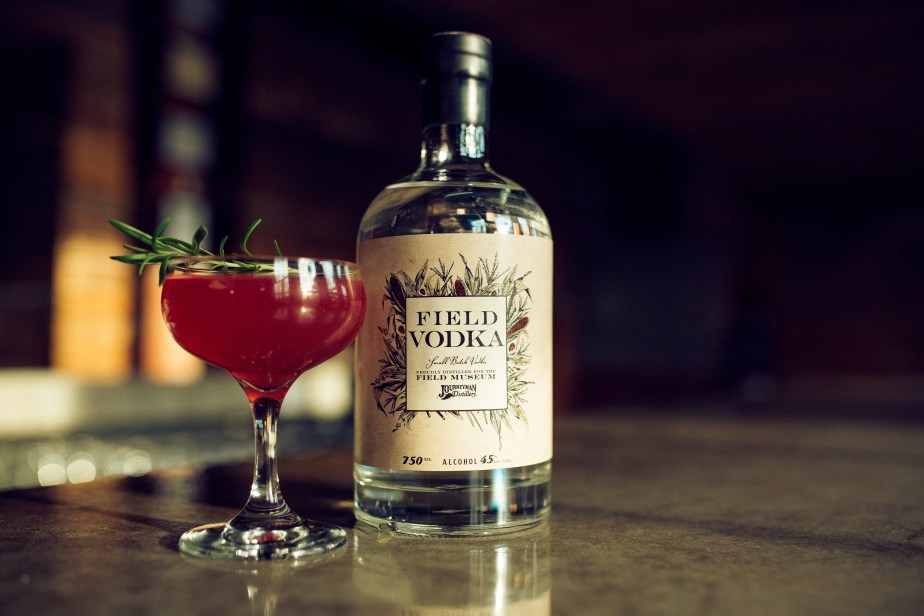
The first product they created was their Field vodka using Bloody Butcher Corn, an heirloom variety often used for making bourbon. The vodka then served as a base for the next distilled spirit, their Field Gin

“We wanted to make a global gin,” says McClain. “So we were pulling species from around the world. We narrowed it down to around 50.”

But once they had the botanicals and began developing recipes, they had to cross off a few more from the list.

“A lot of botanicals that look and taste good, don’t work where you put them in in alcohol, others that I wanted to use were hard to get or arrived too late, I still have agave in the cooler,” says McClain, noting  they used other criteria as well in the selection process. “Bill and I wanted the gin to be lavender focused. Obviously gin also has to have a heavy juniper taste as well. We wanted the gin to have tropical undertones and had to figure out those as well.”Field3Pack

Then they were down to 27 including not only lavender and juniper berries but also prickly ash, anise, mango, ginger, coconut palm sugar, pineapple, papaya, Valerian Root, cinnamon, coriander, Horehound, star fruit and Charoli nuts which are sourced from India.

For their Field Rye Whiskey, they tried several types of figs which McClain describes as the world’s oldest sweeteners, finally deciding that Black Mission figs worked the best. The figs were macerated or soaked in alcohol for three months, a process that brought out subtle and all-natural flavors of bananas, sweet melons and strawberries.

“It’s an incredible whiskey,” says McClain. “It has heavy caramel notes and soft marshmallow like palate.”

Bottles of the Field distilled spirits are available for sale. For those who would like to learn more about their taste, they’re also used in some of the cocktails served at the Staymaker, Journey’s restaurant.

Sidebar: Brews

Beer, which is so Chicago given its rich German heritage, was the first partnership Megan Williams embarked upon when she started her beverage program. Two Chicago breweries, Off Color Brewing and Two Brothers Brewing were among the first to use the botanicals to create beers for the museum. researchers at the Field Museum have spent years excavating and studying the Wari site in Peru. Toppling Goliath introduced PseudoSue pale ale, a nod to the museum’s famous 40 feet long and 13 feet tall at the hip, Tyrannosaurus rex.  Physically SUE is the largest specimen T. rex specimen that’s been discovered so far.

Off Color’s introduced Wari, their artisan beer based on the Peruvian chicha, a purple corn beer native to areas of Central and South America. One of its other tie-ins with the museum is that Field scientists have spent years leading excavations at Cerro Baúl, a remote mountaintop citadel which was the only contact point between the Tiwanaku and the Wari, considered two great kingdoms whose dynamic relationship ultimately contributed to the rise of the Incan Empire. According to Off Color’s website, an essential sacrament shared by both cultures revolved around chichi. It seems that both tribes liked to consume massive quantiles of chicha served in ornately inscribed drinking cups called keros that were discovered during the archaeological expeditions at Cerro Baúl. In this way, Wari and Tiwanaku cemented their relationships. In other words, next time you see a bunch of heavy alcohol consumers at bars, understand they’re just continuing a thousand year ritual similar to that of the Wari and Tiwanaku.

The following recipes are courtesy of the Journeyman Distillery.

Journeyman Fig Old Fashioned

1.5 oz Field Rye

0.5 oz Fresh Orange Juice

0.25 oz Journeyman Bourbon Maple Syrup

Dash of Journeyman Barrel-Aged Balsamic Vinegar

Dehydrated Orange Wheel

Stir ingredients and pour into a rocks glass, over ice. Garnish with dehydrated orange wheel.

Field Vodka Gimlet

1.5 oz Field Vodka

.75 oz Fresh Lime Juice

.5 oz Simple Syrup

Fresh Lime Wheel

Shake ingredients well and strain into a tall glass over ice. Garnish with a fresh lime wheel.

Field Gin Fizz

1.5 oz Field Gin

.75 oz Fresh Lemon Juice

.5 oz Pear Simple Syrup

1 oz Aquafaba or Egg White

Soda

Star Anise

Combine ingredients and dry shake before adding ice to the shaker. Wet shake until froth has built up. Strain into a Collins glass and top with soda. Garnish with Star Anise.

Food & Drinks: Super Pairing for the Super Bowl

Tussock Jumper Red Zone Sangria

Game On!

Wine expert Cassandra Rosen offers a way to take game day beyond chips and beer with special pairings of super cocktails and edibles for a crowd. Rosen, who represents award winning Tussock Jumper Wines, has created a fascinating array of cocktail options along with food pairing ideas that are sure to score on Super Bowl day.

Calling it a twist on the classic ‘Bishop cocktail,’ Rosen says her recipe for The Smoking Quarterback will not only take the chill off, it’s a great pairing for all of those savory, cheesy dishes on the menu.  “Try it with creamy cheese fondue, and a selection of breads, pretzels, and crackers. The rich, saltiness of the fondue will contrast well with the wine and apple flavors, and the spice notes in both the drink and the dish will complement each other.

The Smoking Quarterback

8-10 servings

Tussock Jumper Smoking Bishop750 ml bottle Tussock Jumper Tempranillo or Merlot

1 cup fresh apple cider

1 cup spiced rum

1 cup fresh apple cider

3/4 cup dark brown sugar

4 cinnamon sticks

5 cloves

½ tsp freshly ground nutmeg

3 whole star anise pods

Peels from 2 large oranges

1 teaspoon bourbon vanilla extract or one vanilla bean, split

Simmer all of the ingredients in a large sauce pot over medium low heat for approximately 1 hour.  Strain and serve warm in mugs garnished with cranberries or cinnamon sticks.

“Spinach artichoke dip or chorizo stuffed mushrooms pair well with a white sangria cocktail,” says Tussock about her Touchdown Citrus Sangria. “Artichokes may make the drink seem sweeter than it is, so a crisp, citrusy  cocktail or wine will complement the dip, and are also a good contrast for as the spice and fats in the sausage.


Touchdown Citrus Sangria

Tussock Jumper Touchdown Citrus Sangria

6-8 servings

  • 1 Bottle Tussock Jumper Pinot Grigio
  • 4 oz dry orange liqueur
  • 4 oz orange kombucha
  • 1 cup green grapes
  • 2 peaches, pitted and sliced
  • 1 orange, thinly sliced
  • 1 lime, thinly sliced
  • Garnish: rosemary or mint sprig

Add all the ingredients to a pitcher and refrigerate for 2 to 4 hours before serving.  Serve in wine glasses, over ice.

“Feed that hungry crowd with loaded nachos and this modern version of Spanish Sangria for a pairing that’s sure to please,” says Rosen about her concoction—The Red Zone. “The rich cheese flavors will pair well with an easy going red wine, and the citrus in the drink will complement both the corn chips, as well as the fresh salsa or pico de gallo.”


The Red Zone

6-8 servings

  • 1 bottle Tussock Jumper Tempranillo, chilled
  • ½ cup brandy
  • 2 tbs simple syrup
  • 1 large orange, sliced into wedges
  • 1 cup sliced or chopped seasonal fruit (apples, kiwi, strawberries, peaches, grapes)
  • 1 lime or lemon, sliced into wheels

Slice the citrus and fruits, squeezing a few slices of limes over the apples to prevent browning. Squeeze half of the orange into a pitcher, chop the remaining wedges, and add them to the pitcher. Add the rest of the fruit. Add the brandy, simple syrup, and wine, stir to combine.

Serve the sangria immediately, or let it chill for a few hours or overnight for more flavor. Serve in glasses with ice.

“Give your party a little tropical flair with a hibiscus tea infused red wine spritzer,” says Rosen, about Welcome to Miami. “Serve with Cuban sandwiches or pork tacos. Pinot Noir is a lighter, fruit-forward wine, and the flavors will dissolve the oiliness of the pork. It’s also a great match for the buttery, nutty Swiss cheese on the Cuban sand.”


Welcome to Miami-Tussock Jumper

Welcome to Miami

6-8 servings

Ingredients

  • 1 bottle Tussock Jumper Pinot Noir
  • 6 oz sweet hibiscus tea, brewed and cooled
  • Fresh fruit, like orange slices and strawberries
  • 4 oz vodka
  • 2 oz dry orange liqueur
  • Sparkling water
  • Additional fruit for garnish

To make the cocktail: Add the fruit, tea, wine, and liqueur to a large pitcher. Stir, chill, and serve with

Pair teriyaki chicken wings or Asian style meatballs with this party-friendly cocktail, inspired by the Chambord Bellini says Rosen, adding that Riesling wines can be fruity and slightly sweet, which makes them an ideal match for the sweeter flavors in Asian dishes.

Tussock Jumper Apple Berry Snap

Apple Berry Snap

6-8 servings

  • 1 (750 ml) bottle Tussock Jumper Riesling, chilled
  • 1 (750 ml) bottle Tussock Jumper Prosecco, chilled
  • 1 cup fresh apple cider
  • 4 oz raspberry liqueur
  • Juice from ½ a lemon
  • 1 Envy or Jazz apple, sliced
  • 1 cup fresh blackberries
  • 8 sprigs thyme

In a large pitcher, combine Tussock Jumper Riesling, apple cider, apples, and blackberries.

Chill the pitcher in the refrigerator for at least 1 hour, or overnight. When ready to serve, fill glasses with ice, top with Tussock Jumper Prosecco, and garnish.

About Tussock Jumper Wines

As a gold medal award winning wine portfolio, Tussock Jumper Wines sources only the best limited production vintages each growing season from producers around the globe.

The label speaks to the adventure-seeker, looking to explore new and unique wine experiences. Each bottle features a hand drawn animal representative of its country of origin, wearing a colorful sweater-traditionally red, or green for organic-as a mark of distinction for the Tussock Jumper’s focus on high quality, sustainably made wines.

Currently, the Tussock Jumper portfolio encompasses over 24 wines from eleven different winemaking regions. Each of their wines are bottled right at the source, capturing the best flavors and aromas from grape to glass.  All natural and organic farming practices are also implemented whenever possible.

Get the App!

Adding to the fun, Tussock Jumper has also developed an augmented reality app, with each regional ambassador ‘jumping’ off the bottle to help with wine pairings and recommendations for the varietal. Download it free on the Play Store or iTunes now.


King Hills Comfort Food Cruise Returns: Just launched Comfort Food Trail Pass included in tickets.

Cheeseburger at Mam’s Rusted Skiller

The 7th annual Hocking Hills Comfort Food Cruise runs for the next three weekends in beautiful Hocking Hills, Ohio. It’s the perfect way for travelers to try all the wonderful casual dining restaurants located in this scenic area in Southern Ohio. Only $20, each ticket includes one comfort food dish at each of the 15 restaurants included in the cruise. $5 from the cost of each ticket goes to benefit the region’s local food pantries and are good for the weekends of  Jan. 11-12; Jan. 18-19 and Jan. 25-26. 

Hocking Hills Coffee Emporium

Beautiful any time of the year, Hocking Hills, with its stunning rock formations, dense woods, charming small towns and villages, wonderful vistas and magnificent cataracts, waterfalls and rapids, that in the winter morph into sensational sculptures of frozen water, is perfect for cold weather beauty and Instagramable moments. Bundle up and enjoy the outdoors then warm up with dishes from cafes, diners, country inn and local eateries.

Photo courtesy of Inn and Spa at Cedar Falls in Hocking Hills, Ohio

New this year, the Comfort Food Trail Pass, included in the $20 ticket, for this year’s Comfort Food Cruise  is designed for both travelers and locals alike to enjoy Hocking Hills’ locally owned eateries year-round. This card features special offers at all Trail stops throughout 2020. Reservations are not needed, but Comfort Food Cruise tickets, the Trail Pass and complete visitor and lodging information, are available at ExploreHockingHills.com.
There are three easy ways to purchase tickets:

 In person

Stop by the Welcome Center to pick up your tickets. Cash, check or credit cards accepted.

Purchase tickets by mail

Send your name, address and the number of tickets you want with your check to Comfort Food Cruise, Hocking Hills Regional Welcome Center, 13178 State Route 664 S, Logan, OH 43138.

Purchase tickets online – Tickets are on sale now.

Photo courtesy of the Inn & Spa at Cedar Falls.

2020 participating stops include:

·         The Boot Grill: Baked Steak Sliders & Loaded Baked Potatoes

·         Bush’s Restaurant: Homemade Chili

·         Hocking Hills Coffee Emporium: Carmel Pecan Cinnamon Roll or Apple Danish

·         Hocking Hills Diner: Banana Bread French Toast

·         Home Tavern: Sloppy Joe Slider and Cup of Soup

·         Inn & Spa at Cedar Falls: Mixed Berry Cobbler

·         M&M Family Diner: Vegetable Soup

·         Mam’s Rusted Skillet: Cheeseburger Slider & Homemade Chips

·         Millstone Barbeque: Pulled Pork Sliders & Baked Beans

·         Nelsonville Emporium Kitchen: Homemade Pretzel

·         The Olde Dutch: Chicken & Noodles or Mashed Potatoes

·         Pearl’s Diner: Biscuits and Gravy

·         Pizza Crossing: 8’’ Pepperoni or Cheese Pizza

·         The Ridge Inn Restaurant: Meatloaf

·         Treehouse Treats & Treasures: Jr. Ice Cream Cone

Inn & Spa at Cedar Falls

According to Sophia Winegard of Weirwick Communications, in between stops — or after their cruise — travelers are encouraged to enjoy even more of the Hocking Hills beauty and its experiences. They can work up an appetite or walk off a full stomach while they capture Instagram-worthy photos of Old Man’s Cave. Visitors can also enjoy the area’s fresh air and spectacular winter landscape with an easy hike to Ash Cave, a longer trek to Cedar Falls, meander around Conkle’s Hollow, or explore any of the area’s many other gorgeous natural features.

Hanukkah 2019

            Hanukkah, also known as the Festival of Lights, is celebrated on the 25th day of the month of Kislev on the Hebrew calendar and lasts eight days, this year from December 22 to 30.  One candle a night, on a nine-branch menorah, is lit at sunset each of the evenings. The ninth candle, called a shamash meaning helper or attendant, is used to light the other eight. It’s a very touching ceremony. But it didn’t stop me from being a little “grinchy” as I think I’ve mentioned before when I was growing up and Hanukkah rolled around.

Instead of just appreciating my holiday and my best friend Lizzy Cohen’s holiday, I would complain to my mother when I returned home after watching Mr. Cohen light the candle and say the blessing, “Baruch atah Adonai, Eloheinu Melech ha’olam, asher kid’shanu b’mitzvotav v’tsivanu l’hadlik ner shel Hanukkah” in his deep baritone, that Lizzie got eight presents—one for each night. My mother pointed out that though I got all my presents on one day, if I added them up the total was probably larger than eight. But I chose not to listen to reason. She had other bad news for me as well, telling me we couldn’t convert our faith to Judaism just so I could get more gifts.

          I’m kind of over the Lizzie Cohen thing now—we’re still friends on Facebook and I never mention that I know she’s getting a lot more presents that me.

Now, when I think of Hanukkah, I remember sharing a meal with the Cohens and lighting the candles and appreciate them taking me into their family and sharing their holiday with me.

          Knowing Hanukkah was coming up, I asked my good friend Carrie Bachman if she had any recipes she could share, and she sent me the following which are from the just released Joy of Cooking 2019 . I’ve copied the recipes just like they are in the cookbook with the unique formatting that is so particular to this great book.

VEGAN EGGNOG

About eight 6-ounce servings

This eggnog is quite boozy, which is how we like it, but feel free to scale back on the rum, if desired.

Soak overnight in water to cover:

            1 cup raw cashews

Drain and transfer to a blender along with:

            One 13 ½-ounce can coconut milk

            1 cup water

            ½ cup sugar or maple syrup

            1 tablespoon vanilla

Blend until completely smooth and creamy. Strain into a punch bowl or pitcher and stir in:

            1 cup light rum

            ½ cup Grand Marnier or Cointreau

Serve garnished with:

            Freshly grated nutmeg

If making ahead of time, the eggnog may separate when refrigerated. Simply let it sit for 20 minutes at room temperature, then whisk well or reblend before serving.

               LATKES (POTATO PANCAKES)

About fourteen 3-inch cakes

The high starch content of russet potatoes helps hold the cakes together. Shredded celery root, parsnip, sweet potato, or carrot may be substituted for up to half the potatoes.

Wrap in a clean kitchen towel and wring to squeeze out as much moisture as possible:

            1 pound russet potatoes (about 2 medium), peeled and shredded (about 2 cups)

            1 medium onion, grated

Combine in a bowl with:

            2 large eggs, well beaten

            3 tablespoons all-purpose flour or matzo meal

            1 ¼ teaspoons salt

Preheat the oven to 200°F. Heat in a large heavy skillet over medium-high heat until hot:

            ¼ inch or more vegetable oil or butter

Place spoonfuls of the potato mixture into the skillet, in batches, and form them into 3-inch patties about ¼ inch thick. Brown on the bottom for about 4 minutes, reducing the heat to medium if necessary, to prevent scorching. Turn and brown the second side until crisp, about 4 minutes more. Transfer to a plate or rimmed baking sheet lined with paper towels and keep warm in the oven while frying the remaining latkes. Serve at once with:

            Applesauce

            Sour cream or Greek yogurt

            Minced chives

Schimpff’s, one of the oldest, continuously operated, family-owned candy businesses in the United States, dates back to the late 1800s.

Watch candy and history being made at Schimpff’s Confectionery in historic Jeffersonville, Indiana, just across the Ohio River from downtown Louisville. Known for their red hots and red-fished shaped candies are among the originals made by this multi-generational family owned confectionery. Another favorite, dating back to when European opera star Helena Modjeska toured the U.S. several times, performing in front of vast and enthusiastic crowds in Louisville, Kentucky in the 1880s. Sure, she thrilled the elite in New York and San Francisco but did they create and name a candy after her?

No but Kentucky did and Modjeskas are very much a treat around here–marshmallows dipped in caramel and then chocolate.

Schimpff’s Confectionery, one of the oldest, continuously operated, family-owned candy businesses in the United States, began in its present location on April 11, 1891. Started by Gus Schimpff Sr. and Jr., the business survived wars, floods, depressions, and recessions through four generations and continues to flourish.

But really, those Schimpffs have been making candy a whole lot longer, starting in Jeffersonville around 1871 and in Louisville since the 1850’s. That’s a lot of candy.

The 1860 census shows various Schimpffs making candy on Preston Street in Louisville. Magdalene Schimpff, a widow, brought five of her eight children from Bavaria to settle in Louisville, where the eldest son had already settled. The two youngest children joined them after finishing elementary school in Germany. Magdalene and daughter, Augusta, went into the embroidery business while the sons went into the confectionery business.

Warren Schimpff prepares their cinnamon Red Hots .

Fast forward through the decades, no make that more than century total, according to their website

Warren Schimpff with the molten liquid candy
In the 1940s, Catherine, Wig, and his son, Sonny, became the working partners. Wig was the candy maker and Catherine the manager and lunchroom cook.In the 1950s, Sonny developed an area of the store as a hobby business, specializing in model trains and planes. His mother, Vivian, became the bookkeeper.

After Wig’s death in 1952, Sonny took over as the candy maker and for forty years he and Aunt Catherine built a reputation known widely throughout Southern Indiana. Sonny’s death in 1988 and Catherine’s in 1989 forced another change in the ownership of Schimpff’s Confectionery.
The molten candy used to make the Swedish Fish will now be rolled out.

Still a family business, it’s now owned and operated by Warren Schimpff, one of Weber’s sons, and his wife, Jill Wagner Schimpff who bought the candy business from his Aunt Catherine’s estate. They wanted to be able to celebrate the centennial anniversary and to maintain the Schimpff family’s candy legacy.

Swedish Fish

It’s a romp through candy history as well–there’s an old fashioned soda fountain an a large confectionary museum that’s free of charge.

Hours & Location

Schimpff’s Confectionery
347 Spring Street
Jeffersonville, IN 47130
(812) 283-8367

KETO POWER!!

Keto diets which while very similar to the Atkins Diet, both of which are based on drastically reducing carbohydrates in order to throw the body into ketosis meaning it turns to fat for fuel once its glucose stores are used up. But while Atkins was designed for weight reduction, the keto diet is being studied for its possible ability to reduce seizures in people with epilepsy, be heart healthy, protect brain functioning including increasing alertness and maybe treat or prevent conditions like Parkinson’s, Alzheimer’s and certain types of sleep disorders. Two great books to help you learn about and incorporate keto into your diet are: The Keto Instant Pot Cookbook: Ketogenic Diet Pressure Cooker Recipes Made Easy and Fast By Urvashi Pitre and The One-Pot Keto Diet Ketogenic Cookbook: 100+ Easy Weeknight Meals for Your Skillet, Slow Cooker, Sheet Pan, and More by Liz Williams.

Other Interesting Keto news.

Global Keto Diet Market to Grow 5.6% per Annum to $15.6 Billion Value by 2027

With more and more consumers becoming aware of its overall health benefits, the ketogenic diet has grown into one of the most popular diet plans over the years. According to DrJohn.org research, the global ketogenic diet market is expected to grow at a CAGR of 5.5% and reach a $15.6 billion value by 2027.

North America Holds the Largest Share of Global Keto Diet Market

In 2018, the global ketogenic diet market reached $9.6 billion in value. The expanding trend continued in 2019 with a 4.27% year-on-year growth rate. The 2019 data show that North America generates the most significant share of the global keto diet market revenue.

The rise of the ketogenic diet market in North America is primarily a result of the growing consumer awareness related to obesity and health issues. The recent surveys showed that besides the easy availability of keto-friendly products and the wide offer on the market, the consumers in the US and Canada have also started to adopt active diet habits to lose weight. At the same time, North American keto diet companies are constantly improving the quality of their products to fully accommodate the customers’ demands.

With the increasing number of consumers interested in keto-friendly products, Europe is the second-largest keto diet market in the world. According to the surveys, Europe is expected to generate 32% of the global keto diet market growth in the years to come.

Beverage Products Generate the Most Significant Market Revenue

One of the key drivers for the rapid global keto diet market growth is the increasing availability of keto products across different distribution formats. The 2019 surveys show that drink products are generating the most substantial part of the overall market revenue.

The low-carb and high-fat keto beverages are developed to help accelerate the metabolic state of ketosis, which improves the body’s efficiency while burning fat for energy. Today, the global ketogenic dieters are offered with an increasing number of new beverage products. Almond butter in to-go pouches, medium-chain triglycerides oil, nutritional drinks, and bone broth with keto-specific packaging are some of the most popular products on that list. Other significant revenue streams on the market are keto-friendly supplements and meals, sauces and condiments, sweeteners and dark chocolate.

The Keto Instant Pot Cookbook: Ketogenic Diet Pressure Cooker Recipes Made Easy and Fast

By Urvashi Pitre

Rockridge Press $10.30 (Amazon price)

Urvashi Pitre, who blogs at TwoSleevers.com and wrote the bestselling Indian Instant Pot Cookbook, offers an introduction to the Keto diet concept, the use of Instant Pots for those who are new to cooking with one and then shares a broad range of Keto recipes that are tasty.

Cauliflower Mac and Cheese

2 cups Cauliflower Rice (see note below)

2 tablespoons cream cheese,

at room temperature

1/2 cup half-and-half

1/2 cup grated sharp

Cheddar cheese

1 teaspoon salt

1 teaspoon freshly ground

Black pepper

In a heatproof bowl, mix the cauliflower, cream cheese, half-and-half, Cheddar cheese, salt, and pepper together. Cover the bowl with aluminum foil.

Pour 2 cups of water into the inner cooking pot of the Instant Pot, then place a trivet in the pot. Place the bowl on the trivet.

Lock the lid into place. Select Manual or Pressure Cook and adjust the pressure to High. Cook for 5 minutes. When the cooking is complete, let the pressure release naturally for 10 minutes, then quick-release any remaining pressure. Unlock the lid and carefully remove the bowl. Remove the foil.

Place the cooked cauliflower under the broiler, and broil until the cheese is brown and bubbling, 3 to 5 minutes. Serve immediately.

Per Serving Calories: 134; Total Fat: 11g; Total Carbs: 4g; Net Carbs: 3g; Fiber: 1g; Sugar: 2g; Protein: 6g

Note: Many grocery stores are now selling cauliflower rice in their frozen food sections. But if you want to make your own, here’s an easy way to do so. Place cauliflower florets in a blender with plenty of water, pulsing until the cauliflower is completely chopped up. Drain the mixture using a large strainer. It’s as easy as that.

The One-Pot Keto Diet Ketogenic Cookbook: 100+ Easy Weeknight Meals for Your Skillet, Slow Cooker, Sheet Pan, and More

By Liz Williams

Rockridge Press $8.99

Roasted Asparagus, Bacon and Egg Bake

12 uncured bacon slices

16 to 20 asparagus spears, ends snapped off and discarded

Salt

Freshly ground black pepper

8 large eggs

1 avocado, peeled and sliced

Preheat oven to 425° F.

In large cast iron skillet over medium heat, cook the bacon. Turn the slices with tongs every few minutes and cook until bacon is 75% cooked, 5 to 7 minutes. Transfer to a paper towel-lined plate.

Drain the bacon grease from the skillet and discard, keeping 3 tablespoons of bacon fat in the pan. Add the trimmed asparagus spears to the skillet, season with salt and pepper and toss until coated with fat.

Bake in the oven for 6 to 8 minutes or until the spears start of soften. Remove from the oven and turn the asparagus with tongs. Return the bacon to the skillet. Crack the eggs over the top of the bacon and asparagus.

Return the skillet to the oven and back for 5 to 7 minutes or until the eggs reach desired doneness.

Serve immediately with avocado slices.