On the road and at home, it's always about food and fun!
Author: Jane Simon Ammeson
Jane Simon Ammeson is a freelance writer who specializes in travel, food and personalities. She writes frequently for The Times of Northwest Indiana, Mexico Connect, Long Weekends magazine, Edible Michiana, Lakeland Boating, Food Wine Travel magazine , Lee Publications, and the Herald Palladium where she writes a weekly food column. Her TouchScreenTravels include Indiana's Best. She also writes a weekly book review column for The Times of Northwest Indiana as well as food and travel, has authored 16 books including Lincoln Road Trip: The Back-road Guide to America's Favorite President, a winner of the Lowell Thomas Journalism Award in Travel Books, Third Place and also a Finalist for the 2019 Foreword INDIES Book of the Year Awards in the Travel category. Her latest books are America's Femme Fatale: The Story of Serial Killer Belle Gunness and Classic Restaurants of Northwest Indiana.
Her other books include How to Murder Your Wealthy Lovers and Get Away with It, A Jazz Age Murder in Northwest Indiana and Murders That Made Headlines: Crimes of Indiana, all historic true crime as well Hauntings of the Underground Railroad: Ghosts of the Midwest, Brown County, Indiana and East Chicago. Jane’s base camp is Stevensville, Michigan on the shores of Lake Michigan. Follow Jane at facebook.com/janesimonammeson; twitter.com/hpammeson; https://twitter.com/janeammeson1; twitter.com/travelfoodin, instagram.com/janeammeson/ and on her travel and food blog janeammeson.com and book blog: shelflife.blog/
Watch candy and history being made at Schimpff’s Confectionery in historic Jeffersonville, Indiana, just across the Ohio River from downtown Louisville. Known for their red hots and red-fished shaped candies are among the originals made by this multi-generational family owned confectionery. Another favorite, dating back to when European opera star Helena Modjeska toured the U.S. several times, performing in front of vast and enthusiastic crowds in Louisville, Kentucky in the 1880s. Sure, she thrilled the elite in New York and San Francisco but did they create and name a candy after her?
No but Kentucky did and Modjeskas are very much a treat around here–marshmallows dipped in caramel and then chocolate.
Schimpff’s Confectionery, one of the oldest, continuously operated, family-owned candy businesses in the United States, began in its present location on April 11, 1891. Started by Gus Schimpff Sr. and Jr., the business survived wars, floods, depressions, and recessions through four generations and continues to flourish.
But really, those Schimpffs have been making candy a whole lot longer, starting in Jeffersonville around 1871 and in Louisville since the 1850’s. That’s a lot of candy.
The 1860 census shows various Schimpffs making candy on Preston Street in Louisville. Magdalene Schimpff, a widow, brought five of her eight children from Bavaria to settle in Louisville, where the eldest son had already settled. The two youngest children joined them after finishing elementary school in Germany. Magdalene and daughter, Augusta, went into the embroidery business while the sons went into the confectionery business.
Warren Schimpff prepares their cinnamon Red Hots .
Fast forward through the decades, no make that more than century total, according to their website
Warren Schimpff with the molten liquid candy
In the 1940s, Catherine, Wig, and his son, Sonny, became the working partners. Wig was the candy maker and Catherine the manager and lunchroom cook.In the 1950s, Sonny developed an area of the store as a hobby business, specializing in model trains and planes. His mother, Vivian, became the bookkeeper.
After Wig’s death in 1952, Sonny took over as the candy maker and for forty years he and Aunt Catherine built a reputation known widely throughout Southern Indiana. Sonny’s death in 1988 and Catherine’s in 1989 forced another change in the ownership of Schimpff’s Confectionery.
The molten candy used to make the Swedish Fish will now be rolled out.
Still a family business, it’s now owned and operated by Warren Schimpff, one of Weber’s sons, and his wife, Jill Wagner Schimpff who bought the candy business from his Aunt Catherine’s estate. They wanted to be able to celebrate the centennial anniversary and to maintain the Schimpff family’s candy legacy.
Swedish Fish
It’s a romp through candy history as well–there’s an old fashioned soda fountain an a large confectionary museum that’s free of charge.
Keto diets which while very similar to the Atkins Diet, both of which are based on drastically reducing carbohydrates in order to throw the body into ketosis meaning it turns to fat for fuel once its glucose stores are used up. But while Atkins was designed for weight reduction, the keto diet is being studied for its possible ability to reduce seizures in people with epilepsy, be heart healthy, protect brain functioning including increasing alertness and maybe treat or prevent conditions like Parkinson’s, Alzheimer’s and certain types of sleep disorders. Two great books to help you learn about and incorporate keto into your diet are:The Keto Instant Pot Cookbook: Ketogenic Diet Pressure Cooker Recipes Made Easy and Fast By Urvashi Pitre and The One-Pot Keto Diet Ketogenic Cookbook: 100+ Easy Weeknight Meals for Your Skillet, Slow Cooker, Sheet Pan, and Moreby Liz Williams.
Other Interesting Keto news.
Global Keto Diet Market to Grow 5.6% per Annum to $15.6 Billion Value by 2027
With more and more consumers becoming aware of its overall health benefits, the ketogenic diet has grown into one of the most popular diet plans over the years. According to DrJohn.org research, the global ketogenic diet market is expected to grow at a CAGR of 5.5% and reach a $15.6 billion value by 2027.
North America Holds the Largest Share of Global Keto Diet Market
In 2018, the global ketogenic diet market reached $9.6 billion in value. The expanding trend continued in 2019 with a 4.27% year-on-year growth rate. The 2019 data show that North America generates the most significant share of the global keto diet market revenue.
The rise of the ketogenic diet market in North America is primarily a result of the growing consumer awareness related to obesity and health issues. The recent surveys showed that besides the easy availability of keto-friendly products and the wide offer on the market, the consumers in the US and Canada have also started to adopt active diet habits to lose weight. At the same time, North American keto diet companies are constantly improving the quality of their products to fully accommodate the customers’ demands.
With the increasing number of consumers interested in keto-friendly products, Europe is the second-largest keto diet market in the world. According to the surveys, Europe is expected to generate 32% of the global keto diet market growth in the years to come.
Beverage Products Generate the Most Significant Market Revenue
One of the key drivers for the rapid global keto diet market growth is the increasing availability of keto products across different distribution formats. The 2019 surveys show that drink products are generating the most substantial part of the overall market revenue.
The low-carb and high-fat keto beverages are developed to help accelerate the metabolic state of ketosis, which improves the body’s efficiency while burning fat for energy. Today, the global ketogenic dieters are offered with an increasing number of new beverage products. Almond butter in to-go pouches, medium-chain triglycerides oil, nutritional drinks, and bone broth with keto-specific packaging are some of the most popular products on that list. Other significant revenue streams on the market are keto-friendly supplements and meals, sauces and condiments, sweeteners and dark chocolate.
The Keto Instant Pot Cookbook: Ketogenic Diet Pressure Cooker Recipes Made Easy and Fast
By Urvashi Pitre
Rockridge Press $10.30 (Amazon price)
Urvashi Pitre, who blogs at TwoSleevers.com and wrote the bestselling Indian Instant Pot Cookbook, offers an introduction to the Keto diet concept, the use of Instant Pots for those who are new to cooking with one and then shares a broad range of Keto recipes that are tasty.
Cauliflower Mac and Cheese
2 cups Cauliflower Rice (see note below)
2 tablespoons cream cheese,
at room temperature
1/2 cup half-and-half
1/2 cup grated sharp
Cheddar cheese
1 teaspoon salt
1 teaspoon freshly ground
Black pepper
In a heatproof bowl, mix the cauliflower, cream cheese, half-and-half, Cheddar cheese, salt, and pepper together. Cover the bowl with aluminum foil.
Pour 2 cups of water into the inner cooking pot of the Instant Pot, then place a trivet in the pot. Place the bowl on the trivet.
Lock the lid into place. Select Manual or Pressure Cook and adjust the pressure to High. Cook for 5 minutes. When the cooking is complete, let the pressure release naturally for 10 minutes, then quick-release any remaining pressure. Unlock the lid and carefully remove the bowl. Remove the foil.
Place the cooked cauliflower under the broiler, and broil until the cheese is brown and bubbling, 3 to 5 minutes. Serve immediately.
Per Serving Calories: 134; Total Fat: 11g; Total Carbs: 4g; Net Carbs: 3g; Fiber: 1g; Sugar: 2g; Protein: 6g
Note: Many grocery stores are now selling cauliflower rice in their frozen food sections. But if you want to make your own, here’s an easy way to do so. Place cauliflower florets in a blender with plenty of water, pulsing until the cauliflower is completely chopped up. Drain the mixture using a large strainer. It’s as easy as that.
The One-Pot Keto Diet Ketogenic Cookbook: 100+ Easy Weeknight Meals for Your Skillet, Slow Cooker, Sheet Pan, and More
By Liz Williams
Rockridge Press $8.99
Roasted Asparagus, Bacon and Egg Bake
12 uncured bacon slices
16 to 20 asparagus spears, ends snapped off and discarded
Salt
Freshly ground black pepper
8 large eggs
1 avocado, peeled and sliced
Preheat oven to 425° F.
In large cast iron skillet over medium heat, cook the bacon. Turn the slices with tongs every few minutes and cook until bacon is 75% cooked, 5 to 7 minutes. Transfer to a paper towel-lined plate.
Drain the bacon grease from the skillet and discard, keeping 3 tablespoons of bacon fat in the pan. Add the trimmed asparagus spears to the skillet, season with salt and pepper and toss until coated with fat.
Bake in the oven for 6 to 8 minutes or until the spears start of soften. Remove from the oven and turn the asparagus with tongs. Return the bacon to the skillet. Crack the eggs over the top of the bacon and asparagus.
Return the skillet to the oven and back for 5 to 7 minutes or until the eggs reach desired doneness.
When Rebecca Katz’s Cancer-Fighting Kitchen: Second Edition: Nourishing, Big-Flavor Recipes for Cancer Treatment and Recovery, a finalist in the Health & Special Diet category of the IACP Awards, came out a decade ago. the idea of cookbooks geared towards specific illnesses was still relatively new. But the success of that book as well as Katz’sOne Bite at a Time: Nourishing Recipes for Cancer Survivors and Their Friends, both of which provide nurturing recipes designed to help those who are undergoing treatment and dealing with side effects as well as introduce foods that studies have shown might help in preventing the disease, was so great, that a second edition came out a little over a year ago.
Curried Chicken Salad
SERVES: 6
1 1⁄2 pounds roasted organic chicken
1 Granny Smith apple, diced into 1⁄4-inch pieces
1⁄4 cup raisins or currants
1⁄4 cup minced scallions, green part only
2 stalks celery, diced small
1⁄2 cup organic plain Greek-style yogurt
1⁄4 cup mayonnaise
1 tablespoon freshly squeezed lime juice
1 tablespoon curry powder
1⁄2 teaspoon ground ginger
1⁄2 teaspoon sea salt
6 butter lettuce leaves, washed and dried
1⁄4 cup slivered toasted almonds, for garnish
1⁄4 cup chopped fresh cilantro, for garnish (optional)
Chop the chicken into 1⁄2-inch pieces and put them in a bowl. Stir in the apple, raisins, scallions, and celery. Separately, whisk together the yogurt, mayonnaise, lime juice, curry powder, ginger, and salt. Add the yogurt mixture to the chicken and stir gently until thoroughly combined. Serve atop the lettuce leaves, garnished with the almonds and cilantro, if desired.
COOK’S NOTE: Save time by using store-bought organic roast chicken.
STORAGE: Store in an airtight container in the refrigerator for 3 days.
PER SERVING: Calories: 300; Total Fat: 11.3 g (3.1 g saturated, 3.8 g monounsaturated); Carbohydrates: 15 g; Protein: 34 g; Fiber: 2 g; Sodium: 375 mg
Orange Pistachio Quinoa
Quinoa is its own little ecosystem, containing all of the essential amino acids that we must obtain through the diet. Put another way, quinoa brings some good nutrients to the table that the body needs to begin repairing itself. Its mild taste makes it a perfect backdrop for this nicely layered crunchy/chewy portable dish, in which olive oil, citrus, vitamin-rich pistachios, and raisins dance delightfully on the taste buds, and herbs (mint, cumin, and coriander) provide a huge hit of taste and anticancer nutrients.
SERVES: 6
PREP TIME: 15 minutes
COOK TIME: 15 minutes
1⁄2 cup raw pistachios
1 1⁄2 cups quinoa
2 1⁄2 cups Magic Mineral Broth (page 49) or water
1 teaspoon sea salt
1 teaspoon cumin
1⁄2 teaspoon coriander
1⁄8 teaspoon freshly ground pepper
1⁄2 cup chopped fresh mint
2 scallions, both green and white parts, finely chopped
1⁄8 cup freshly squeezed orange juice
Zest of 1 orange
1 1⁄2 tablespoons olive oil
1 1⁄2 tablespoons freshly squeezed lemon juice
1⁄2 cup raisins
Preheat the oven to 325°F.
Spread the pistachios in an even layer on a sheet pan and bake for 7 to 10 minutes, until aromatic and slightly browned. Let cool.
Place the quinoa in a fine-mesh strainer and rinse well under cold running water to remove all the resin.
In a pot, bring the broth and 1 teaspoon salt to a boil. Add the quinoa and cover. Decrease the heat and simmer for 15 minutes. Transfer from the heat and fluff with a fork. Spread mixture out on a sheet pan and “rake” with a fork occasionally until cooled.
Transfer the quinoa from the sheet pan to a large bowl. Stir in the cumin, coriander, salt, and pepper. Add the mint, scallions, orange juice, orange zest, olive oil, lemon juice, toasted pistachios, and raisins. Mix well and taste; you may need a pinch of salt, a squeeze of lemon, or a dash of olive oil.
VARIATION: Make this a meal in a bowl by adding 1 cup of cooked chickpeas when you stir everything together.
COOK’S NOTES: Rinse, rinse, and rinse again! Quinoa is naturally coated with a bitter-tasting resin. To get rid of the resin, put the grain in a bowl of cool water, swish it around with your hand, then drain it in a fine-mesh sieve.
Quinoa is gluten free, which makes sense when you consider that botanically, it isn’t a grain at all; it’s more closely related to beets.
STORAGE: Store in an airtight container in the refrigerator for 4 days.
PER SERVING: Calories: 265; Total Fat: 10.3 g (1.3 g saturated, 5.9 g monounsaturated); Carbohydrates: 40 g; Protein: 7 g; Fiber: 6 g; Sodium: 435 mg
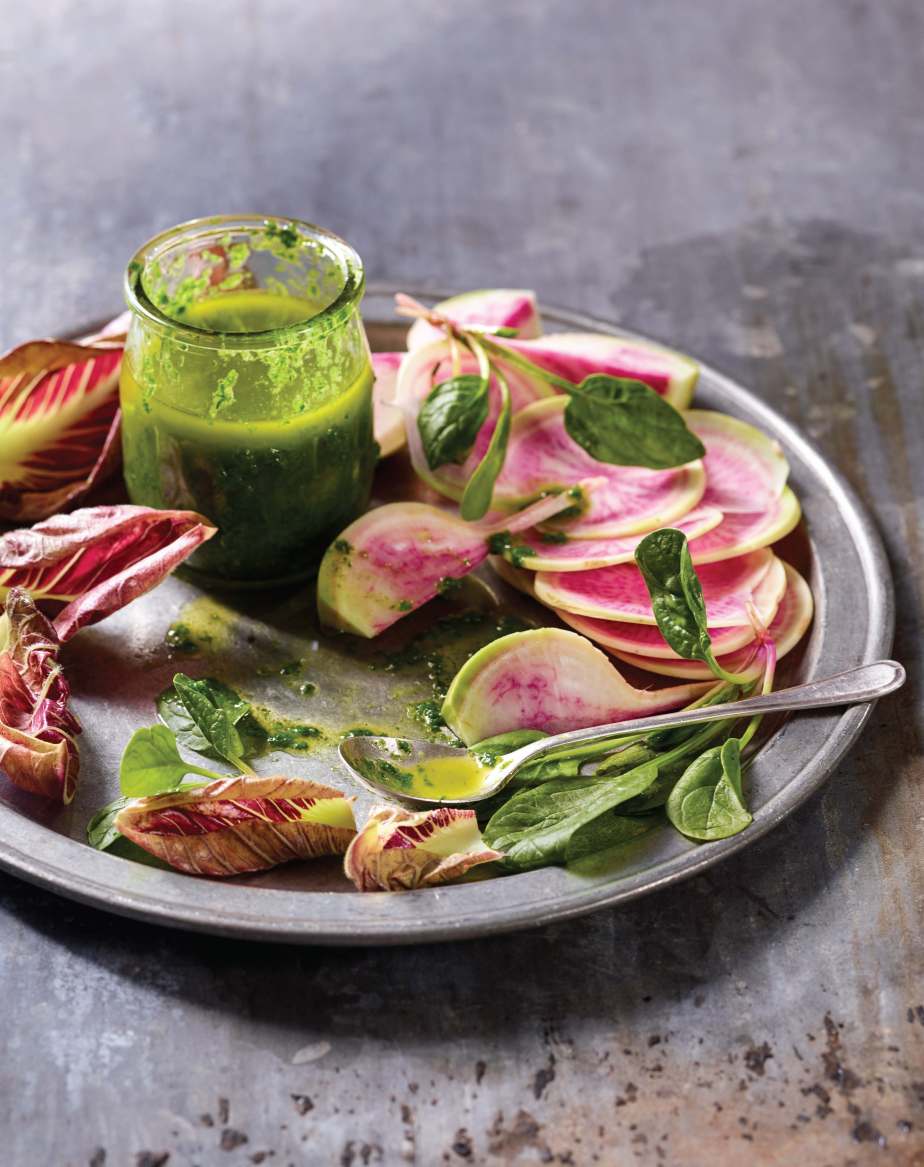
This is the little black dress of condiments—appropriate in almost any situation. What it really comes down to is mixing lemon zest, basil, and lemon juice, and—zingo!—you have a condiment that brightens and brings out the flavor in anything you put it on top of—veggies, chicken, fish, whatever. An added bonus is the blast of cancer-fighting properties, especially basil’s anti-inflammatory agents and lemon’s antioxidant phytochemicals.
MAKES: 1⁄2 cup
PREP TIME: 5 minutes
COOK TIME: Not applicable
1 cup loosely packed fresh basil leaves
2 tablespoons freshly squeezed lemon juice
1 teaspoon lemon zest
1⁄4 cup extra-virgin olive oil
1 teaspoon maple syrup (optional)
1⁄4 teaspoon sea salt
Put all of the ingredients in a food processor and process until well blended.
GOES WITH: Italian White Bean Soup (page 52), Minestrone (page 57), Cooling Cucumber Avocado Soup (page 62), Roasted Red Roma Tomato Soup (page 69), Creamy Broccoli and Potato Soup (page 71), Basil Broccoli (page 75), Easy Eggs in a Cup (page 100), Nana’s Egg Salad (page 102), Tuscan Farro and Bean Salad (page 111), Lemon Mustard Salmon Salad (page 115), Mediterranean Lentil Salad (page 144), Simple Tuscan Farro (page 147), and, as you might guess from this list, myriad other savory dishes.
VARIATION: For a richer drizzle that’s more like pesto, add 1⁄4 cup pecans or walnuts when you process the ingredients.
STORAGE: Store in an airtight container in the refrigerator for 7 to 10 days or in the freezer for 2 months.
PER SERVING: 2 tablespoons—Calories: 125; Total Fat: 14.1 g (2 g saturated, 10 g monounsaturated); Carbohydrates: 1 g; Protein: 0 g; Fiber: 0 g; Sodium: 150 mg
CREDIT:Reprinted with permission from The Cancer-Fighting Kitchen 2nd Edition, copyright by Rebecca Katz with Mat Edelson,2016. Published by Ten Speed Press, an imprint of Penguin Random House LLC.
Shauna Sever lived in California for 12 years before moving back to Chicago with her husband and children. But she doesn’t yearn for California cuisine. Instead Sever, the author of the recently releasedMidwest Made: Big, Bold Baking from the Heartland, embraces her homeland roots and wants people to know we’re not just some huge, homogenous flyover region with bland and boring food.
“There’s much more variety than people realize about the Midwest,” says Sever, a contributor to the long-running public radio show The Splendid Table, for which she was nominated for an IACP award in 2017. “Every state or every little city or little town has different recipes that are important to the people there.”
Indeed, as Sever sees it, the Midwest represents the great baking traditions of Europe, passed down generationally by immigrant families who settled here over the last century or so. Each dish has its own special history like runzas–yeasted dough baked around a savory meat filling that can conveniently be stuffed in a pocket that are also known as bierocks and krautburgers. In ways, they are like pasties, those Cornish turnovers popular in Michigan’s Upper Peninsula, which were also good for stuffing in pockets so that miners could take them to work and not have to worry about forks and knives.
“They {runsas} likely originated in Russia in the 1800s, and came to the Midwest with the Volga Germans, a population of German people who lived along the Volga River in southeastern Russia in the 18th century and settled in Nebraska, Kansas, and the Dakotas in the early 20th century,” Sever writes in her introduction to the recipe.
For Michiganders, there’s Bumpy Cake—though I’d never heard of it before flipping through Sever’s book. But it’s the real Michigan deal, created in the early 1900s by Detroit’s Sanders Chocolates company. She also includes a recipe for potato chip cookies popularized around 1940 as a promotional effort by potato chip companies to sell more products. I first tried them at The Southerner, a restaurant on the water in Saugatuck. Owner/executive chef Matt Miller, whose family migrated from Appalachia to Detroit to work in the auto industry, uses his heritage as inspiration for menu items. Hence, his version of potato chip cookies.
Sever says when making this dish, we can use whatever Potato chip brand we want though she notes a really thin, delicate chip like Lay’s Classic work well.
“This variety is very salty, so I only add 1/4 teaspoon of salt to the dough itself,” she says. “The key to these cookies is their salt level, so if you use a lightly salted chip or another brand, taste the dough for salt and see if you’d like a bit more–1/8 teaspoon or a couple of pinches–to achieve the level of salty-sweetness you like. It’s easiest to weigh the amount of whole chips you need, and then crush them in a resealable plastic bag with a rolling pin.”
2 tablespoons unsalted butter, melted, for serving
Position racks to the upper and lower thirds of the oven and preheat it to 350°F. Line 2 baking sheets with parchment paper.
Prepare the dough: In a small cup, whisk together the yeast and warm water.
In the bowl of an electric mixer fitted with the dough hook, combine the flour, sugar, and salt.
In a medium bowl, whisk together the warm milk, melted butter, eggs, and dissolved yeast mixture. Whisk until smooth. Pour into the flour mixture and stir with a wooden spoon to form a shaggy dough. Set the mixer to medium speed and knead until the dough is smooth and elastic, 5 to 6 minutes. Place the dough in an oiled bowl, cover tightly, and let rise in a warm place for 30 minutes. Punch the dough down, cover, and let rise for another 30 minutes.
Meanwhile, prepare the filling: In a large skillet over medium-high heat, heat the oil. Add the onion and garlic and sauté until soft and just beginning to turn golden, about 5 minutes. Add the ground beef and cook until browned, 5 minutes more. Add the Worcestershire sauce and cabbage and cook until tender, about 8 minutes. Season to taste with salt and pepper. Remove the pan from the heat and allow the filling to cool. Once cooled, stir in the cheese.
Assemble the sandwiches: Turn out the dough onto a lightly floured work surface and divide into 12 equal portions. Roll each portion into a ball, then use a rolling pin to form the dough balls into rough 6-inch circles (if the dough fights you as you’re trying to roll it out, let it rest for 5 minutes and start again). Place a generous 1/3 cup of filling in the center of each circle. Fold half of the dough over the filling, and pinch the edges to seal, rolling them up slightly all around the edge. Place the runzas, seam-side down, on the prepared baking sheets.
Bake until golden, 20 to 25 minutes. Let cool on the sheets for 10 minutes. Brush lightly with the melted butter just before serving. Any leftovers reheat well the next day.
Potato Chip–Chip Shortbread
Makes 4 dozen cookies
8 ounces unsalted European-style butter, at room temperature
1 teaspoon pure vanilla extract
1/4 teaspoon fine sea salt
1/2 cup firmly packed light brown sugar
1/4 cup confectioners’ sugar
2 cups unbleached all-purpose flour, spooned and leveled
2 cups finely crushed salted potato chips*
1 cup semisweet chocolate chips
1 large egg
1 tablespoon water
A few pinches of granulated sugar
Position a rack to the center of the oven and preheat it to 375°F. Line 2 baking sheets with parchment paper.
In the bowl of an electric mixer fitted with the paddle attachment, beat the butter, vanilla, and salt together on medium-high speed until creamy, about 1 minute. Add the brown and confectioners’ sugar and continue to beat until very fluffy, 2 minutes more. Scrape down the bowl well and add the flour. Mix on low speed until a smooth dough forms. Stir in 1 cup of the crushed potato chips and the chocolate chips.
To form the cookies, sprinkle about 1/2 cup of the remaining crushed potato chips onto a work surface in small area, about 10 x 12 inches. Turn out the dough onto the crushed potato chips and pat it into a rough rectangle. Cover the surface of the dough with parchment paper or plastic wrap. Roll the rectangle to a 1/2-inch thickness, about 7 x 11 inches. Remove the parchment or plastic wrap.
In a small cup, beat the egg vigorously with the water and granulated sugar until smooth. Brush the surface of the dough lightly with the egg wash, then scatter the remaining crushed potato chips over the dough. Lightly roll over the dough with a rolling pin to encourage the chips to adhere. Use a bench scraper or large, sharp knife to cut the rectangle into 4 dozen 1 1/4-inch. Transfer the cookies to the prepared baking sheets with a bench scraper or small offset spatula, spacing the cookies about 2 inches apart on the cookie sheet.
Bake 1 sheet at a time until set and golden in color, about 13 minutes. Let the cookies cool on the baking sheets for 2 minutes before transferring them to a wire rack to cool completely—they will crisp as they cool. Store in an airtight container for 3 to 4 days. They taste even better after an overnight rest.
Chocolate Bumpy Cake
Serves 15 to 20
Cake:
Nonstick cooking spray for pan
2 cups unbleached all-purpose flour, spooned and leveled
2 cups granulated sugar
1/2 cup/ unsweetened cocoa powder*
1 1/2 teaspoons baking soda
3/4 teaspoon fine sea salt
1 cup well-shaken buttermilk, at room temperature
1/2 cup hot brewed coffee or hot water
1/2 cup vegetable or canola oil
2 large eggs
2 teaspoons pure vanilla extract
Vanilla buttercream:
1 cup granulated sugar
1/4 cup cornstarch
1/8 teaspoon fine sea salt
1 cup whole milk
1 teaspoon pure vanilla extract
1/2 cup unsalted butter, at cool room temperature
Fudge icing:
1 cup unsalted butter, divided
1 cup granulated sugar
1/2 cup well-shaken buttermilk
1/3 cup dark corn syrup
1/3 cup unsweetened cocoa powder
1/4 teaspoon fine sea salt
1 cup confectioners’ sugar
1 teaspoon pure vanilla extract
Prepare the cake: Position a rack to the center of the oven and preheat it to 350°F. Spray a 9 x 13-inch light-colored metal baking pan with nonstick cooking spray.
In a large bowl, whisk together the flour, granulated sugar, cocoa powder, baking soda, and salt.
In a medium bowl, whisk together the buttermilk, coffee, oil, eggs, and vanilla. Pour the wet ingredients in the dry. Beat with an electric mixer until smooth. Pour the batter into the prepared pan. Bake until a toothpick inserted in the center of the cake comes out clean, 30 to 35 minutes. Set the pan on a wire rack to cool completely.
Meanwhile, prepare the filling: In a 2- to 2 1/2- quart saucepan, whisk together the granulated sugar, cornstarch, and salt. Whisk in the milk. Bring to a boil over medium-high heat; boil for 1 minute. Remove from the heat and whisk in the vanilla. Transfer to the bowl of an electric mixer and let cool completely. Beating with the paddle attachment on medium speed, beat in 1 tablespoon of butter at a time. Increasing the speed to medium-high, beat until light and fluffy and resembling whipped cream, about 5 minutes.
When the cake has cooled completely, load the filling into a pastry bag fitted with a 1-inch large round tip. Pipe nine 9-inch lines crosswise over the cake, 1 inch apart. Freeze until the filling is solid, at least 30 minutes.
When the filling is solid, keep the cake in the freezer while you prepare the icing: In a 2- to 2 1/2- quart saucepan, combine 1/2 cup of the butter and the sugar, buttermilk, corn syrup, cocoa powder, and salt. Place the pan over medium-high heat and bring the mixture to a boil. Clip a candy thermometer to the side of the pan and cook until the mixture reaches 235°F, no higher. Whisk in the remaining butter, 1 tablespoon at a time. Stir in the confectioners’ sugar and vanilla, whisking until the icing is smooth. Remove the cake from the freezer.
Immediately pour the icing in waterfall-like ribbons over the surface of the cake. If needed, gently rewarm any icing clinging to the pan, and pour it again. Freeze the cake until the icing is set, about 15 minutes, or refrigerate until ready to serve. Store any leftovers tightly covered in the refrigerator for up to a week.
Cocktails when I was in college meant run and coke and, though I hate to admit it, since then I haven’t really upped my cocktail making skills except to use Diet Coke in the early years after graduating.
That’s why I decided to meet with Schueneman and Andrew Claeys at the 1912 white round barns that is the focal point of the Round Barn Estate, a winery, distillery and brewery in Baroda, Michigan to learn about the Shake & Stir workshops they hold each weekend.
“We try to use the fruits that are in season,” say Schueneman, the retail manager at Round Barn. “That’s why for the three cocktails we’re making in October we’re using pear juice and local honey for our Honey Pear Margarita which is garnished with a sprig of rosemary. We also have an Apple Cider Sangria we’ll be showing how to make using apple cider, pears and apples.”
A section to hold the workshop has been separated from the tasting room area and has a lounge-like look with comfortable stuffed chairs.
“We think it’s the perfect place to spend a fall afternoon,” says Schueneman. Indeed, it is very cozy while still being sophisticated—the perfect place to watch rain or snow come down and still feel snug.
But before one can relax, there are lessons to be learned. The recipes are displayed on television screen and they look easy enough. But there’s a complicated basket of wood and gleaming stainless steel cocktail making equipment. I recognize the two types strainers, jigger and zester as well as shaker, cutting board and several types of glasses. Schueneman explains one of the several objects is a muddler.
Giving the lesson today is Seth Claeys who shows how to make each recipe with a showmanship that is impressive. He can pour the drinks at great heights from the shaker without a drop being spilt. It would seem he’s done this many times before.
“We like the recipes to be easy so that people, after attending the workshop, can create them at home,” he says.
The 60-minute cocktail making masterclass costs $40 per person and includes creating and tasting three Round Barn cocktails as well as the weekend cover charge/
“The classes take place on Saturdays and Sundays unless people schedule ahead of time,” says Claeys. “We change recipes frequently so people can come back and learn how to make other cocktails.”
While the equipment stays there after the workshop, those attending receive a souvenir cocktail glass and $5 off every three-bottle purchase.
Since I have a strainer (though I’ve never used it before and it just gets shoved aside as I look for other equipment, zester and jigger from my parents who made martinis and Manhattans, I didn’t really need anything else to make the Honey Pear Margaritas at home. My husband said they were delicious but then what else can a husband say. But I haven’t learned to pour the drinks from a great height and have them fill the glass perfectly. In fact, I didn’t try figuring I’d rather drink the cocktail then clean it off the counter.
Adam
Richman,TV
personality, culinary traveler, cook and author, travels so much for his shows
such as “Secret Eats with Adam Richman,” that I wondered if he ever woke up in
the morning and wasn’t sure where he was.
“Yes I
do,” Richman tells me. “In fact, one time, it was the
strangest/saddest/weirdest sensation I’ve ever had. I woke up at home and
didn’t know where I was. My first thought was, ‘This must be one of those old
boutique hotels that they renovated an apartment to make.’ I honestly did not
even recognize my own home. It’s a mixed bag of emotions, but I wouldn’t change
up the opportunities I have and have been given for anything.”
Expect him, though, to know what
he is demonstrating when he’s in front of a crowd because Richman is totally
into making cooking accessible to everyone.
A while back I caught up with Richman at the KitchenAid Fairway Club where he was doing a cooking demo when Harbor Shores, a Signature Jack Nicklaus golf course on Lake Michigan in Benton Harbor, Michigan was the venue for the KitchenAid Senior PGA Championship.
“The recipes are simple but deeply delicious, and each dish can be used for multiple purposes: the salmon can be by itself, or served a top a salad,” Richman says about what has become almost his mantra and why his cookbooks and shows such as “Secret Eats with Adam Richman” and “Man vs. Food.” He now is starring in Matchday Menus, a brand new series on Facebook where he uses football stadium food to explore some of the coolest places in the world. It started three weeks ago and already has almost 3.5 million followers.
As for
the golfing aspect of the tournament, I asked Richman if he played.
“I was
actually on my high school team,” he says “I have not played in ages, and I
cannot imagine how my game has suffered as a result of that. I still enjoy the
driving range quite a bit, but most of all, my favorite thing about
opportunities like this is to meet the people that watch my shows and enjoy the
things I do. Because this way, I can give people more of what they want, and
find out what else they are interested in that I have yet to explore.”
From real, authentic poutine and Montreal bagels in Quebec, to unbelievable home cooked Latin meals in El Paso, Matchday Food is the show for you.
Exploring—whether
it’s the backroads and city streets in the United States or internationally—is
what Richman’s shows are all about. How did
he decide where to go for shows such as “Secret Eats with Adam Richman?”
“The
locations for the international season were decided by the network–at least in
terms of the cities,” he explains. “Because my shows have had a significant and
very fortunate degree of international success, they wanted to film in cities
where my shows already had a foothold. In terms of the establishments with in
those cities, I am blessed to work alongside an amazing team of storied
producers, and I have a great director and show runner. We all do research for
a couple of months and then meet with the places we have for each city. It’s
actually quite a bit of fun. Everybody is trying to out-secret each other.
Everybody tries to find the coolest place, the coolest hidden dish and so on.
Ultimately, we look over everything that everyone has brought in, and then try
to figure out what makes the best four location episode that really represents
the city.”
Richman says he’s flattered people call him a chef but says
he thinks there’s something academic and studious to the word chef.
“I think of myself—excuse the expression—as a badass
cook,” he says. “I may not be a chef,
but I’ve worn clogs a few times and baggy checkered pants.”
The latter clothing list is a nod to
Mario Batali, the embattled restauranteur/TV food star/cookbook author who was
known for his orange Crocs, hair pulled back into a ponytail and oversized
shorts and patterned pants.
“It used to be if you had a sheath
of tattoos up and down your arm, you were a biker,” he continues. “Now it means
you can cook a great pork belly.”
His cooking demonstrations include a
lot of digressions as well as action while he’s talking. Slicing a lemon with a
mandolin, he tell us about how to avoid taking a slice out of your hand,
sharing the story of an incident where he did just that and then lamenting it
was too bad, he wasn’t making marinara sauce in order to cover up the
accident. There’s advice against cooking
with wine we wouldn’t drink and adding oil to an unheated pan.
It’s a science thing about the latter, he
says, adding it’s important to heat the pan first. That’s because the longer
fats cook, the quicker they’ll break down and start to burn impacting both the
taste and even releasing harmful toxins.
How do you know when the pan is hot
enough to add oil? Richman shows how but holding his pan close to the
surface—really closed.
“My mother hates when I do that,” he
says, noting that less perilously, splashing a drop or two of water in the pan
and seeing if it sizzles also works.
There
are so many cookbooks on the market, what do you tell me people about why they
should buy yours.? I ask.
“That it is approachable, nonthreatening, and there is something in Straight Up Tasty for everyone, regardless of their level of experience in the kitchen,” he says. “I aim to introduce people to flavors, ingredients, and maybe even techniques that they have not used in their kitchens before. I want people to use my recipes as a point of departure for them to then tweak and customize to make them their own. Above all, I want people to have fun. It’s not just recipes – there are poems, essays, even lists of great restaurants to check out that I have discovered in my travels.”
Miso-roasted veggies
Ingredients
¼ cup olive oil
½ cup miso paste (yellow or mild works well with the
vegetables here)
3 sweet potatoes, peeled and cubed
3 beets, peeled and cubed
2 12-ounce bags of broccoli florets
2 Spanish onions, cubed
1 head of garlic, separated into cloves and peeled
¼ cup garlic powder (not granulated garlic) or more to taste
Directions
1. Preheat the oven to 375°F
2. In a large bowl, combine the oil and the miso. Add the
sweet potatoes, beets, broccoli, onions, and garlic cloves and toss to coat.
3. Spray a 9 x 13-inch baking pan with nonstick cooking
spray and add about ¼ inch of water. Add the vegetables to the pan. Dust
everything with the garlic powder. Cover the whole dish with aluminum foil.
4. Roast the vegetables for 50 minutes. Remove the foil,
stir the veggies, and cook uncovered for an additional 10 minutes, or until the
sweet potatoes and beets are fully covered. Serve hot or warm.
Smoked paprika onion rings
Ingredients
3 Vidalia onions (or other sweet onion), peeled
2 cups all-purpose flour
2 large eggs, beaten
2 cups panko breadcrumbs
3 TBS sweet smoked paprika
Vegetable or peanut oil, for deep frying
Kosher salt to taste
1. Using a mandolin or a very sharp knife, slice the onions
into ¼-inch-thick rounds. Separate the rounds into rings.
2. Place the flour, beaten eggs, and panko in three separate
shallow bowls. Mix a tablespoon of paprika in each bowl.
3. Dredge the onion rings first in the flour, then in the
eggs, and finally in the panko. Place the dredged rings on a baking sheet and
allow the coating to set for 10 minutes.
4. In a large pot set over medium-high heat, bring about 4
inches of oil to 365 degrees (use a deep-frying or candy thermometer to check
the temperature).
5. Line a separate baking sheet with paper towels. Working
in batches, fry the onion rings until golden brown, 2 to 3 minutes per side.
When done, the rings should float to the surface of the oil. Transfer each
batch of fried rings to the prepared baking sheet and season with salt.
6. Keep the finished onion rings warm under layers of paper
towels as you cook the remaining batches. Serve hot.
1. Preheat the oven to 350 degrees Fahrenheit. Grease two
9-inch round cake pans with cooking spray.
2. In a large bowl, whisk together the cake mix, eggs, 1 cup
of cold water, and the mayonnaise.
3. Pour the mixture into the greased cake pans and spread
with a spatula to smooth. Bake according to package instructions. When done,
remove the pans from the oven and place them on wire racks to cool
completely.
4. Invert one of the cake layers onto a plate. Using a
rubber spatula, spread a thick layer of frosting over the top. Carefully invert
the other cake layer on top and spread the top and sides with the remaining
frosting.
The Golden Lamb had been open for three decades or so when Lincoln visited Lebanon, Ohio. Though no records exist that he dined or stayed at what was then a busy stagecoach stop, it seems more than likely he’d at least sup in the dining room with its wide fireplaces used for cooking as well as to heat the rooms.
Let’s hope if he did,
the scene was somewhat quieter than past meals such as the one described on the
Golden Lamb’s website, recounting how “superb dinners were prepared by Jonas
Seaman, Henry Share and others and served on the public square.
“These affairs
frequently ended in brawls, and on July 4th, 1804, one of the guests attacked
Jonas Seaman with his sword. Seaman brought charges against the man, Francis
Lucas, who was a guest at his hotel. The charges read that “the guest
Francis Lucas, with sword, staves and knives, force and arms, assaulted the
said Jonas Seaman and did great damage against the peace of the State of Ohio.
We’re not quite sure
when the Golden Lamb first began serving Thanksgiving dinners (Lincoln declared
the fourth Thursday of November a national holiday in 1863) but it was a
standard most likely from the very beginning.
John Zimkus, historian
for the Golden Lamb, a glorious four-story building located in Lebanon’s
historic downtown, discovered an article that ran in the Dec 6, 1888, edition
of The Western Star. The reporter boasts about how great the Thanksgiving meal
was, comparing it more than favorably to anything served in Cincinnati. Menu
items included oysters, consommé oysters and turkey stuffed with oysters, along
with whitefish, roast beef, chicken croquettes, wild duck, broiled quail,
celery and lettuce (plain or with mayonnaise), plum pudding, mince pie,
pineapple with “De Brie cheese” and Charlotte Russe.
I couldn’t find a
description of the “De Brie cheese” or even why it was in quotations, but it
must have been very popular as there were plenty of advertisements for it in
the late 1800s and early 1900s. As for Charlotte Russe, it’s a dessert of sweet
cream and sponge cake, popular during the Victorian and Edwardian eras.
Oysters, which were
cheap back then, no longer grace most Thanksgiving tables except maybe in the
stuffing and nobody I know serves chicken croquettes, wild duck, whitefish or broiled
quail for the holiday. So if you have a hankering for boil quail, look elsewhere.
But several traditional items remain from that 1888 meal–cranberry sauce,
mashed potatoes, turkey, sweet potatoes and the restaurant’s famous rolls. All can
be enjoyed in the central dining room original to the inn which opened in 1804.
The following recipes
are courtesy of the Golden Lamb.
Apple Sage Stuffing
1 teaspoon butter
2 Granny Smith
apples, in half-inch dice
1 tablespoon brown
sugar
Pinch of cinnamon
1 stick butter
½ cup diced onion
1 stalk of celery
1 leek, quartered,
rinsed thoroughly, diced
2-3 cups turkey or
chicken stock
1 teaspoon rubbed
(dry) sage
1 teaspoon poultry
seasoning
¾ teaspoon Kosher
salt
½ teaspoon ground
black pepper
3 quarts cubed bread,
stale or dried in oven (about 1 ½ pounds)
¼ cup fresh sage,
chopped
Melt the teaspoon of
butter in a large skillet. Add apples and sugar and sauté lightly until sugar
is melted and apples are softened but still have a bite. Remove to a bowl.
Melt the stick of
butter in a large deep skillet, add onion, celery and leeks and cook slowly
until onions become transparent. Add 2 cups of turkey stock, the rubbed sage,
poultry seasoning, salt and pepper. Add the bread cubes and stir. The cubes
should be evenly moist, but not soggy. Add more stock if necessary.
Stir in apple
mixture.
Spread in a shallow
pan in a layer no thicker than 2 inches. Bake for about half an hour, until top
layer is brown and crusty.
Brussels Sprout Salad with Dried Cranberries and Sliced Almonds
1 pound fresh
Brussels sprouts, very thinly sliced
½ cup dried
cranberries
¼ cup slivered
almonds, toasted
½ cup lemon poppyseed
dressing
1 teaspoon poppyseeds
Salt and pepper
In a salad or serving
bowl, toss all the ingredients. Add salt and pepper to taste, and more dressing
if necessary. Let marinate for at least 30 minutes.
Lemon Poppyseed
dressing
¼ cup lemon juice
1 teaspoon Dijon
mustard
1 clove garlic,
chopped
2 tablespoons chopped
shallot (about half a shallot)
Salt and pepper to
taste
1 cup salad oil
1 teaspoon poppy
seeds
1 teaspoon white
vinegar
1 tablespoon sugar
Blend lemon juice,
mustard, vinegar, garlic, shallot and sugar together in a blender. Slowly
drizzle salad oil in while running blender, until emulsified. (Or whisk with a
fork while adding oil or put in a jar and shake). Add salt and pepper and poppyseeds, taste and
adjust seasonings.
Cranberry sauce
There’s an easy way and
a difficult way to make a spice sachet. If you’re totally in on authenticity, cut
a square out of cheesecloth and place all the spices listed below in it. Then gather
the edges the square and tie tightly with twine or string.
Rather not?
Substitute a coffee
filter for the cheesecloth, just make sure to tie the ends tightly together.
1 teaspoon whole
cardamom
1 cinnamon stick
1 teaspoon whole
coriander seeds
½ teaspoon ground
nutmeg
2 oranges
1 12-ounce bag fresh
cranberries (or frozen)
1 cup sugar
⅓
cup orange juice
1 ½ cups cranberry
juice
Put the cardamom,
cinnamon, coriander and nutmeg in a spice sachet. Peel the oranges, being sure
to remove white pith. Cut in half, then slice. Place cranberries, oranges,
sugar, orange juice and cranberry juice in a pot. Add the sachet. Bring to a
boil, then reduce to a simmer until the cranberries have popped, the liquid has
thickened and has reduced somewhat. Let cool, then chill.
After 20 Years, Bruce Sherman Turning Over Kitchen to Chef de Cuisine Tim Vidrio.
Since taking over what was a casual park café in 1999, Sherman has been the only executive chef North Pond.
“It’s with mixed emotions for sure…back then, I couldn’t have dreamt of all we’d achieve here, and I’m so proud of what we’ve accomplished. The time feels right, there is a strong team in place and I look forward to seeing what the next twenty years bring – for the restaurant, and for me,” says Sherman.
Under his leadership, North Pond has received numerous awards and honors such as a Michelin star rating for seven consecutive years as well as multiple James Beard nominations and winning Best Chef: Great Lakes in 2012.
While he’ll no longer be running the kitchen, he will, along with longtime business partner Richard Mott, remain a partner. “I want to thank Bruce for all he’s done here. He’s been a great chef, partner and friend and I understand his desire to start a new chapter. We will all miss him, and equally, we’re excited to see Tim grow into this role,” states Mott.
Vidrio joined the North Pond team in early 2011 and for the past three years has been chef de cuisine. Prior to joining North Pond, Vidrio worked his way through Chicagoland kitchens, including Le Francais, Moto, and NoMi at the Park Hyatt Hotel. He shares Sherman’s philosophy of respectfully and sustainably working with the best of the season while maintaining close relationships with farmers, producers and growers. John Arents, who worked at North Pond some fifteen years ago, returns in December as Managing Partner/General Manager, and longtime GM Natalie Boschert will return from maternity leave in spring in an operations role.
North Pond serves dinner Wednesday — Sunday beginning at 5:30 p.m.; Sunday brunch service begins at 10:30 a.m. Smoking is not permitted in North Pond. Valet parking is available on weekends at the corner of Lakeview and Deming Streets and reservations are recommended. For reservations or further information, please call 773.477.5845 or visit North Pond.
Chef Sherman’s Winter Spinach-Apple Soup
1 shallot, peeled, sliced thinly
1/2 small onion, peeled, sliced thinly
1 firm, sweet apple, peeled, cored, thinly sliced
1 clove roasted garlic
1 tbl. olive oil
10 oz winter spinach
1/3 heavy cream (optional)
1 c chicken stock or water
nutmeg
cinnamon
cayenne pepper
salt and white pepper
3 oz butter, chilled and cubed
Method
Heat a medium size Teflon (non-stick) pan over the fire and place the olive oil in it. Add the sliced shallots, onion, apple and roasted garlic and stir for 2-3 minutes until softened but not colored. Next, add in the washed baby spinach- stemmed, if necessary. Add in some salt, pepper and a pinch of nutmeg and then stir for 1-2 minutes until softened. Add in cream and reduce by half until thickened. Add the chicken or vegetable stock and heat until the liquid boils. Transfer the mixture to a blender, add in the butter and puree until very smooth. Transfer to a pot to heat through, adjust consistency and seasoning before serving.
My friend Angela McCrovitz, owner of the Captain’s House in Miller Beach, which is a Lake Michigan beach enclave on the east side of Gary, Indiana is always up to something cool when it comes to food.
For this Thanksgiving she’s in vanguard of what she tells me will be a national trend by sharing several recipes for turkey masks (if you Google it, you get links for turkey hunters—that’s how new it is). When she first asked me if I had heard of them, I was thinking it was some type of face mask or costume for a Thanksgiving turkey. But no. For Angela, it’s cheesecloth soaked in different brines to both add flavor to the turkey and keep it from overcooking and drying out. She’s created a variety of recipes that certainly offer different flavor profiles for Thanksgiving dinner.
For all turkey masks:
Make brine (choose the recipe below that fits best with your
Thanksgiving meal) and soak a cheesecloth in brine for 20 minutes.
Wrap the turkey with cheesecloth so it covers the breast and
part of the leg area. Place turkey, legs first in oven and roast 30 minutes
while brushing cheesecloth and exposed turkey parts with remainder of brine.
Then cook your turkey using your favorite method.
APPLE, MAPLE, BROWN SUGAR FACE MASK:
The apple juice in this face mask gives the slightest hint
of tartness that fills out the flavors of the turkey. Add to it brown sugar,
cloves, cinnamon, and orange zest and you have a bright, flavorful and tangy
flavor profile.
1 cup kosher
salt
1/2 cup
brown sugar
1 quart
water
10 whole
cloves
1 cinnamon
sticks
1 tablespoon
black peppercorns
2
tablespoons orange zest
2 quarts
apple juice
2
tablespoons soy sauce
½ cup maple
syrup
2 bay leaves
CITRUS
TURKEY FACE MASK:
The citrus
not only adds tangy flavors but also tenderizes the bird. Acidic lemons,
oranges and limes, help carry flavors deep into the meat, adding onion, garlic,
salt and sugar adds a nice savory touch.
1 gallon
water
1 cup kosher
salt
3/4 cup
sugar
1 large lime
1 lemon
1 orange
1 onion (cut
into thick slices)
4 cloves
garlic (crushed)
4 bay leaves
1 tablespoon
thyme (dried)
POLYNESIAN FACE MASK:
Fruit and fruit juices are a common way to tenderize
meat, peels and seeds are used in many cultures to infuse flavor into meats,
but also to make tough cuts of meat softer and juicier. This Hawaiian-style
mask includes pineapple, sugar, soy sauce, maple syrup, dry herbs, and garlic.
It is a fruity and tropical mask which adds tang to the holiday bird. Raw
pineapple and onions increase extra fragrance and flavors.
3
quarts pineapple juice
2
cups dark brown sugar
1
1/2 cups soy sauce
1
cup light maple syrup
1
cup kosher salt
8
cloves garlic
4
bay leaves
2
tablespoons crushed red pepper
A WILD TURKEY
MANHATTAN FACE MASK:
A more concentrated
flavor profile than wine, vermouth is the secret for adding complexity to the
turkey making this a favorite mask.
6
quarts water
1
¼ cups kosher salt
6
bay leaves
2
tablespoons coriander
1
tablespoon juniper berry
1
tablespoon whole peppercorns
1
tablespoon fennel seed
½
teaspoon mustard seeds
1
medium onion sliced
5
garlic cloves crushed
Fresh
thyme sprigs
3
cups vermouth
A PERFECT SIDE FOR OUR
TURKEY FACE MASKS
Spinach &
Artichoke Bread Pudding (Our Substitute for Stuffing)
2
pounds of bread cut into cubes
18
eggs
1
quart heavy whipping cream
2
cups spinach artichoke dip
4
cups fresh spinach rough cut chopped
1
cup oysters diced
2
garlic cloves
1
jar artichoke heart halves
Mix all ingredients and place in 9×14 glass dish, bake for 45 minutes at 350 degrees.
It’s about what you like, not what the big time wine critics say you should like says Jim Laughren, author of 50 Ways to Love Wine More: Adventures in Wine Appreciation!(Crosstown Publishing 2018; $26.95), an NYC Big Book Award winner and finalist in the American Book Fest Best Book Awards.
“I wrote the book with the intention of starting a conversation about wine,” says Laughren, a Certified Wine Educator and former president of a wine import and distribution company. ““I wanted my book to be for people who really like wine but are put off by wine snobs. All of my writing and teaching is about letting people know that what other people think doesn’t matter, that there are no secrets to wine though many wine critics would have you believe otherwise and that only they hold the secrets. Historically, there’s never been a wine or gate keeper.”
Indeed, says Laughren, wine was, for centuries both seasonal and also for everyone.
“In Rome, they even gave their slaves wine though it was the dregs, of course,” he says. “Wine’s greatest gift is to give pleasure and we’re all entitled to that.”
Determining your own palate means trusting your own preferences. And though wine can be complex, it becomes easier to appreciate when a person understands how memory and emotion are inextricably tied to taste and are determining factors in all of our personal wine journeys.
“At the top of the nasal passage is the olfactory epithelium that connects directly to the area of the brain where memories are stored,” explains Laughren. “You know how some wines have tastes of tobacco. If as a child you had a kindly grandfather who smoked a pipe, contrasted with a child whose parents chain smokers and a house that reeked of cigarettes, those memories would impact how the two would feel about the taste or aromas of tobacco in wine.”
Laughren, founder of WineHead Consulting, encourages people to explore new wines while still enjoying your favorites.
“There are 10,000 different grape varietals,” he says. “Look at Italy, there are probably 800 varieties in that country alone.”
Like most of us, Laughren drank some funky wines in college.
“Most wines made in the 1970s were very sweet,” he says. “Group think changes. Now those in the know pooh-pooh sweet table wines as the drinks of the unwashed masses. But if that’s what you like, don’t spend too much time thinking about it, just enjoy them. Instead think about exposing yourself to other wines and widening your experience.”
Ifyougo:
What: Reading, signing, and wine tasting with renowned wine expert Jim Laughren who be discussing his new book, 50 Ways to Love Wine More.
When: Friday, March 29 at 7 p.m.
Where: The Book Cellar, 4736-38 N Lincoln Ave., Chicago, IL
Used to monitor number of Google Analytics server requests when using Google Tag Manager
1 minute
_gac_
Contains information related to marketing campaigns of the user. These are shared with Google AdWords / Google Ads when the Google Ads and Google Analytics accounts are linked together.
90 days
__utma
ID used to identify users and sessions
2 years after last activity
__utmt
Used to monitor number of Google Analytics server requests
10 minutes
__utmb
Used to distinguish new sessions and visits. This cookie is set when the GA.js javascript library is loaded and there is no existing __utmb cookie. The cookie is updated every time data is sent to the Google Analytics server.
30 minutes after last activity
__utmc
Used only with old Urchin versions of Google Analytics and not with GA.js. Was used to distinguish between new sessions and visits at the end of a session.
End of session (browser)
__utmz
Contains information about the traffic source or campaign that directed user to the website. The cookie is set when the GA.js javascript is loaded and updated when data is sent to the Google Anaytics server
6 months after last activity
__utmv
Contains custom information set by the web developer via the _setCustomVar method in Google Analytics. This cookie is updated every time new data is sent to the Google Analytics server.
2 years after last activity
__utmx
Used to determine whether a user is included in an A / B or Multivariate test.
18 months
_ga
ID used to identify users
2 years
_gali
Used by Google Analytics to determine which links on a page are being clicked
30 seconds
_ga_
ID used to identify users
2 years
_gid
ID used to identify users for 24 hours after last activity