ROCK SPRINGS CAFE: A TASTE OF THE OLD URBAN WEST

         At one time a stagecoach stop because of its natural springs creating the ideal place for watering horses and passengers as they crossed the Sonoran Desert, Rock Springs, a chunk of land just north of Maricopa County off Interstate-17, is the site of one of Arizona’s oldest restaurants as well as an iconic salute to the old west.

         It started in 1918 when Ben Warner erected a canvas tent and started selling mining equipment for those digging for gold and silver in the Bradshaw Mountain range. One of the mines, the Tip Top, ultimately yielded over $4,000,000 worth of silver. Now a ghost town with some buildings remaining, at one time the population reached 500.

  Ranching was also big and so even though the stagecoach era was ending, Warner soon had gas pumps and a building that functioned as a hardware store and café with hotel rooms on the top floor. Early Silver Screen actress Jean Harlow—known for her platinum hair—stayed so frequently (why we don’t know but it may be because of the still found on the property signifying that despite Prohibition alcohol could be had here as well as water) that the room where she stayed is now a museum. Cowboy movie star Tom Mix was also said to spend the night.

         I-17 was a sheep trial back then and herds of 20,000 sheep were driven up the dirt trail to Flagstaff. The Rock as it was called had the only telephone in the area. The number, if you needed to call, was Yavapai County #93. The post office was housed in the hotel and Warner was the postmaster until it closed in 1955. There were no tanker trucks delivering gas and so Warner brought it in five-gallon cans. Because cars used a lot of water back then, there were canvas bags that could be filled with water to take along for when the radiator went dry.

         “Cars going up the incline which was made of gravel and dirt would stop here to add water to their radiators,” says Augie Perry who owns the Rock Springs Café outside of Black Canyon City.

         Now you can buy all the hardware you want at one of the big box stores in Phoenix, everyone has cell phones, the hotel is closed, and the rooms where people stayed are now used to sell arts and crafts but much of Warner’s original store remains. The original flooring, timber, and staircase remain as does the reputation for traditional American diner food—steak and eggs, chicken fried steak, liver and onions, fried chicken, and grind the meat for the hamburgers and meat loaf they serve. 

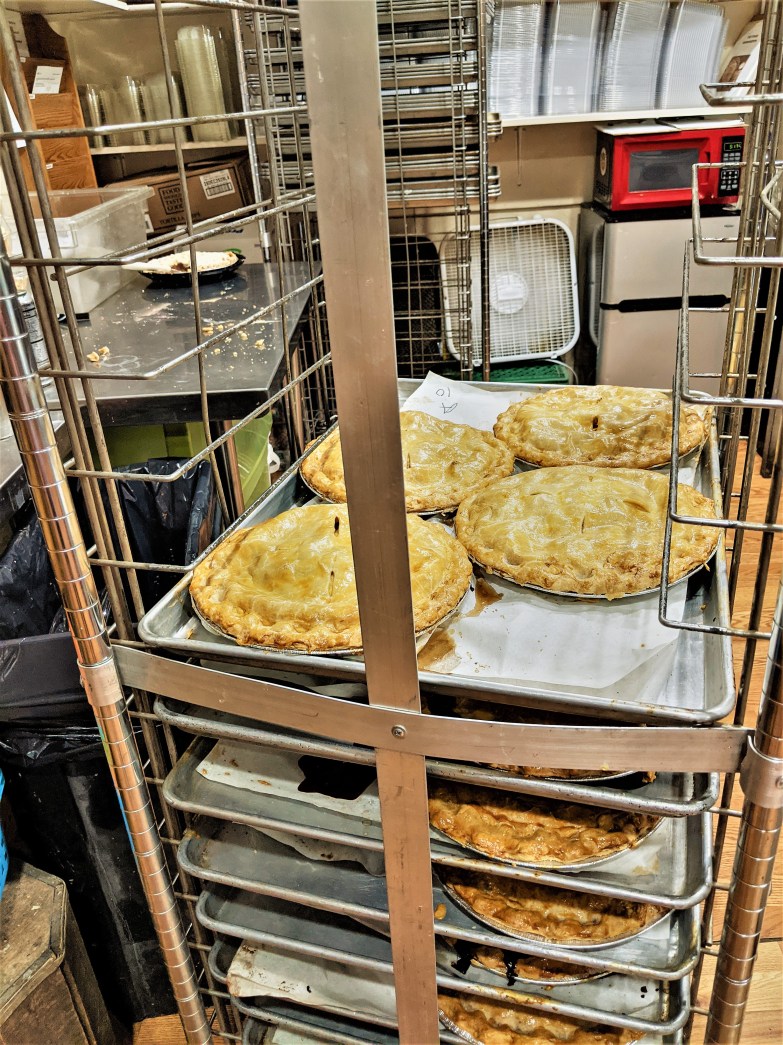
 Mrs. Warner made pies and Perry has kept up that tradition as well but on steroids. Rock Springs Café sells about 120,000 handmade pies a year—their busiest times being around the Thanksgiving and Christmas holidays. During the regular non-holiday week, they sell 250 to 350 pies daily and 500 each day of the weekend. The demand was so high that they started shipping pies about six years ago.

Their most popular pie is the Jack Daniels Bourbon Pecan Pie which Sean Penn ordered when he stopped by a few years back. My favorite is the Tennessee Lemon Pie, but for whatever taste, there’s a pie—chocolate silk, lemon meringue, banana cream, mixed berries, you name it. Their cream pies have a signature top to them—beehive cones that twists up and has been lightly given a pass over with a torch for a slight touch of golden brown atop the peaks. The pie business is so good that Perry, who has a long history as a consultant for large restaurant groups and also owns another eatery in Prescott, Arizona, has just renovated the old stone building where the Warners lived into The Pie Box. It had fallen into disrepair but now will sell pies and other pastries and feature seating areas both inside and out. Another plus, instead of crowding the restaurant and gift shop, people can come and get their pies here.

The property—about 60 acres—is private and it’s a free-range place. For Great Lakes people like me, that doesn’t mean much but in Arizona that translates to cows getting to roam free—which they do. Typically, in the morning they come around to drink from the spring. We haven’t heard of any ordering a pie to go but may be that’s next. They usually are gone by afternoon, maybe because they don’t want to be in vicinity when it comes time to make hamburgers. Because there’s a spring here, the gardens are pretty and lush with flowering plants, grass, and leafy trees. A small collection of historic buildings sells Native American art, organic and freshly grown produce, and specialty foods. There’s a wide selection of foods in the gift shop area of the café as well including cactus candies and other cactus goodies. Another room contains a huge Brunswick Bar built in 1856 and other artifacts from its early history.

Rock Springs in the 1920s and 1930s was what Perry describes as being an “urban western” place with a mix of cars and horses. That’s in comparison to Tombstone which was “frontier western”—pretty much just horses.  Whichever you stumble upon, it’s a refreshing reminder of what the west once was like.
Chicken Fried Steak

1 1/2 cups whole milk

2 large eggs

2 cups all-purpose flour

2 teaspoons seasoned salt

Freshly ground black pepper

3/4 teaspoon paprika

1/4 teaspoon cayenne pepper

3 pounds cube steak (tenderized round steak that’s been extra tenderized)

Kosher salt

1/2 cup canola or vegetable oil

1 tablespoon butter

Gravy:

1/3 cup all-purpose flour

3 to 4 cups whole milk

1/2 teaspoon seasoned salt

Freshly ground black pepper, to taste

 Mix the milk with the eggs. In another bowl, flour with the seasoned salt, 1 1/2 teaspoons black pepper, paprika and cayenne.

 Sprinkle both sides of each steak with kosher salt and black pepper, then place it in the flour mixture, coating on both sides.  Dip in the milk/egg mixture, again coating each side and then dip on both sides in the flour.

Heat the oil in a large skillet over medium heat. Cook the steaks three at a time making sure not to crowd them until their edges turn golden brown, about 2 minutes each side. Drain on paper towels and cover with another plate or tin foil to keep warm. Repeat with the next batch..

After all the meat is fried, pour off the oil/butter/dredgings into a heatproof bowl. Without cleaning the skillet, return it to the stove over medium-low heat. Add 1/4 cup of the oil back to the skillet and heat.

 Sprinkle the flour evenly over the hot oil. Mix the flour using a flour and stir until it turns a deep golden brown color.

Pour in the milk, whisking constantly. Add the seasoned salt and black pepper to taste and cook, whisking, until the gravy is smooth and thick, 5 to 10 minutes. Be prepared to add more milk if it becomes overly thick.

Jack Daniel’s Pecan Pie

 6 servings

1 cup granulated sugar

4 tbsp melted butter

1/2 cup dark corn syrup

3 large eggs, beaten

1 1/2 cup Pecan halves

2 1/2 tbsp Jack Daniel’s

1-9 inch pie shell, unbaked

Preheat oven at 375.

In a bowl, add sugar, melted butter, Jack Daniel’s and stir well.

Then add dark corn syrup, beaten eggs, pecans and stir well.

Place filling into pie shell. Transfer pie onto cookie sheet and place in oven.

Bake at 375 for 10 minutes. Then lower to 350 and bake for additional 25 minutes or until pie has set.

Tennessee Lemon Pie

3 eggs, separated

Zest of 1 lemon

1/4 cup fresh lemon juice

1/4 teaspoon salt

1 teaspoon vanilla extract

1 cup extra-fine sugar, divided

1 9-inch Pure Butter Pie Crust, pre-baked (see recipe below)

In a medium-sized bowl, beat egg yolks for 2 minutes. Add lemon zest, lemon juice, salt and 1/2 cup granulated sugar.

Transfer mixture to a double boiler and cook, stirring constantly, until very thick and a thermometer reads at least 182°F, about 10 minutes. Remove from heat, stir in vanilla and let cool for 15 minutes.

Preheat oven to 350°F.

In a large bowl, beat egg whites with a hand mixer or stand mixer, until stiff peaks form. Add remaining 1/2 cup granulated sugar and beat until just combined.

Fold egg whites into the custard, until just combined. Pour into pre-baked pie crust and then bake for 15 minutes, until pie is set. Top will lightly brown.

Pure Butter Pie Crust

2 1/2 cups all-purpose flour, preferably unbleached

1 cup (2 sticks) butter, unsalted and very cold

1/4 cup buttermilk or ice cold water

1 teaspoon salt

1 teaspoon extra fine granulated sugar

1 teaspoon vanilla extract

Place flour in a bowl of an electric mixer and place in freezer along with mixer’s paddle attachment for at least 20 minutes.

Cut butter quickly in small cubes and place in freezer for 15 minutes.

Combine buttermilk with salt, sugar and vanilla extract and place in refrigerator.

Remove cold flour bowl from the freezer and add butter. With paddle attachment mix mixture on medium speed until butter pieces become smaller than peas and mixture feels like coarse meal.

With machine mixing on low speed add buttermilk mixture very fast and mix just until dough forms. Do not overmix. Chill dough in refrigerator for at least one hour.

Roll dough into desired thickness of about 1/8 inch and use for baking pie. Shapes of leaves can be cut out for pies if desired.

For more information about Rock Springs Café, (623) 374-5794; rocksprings.cafe

What would Frida Kahlo and Diego Rivera Eat: Food and Art in Tubac, Arizona

          Past Tucson on the road heading south towards Mexico, we took a detour to look for the home where my brother-in-law’s parents had lived up until 1989.

          “Does this look familiar?” one of the passengers kept asking as we drove through Green Valley.

           “Nothing in Arizona looks the same as it did even last week,” I said, checking Google which informed me that the population in Green Valley had doubled in the last 32 years.

          We didn’t, as you might have guessed, find the home or even the street. But when we arrived in Tubac, located in a broad valley ridged by the Tumacacori Mountains with their reddish cast to the west and the larger more rugged Santa Rita range to the east, I discovered that I was wrong. Founded in 1752 as a presidio or fortified military settlement on the Spanish Colonial Frontier, Tubac provided protection for the Mission San José de Tumacácori, the remains of which can be seen in nearby Tubac Presidio State Historic Park—Arizona’s first state park. Also on site is the 1885 Old Schoolhouse, the oldest is the schoolhouse in Strawberry, Arizona.

Abandoned and resettled several times, Tubac’s days as an artist colony stretches back to the late 1940s and much of the adobe and dusty roads allure remains in this small village two dozen miles from the Mexico border. Tubac recently was the winner of the Best Small Art Town National Contest.

          It was off-season on a day when temperatures climbed beyond one hundred. Even though the mantra in Arizona is “dry heat,” I can attest that 105 degrees with the hot sun beating down is—well—hot.

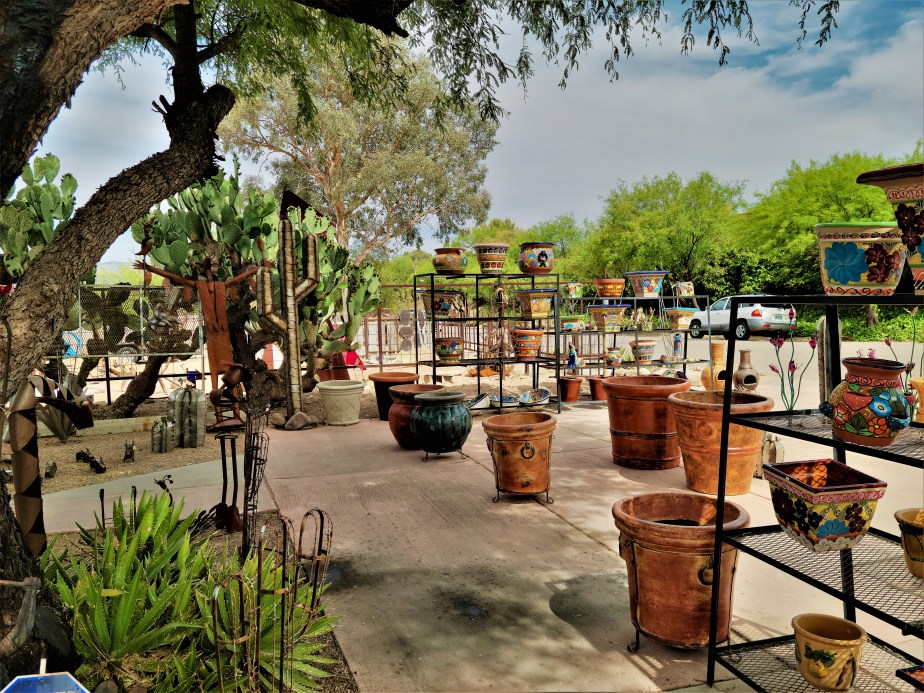
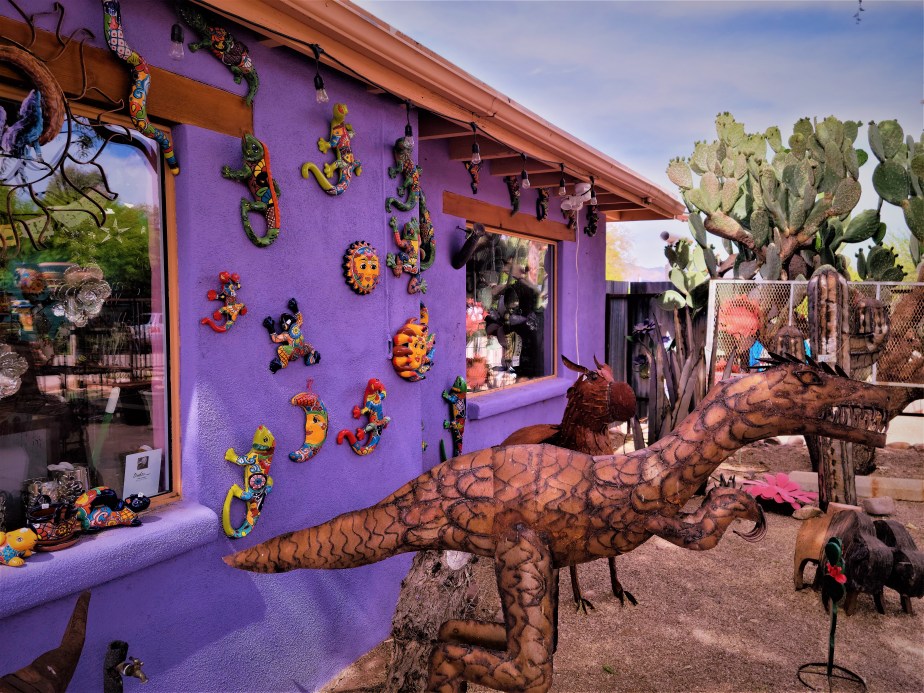
The 100 or so shops, art galleries, and museums, many of them made of dried earth, clay, and straw bricks called adobe, were painted in a variety of colors ranging from soft blues, greens, and pinks, to more bold pistachio and red. If it became too toasty perusing the displays of art ranging from  tin javalinas and coyotes to intricately wrought metals, mosaics,  tiles, pottery, and  jewelry on the front patios and side yards of the art galleries and stores—which comprise, along with restaurants, the major businesses in Tubac—the interiors were cool.  

          A little history is called for and Tubac almost 250 years old, certainly has that. It’s current laid back charm as an artist colony belies a bloody wild west history including Apache attacks, Civil War troops, and desperados eager for quick cash litter its history. All to be expected on an outpost along the Spanish Colonial Frontier. Besides being the first European settlement in Arizona with the first newspaper and the first white women, Tubac was also where in 1789 the first school in the state first opened. Of course, it wasn’t a state back then but part of Mexico as it would remain—along with Tucson—until 1853.

        Early times were tough for  Tubaca (or as the friendly O’odham Indians would have pronounced it “s-cuk ba’a” “cu wa”)  meaning place of the dark water or low place. Or at least that’s one story. Marshall Trimble,  Arizona’s official historian and vice president of the  Wild West History Association, writes its name came about based on a clash between bands of Indian. The resulting dead and the searing sun led the Pima to choose the name that translates to  “Where something smelled rotten.”

          Whatever. Since this is ultimately a food and travel story, we’re going to skip any more details like that except to say that it wasn’t quite as dreamy as it is now.

          While Arizona booms—Phoenix is the fastest growing city in the U.S.—there’s a laid back charm to Tubac as if time stopped half-a-century ago.

          The population in 2019 was just under 1400. Though the landscape is far from the verdant greens of the Midwest, the Santa Cruz River runs through here and feeds the stands of mesquite, willows, and the chartreuse-colored cottonwoods that make such a startling contrast against the desert palate of  beiges, browns, and subdued yellows.   

          Creativity at all levels defines Tubac and the restaurants and overnight accommodations showcases great food and luxurious places to summon your inner—and slightly pampered—cowgirl. With no chains, the village’s restaurants are independent and often family-owned.

          The 500-acre Tubac Golf Resort & Spa was once part of the Otero Ranch, settled in 1789 features several levels of dining options including The Stables Ranch Grille and La Cantina.  Shelby’s Bistro serves Southwestern and Mexican cuisine. Both are almost always rated among the village’s top ten but the one that really intrigued me was Elvira’s because of its history having first opened in Nogales, Mexico in 1927 as a take-out joint. Now the place to go for sophisticated Mexican cuisine, owner/chef Ruben Monroy, grandson of the original founder, takes traditional dishes such as moles (they have a large variety), quesadillas, chiles rellenos including one named after Frida Kahlo the Mexican artist known for her use of bold colors, and other Mexican fare and kicks them up several notches.  The drink list features tequila and mezcal, Mexican wines and beers as well as Margaritas made with a variety of fruits such mango, tamarind, and agave honey along with other cocktails such as mojitos and guanabanatinis—a martini made with guanabana, a fruit that grows in Mexico.

From the outside, Elvira’s is attractive with ochre-colored exterior walls, tile and wood accents, pots filled with flowers, and hanging lights made of large metal spheres with cut out stars.

Inside, it’s something else. Monroy earned degrees in graphic arts and interior design before going to culinary school and his training is evident. Blue walls are the backdrop for large-framed mirrors, colorful cascading lights suspended in various heights from the ceiling, a sleek wooden bar, vases and pots, red curtains, candle holders in an array of shapes and sizes, Mexican crafts and art, and so much more that everywhere you look there’s something fascinating to behold. In case you like what you see, there’s a home décor store adjacent to the restaurant’s entrance.

One of the streets in Tubac (and there aren’t many) is named Calle Frida Kahlo (calle is Spanish for street) but I couldn’t find any reference to her having visited the town during her short life. But I know that she was an enthusiastic cook and so I looked up her recipe for  Poblano Chiles Stuffed with Picadillo that was adapted from “Frida’s Fiestas: Recipes and Reminiscences of Life with Frida Kahlo” (Clarkson Potter). The book, written by Guadalupe Rivera and Marie-Pierre Colle, says this dish was served at her wedding to Diego Rivera.

Mexican cuisine can be complicated and if you’re feeling somewhat lazy, you can turn this dish into a casserole using the recipe I included below the one served at Frida and Diego’s wedding. I should note that the marriage didn’t last but their on and off again affair did until she passed away.

Poblano Chiles stuffed with Picadillo

Serves 8

  • 16 poblano chiles, roasted, seeded, and deveined
  • All-purpose flour
  • 5 eggs separated
  • Corn oil or lard
  • 3 lbs. ground pork
  • 1 large white onion, halved
  • 3 garlic cloves, chopped
  • 6 tablespoons lard or oil
  • 1 small onion, finely chopped
  • 2 zucchini, finely chopped
  • 1 lb. tomatoes, seeded, chopped
  • 1 cup cabbage, shredded
  • 3/4 cup blanched almonds, chopped
  • 1/2 cup raisins
  • Tomato broth ( see recipe below)

Prepare chiles:  Char chiles over an open flame or under the broiler, then place in a plastic bag, seal and let steam for about 10 to 15 minutes. Remove from bag and using the back of a spoon peel off skin. 

Make a lengthwise slit in the chile, remove the seed cluster, seeds, and membrane with a knife but leave the stem intact and place on a cookie sheet. Place the poblanos in the freezer as they will easier to fill and batter when cold.  

Prepare the Filling: Cook the pork with the onion halves, garlic and salt and pepper  for about twenty minutes. Drain the liquid and remove onion. Heat the oil or lard in a sauté pan, adding the onion, carrots, and zucchini, cooking until onion is translucent. Add the tomato, cabbage, almonds, raisins and pork and season with salt and pepper to taste. Simmer mixture for about twenty minutes until it has thickened, and the tomato is cooked through.

Stuff Chiles: Stuff the chiles with filling, then dust with flour. Beat the 5 egg whites until stiff. Beat the yolks lightly with a pinch of salt and gently fold into the whites to make a batter. Dip the chiles into the batter and fry in very hot oil until golden. Drain on paper. Serve with tomato broth.

Tomato Broth for Stuffed Chiles

  • 3 tablespoons olive oil
  • 1 onion, thinly sliced
  • 2 carrots, peeled and thinly sliced
  • 10 Roma tomatoes, charred, seeded, and chopped
  • 1/2 cup vinegar
  • 3 tablespoons sugar
  • Salt and pepper
  • 2 teaspoons dried oregano
  • 1/2 cup queso cotija or ranchero cheese, crumbled

Char the tomatoes using the same method as above for the peppers. Heat the olive oil and sauté the onion and carrots until softened. Add the tomatoes, vinegar, sugar, and salt and pepper to taste. Simmer for 10 minutes. Stir in the oregano and continue to cook until the broth is rich and flavorful, and the tomatoes cooked through. Ladle broth onto a plate and place the chile on top.  Garnish with queso cotija or ranchero cheese.

Chile Rellenos Casserole

  • 2 large fresh poblano chile peppers or fresh Anaheim chile peppers
  • 1 ½ cups shredded Mexican-style four-cheese blend  or make the Picadillo recipe above
  • ½ cup crumbled Cotija or Ranchero cheese
  • 3 eggs, lightly beaten
  • ¼ cup milk
  • ⅓ cup all-purpose flour
  • ½ teaspoon baking powder
  • ¼ teaspoon cayenne pepper
  • ⅛ teaspoon salt
  • 1 large can of enchilada sauce or use the Tomato Broth recipe above

Serves 4

1 large can of enchilada sauce or use the Tomato Broth recipe above.

The basic difference here is that instead of stuffing the peppers, then coating them in batter, and frying, roast the peppers according to the first recipe,  slice them lengthwise so the entire pepper can be laid flat.

Grease a casserole dish, add a layer of the sauce, lay the peppers on top and the cover with the desired filling—either the cheese or the picadillo sauce that Frida made.

Top with more sauce, another layer of roasted peppers, filling and sauce. Repeat until all the ingredients are used.  a medium bowl combine eggs and milk. Add flour, baking powder, cayenne pepper, and salt.

Beat egg mixture until smooth. Or if using a food processor or blender,  place in a food processor, cover and process or blend until smooth. Pour mixture over peppers  and filling.

Bake for 15 minutes in a 400°F. or until golden brown.

Mushroom Quesadillas

Makes 6

  • 12 flour tortillas
  • ½ pound mushrooms
  • Butter
  • 1 ½ to 2 cups shredded Mexican cheese mixture
  • 1 Poblano pepper, roasted, seeded and finely chopped
  • Your favorite salsa

Thinly slice mushrooms and place in a skillet with one tablespoon melted butter. Cook until done. Drain any juices left.

Preheat oven to 300°F.

Heat a heavy skillet (cast iron works well) on high. Butter one side of each tortilla. Place as many as the skillet will hold but no more than six. Top each tortilla evenly with mushrooms, diced roasted pepper, cheese, and salsa. Top with the other tortilla, butter side up. Cook until cheese starts to melt, adjusting the heat to make sure the tortillas don’t burn. Flip over and cook until the tortilla is golden brown.

Transfer the quesadillas to a cookie sheet and place in oven. Cook the remaining quesadillas.

Serve with sour cream or Mexican crema and salsa. Can be served whole or cut in half or quarters.

Mango Margarita

From “Love & Lemons Cookbook” by Jeanine Donofrio.

  • 3 cups cubed frozen mango, from about 4 small mangos
  • ¼ cup lime juice, plus lime slices for garnish
  • 3 ounces silver tequila
  • 2 ounces Cointreau
  • 3 handfuls ice cubes
  • Sea salt for the glass rims, optional

Place the mango, lime juice, tequila, and Cointreau in a blender and blend until smooth. Add the ice and blend to the desired consistency. If the mixture is too thick to blend, let it sit and melt for a few minutes.

If desired, use a lime wedge to moisten the rims of the glasses and then dip the rims in a small plate of salt.

Pour the mango mixture into the glasses and garnish with a lime slice.