Imagine strolling through Paris with a friend, one who knows the greatest little patisseries, cafes, outdoor markets and shops tucked along winding cobbled streets. Together the two of us try on amazingly chic designer dresses at La boutique Didier Ludot and amble through the courtyard gardens and gaze at the Swedish art work at Institut Suedois located in the Hôtel de Marle, a 16th century mansion in the heart of the central Marais district.
We order small plates of fantastic food amidst 19th century murals of clowns at the appropriately named Clown Bar, considered one of the city’s finest restaurants. After stopping to admire the Eiffel Tower, we trek even more before stopping to reward ourselves with ice cream at Berthillon Glacier. We are, definitely, Parisian insiders.
Wait—don’t have a friend in Paris? Don’t even have tickets or plans to go sometime soon? Well, Rick of Casablanca told Else they’d always have Paris and for the rest of us, before we get there, we’ll have the recently released Paris in Stride: An Insider’s Walking Guide(Rizzoli 2018; $27.50), co-authored by Jessie Kanelos Weiner, a Chicago gal who grew up on the Northside and Sarah Moroz both of whom have lived in Paris for the last decade. Charmingly illustrated with over 150 of Weiner’s delicate watercolors, the book curates walking itineraries the authors put together to go beyond the typical guidebooks.
“We wanted to put together walking tours of a timeless Paris, the type of Paris that will always be the same,” says Weiner. “We wanted something that wasn’t too text heavy, a book that was a jumping off point to see what you want to see, one that wasn’t prescriptive but takes you down the side streets.”
Paris is Weiner’s passion and wandering its streets is what she loves to do.
“It’s a city based on pleasure,” she says, “and one with many beguiling things along the way.”
Hoosier Craft Beer and Wine Salesman Brings it Home
Tiny Town Issues its Highest Honor to Brad Brookbank
******************************
Story, Indiana. Since its founding in 1851, Story has had no mayor, no board of commissioners, no town counsel, and certainly no election commission to oversee the peaceful transfer of power to such non-existent offices. Yet, despite the dearth of government, democracy thrives in this tiny southern Indiana hamlet.
If one were compelled to identify the seat of real power in Story, it would be the Tavern located in the basement of the old General Store, where town residents and overnight guests huddle to share news, gossip, and solve the world’s problems. And on April 1 of each year, “town elders” a/k/a tavern regulars, who by default comprise Brown County’s cognitive elite, confer to elect a “Village Idiot”. “It’s a tribute to the fermentation process” says Rick Hofstetter, the Story Inn’s co-owner and town’s only employer.
The balloting consists of submissions to the tavern’s bartender, Ann Johnson. “We have only one requirement for voting for, and being elected to, this esteemed position: at some point in your life, you must be a customer here” she explains.
This year’s “Idiot” accolades falls to Brad Brookbank, a salesman from 450 North Brewery/Simmons Winery in nearby Columbus. One may deduce that Brad is no stranger to his own wares.
For three consecutive years, Brad has been presenting Simmons’ wines at the Indiana Wine Fair, a large public event held at the Story Inn each spring. After loading a trailer with product, Brad hitched it to his truck, not paying attention to the fact that it had the wrong size ball hitch. Predictably, the trailer detached itself from the truck when Brad reached cruising speed on I-65, careening into a ditch. There were no injuries, but a total loss of product, and some hard questions from the Indiana State Police. “We had several cases of our Merlot in that trailer” he says, ruefully.
Brad has also been an occasional presenter at beer dinners hosted by the Story Inn. After one such gathering, Brad retired to one of the Story Inn’s cottages, where he decided to draw a hot bath. Upon discovering that the tub was not equipped with jets, he decided to improvise—by emptying a fire extinguisher into the tub. “I thought it was just air in those things” said he, upon being confronted with a prodigious mess.
The Story Inn’s cottages are all close together, linked by foot paths. While attempting to find parking near his cottage, Brad drove his car down one of those foot paths, and nearly into a creek. The next morning, he discovered the error of his ways, but could not locate his car keys. He eventually found them—under the vehicle. He was three hours late for work that day.
On another visit to Story, Brad concocted a practical joke for some friends staying in another cottage (one that was equipped with an outdoor hot tub). He hopped a privacy fence to steal the woman’s bathing suit, only to discover that the people staying there were strangers, and not a bit amused.
Brad celebrated New Year’s Eve at the Story Inn in Bacchanalian fashion, and at midnight, joined patrons in front of the Inn who were setting off conspicuously large rockets (known as “RGS Black Widow Artillery Fireworks”, and probably illegal). For reasons unknown, Brad reclined on the sidewalk, placed the stem of the rocket in his mouth, and lit it with a cigarette. The ensuing shower of sparks ignited his facial hair.
“This is the kind of stuff you see at fraternity parties” observed an incredulous Ann Johnson.
Brad’s victory, though well-deserved, was by no means assured, as competition for “Idiot” became fast and furious. Runners-up included a local resident and tavern regular (name withheld by request) who proved adept at, quite literally, recognizing a “diamond in the rough”. She received one nomination for allowing her pug dog to eat a diamond earring and, not to be “de-turd”, successfully retrieved it from her back yard. She received a second nomination for owning a pug dog in the first place.
Former Village Idiots made gallant efforts to reclaim the title. “The rules do not prevent someone from winning a second term, but that has never happened” observes co-owner Jacob Ebel. Jacob received his first nomination ever, for spending five fruitless days in a tree stand during hunting season, possibly because he refused to turn off his cell phone.
In 2010, Dani Ham was elected “Village Idiot” for igniting her own hair on fire while attempting to tame her coiffure with hair spray while smoking a cigarette and driving a car. “I multitask”, says she, by way of explanation. This year, Dani found two uncashed paychecks, dating back to her “Idiot” award, in the glove box of an old Buick.
Former Idiots Stan Smith and Lou Melillo combined forces in an apparent effort to re-make the movie “Dumb and Dumber”. The duo backed Stan’s truck to Stan’s house to move furniture, and quickly discovered that the truck had become stuck in the mud. Their efforts to extract the truck proved to be futile, but they trashed Stan’s yard in the process. Then Lou (re-named “Loo” at his 70th birthday) discovered that Stan had left the parking brake on.
Loo won “Idiot” accolades in 2012 for, among other things, dropping his wife Holly on her head while attempting to flip her over his back (the couple has remained married for 50 years—any coincidence?).
Holly Melillo’s head injury may well have done permanent damage. She received a nomination from Loo for losing her cell phone. After fruitless minutes searching, Loo had the bright idea to call it, which he did, whereupon Holly discovered that the phone had been tucked in her bra where she always keeps it.
Ricky Sawyer (Village Idiot 1999—for flipping a truck on its inaugural drive home from the dealership) received a nomination for dropping a pair of tongs into the Story Inn’s deep fryer—and then reaching for it. (Remarkably, he suffered only minor injury.) Thomas Kennedy f/k/a Thomas Doane (Idiot, 2008—for falling asleep in the median of a public highway) received a nomination for legally taking his wife’s name (Kennedy), and then getting a divorce.
Rick Hofstetter (2006 Idiot—for selling desiccated horse turds) made an impressive run for a second term, allowing his Toyota Prius to idle in the driveway for three consecutive days without noticing, possibly because he had allowed his dog Snow to eat one of his hearing aids. By late summer, Rick’s Birkenstocks had become so befouled that bartender Ann Johnson used them to start a campfire. By one extraordinary account—impossible to independently verify—Rick found a tick attached to a most private part of his anatomy.
Brad captured “Idiot” honors from local artist Brad Cox, who demonstrated his mechanical ineptitude when he drained both the engine oil and transmission fluid from his wife’s car, and refilled the crankcase twice, leaving the transmission bone dry. When his wife called to report problems, he dismissively accused her of driving the car into a creek. (The car sustained extensive engine and transmission damage, incidentally.)
Brad Brookbank will receive a $100 gift certificate, which he will most certainly spend in the Story Inn’s Tavern. He will hold the title of “Village Idiot” until March 31, 2019.
Memorable quote:
“Moments last a second; Story lasts a lifetime; the Story Inn’s Village Idiot lasts forever.”
Dancing bunnies, singing rabbits, a cotton-tail waving from the engine room and a Bunny Patch with over 4000 Easter eggs—it’s going to be that kind of Easter celebration for those taking a ride on the many Easter trains near and around Northwest Indiana. So go ahead and hop aboard.
Saturday, March 31 at 11am and 1:30pm; Boarding 20 minutes before departure
Easter Bunny is joined by Quack the Duck, Story-Telling Princess and Bo-Bo the Lamb on a 90-minute ride aboard a vintage train decorated for the holiday. Stories are told, by the princess of course, while bunny and his friends offer each child a chance to choose a toy from their baskets.
Easter Bunny Express: French Lick Scenic Railway, French Lick, IN; (812) 936-2405; indianarailwaymuseum.org
March 25 at 4pm
Board vintage railroad cars for a trip to Easter Egg Field. Here passengers disembark to hunt for more than 4000 eggs and have their photo taken with the Easter bunny. Proceeds from the Easter Bunny Express go to benefit Goody B’s Teen Center.
Easter Train: Hoosier Valley Railroad Museum, North Judson, IN; (574) 896-3950; hoosiervalley.org
March 31 at 10am, 12:30pm, and 2:30pm
This hour-long excursion crosses the Kankakee River at English Lake and then returns to North Judson for a stop at a park to hunt eggs and meet the Easter bunny who will be handing out candy and a bag of toys to every child. The Hoosier Valley Railroad Museum has one of the largest collections of working railroad signals so take time before or after the ride to stop by (admission is free). Visitors are invited to touch the museum’s C&O 2789 steam locomotive and take stroll through the museum’s grounds with its displays of rolling stock, engines and memorabilia of railroad history. Purchasing tickets online is recommended as trips have sold out in the past.
Cotton Tail Express: The Old Road Dinner Train Experience, Blissfield, MI; 888-GO-RAIL-1 (888-467-2451); murdermysterydinnertrain.com
Saturday, March 31 at 10am & 12:30pm; boarding is 15 minutes before departure.
Visit with bunny, color pictures and enjoy doughnuts and juice on a 90-minute ride on an antique train. Reservations are required.
Mr. Bunny will be on hand to say hi, pose for photos and hand out candy filled eggs on a one-mile ride through Waterman’s Lions Community park.
Whitewater Valley Railroad, Connersville, IN; (765) 825-2054; whitewatervalleyrr.org
March 31 at 10am, 12pm, 2:30pm & 4:15pm.
Grab your basket and board the Indiana’s longest scenic railroad, for their 18th annual Easter Bunny Express. Departing from Connersville Grand Central Station, enjoy the two-mile trip to the Easter Bunny Patch, meet the Easter bunny and search for his golden egg. Reservations are recommended. Train operates rain or shine. The egg hunt is open to ages 8 and under.
This December I received a notice on my Google calendar that Leila Edwards’ birthday was coming up. It was a painful reminder because Leila, who was a friend, had died in September when her husband shot and killed her and then himself. Anyone who knew Michael Watkins, her husband, couldn’t imagine him doing that, but he’d been very ill with cancer and they were divorcing and, well, there are some things that are unfathomable. Michael and Leila’s son, Ben Watkins was in the house, but not harmed and is now living with his grandmother, Donna Edwards, in Miller Beach, a small community east of Gary, Indiana on Lake Michigan where the Watkins had lived as well.
Ben has always been a dedicated cook, who first started cooking when he was around three and was making food several days a week at the family restaurant when he wasn’t competing in spell bowl, math bowl, chess club or repairing broken bikes for kids in need through the Ken Parr Build a Bike program in Miller Beach.
The family was well-known in Miller Beach not only because of the restaurant, which is now closed because of the deaths, but also since Leila Edwards was a noted artist and jewelry maker who sold her creations in a store downtown. Besides that, she was a very active volunteer at Discovery Charter School in Chesterton, which Ben attends.
With all this sadness, I was really surprised and extremely happy to get a text from my niece, Linda Simon, who is a good friend of the family, that Ben, now 11-years-old, is a contestant in this season’s MasterChef Junior which premiered two weeks ago. Ben so impressed judges Gordon Ramsay, Christina Tosi and Joe Bastianich that he was one of the 24 contestants earning white aprons and a chance to go on to the next level.
The winner gets $100,000 which would be so important to Ben. The Miller Beach community has been wonderfully supportive, holding fundraisers and starting a Go Fund Me (gofundme.com/love4ben) to raise money for his education, maintenance and health care but, as we all know, raising a child is expensive.
MasterChef Junior airs at 8 p.m. Fridays on Fox so if you get the chance tune in and root for Ben whose future dream is to be a professional chef or scientist (he excels in math and science at his school).
You may enjoy this recipe, one of many he has shared with me over the years. He created it himself when he was in third grade, because, he said, “I like all three things and so I thought about putting them together — a layer of chocolate chip cookie dough on the bottom, crushed Double Stuf Oreos in the middle, covered with a layer of brownie batter and then baked.”
Ben Watkins’ Chocolate Chip Cookie and Oreo Brownie Bars
Cookie Layer:
1 cup unsalted butter, room temperature
¾ cup sugar
¾ cup brown sugar
2 eggs
1 tablespoon vanilla extract
2 ½ cups flour
1 teaspoon baking soda
24 ounces chocolate chips
Mix butter with sugar until creamed. Add eggs and vanilla extract. In a separate bowl mix flour mixture and baking soda. Add to creamed butter. Fold in chocolate chips and spread evenly on the bottom of a greased 9×13-inch pan.
18 to 24 Double Stuf Oreos, crumbed.
Spread crumbled Oreos evenly over the top of the chocolate chip cookie dough.
Brownie Layer:
4 ounces unsweetened Baker’s chocolate
¾ cup butter
2 cups sugar
3 eggs
1 teaspoon vanilla
1 cup flour
Place chocolate in microwave and melt. Melt butter, stir in chocolate and sugar. Stir in eggs one a time and vanilla. Add flour. Mix thoroughly. Spread evenly on top of chocolate chip cookie dough and Oreos.
When I arrive in the new bourbon tasting room at the historic Beaumont Inn, there are already set-ups of four bottles of bourbon with empty glasses in front of each. Master Blender Dixon Dedman, who with his parents own the inn which has been in their family since 1917, is famed for his bourbon tastings as well as his revival of the bourbon his great great grandfather, Charles Dedman, who in 1880 started up what would become one of the largest distilleries in the state, until before Prohibition shut it down.
In other words, Dedman is a bourbon expert and I am someone who in my college days mixed the spirit with diet cola. But not this evening. Dedman is going to teach me how to taste the “terroir” of bourbon meaning the type of land here—limestone rock and natural springs that give a special flavor to the wheat, corn and rye used to make bourbon. There is, I note, no diet cola anywhere in sight.
“When they char the barrel it releases the sugars and caramelizes it,” Dedman says as he pours Pappy Van Winkle, a 20-year old bourbon named in tribute to Julius Van Winkle by his grandson and great grandson who are carrying on the family tradition.
That’s important because Pappy Van Winkle is a wheated bourbon which means it contains no rye and thus gets its flavor from the interaction with the barrel.
“Focus on where you’re tasting it,” he says. “That’s how you build your palate.”
Because it’s wheated, which means, Dedman tells me, you can taste it in the front of your mouth.
Pappy Van Winkle has almost a cult like following says Dedman.
“When they’re going to release it, people sit in their cars in front of liquor stores for two days to get a bottle,” he says.
At this point, I know I can’t ask for a can of diet cola.
The next taste is a sip of Four Roses Al Young 50th Anniversary. Now I remember Four Roses as a cheap bourbon—the kind you do mix with soda pop particularly at college dorm parties but its roots go back 130 years. The brand was allowed to languish and almost disappeared until Al Young, Senior Brand manager with 50 years of experience in the bourbon biz, was allowed to bring it back to its glory. He has several blends which are based on patented yeast strains he’s developed. The taste of this bourbon comes from the yeast strains and rye and Dixon says to pay attention to its finish on the back on the mouth.
When Dixon was working on developing Kentucky Owl he wanted to emulate the complexity of Four Roses. Later this month, he’ll be releasing his Kentucky Owl Batch # 7, the seventh of his limited release bourbons.
“It’s an 11-year old Kentucky Straight Rye Whiskey and it’s exactly what a Rye Whiskey should be,” Dixon writes on Kentucky Owl’s Facebook page. “I put this blend together and bottled it at 110.6 proof. It’s a full-flavored rye perfect for the coming fall weather.”
Barrel aging can produce bourbons with a high proof count but then before they’re bottled, they’re watered down to around 80 proof. But Dixon wasn’t about to do that to Kentucky Owl.
“It’s full flavored,” he said about this batch of Kentucky Owl and it sure was. “You can’t hide anything in barrel proofed whiskeys.”
Later, when I’m in the dining room ordering dinner—the Classic Beaumont Inn fried yellow leg chicken, beaten biscuits, country ham—I glance at the bourbon list. I read that Dixon’s Batch #6 costs $40 a glass and am glad I didn’t ask for a diet cola. Not just because I would have looked stupid but also because I had begun to get a sense of how to appreciate a great bourbon.
But the Beaumont Inn is about more than Kentucky Owl. It was built in 1845 as a girl’s school and was bought by Dixon’s great great grandmother in 1917. Two years later she turned it into an inn. Many of the recipes on the menu and in their cookbook have been favorites since they first opened including, fried green tomatoes, house made pimento cheese, traditional Kentucky Hot Brown, corn meal batter cakes with brown sugar syrup and the General E. Lee Orange Lemon Cake.
The latter, my waiter told me, was such a favorite of the general that he carried the recipe in his breast pocket. I guess that was in case anyone asked if they could bake a cake for him. I, of course, had to order that despite being a northern girl, and it was delicious—very light with a distinct sugary citrus taste. The lightness I discovered later was because the cake flour used in the recipe is sifted eight times.
The food at the Beaumont Inn is so good that a few years ago they won the James Beard America’s Classic Award which is given to “restaurants with timeless appeal, each beloved in its region for quality food that reflects the character of its community. Establishments must have been in existence for at least ten years and be locally owned.”
The inn itself is beautiful, all polished wood and thick carpets, antique furniture and the timeless grace of a wonderfully kept three-story historic mansion with an exterior of red brick and tall white columns. Located in Harrodsburg, the oldest city in Kentucky, it sits on a rise on several rolling, beautifully landscaped acres. I mentioned Duncan Hines a few weeks ago when I was writing about Claudia Sanders Dinner House in Shelbyville, Kentucky well, Duncan was here quite a bit too and I can see why.
“Now write this down for the people in Kentucky,” he told a reporter back in 1949. “[Say] I’ll be happy to get home and eat two-year-old ham, cornbread, beaten biscuits, pound cake, yellow-leg fried chicken, and corn pudding. And you can say what I think is the best eating place in Kentucky: Beaumont Inn at Harrodsburg.”
Beaumont Inn
The food here is real Kentucky fare–Weisenberger meal from a seventh generation mill not far from here, Meacham hams which the Dedmans bring to maturation in their own aging house—a process that takes several years and, of course, Great Great Grandpappy’s Kentucky Owl.
The following recipes are courtesy of the Beaumont Inn Special Recipes, their cookbook now in its sixth edition.
Corn Pudding
2 cups white whole kernel corn, or fresh corn cut off the cob 4 eggs 8 level tablespoons flour 1 quart milk 4 rounded teaspoons sugar 4 tablespoons butter, melted 1 teaspoon salt
Stir into the corn, the flour, salt, sugar, and butter. Beat the eggs well; put them into the milk, then stir into the corn and put into a pan or Pyrex dish. Bake in oven at 450 degrees for about 40-45 minutes.
Stir vigorously with long prong fork three times, approximately 10 minutes apart while baking, disturbing the top as little as possible.
Country Ham Salad
6 cups chopped aged country ham
1 cup chopped celery
1/2 cup chopped red pepper
1/2 cup chopped purple onion
1.5 cups chopped sweet pickle
2 chopped hard boiled eggs
2 tablespoons of whole grain mustard
Hellman’s Mayonnaise to your liking.
Note: This is great on crackers, finger sandwiches with a thin slice of homegrown tomato, toasted open faced sandwiches with tomato and a melted slice of your favorite cheese or as an appetizer – toasted crostini, ham spread, thin slice of homegrown tomato topped with shredded parmesan cheese run under the broiler.
Corn Meal Batter Cakes
1 cup corn meal
1/2 teaspoon baking soda
1 1/4 cups buttermilk
1/2 teaspoon salt
2 eggs, beaten
2 tablespoons bacon drippings or shortening
Sift meal, soda and salt together. Add beaten eggs, then buttermilk. Beat until smooth. Dip a tablespoon of batter (or a bit more) onto a greased hot griddle. Let brown on bottom, then turn quickly and lightly to brown on other side. Serve with Brown Sugar syrup.
Makes about 10-12 good-sized cakes.
Brown Sugar Syrup
2 pounds light brown sugar
3 cups cold water
Mix sugar and water well. Bring to a hard boil for 10 minutes. Do not stir after placing over heating element as stirring or agitating will cause syrup to go to sugar
General Robert E. Lee Orange-Lemon Cake
9 Eggs, separated
a few grains salt
2 cups cake flour, sifted twice before measuring
2 cups white sugar, sift 6 times
1 1/2 teaspoons baking powder
1/2 teaspoon cream of tartar
1 lemon, juice
Grated rind (yellow part only)
1/2 cup vegetable oil
Beat egg yolks to creamy texture; beat egg whites until stiff. Add baking powder and tartar to flour and sift six times. Mix all ingredients together. Divide batter into four greased 9-inch cake pans. Bake at 325 degrees for 20 minutes. Turn cakes upside down on a rack until cool.
Spread Orange-Lemon Frosting between layers and on top and sides of cake. Store in refrigerator until serving time. Garnish with orange slices and fresh mint leaves if desired.
Orange-Lemon Frosting
¼ pound butter, softened
3 egg yolks
2 (16 ounce) packages powdered sugar, sifted
4 oranges, rind of, grated
2 lemons, rind of, grated
4 tablespoons lemon juice
6-8 tablespoons orange juice
Cream butter; add egg yolks and beat well. Add powdered sugar and grated rind alternately with juices, beating well.
Original “Robert E. Lee” Cake
Twelve eggs, their full weight in sugar, a half-weight in flour. Bake it in pans the thickness of jelly cakes. Take two pounds of nice “A” sugar, squeeze into it the juice of five oranges and three lemons together with the pulp; stir it in the sugar until perfectly smooth; then spread it on the cakes, as you would do jelly, putting one above another till the whole of the sugar is used up. spread a layer of it on top and on sides.
638 Beaumont Inn Drive, Harrodsburg, KY. (859) 734-3381; beaumontinn.com
To me, fairies have always been about the holiday season—think the Sugar Plum Fairy from the Nutcracker Suite ballet and Tinkerbell, the blonde-haired imp who wore a green outfit with matching translucent green wings in the 1904 play Peter Pan and knew how to handle a wand and pixie dust—both a job requirement. Imagine then my delight when my friend Lily Lopate sent me a copy ofThe Faerie Handbook: An Enchanting Compendium of Literature Lore, Art, Recipes and Projects by Carol Turgeon with Grace Nuth and the Editors of Faerie Magazine (Harper Design 2017; $35). And yes, there is a Faerie Magazine.
This beautifully illustrated book containing all things faerie (the archaic literary spelling) is divided into chapter including Flora & Fauna with such headings as “A Select List of Fairy World Inhabitants” and their history, a “Fairy Herb and Flower Almanac,” as well as instructions on making such fairy necessities as houses, furniture, pressed flowers, and terrariums. In the section on Fashion & Beauty we learn about such style icons as Morgan Le Fay, Titania of the Fairy Realm and La Belle Dame Sans-Mercy—a woman with eyes that mesmerized helpless, handsome men (way to go, La Belle, we say). The Fashion & Beauty chapter gives us the low down on fairy couture including fairy shoes which are totally inappropriate for walking particularly the ones with five-inch heels made of flowers. It also contains directions on how to make a fairy crown—a clothing item no one should be without.
It isn’t easy being a fairy. You have to get up early to gather the right beauty ingredients. After all, according to Samuel Pepys, the great 17th century diarist, his wife was a big believer in maintaining her looks in a faerie manner by collecting early morning May dew. Another requirement is being able to make fairy dust. That’s what Tinkerbell used to get Peter Pan to fly. You wouldn’t want to be without it.
Want to hang with the faeries? The authors tell about how to find fairy portals and pathways. You’ll need to read the chapter, but we can give some hints. Look for a strange circle of mushrooms (those are fairy rings), bridges (but be careful of the trolls, country crossroads are good places to run into fairies (but devils hang out there too) and natural portals like ocean cliffs and tangled branches with an open center in the middle.
Of course, what interested me the most was fairy food. As one might expect, fairies love parties and the authors show us how to host a Midsummer Night’s Dream Garden Party. Fairies main ingredient when it comes to cooking seems to be edible flowers. Their menus consist of such goodies as Flower Lollipops, Honey Ricotta Tart with Lavender Scented Crust, Candied Violets and Lavender Shortbread Cookies.
Faeries also love tea parties—ones with lots of flowers in pastel colors of pink, lavender, violet, pale blues and even moss. What to eat at such a party? Fairy Tea Cakes and flower teas.
Candied Violets
40 fresh violets, pesticide free, with stems intact
1 egg white
1 cup superfine sugar
Special Equipment:
Fine-tipped paintbrush, preferably new
Small sharp scissors
Place a wire rack over a parchment-lined baking sheet and set aside.
In a small bowl, whisk the egg white until frothy.
Holding a violet by the stem, dip the paintbrush in the egg white and carefully coat each petal, front and back.
Sprinkle the superfine sugar over the violet and shake off any excess. Sprinkle again until the whole flower is lightly coated.
Gently place the violet on the drying rack. Repeat with theremaining flowers.
Allow the violets to dry for 24 hours, then use the scissors to cut off the stems. Candied violets may be stored in an airtight container for up to eight weeks.
Lavender Shortbread Cookies
¾ cup granulated sugar
1 teaspoon dried lavender, pesticide-free
1 stick plus 4 tablespoons unsalted butter, softened
¼ teaspoon fine sea salt
2¼ cups all-purpose flour
3 tablespoons whole milk (optional)
½ cup sanding sugar (optional)
Preheat the oven to 350° F.
Line a baking sheet with parchment paper.
Place the sugar and lavender in a food processor and pulse to achieve a fine texture.
In a large bowl, combine the lavender sugar, butter, and salt. Use the electric hand mixer to cream the ingredients until light and fluffy.
Gradually add the flour, mixing until the dough comes together. If it’s too crumbly, lightly wet your hands with water and knead the dough in the bowl untilthe flour is completely absorbed, and the dough is smooth.
Transfer the dough to a lightly floured surface. With a rolling pin, roll out the dough to a ½-inch thickness.
Use a cookie cutter to cut out the dough. Transfer the cookies to the parchment-lined baking sheet.
If desired, use the pastry brush to lightly coat each cookie with milk, then sprinkle with sanding sugar.
Transfer cookies to the oven and bakefor approximately 25 minutes, rotating the pan once, until the cookies are golden brown.
The cookies will be very soft when you remove them from the oven, but will set once cool. Allow them to cool completely on the baking sheet before transferring them to a plate.
Frosted Cranberries
1 ½ cups water
1 ½ cups granulated sugar, plus 1 cup for dusting
1 cinnamon stick
4 whole cloves
2 cups fresh cranberries
In a small saucepan, combine the water, sugar, cinnamon, and cloves. Cook over low heat, stirring until sugar is dissolved.
Remove from heat and cool for 15 minutes before stirring in the cranberries. Transfer to a bowl, cover, and refrigerate overnight.
The next day, set a wire rack over a parchment-lined baking sheet. Use a slotted spoon to transfer the berries onto the rack and set aside for 1 hour. Meanwhile, line another baking sheet with parchment paper.
Place the remaining 1 cup sugar in a shallow dish. Working in small batches, roll the cranberries in the sugar until they are completely coated, then transfer to the clean parchment-lined baking sheet. Make sure berries are in a single layer and not touching each other.
Allow to stand at room temperature for about 1 hour or until dry. Frosted cranberries may be stored in an airtight container for several days.
For the inner comedian in all of us, no matter our age, Toronto’s Bad Dog Theatre Company is known for both their wide variety of family friendly comedy and improvisational performances and improv classes designed for every skill level.
“Our Youth Academy offers week long summer camps for youth and teens all summer long,” says Beth Dunn, Youth Academy Director at Bad Dog Theatre which is located in the city’s Palmerston-Little Italy neighborhood.
Vacationers who might not be staying in the city long enough for a week-long class can opt for one day camp registration at a pro-rated price says Dunn, adding that summer camps students receive two improv workshops a day, plus an afternoon activity or performance.
While kids hone their own improv techniques, adults 18 and over can attend the adult drop-in classes.
“Bad Dog offers a wide range of drop-in classes like our beginner classes, No Experience Necessary and Spanish Language because we strive to be inclusive,” says Dunn who has been performing there since 2014.
Beyond learning improvisational techniques, family-oriented shows include The Early Show held every Saturday evening at 7 p.m. followed by Theatresports at 8 p.m. which Dunn describes as their flagship show.
“It’s been around for 30 years and features two teams of all-star improvisers going head-to-head on stage battling for your love and laughter,” she says.
Toronto’s easily navigable subway system makes getting to the theatre super simple, as it’s located right across the street Ossington Station.
“All classes and drop-ins are taught by Toronto’s finest improv instructors,” says Dunn. “Also, all of instructors perform regularly at the theatre. There is nothing better than watching your drop-in instructor battle it out later in the night at Theatresports.”
Well, maybe one thing better. Staging your own family improv battles using the skills you learned. 416-491-3115; baddogtheatre.com or email Adult & Youth Classes: classes@baddogtheatre.com
I had the chance to chat with Valerie Bertinelli when she was in Chicago a few weeks ago to sign copies of her new cookbook, Valerie’s Home Cooking: More than 100 Delicious Recipes to Share with Friends and Family (Oxmoor House 2017; $30). It’s always interesting to meet someone in real time that you’ve, in a way, grown up with. Not saying Bertinelli and I were from the same neighborhood or belonged to the same Girl Scout troop, but I was about her age when I watched her play the role of Barbara on “One Day at a Time,” which ran from 1975-1984. The sitcom was rather revolutionary for its time because it was about a divorced single mom raising two kids at a time where most family shows were about households with a mom, dad and a couple of kids.
“Barbara” was adorably cute, bubbly and, in my memory, almost always smiling. Flash forward 30 some years, numerous movies and a starring role on the TV series, “Hot in Cleveland” for which she won her second Golden Globe award (the first was for “One Day at a Time”) and Bertinelli could still be channeling Barbara. She’s warm and friendly and totally enthusiastic about cooking. Currently she has two Food Network shows, “Valerie’s Home Cooking” and “Kids Baking Championship,” the latter which she co-hosts with pastry chef Duff Goldman.
Her cooking style, she says, is all about simplicity and ease.
“Who wants to complicate their life any more than they have to?” she says. “We all have enough complications going on in our life, so let’s make it easy in the kitchen. The last thing I want is for people to feel intimidated by my recipes so I work at making them easy to follow and delicious as well.”
Each of the 100-plus recipes in her book not only tell how long they take to make from start to finish but also the “hands-on” time. For example, hands-on time for her Spicy Arrabiata Penne is five minutes, total cooking time is 20 minutes. She also prefaces the recipes with a personalized anecdote about its importance to her and offers variations of the dish.
Describing herself as a Food Network addict, Bertinelli says it’s “crazy” to find herself starring in two shows on the channel and writing a cookbook, the title of the first being a take on her original TV series and called “One Dish at a Time.”
When asked how cooking at home differs from preparing dishes on her show, Bertinelli says she finds it challenging because when she’s cooking in her own kitchen she’s cooking alone.
“I don’t have to look up and talk and explain how and why I’m doing something,” she says. “It’s a little bit different of a muscle. It’s like cooking two Thanksgiving dinners every day as we shoot each show. You’re on your feet a lot and I’m exhausted everyday shooting the show. But it’s also invigorating as well because it’s so much fun to share something I love.”
Steamed Clams with Spicy Garlic Bread
Serves 2
Hands-on 20 minutes
Total 20 minutes
2 tablespoons olive oil
8 ounces smoked sausage, sliced
1 shallot, thinly sliced
2 garlic cloves, chopped
1⁄8 teaspoon crushed red pepper
1 cup dry white wine
1/2 cup coconut milk
1 tablespoon salted butter
1⁄8 teaspoon ground turmeric
1⁄8 teaspoon ground ginger
1 teaspoon kosher salt
¼ teaspoon black pepper
1 pound clams in shells, scrubbed
1 tablespoon fresh lime juice
3 lemon thyme or thyme sprigs
Spicy Garlic Bread (recipe follows)
Heat the oil in a large skillet over medium. Add the sausage; cook, stirring often, until golden brown, about 5 minutes. Transfer the sausage to drain on paper towels, reserving the drippings in the skillet.
Place the sausage in a large serving bowl.
Add the shallot to the skillet; cook, stirring often, until translucent and tender, 3 to 4 minutes. Stir in the garlic and crushed red pepper; cook for 1 minute. Add the wine, stirring and scraping to loosen the browned bits from the bottom of the skillet. Stir in the coconut milk, butter, turmeric, ginger, salt, and black pepper. Add the clams; cover the skillet, and let the mixture steam until the clams open, 6 to 7 minutes.
Transfer the clams to the bowl with the sausage. Stir the lime juice into the broth. Pour the broth over the clams and sausage. Remove the leaves from the thyme sprigs; discard the stems. Sprinkle the clam mixture with the lemon thyme leaves. Serve immediately with the Spicy Garlic Bread.
Spicy Garlic Bread
Serves 4
Hands-on 5 minutes
Total 10 minutes
1 (12-ounce) French bread loaf
¼ cup unsalted butter, softened
3 garlic cloves, minced
¼ teaspoon crushed red pepper
Pinch of kosher salt
Preheat the oven to 350°F. Cut the bread in half lengthwise through the top of the loaf, cutting to, but not through, the opposite side. Cut the bread crosswise at 1-inch intervals, cutting to, but not through, the opposite side.
Stir together the butter, garlic, crushed red pepper, and salt. Spread the butter mixture over the bread and between the slices.
Not long ago I traveled with friends to Williams, Arizona, a tiny rodeo-type town on Route 66 which bills itself as the Gateway to the Grand Canyon. On our arrival we parked at the historic Williams Depot, got our tickets for the Grand Canyon Railway, in existence since 1901, and then headed down the tracks to where an old Wild West show had started. It’s all rather hokey with bad jokes and the sheriff in the end shooting the bad guys but still, taken for what it was, fun. The western theme sure set the mood for a trip to the canyon which I had never seen before and, on our way home, the sight of gunmen riding horses across the sage and coming aboard as part of an old fashioned train robber (spoiler alert—it was the same sheriff and two dead desperados who had shot up the corral earlier in the day).
Boarding the vintage train (our car dated back to 1926, ‘27 or ’28 depending on which guide was speaking) powered by a steam engine, our journey started in a landscape of Ponderosa pines, descended slightly from 7000-feet as we passed through Northern Arizona’s Colorado Plateau which at 5000-feet is a mix of high desert and scrubby forests, rose to 12,600 feet at the highest point in state– San Francisco Peaks and then back down to 7000-feet when nearing the canyon. A musician made his way through the train cars playing—not the western songs I expected—but modern melodies (oh come on, no Red River Valley?) as we spotted herds of caribou and elk in the distance
The canyon itself, with its amazing vistas, was much more beautiful than any photograph but of course being food centric, I was interested in taking a tour of the Fred Harvey museum at Bright Angel Lodge, one of the restaurant/lodge complexes overlooking the canyon’s southern rim.
I was only vaguely aware of Fred Harvey, an Englishman who starting in 1853 built a string of restaurants and hotels along the Santa Fe Railroad and then Route 66 between Illinois to California. My friend Pete Racine, the late owner of the Grand Mere Inn in Stevensville, Michigan, had started his career working for the Fred Harvey company in the Chicago area where they had eateries along the toll road before going to work for Win Schuler’s in Michigan and then opening up, with wife Nancy, his own restaurant. But I was surprised to learn that in 1883 Harvey created the Harvey Girls–young, single, well-mannered, and educated American women (oh and they also had to be white) dressed in rather staid uniforms who served food in his restaurants. Being a Harvey Girl was a big deal—The Harvey Girls starring Judy Garland (as the sweet Harvey girl) and vampy Angela Lansbury as a sequined bar queen) was made in 1946 and based on a book by the same name written in 1942. Their uniforms and photos of the women through the years were on display in the one-room museum.
Some of menu items at the lodge’s Historic Harvey House Café where we ate had been around for a long time. The Cobb salad I ordered dated back to 1940, Chili con Carne first appeared in 1937 and the Ponderosa Chicken Club was even older–1938.
When I got home, I of course Googled it all and discovered that Stephen Fried, author of Appetite for America: Fred Harvey and the Business of Civilizing the Wild West—One Meal at a Time, which was named one of the top ten books of the year by the Wall Street Journal and the Philadelphia Inquirer, had started a website titled The Harvey Girl Cookbook Project. During his intensive research on Harvey, he’d come across hundreds of recipes that had been served in the restaurants, some dating back to the 1880s and decided to post them, asking others to post any they might have and also giving a history of Harvey, the girls and his empire.
The recipes are varied, some for foods that we probably wouldn’t order even if they were still on the menu such as Bull Frogs Sauté Provencal which is basically skinned frogs, dissected (their words not mine) and sautéed with mushrooms and tomatoes, Dandelion Soup (chopped dandelion greens and flowers cooked in milk) and calf brains. There are also recipes for food items we don’t see any more—Guinea Hen, Boneless Squab, Gansenmeir Stuffed Goose, Broiled Pig’s Feet, Calf’s Sweetbreads and Gooseberry Meringue Tart. Recipe styles include a lot of French terms—Epicurienne, Diable, Bonne Femme and Valencienne and older recipes are written in paragraph style like they did a century or more ago.
And, if you’re seriously into this, as I am starting to be, it turns out there are tons of people interested in the history of Fred Harvey and they even have a name—Fredheads. There’s an annual get together, the Fred Harvey Weekend, held this year in New Mexico, October 20-22. For more information facebook.com/events/1917935448430054
As for channeling Fred Harvey into your own kitchen, try perusing the recipes Fried collected. They’re a fascinating lesson in culinary history. I chose a few from the more than 500 Fried collected to include here. For more, visit fredharveycookbook.tumblr.com
Cheese Biscuits
½ cup butter
1½ cups flour
1 pound sharp cheddar cheese, grated
Salt, cayenne to taste
Mix all ingredients, roll into small-sized balls, and bake on greased cookie sheet at 400 degrees for ten to fifteen minutes.
Ham Dumplings
Whip 2 ounces butter until foamy, add 2 whole eggs, 4 ounces fresh bread crumbs, 1 spoonful flour and 3 ounces finely chopped lean ham. Rub through sieve, mix thoroughly and with teaspoon form small dumplings. Poach in boiling consommé and add to soup.
Beef Rolls
4 8-ounce pieces of beefsteak
4 tablespoons butter or margarine
2 teaspoons salt
1 tablespoon all-purpose flour
¼ teaspoon pepper
2 tablespoons catsup
4 slices bacon
2 beef bouillon cubes dissolved in
4 slices onion cut in half
2 cups of water
1 large dill pickle, cut in fourths
Do this:
With a meat cleaver, pound the steaks until they are flat. On each steak place a slice of bacon, an onion slice, and a pickle slice. Roll the steak around the onion and pickle and tie together with apiece of clean string. Spread the flour on a plate and roll the tied steak in it. In a heavy pan with a lid melt the butter or margarine and brown the floured beef rolls and remove them to a plate.
Add 1 tablespoon flour to the butter or margarine still in the pan and mix together. Add the beef broth, made from beef bouillon, and stir this mixture over low heat until slightly thickened.
Then put the browned beef rolls back in the pan, cover, and cook over low heat for 40 minutes.
Remove string before serving. Be sure to serve this main dish nicely as Fred Harvey would have done
Chocolate Custard
1 quart milk
6 eggs
4 ounces sugar
Pinch salt
1 teaspoon vanilla extract
2 ounces bitter chocolate
Melt chocolate in warm milk, beating with egg whip. Mix eggs, sugar, and salt, combine with chocolate milk and add vanilla extract. Fill custard molds and bake in moderate oven for about 30 min, until set. Let cool, unmold, and garnish with whipped cream.
Acknowledgements: The above photos and information is courtesy of Stephen Fried.
I was invited to attend the International Puerto Vallarta Gourmet Food Festival, where chefs from around the world including the U.S., India, Sweden, Australia, South America and Europe, join the executive chefs of the many sophisticated city restaurants, developing recipes and menus during the weeklong annual event.
It’s a great time and way too much food and for a break, our host Gustavo Rivas-Sollis signed us up for a decidedly less upscale but just as delicious street food tour through downtown Puerto Vallarta. The 1.5-mile, four hour tour met at Vallarta and Aquiles Serdán Streets in the city’s Romantic Zone where Ricardo, our guide, gave us a list of the places we’d be visiting and an overview of the history and culture of the foods we’d be tasting as well as some of the sights we’d be passing such as Nuestra Señora de Guadalupe, a beautiful cathedral with Renaissance-styled towers and magnificent views of the city and water.
The stops, he told us, would include Mariscos El Güero where since 1989 the owners have shopped for fresh fish at the market early each morning, bringing back the best catch of the day to make their ceviche tostadas and other seafood dishes.
Not on our list, we also made an unplanned stop at the seafood market where Antonio from Mariscos El Güero and many other restaurateurs get their fish. I was invited to go out at 3 a.m. the next morning to experience the actual adventure of fishing but declined not being that early of a riser. Besides, I figured having been surrounded by the bins of octopus, shrimp, snapper and tuna was experience enough.
To finish up, Ricardo told us, we’d walk the Malecón—the lively and long boardwalk which stretches along the bay– for a taste of tuba, a type of drink made from coconut palm juice, walnuts, apples, sugar and several other “secret” ingredients all of which were marinated overnight. This tuba vendor, he told us, got to work at 7 a.m and dressed in all white including a large white hat, sold his drink until late at night. Intrigued, I tried to Google a recipe for tuba as we walked, but alas couldn’t find one. That was because, Ricardo told me, tuba wasn’t well known outside of Puerto Vallarta.
Our first stop was at Robles Birria Tacos, a more or less permanent food truck which has been in business since 1986. Luckily Ricardo has pull because there was a long line of people waiting to order but he was able to circumvent the queue. All the tables were taken and so once we got our tacos, we sat on the curb and ate—something many others were doing as well.
Cesar’s Coconut Stand was even less fancy. Set up on the sidewalk of Avenida Mexico, Cesar, who has been in business there since 1984, used a machete to slice open the hulls of coconuts he plucked from a large pile (he had even more in the back of his pickup truck which was parked next to the stand). Then using the tip of his machete, he gouged a hole in the top, stuck in a straw and handed one to each of us.
Ricardo described him as one of the busiest coconut vendors in the city, saying he sold over 900 coconuts a week. In what might be the ultimate drive through, people would pull their cars close to the stand, lower the window and place an order. Cesar handed them their drinks and bagged chunks of coconut meat in exchange for payment. Ricardo extolled the vir
Probably less healthy was our stop at Con Orgullo La Azteca Candy Store, a crowded place stacked with bags and bags of candies made with regional ingredients such as guava fruit, papaya, coconut, cane sugar, vanilla and spices like cinnamon and nutmeg. More like a shrine than a bustling confectionary, the nearby Xocodiva, an artisanal chocolate shop, gave us samples and also a history lesson about the Mexican cacao bean which Ricardo assured us was the source of the world’s first chocolate and still the best.
El Güero Fish Tostados
2 pounds firm, fresh red snapper fillets (or other firm-fleshed fish), cut into 1/2 inch pieces, completely deboned
1/2 cup of fresh squeezed lime juice
1/2 red onion, finely diced
1 cup of chopped fresh seeded tomatoes
1 serrano chili, seeded and finely diced
2 teaspoons of salt
Dash of ground oregano
Dash of Tabasco or a light pinch of cayenne pepper
Cilantro, Avocado, and Tostadas
In a non-reactive casserole dish, either Pyrex or ceramic, place the fish, onion, tomatoes, chili, salt, Tabasco, and oregano. Cover with lime and lemon juice. Let sit covered in the refrigerator for an hour, then stir, making sure more of the fish gets exposed to the acidic lime and lemon juices. Let sit for several hours, giving time for the flavors to blend.
Chop cilantro into tiny pieces. Cut avocado into cubes. Fry tostados in oil until crispy. Top with fish mixture and then cilantro and avocado.
Con Orgullo La Azteca Candy Store’s Cocada or Coconut Bark
1 large coconut, drained, peeled and grated
1 cup water or more as needed
1 pound sugar
3 beaten egg yolks
1 tablespoon butter
Ground cinnamon to taste
Measure the liquid drained from the coconut, and add enough water to make three cups liquid. Place the liquid and the sugar in a saucepan and cook until the mixture thickens. Remove from heat, stir in beaten egg yolks and the grated coconut meat.
Return to heat and cook, stirring constantly, until the bottom of the pan is visible. Remove from heat and stir in the butter. Spread the cocada in a baking tray, sprinkle with cinnamon and allow it to cool completely before cutting into squares.
Used to monitor number of Google Analytics server requests when using Google Tag Manager
1 minute
_gac_
Contains information related to marketing campaigns of the user. These are shared with Google AdWords / Google Ads when the Google Ads and Google Analytics accounts are linked together.
90 days
__utma
ID used to identify users and sessions
2 years after last activity
__utmt
Used to monitor number of Google Analytics server requests
10 minutes
__utmb
Used to distinguish new sessions and visits. This cookie is set when the GA.js javascript library is loaded and there is no existing __utmb cookie. The cookie is updated every time data is sent to the Google Analytics server.
30 minutes after last activity
__utmc
Used only with old Urchin versions of Google Analytics and not with GA.js. Was used to distinguish between new sessions and visits at the end of a session.
End of session (browser)
__utmz
Contains information about the traffic source or campaign that directed user to the website. The cookie is set when the GA.js javascript is loaded and updated when data is sent to the Google Anaytics server
6 months after last activity
__utmv
Contains custom information set by the web developer via the _setCustomVar method in Google Analytics. This cookie is updated every time new data is sent to the Google Analytics server.
2 years after last activity
__utmx
Used to determine whether a user is included in an A / B or Multivariate test.
18 months
_ga
ID used to identify users
2 years
_gali
Used by Google Analytics to determine which links on a page are being clicked
30 seconds
_ga_
ID used to identify users
2 years
_gid
ID used to identify users for 24 hours after last activity


 “We wanted to put together walking tours of a timeless Paris, the type of Paris that will always be the same,” says Weiner. “We wanted something that wasn’t too text heavy, a book that was a jumping off point to see what you want to see, one that wasn’t prescriptive but takes you down the side streets.”


 Dancing bunnies, singing rabbits, a cotton-tail waving from the engine room and a Bunny Patch with over 4000 Easter eggs—it’s going to be that kind of Easter celebration for those taking a ride on the many Easter trains near and around Northwest Indiana. So go ahead and hop aboard.
 Cotton Tail Express: The Old Road Dinner Train Experience, Blissfield, MI; 888-GO-RAIL-1 (888-467-2451); murdermysterydinnertrain.com
 The family was well-known in Miller Beach not only because of the restaurant, which is now closed because of the deaths, but also since Leila Edwards was a noted artist and jewelry maker who sold her creations in a store downtown. Besides that, she was a very active volunteer at Discovery Charter School in Chesterton, which Ben attends.

 When I arrive in the new bourbon tasting room at the historic

 But the Beaumont Inn is about more than Kentucky Owl. It was built in 1845 as a girl’s school and was bought by Dixon’s great great grandmother in 1917. Two years later she turned it into an inn. Many of the recipes on the menu and in their cookbook have been favorites since they first opened including, fried green tomatoes,

 To me, fairies have always been about the holiday season—think the Sugar Plum Fairy from the Nutcracker Suite ballet and Tinkerbell, the blonde-haired imp who wore a green outfit with matching translucent green wings in the 1904 play Peter Pan and knew how to handle a wand and pixie dust—both a job requirement. Imagine then my delight when my friend Lily Lopate sent me a copy ofThe Faerie Handbook: An Enchanting Compendium of Literature Lore, Art, Recipes and Projects by Carol Turgeon with Grace Nuth and the Editors of Faerie Magazine (Harper Design 2017; $35). And yes, there is a Faerie Magazine.
 Candied Violets

 For the inner comedian in all of us, no matter our age, Toronto’s Bad Dog Theatre Company is known for both their wide variety of family friendly comedy and improvisational performances and improv classes designed for every skill level.


 Not long ago I traveled with friends to Williams, Arizona, a tiny rodeo-type town on Route 66 which bills itself as the Gateway to the Grand Canyon. On our arrival we parked at the historic Williams Depot, got our tickets for the Grand Canyon Railway, in existence since 1901, and then headed down the tracks to where an old Wild West show had started. It’s all rather hokey with bad jokes and the sheriff in the end shooting the bad guys but still, taken for what it was, fun. The western theme sure set the mood for a trip to the canyon which I had never seen before and, on our way home, the sight of gunmen riding horses across the sage and coming aboard as part of an old fashioned train robber (spoiler alert—it was the same sheriff and two dead desperados who had shot up the corral earlier in the day).
 Boarding the vintage train (our car dated back to 1926, ‘27 or ’28 depending on which guide was speaking) powered by a steam engine, our journey started in a landscape of Ponderosa pines, descended slightly from 7000-feet as we passed through Northern Arizona’s Colorado Plateau which at 5000-feet is a mix of high desert and scrubby forests, rose to 12,600 feet at the highest point in state– San Francisco Peaks and then back down to 7000-feet when nearing the canyon. A musician made his way through the train cars playing—not the western songs I expected—but modern melodies (oh come on, no Red River Valley?) as we spotted herds of caribou and elk in the distance
 Some of menu items at the lodge’s Historic Harvey House Café where we ate had been around for a long time. The Cobb salad I ordered dated back to 1940, Chili con Carne first appeared in 1937 and the Ponderosa Chicken Club was even older–1938.
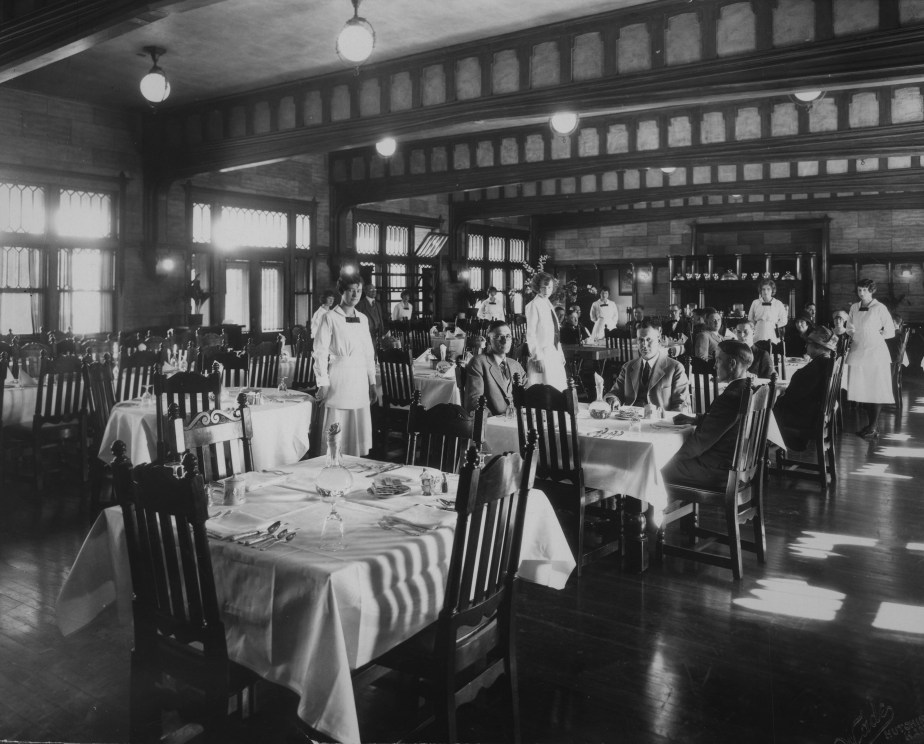 And, if you’re seriously into this, as I am starting to be, it turns out there are tons of people interested in the history of Fred Harvey and they even have a name—Fredheads. There’s an annual get together, the Fred Harvey Weekend, held this year in New Mexico, October 20-22. For more information facebook.com/events/1917935448430054


 The stops, he told us, would include


