Carla Hall Cooking Demo at This Year’s KitchenAid Senior PGA Championship at Harbor Shores in Benton Harbor

            “I would love to walk into a room seeing everyone with big curly hair or different hairstyles, funky glasses and mixed prints,” Carla Hall tells me when I ask what it would be like if people attending her cooking demonstration at the KitchenAid Fairway Club during this year’s KitchenAid Senior PGA Championship at Harbor Shores in Benton Harbor copied her distinctive style.

The question came to mind after I clicked on “Get Carla’s Style,” a page on her Website. Hall is all in for a room full of Carla’s and if it happens, she says, an impromptu party would start immediately.

“By the way, it’s not too late for me to tell you what I’ll be wearing and purchase it for the whole audience is it?” she says. “LOL.”

Well, I’ll have to check with Andy Steinke, the HP’s feature editor, to see if that’s in the budget though I kind of doubt it. Besides, we don’t need to style like Carla to have fun—she creates her own party-like atmosphere  wherever she goes.

As co-host, along with Michael Symon and Clinton Kelly, of ABC’s Daytime Emmy-winning lifestyle series “The Chew,” Hall also appeared on Bravo’s “Top Chef” and “Top Chef: All Stars” where she wowed people not only with her culinary skills and philosophy of cooking with love but also with the catch phrase, “Hootie Hoo.”

Two years ago, she did a cooking demo at the KitchenAid Fairway Club to a standing room only crowd, entering the exhibit kitchen area doing a few dance steps and choosing kids from the audience to help her cook one of her dishes. She’s excited about being back in the area, her husband is from Kalamazoo and her mother-in-law from Benton Harbor. Plus since then Hall’s added a new skill to her repertoire.

“Since I was at the Senior PGA tour the last time, I was inspired to finally pick up a golf club somewhere other than a kiddy putt putt attraction,” she says. “I played my first 9 holes on a very prestigious course–no one else was on the course other than the other neophytes. I won’t talk about my score, but I did it. And I really enjoyed it. I’m looking forward to being back in the KitchenAid kitchen and teaching golf/cooking fans culinary techniques that I sometimes have to rush through on TV.”

One of the recipes she’ll be sharing this year is her Mac & Cheese Bundle.

“Think macaroni and cheese in tortellini form, bathed in a rich butter sauce and sprinkled with crunchy cheese and bread crumbs,” she says, immediately making me hungry. “Yep, a hole-in-one.”
With a degree in accounting, the Nashville, Tennessee native segued into culinary arts, studying classic French cooking at the L’Academie de Cuisine in Maryland. But it’s more complicated—and simple—than that. Her food is a blend of her Southern heritage and her culinary training and her number one goal is simplicity.

“The recipes in my cookbooks are approachable in both technique and in sourcing ingredients,” she says. “I even thought about the number of dishes you would use, especially in Carla’s Comfort Foods and my upcoming book, Carla Hall’s Soul Food. There are plenty of vegetarian recipes as well as a number of delicious dessert and comfort food recipes that my fans have come to expect from me.”

Hall’s newest cookbook, Cooking with Love is out this October and she says it’s loaded with recipes chronicling her life at her Granny’s table and in home and professional kitchens.

“I feel like the other two cookbooks, the experience of opening and closing my hot chicken restaurant and learning about my ancestral roots through DNA testing have all led to this book,” she says.

Having loved acting since she was young, Hall describes herself as “over-the-moon” at being on “General Hospital” for two episodes, starting May 16th.

She’s happy to hear that KitchenAid will again have copies of her cookbooks to be signed by her in exchange for donations to charities.

“Ever since I stepped foot into a soup kitchen over 20 years ago while in culinary school, I have been using my culinary skills to help others and to draw attention to issues around food insecurities in our nation and hunger relief,” she says. “When I found myself on a national television show, I made the conscious decision to use that platform to continue to help others and to give back. It warms my heart to know that the purchase of my cookbooks will be doing just that.”

Ifyougo:

What: Interactive Cooking Demonstration with Carla Hall

When:  Noon CST/1 p.m. EST on Friday, May 25

Where: KitchenAid Fairway Club near the main entrance, Harbor Shores, Benton Harbor, MI

FYI: For more information about the Senior PGA Championship, or to buy tickets, visit pga.com/events/seniorpgachampionship/2018 or call 269-487-3200.


Justin Chapple Interactive Cooking Demonstration at KitchenAide Sr. PGA

“I’ve always been a people person,” Justin Chapple tells me almost immediately after he calls for the scheduled interview.

Within minutes, I totally believe him. It’s like we’ve been best friends forever.

“I love to hear from people,” he says, adding that he almost always answers people who contact him via his many social media outlets such as Facebook and Instagram. “I tell people if they pre-order my new book through my website, justinchapple.com, I’ll send them a note and an autographed bookplate. I spend most mornings writing notes.”

Yes, he does. Even though Chapple has the high prestige job of Culinary Director at Food & Wine magazine, was nominated for a James Beard Award for “Mad Genius,” the weekly morning show he hosts, does the magazine’s video series “Mad Genius Tips” and is the author of two cookbooks, Mad Genius Tips (Broadmoor House 2016) and the soon to be released Just Cook It! 145 Built-To-Be-Easy Recipes That Are Totally Delicious (Houghton Mifflin Harcourt, 2018; $30), he’s all about you.

“It means a lot to me to have people’s support,” says Chapple, who regularly appears on NBC’s “Today.” “And if they have a question about one of my recipes or cooking, I always try to answer it.”

He’s also all about recipes, cooking tips and making it simple. As part of his job as culinary director, he not only has developed and tested thousands of recipes but also converts esoteric recipes from famous chefs—the kind most of us would look at and shake our heads in despair—and makes them accessible for our own kitchens. Watch a few episodes from his “Mad Genius LIVE and “Mad Genius Tips” shows and you’re first thought is, I can use that followed by where does he get all those ideas.

“Sometimes they pop up in my head and I’ll say ‘omigoodness’,” says Chapple who really doesn’t sound like someone who trained at the prestigious French Culinary Institute. “Other times it’s what people ask of me—they want to know how to do something like peel a mango and I’m happy they asked and come up with ideas.”

Though his classical French cooking background is important, he says he learned much of his kitchen know-how from his grandmother.

“She had to make do with whatever she had and she always made the food taste wonderful,” he says.

Describing Just Cook It as low-concept, he says it’s about everyday simple easy recipes. For example, when you have a hankering for lasagna but there’s not enough time to pull it all together, he suggests Ravioli Lasagna with Arugula. It’s good, fast approximation for busy weeknights. Just buy some cheese ravioli, parboil it, drain, place in a casserole and then add fresh mozzarella. Open a jar of good marinara sauce, sauté it with ground beef or fresh veggies or just add it plain to the ravioli. There you have it.

Like gnocchi or other types of dumplings but don’t want to mess with rolling each one out and shaping them by hand?  Never fear, there’s a secret to that as well. Using a food processor, he mixes the ingredients for his Ricotta Gnudi (gnocchi are dumplings made with potatoes and gnudi are made with ricotta cheese), but the next step is much more unusual. Taking an ice cream scoop, he spoons small balls of the dough directly from the food processor and dumps them into hot water.

“Simmer them until they pillowy and just firm,” he says. “I then sauté them until they’re browned and coated with the butter mixture.”

He sprinkles the cook gnuda with pistachio-almond dukka, an Arabic dish (you often also see a bowl of it at Indian restaurants near where you pay your bill). It’s a mixture of spices, seeds and nuts including cumin, coriander, sesame and caraway seeds, pistachios and almonds and cayenne and black peppers.

Dukka is another example of the recipes in his new cookbook. There are a plethora of global offerings such as Thai Skillet Corn, Shumai Stew with Shiitake & Mustard Greens, Rice & Pork Congee with Chiles, Crispy Garlic & Ginger, several types of curry and Catalan-Style Mussels with Green Olives & Fried Almonds. In other words, you can create international meals effortlessly and without fuss.

As for the cooking demonstration at the KitchenAid Fairway Club during the KitchenAid Senior PGA Championship, Chapple says he’s very excited as he’s heard southwest Michigan is beautiful.

“I’m going to demonstrate a few different very simple and fun recipes including a golden tomato gazpacho,” he says.

Though his background in French cooking would seem to call for rich creams and butter, Chapple says he ‘d rather add flavors with such ingredients as good quality olive oil that creates a “silky taste.”

“Another one of the secrets I like to share is using smoked almonds,” he says. “They’re so delicious and so easy and they impart a lot of flavor.”

Chapple talks about his “secrets” and I ask, jokingly, how they can be secrets since he tells them to everyone.

“That’s the fun of secrets,” he says. “Telling them to people.”

Ifyougo:

What: Interactive Cooking Demonstration with Justin Chapple

When: Noon CST/ 1 p.m. EST on Saturday, May 26

Where: KitchenAid Fairway Club near the main entrance, Harbor Shores, Benton Harbor, Michigan

FYI: For more information about the KitchenAid Senior PGA Championship, or to buy tickets, visit pga.com/events/seniorpgachampionship/2018 or call 269-487-3200.


Follow Justin on Twitter and Instagram at: @justinchapple and Facebook at facebook.com/justin.a.chapple.


Celebrity Chefs’ Demos at KitchenAid Senior PGA Championship at Harbor Shores in Benton Harbor

            Every two years I look forward to the KitchenAid Senior PGA Championship at Harbor Shores in Benton Harbor, not because I love golf that much, but because there’s always an exciting line-up of celebrity chefs as well as some great Southwest Michigan chefs showing how to create some of their favorite recipes. So I was excited when my friend Deb O’Connor, director of global partnerships for KitchenAid, sent me the line-up for this year’s event, which is being held at the KitchenAid Fairway Club near the main entrance over Memorial Day weekend, May 24-28.Credit David Cicconi (1)

            The first live cooking demonstration is at 1 p.m. Thursday and features TV personality Adam Richman, who is  the author of Straight Up Tasty, and also hosts the Cooking Channel’s “Secret Eats with Adam Richman.” Richman has the tough job of having had to travel to over 40 countries in search of the world’s best fine dining and then writing about it.

            Be sure to stay around once Richman is done because at 2:30 that same day, Cheyenne Galbraith, the  executive chef at the Bistro on the Boulevard, will be doing another culinary exhibition.AR Headshot (photo credit Travel Channel) (1)

            Carla Hall, co-host of ABC’s Emmy-Award Winning daytime series “The Chew” and Bravo “Top Chef,” will be returning (she was here two years ago and was great fun) on Friday, May 25 at 1 p.m. followed at 2:30 p.m. by Mike Kenat of Salt of the Earth in Fennville.

            Then on Saturday, May 26, James Beard Award nominee Justin Chapple who is the Culinary Director at Food & Wine magazine, author of two cookbooks and host of “Mad Genius LIVE”—Food & Wine’s weekly TV show featuring genius ideas in food, travel, entertaining and more will be at the KitchenAid Fairway Club at 1 p.m. Tim Foley, owner of the Bread+Bar and Bit of Swiss Bakery is up at 2:30 p.m. followed at 4:00 p.m. by Abra Berens of Granor Farm. 

            According to Deb, KitchenAid Chef Chris Covelli will round out the cooking demonstration schedule.

            “We have created an experience where fans can learn, ask questions and be inspired to challenge themselves in the kitchen,” she says. “We hope that they leave this Championship with a renewed passion and energy to experiment in their own kitchens with KitchenAid.”

            Here are a few of Justin Chapple’s recipes including one for Philly Cheesesteak Queso from his show “Mad Genius Live.” 

Philly Cheesesteak Queso

3 tablespoons canola oil

1 small red bell pepper—stemmed, seeded and thinly sliced

1 small green bell pepper—stemmed, seeded and thinly sliced

 1 small sweet onion, halved lengthwise and thinly sliced Kosher salt Pepper

One 12-ounce rib-eye steak, frozen for 30 minutes and very thinly sliced

1 cup half-and-half

1 pound white American cheese, coarsely shredded (4 cups)

1/2 pound provolone cheese, coarsely shredded (2 cups)

2 hoagie rolls, sliced crosswise and lightly toasted          

In a large cast-iron skillet, heat 2 tablespoons of the canola oil. Add the bell peppers and onion and season with salt and pepper. Cook over moderately high heat, stirring occasionally, until softened and browned in spots, about 8 minutes. Transfer the pepper mixture to a small bowl. 

Wipe out the skillet and heat the remaining 1 tablespoon of canola oil in it. Season the steak with salt and pepper. Add the steak and cook over high heat, stirring occasionally, until browned and just cooked through, about 3 minutes. Transfer the steak to a small bowl. 

Wipe out the skillet, add the half-and-half bring just to a simmer over moderate heat. Whisk in both cheeses in small handfuls until completely melted and the queso is very smooth, about 5 minutes. Top the queso with the steak and pepper mixture. Keep warm over very low heat and serve immediately with the toasted hoagie roll slices.

Black and White Cupcakes

Cupcakes:

1 cup all-purpose flour

1/3 cup unsweetened cocoa powder

1/2 teaspoon baking powder

1/2 teaspoon kosher salt

1/4 teaspoon baking soda

6 tablespoons. unsalted butter

3/4 cup sugar

2 large eggs

1/2 cup sour cream

2 1/2 teaspoon pure vanilla extract

Frosting:

2 stick unsalted butter

4 cups confectioners’ sugar

2 teaspoon pure vanilla extract

1/2 teaspoon kosher salt

4 tablespoon milk

1/2 cup unsweetened cocoa powder 

Preheat the oven to 350 degrees F and line a 12-cup muffin pan with paper liners. In a bowl, whisk the flour with the cocoa powder, baking powder, salt, and baking soda. In a large bowl, using a handheld electric mixer, beat the butter with the sugar at medium-high speed until fluffy. Beat in the eggs 1 at a time, then beat in the sour cream and vanilla until smooth. At low speed, beat in the dry ingredients. Scoop the batter into the lined muffin cups.

Bake the cupcakes in the center of the oven for about 17 minutes, until springy and a toothpick inserted in the centers comes out clean. Let cool slightly in the pan, then transfer to a rack to cool completely.

Meanwhile, Make the Frosting In a large bowl, using a handheld electric mixer, beat the butter at medium speed until smooth. Add the confectioners’ sugar, vanilla, salt, and 2 tablespoons of the milk and beat at low speed just until combined, then beat at medium speed until smooth. Scrape half of the vanilla frosting into a medium bowl. Add the cocoa powder and the remaining 2 tablespoons of milk to the frosting in the large bowl and beat at low speed until fully incorporated.

 Lay a large sheet of plastic wrap on a work surface with the long side facing you. Using a small spatula, spread the vanilla frosting in a 3-inch-wide strip down the center of the plastic wrap. Spread the chocolate frosting in a 3-inch-wide strip alongside the vanilla. Using the plastic, fold the chocolate frosting over the vanilla, twisting one end of the plastic to seal. Pull the twisted end of the plastic through a pastry bag fitted with a large star tip and cut off the protruding plastic at the tip. Refrigerate the frosting until barely firm, about 15 minutes. Pipe onto the cupcakes and serve. 

Jane Simon Ammeson can be contacted via email at janeammeson@gmail.com


Following the Danube to Matyas Pince

FullSizeRender (28)We followed the Danube south as it flows through the center of Budapest up to Marcius 15 – a street lined with centuries-old buildings – to Matyas Pince restaurant, which since it opened in 1904 is almost new in this city of historic culture and architecture.

It was a beautiful evening in Budapest, and we thought we’d sit outside, but the maître d’ insisted we follow him inside – through the first floor with its frescos and lead-glass windows highlighting scenes from King Matthias’ life and then downstairs to a delightful room with brick ceilings and mosaic floors.

This is where, every night, Vilmos Lakatos and his gypsy band play Hungarian songs and two young couples, wearing traditional costumes, did elaborate folk dances which called for a lot whirling and sliding along the dance floor. And for the women (in the way that Ginger Rogers had to do all the dance steps that Fred Astaire did but only backwards and in high heels). the women place flat-bottomed bottles on their heads and  including one where the young women dance with flat-bottomed bottles on their head and pirouetted at a dizzying pace.

Did I want to try, one of them asked me, offering the bottle. Of course, I said. She set it atop my head and it immediately started slipping to the floor. Another career that I’m not qualified for, I thought.

FullSizeRender (20)The menu was long and complicated, each choice promising classical Hungarian fare.  Choosing beef goulash, the first of what would turn out to be many varying iterations of the of the dish which I quickly learned can be served as a soup or stew of different meat and vegetables. My other choice was paprika chicken–chicken paprikash when my grandmother made it when I was young. But she was Romanian and perhaps that’s the difference. Both the goulash and chicken seasoned with a sweet Hungarian paprika – the kind many of us, myself included, use to sprinkle on deviled eggs.

And now we come to paprika. Both dishes were deliciously seasoned with sweet Hungarian paprika–the kind many of us, myself included, sprinkle on deviled eggs.DSC_0023

At home, in my kitchen, I have two types hot and sweet–one in a yellow can and the other in a red. Paprika imparts a deep layer of taste to food, and in Eastern and Central Europe comes in a variety of types, including half-sharp Hungarian paprika (a spicier, hotter version of Hungarian sweet paprika), Spanish smoked hot paprika (aka Pimenton de la Vera) and Spanish smoked sweet paprika (Pimenton de la Vera and Israeli Sweet–I could go on and on.


Later, when visiting a market in Vienna, I would discover bags and bags of paprika, some fullsizerender-15.jpg30 varieties or so, each individualized according to place of origin, sweetness, heat and smoke, and each prized for its specific use. I buy a couple of bags and whenever I use them in my kitchen at home, the aroma–sometimes sweet, sometime piquant, reminds me of the dancers and the markets and all that I saw. Now if only I could learn to balance that bottle on my head.
Paprika Chicken

4 chicken leg quarters, cut in half at joint (about 3 pounds total)

Coarse salt and ground pepper

2 teaspoons vegetable oil

1 large yellow onion, halved and thinly sliced lengthwise

3 garlic cloves, roughly chopped

2 tablespoons sweet paprika

3 tablespoons all-purpose flour

1 3/4 cups chicken broth

1 can (14 ounces) diced tomatoes

1/2 pound wide egg noodles or spaetzle

1/2 cup sour cream or thick plain yogurt

Season chicken with salt and pepper. In a large Dutch oven or heavy pot, heat oil over high. Cook chicken, skin side down, until golden and crisp, six minutes. Flip chicken and cook until browned, six minutes more. Transfer to a plate.

Discard all but 1 tablespoon fat from pot and reduce heat to medium. Add onion and cook, stirring frequently and scraping up any browned bits with a wooden spoon, until beginning to soften, two minutes. Add garlic and cook, stirring frequently, three minutes.

Add paprika and flour, season with salt and pepper, and stir constantly until paprika is fragrant and mixture begins to stick, one minute.

Add broth and whisk until smooth. Add tomatoes and bring to a boil over high.

Return chicken to pot in a single layer, skin side up, and reduce heat to medium. Cover and cook until chicken is cooked through, 20 minutes.

Meanwhile, in a large pot of boiling salted water, cook noodles according to package instructions. Drain noodles and divide among four bowls.

Top with chicken. Stir sour cream into sauce, then ladle over chicken and noodles.

Hungarian Goulash

1 strip bacon

2 onions, medium dice

1 tablespoon olive oil

2 1/2 pounds stewing beef, cut into 1/2-inch cubes

1 garlic clove

Pinch caraway seeds

2 tablespoons good quality sweet paprika

2 cups warm water

2 cubes beef bouillon

2 whole canned tomatoes, chopped

1 green bell pepper

4 or 5 potatoes

2 tablespoons sour cream, plus more for plating

1 pound prepared spaetzle, as an accompaniment

Cucumber salad, as an accompaniment:

Cucumber Salad:

2 cucumbers

Seasoned salt

1/2 onion

1/2 cup white vinegar

1/4 cup water

2 teaspoons sugar

1/8 teaspoon sweet paprika

Pinch dill, dried or fresh (optional)

Dollop sour cream (optional)

Cook’s Note: using good quality paprika is important. After about a year, paprika spice tends to lose its intensity. Use the best quality possible.

In a cold, heavy 6- to 8-quart stewing pot, fry bacon over low-medium heat until fat is rendered, and then discard bacon slice.

Sauté onions in the bacon fat for a few minutes, do not allow the onions to brown. If bacon does not provide enough fat, add a little olive oil to prevent the onions from sticking.

When onions become glossy, add the beef, sautéing with the onions for about 10 minutes, covered, until the meat is browned.

Meanwhile, chop and crush the garlic with the caraway seeds; add to meat and onions.

Remove pot from heat. Stir in paprika rapidly with a wooden spoon. Immediately after paprika is absorbed, add the warm water. The water should just cover the meat, leaving room for potatoes.

Add beef bouillon cubes. Cover pot and cook over low heat for about one hour.

While stew is braising, prepare the tomatoes by cutting into 1-inch pieces. Core green peppers and cut into strips.

After one hour of braising, add the tomatoes and green pepper. Add a little more water, if necessary and a little more salt. Simmer slowly for another 30 minutes.

Peel potatoes and cut into bite-sized cubes and set aside in a bowl of water. Add potatoes, and cook another 30 minutes until the potatoes are fork tender and the goulash is done.

Once goulash is finished, dissolve sour cream and a little of the goulash sauce in a cup. Add to goulash, it should give a creamy consistency. Serve goulash with spaetzle on the side, adding an extra dollop of sour cream to each plate.

Peel and slice cucumbers very thinly. The side of a metal grater with the wide slots works best here, or you can use a mandoline. Place cucumbers in a flat dish and sprinkle throughout with salt, making sure that all the slices are salted. Leave to rest for 30 minutes.

The salt will draw the moisture out of the cucumbers. Cut the onion into paper-thin slices and place in a container. Once the cucumbers have released water, use your hands to squeeze out the excess water and add to the onions. The cucumbers are supposed to be limp, but still crisp.

In a measuring cup, mix vinegar, water, sugar and paprika to create a vinaigrette. Pour over the cucumbers and onions and marinate in the refrigerator for at least 1 1/2 hours.

Cook’s secret: make the cucumbers before the goulash and it will be perfectly marinated by the time you are done making the stew.

Serve with a sprinkle of dill and a little dollop of sour cream, if desired.


Today Show’s Natalie Morales shares family recipes

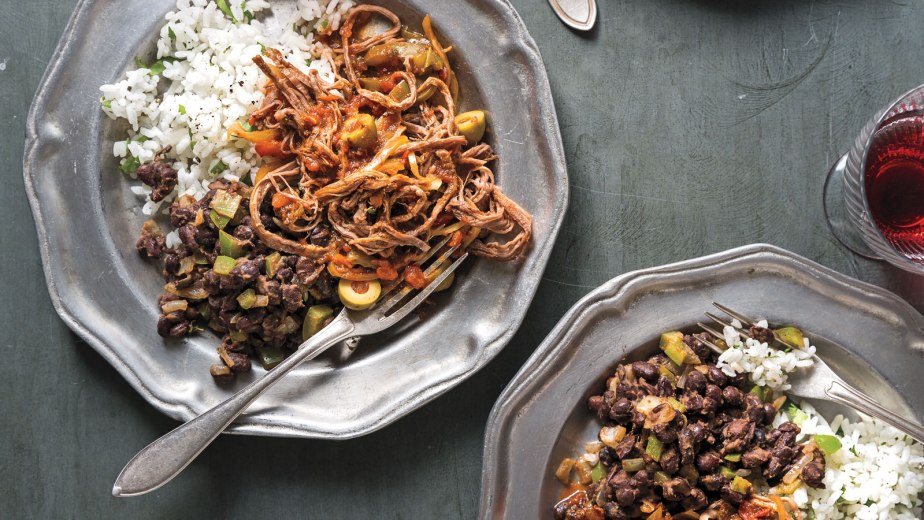
Slow Cooker Ropa Vieja with Classic Brazilian Black Beans & Rice (c) Alanna Hale

Glamorous and globetrotting, Natalie Morales, West Coast anchor for the Today show, could easily be forgiven for ordering take-out for family meals. But Morales, who with her sisters helped her mom cook almost every night when growing up, believes good food can bring a family together.

“I’m a busy mom always on the go and the way we connect is around the dinner table, where we have conversations and talk about what’s going on,” she says.

Morales also finds chopping and sautéing as therapeutic and relaxing after her busy work days which often start at 3 a.m. The meals she prepares are an amalgam of her life experiences, one that she captures in her just released cookbook, At Home with Natalie: Simple Recipes for Healthy Living from My Family’s Kitchen to Yours (Houghton Mifflin 2018; $30).

“I’m Brazilian and Puerto Rican and an Air Force brat–we lived in Central and South America and I spent ages 12 to 17 in Spain,” she says “Now, getting to try new foods is one of the great parts of my job.”

Indeed, Morales who recently was in PyeongChang covering the 2018 Winter Olympic Games, spent her spare time there sampling Korean barbecue.

“For me, food is the foundation of a culture and tradition–you get a real idea of the country when you’re eating their foods,” she says.  “I  remember going to Cypress–best night ever–I ended up dancing on the table and so did whole crew. I went to Chile to report on 33 miners trapped 2,300 feet underground for over two months and was there when they were rescued. There was all this food on the tables waiting for them and sitting and eating helped us break through the barriers.”

Morales says she was inspired to write her cookbook after watching chefs such as Giada De Laurentiis, Bobby flay and Ina Garten demonstrate how to cook on her show.

“Their recipes were easy enough for me to do and that inspired me to create a book with simple, but exciting  recipes,” says Morales. “The book is also  a way of honoring the  legacy of my own family by including dishes I ate when I was young.”Summer Berry Tarte Tatin (c) Alanna Hale

These include her  late grandmother’s recipe for ropa vieja—shredded meat, peppers and onions (she’s modernized it by using a slow cooker) and the chicken empanadas her mom makes.

“These are all part of my heritage,” she says. “I wanted to pass that on.”

Ifyougo:

Ifyougo: Natalie Morales book signing

When: Wednesday, April 18 at 8 p.m. EST

Where: Anderson’s Bookshop, 26 S. La Grange Rd. in downtown La Grange

Cost: Tickets required and can be ordered at nataliemoralesandersons.brownpapertickets.com; $34.00 ($36.18 w/service fee).

This ticket admits one and includes a copy of the new book and admission to the signing line.

FYI: (708) 582-6353; andersonsbookshop.co

Ropa Viejo

Serves 6 to 8

1½ pounds flank steak

Sazón seasoning, such as Goya Sazón (see note below)

1 medium yellow onion, thinly sliced1⁄2 cup thinly sliced red bell pepper

½ cup thinly sliced green bel

l pepper

1 (14 ounce) can crushed tomatoes

1 cup beef broth

2 tablespoons tomato paste

1 tablespoon red wine vinegar

2 garlic cloves, minced

1 tablespoon dried oregano

1 tablespoon ground cumin

½ bottle beer, such as a pale ale

Tabasco sauce (optional)

1 cup halved pimiento stuffed Manzanilla olives (optional)

Chopped fresh cilantro, for garnish

Season the flank steak with Sazón, then put the meat into a slow cooker. Layer the onion and bell peppers on top. Add the crushed tomatoes, broth, tomato paste, vinegar, garlic, oregano, and cumin, stirring to combine.

Pour in the beer and a splash of Tabasco, if desired. Spoon and stir the seasoned liquids over the beef and vegetables. Cover and cook on Low for 8 hours or High for 4 hours. Toward the last hour, add the olives (if using).

When done, shred the beef using two forks. Top with cilantro and serve.

Notes:

Sazón is a Spanish seasoning found in Latin aisle (Goya makes a popular version)or if you can’t find it, a combination of salt, pepper and garlic salt will do. If you prefer a crispier ropa vieja, you can sear the flank steak first in 2 tablespoons olive oil before placing it in the slow cooker.

Summer Berry Tarte Tatin

Serves 6 to 8

DOUGH:

5 tablespoons unsalted butter, cut into small cubes and chilled

¾ cup all-purpose flour, plus more for dusting

¼ cup whole wheat flour

1 tablespoon sugar

Pinch of salt

1 large egg yolk

2 tablespoons ice water

1 teaspoon apple cider vinegar (this makes the crust flakier)

FILLING:

¼ cup sugar

1 tablespoon fresh lemon juice

1 teaspoon pure vanilla extract

3 tablespoons unsalted butter

8 ounces fresh strawberries, halved

8 ounces fresh raspberries, half chopped and half left whole

4 ounces fresh blackberries

In a large bowl (or in a food processor, but it’s quick and I think a bit better by hand), combine the butter, flours, sugar, and salt, using your fingers, until the butter is distributed throughout, smaller than pea size. Add the egg yolk, ice water, and vinegar and stir using a spatula or wooden spoon, until the dough has just come together—do not overwork it.

Dump the dough onto a floured surface and form it into a disc; add more flour or water, if the dough seems too sticky or too dry. Wrap it in plastic wrap and refrigerate for at least 2 hours or up to 2 days.

Preheat the oven to 400°F.

Make the filling: In a small saucepan, stir together the sugar, 1 tablespoon water, the lemon juice, and vanilla over medium heat. Stir gently until the mixture simmers and cook until it is the color of a light caramel, being careful not to let the syrup get too dark, about 5 minutes. Carefully stir in the butter and continue stirring until the sauce is smooth. Pour the caramel syrup into an 8- to 10-inch oven-safe skillet, pie dish, or cake form, tilting it to coat the bottom.

Arrange the strawberries, whole raspberries, and blackberries in a concentric pattern over the bottom of the dish. Fill in the gaps with the chopped raspberries.

When the dough is sufficiently chilled, roll it out into a circle that is about 1 inch larger in diameter than the skillet or dish.

Lay the dough on top of the fruit filling, then tuck the sides inside the pan or baking dish. Using a paring knife, cut four 1-inch slits across the top to release steam as it bakes.

Bake the tarte until it is lightly browned and the berries are bubbling, 25 to 30 minutes. Remove from oven and cool for 15 to 20 minutes.

Take a large round plate and place it on top of the tarte tatin. Over the sink, hold the plate and tarte dish or pan together tightly and flip them over quickly. The idea is to keep the juices as much on the plate as possible and the berries in place. Serve with a dollop of crème fraîche, light whipped cream, or frozen yogurt.

The above recipes were excerpted from AT HOME WITH NATALIE © 2018 by Natalie Morales. Photography © 2018 by Alanna Hale.

Head North for Some Southern Cuisine: The Southerner in Saugatuck, Michigan

20180131_173701 (1)To find Matt Millar’s new restaurant The Southerner, veer off the beaten path from busy downtown Saugatuck, Michigan with its lovely 19th century buildings housing a collection of the coolest shops, restaurants, wineries and galleries. Instead follow the curving road paralleling the Kalamazoo River towards a one-story rambling building set far back from the road. Painted an almost too-bright yellow, there’s a large smoker in the side yard and window boxes brim with colorful flowers. It’s here that Millar, a two-time James Beard Award finalist recreates the Appalachian roots of the families like his who migrated north in mid-1900s to work in Michigan’s auto industry.

Millar is famous in this section of Southwest Michigan, known for The Journeyman, his first restaurant located in Fennville about 15 minutes southeast of Saugatuck where his menu was crafted around the foods from this area—whether it was organically raised pork or cheeses made from goats who feed on raspberry brambles. He then was the executive chef at Reserve, the uber trendy and vastly popular restaurant located in an old bank in downtown Grand Rapids.

The Southerner opened about two years ago and the restaurant’s buzz keeps getting stronger with write-ups in the Wall Street Journal and Bon Appetit magazine. The interior is a fun, casual place—think a friend’s summer cottage. Large windows over-look the river as it flows towards Lake Michigan. Tables and chairs don’t match, neither does the delicate china used as dinnerware. An old-fashioned phonograph is set on a table by the entrance to the bar and the kitchen is open so you can watch Matt and his crew works.

Go there in the winter and it’s easy to get a table, warm weather is different and unless you’re really early count on waiting. But that’s okay, they have a great wine, beer and cocktail list.20180131_180558 (1)

On a busy summer night, the restaurant sells hundreds of pounds of their wonderful fried chicken (Matt shared the recipe) which takes over 12 hours just to marinate. Two great appetizers to try while it’s cooking are the house-made pepper jelly with locally made goat cheese and a rather spicy pimento cheese spread both served with Saltines.

The following recipes are courtesy of Matt Millar.

Nana’s Fried Chicken

Marinate the chicken:

1 fryer chicken, about pounds, cut into 8 pieces

2 tablespoons salt

2 tablespoons fried chicken rub (recipe below)

Toss everything together in a container which will hold everything in close quarters.

Refrigerate for 12 hours.

Make the dredge:

3 cups White Lily flour (not self-rising)

3 tablespoons fried chicken rub

Stir together well. Place the rub in a large bowl. Remove the chicken from the buttermilk, shaking off excess, then coat in the dredge.

Move the pieces to a pan fitted with a cooling rack and let them rest for a half hour to give the flour a chance to adhere.

Heat about an inch of peanut oil in a cast iron skillet to 350 degrees. Add the chicken pieces and fry without fussing for about 12 to 15 minutes, until the chicken is cooked about two thirds of the way through. Flip the chicken and continue frying until it reaches 170° degrees. Remove to a pan fitted with a cooling rack and rest 10 minutes before eating.

Fried Chicken Rub:

This makes more than you will need for the recipe but keeps well in a sealed jar.

2 tablespoons Cayenne Pepper

1 tablespoon granulated onion

1 tablespoon granulated garlic

1 tablespoon black pepper

1 tablespoon mustard powder

2 teaspoons dried savory

Pepper Jelly

Makes 1 quart

3 medium bell peppers

2 red serrano peppers

4 1/2 cups white sugar

1 cup apple cider vinegar

Puree the peppers in a food processor and add them to a medium, non-reactive sauce pan.

Bring the mixture to a boil over high heat, then turn the heat down enough to avoid burning or boiling over, but enough to still maintain a gentle boil.

Cook until the mixture thickens to the consistency of a fruit jam, about 45 minutes.

You should be able to run a spoon across the bottom of the pan and leave a clear trail behind it for a moment. Strain the solids out and chill completely.

Serve with cream cheese or, use one of Matt’s favorites our favorite, chevre or fromage blanc from Evergreen Lane Creamery in Fennville, Michigan. This works great with Saltines.

The pepper jelly is perfect on laminated biscuits (that’s why I’m sharing the recipe below), the type where you can just pull apart the layers, meaning more area to spread butter and jam.

Laminated Biscuits

2½ teaspoons baking powder

2 teaspoons kosher salt

2 teaspoons sugar

¼ teaspoon baking soda

3½ cups all-purpose flour, plus more for surface

1 cup (2 sticks) chilled unsalted butter, cut into ½-inch pieces, plus more, melted, for brushing

1 cup chilled buttermilk

Preheat oven to 425°. In a food processor, pulse baking powder, salt, sugar, baking soda, and 3½ cups flour to combine. Add chilled butter and pulse until largest pieces of butter are the size of a pea. If you don’t use a food processor, use your hands to mix the flour mixture and then add the butter and mix quickly until the butter/flour mixture is the size of peas. Be careful not to handle the dough too much.

Transfer to a large bowl and gradually drizzle buttermilk over top, tossing with a fork as you go to incorporate. Knead mixture a few times in bowl until a shaggy dough forms (mixture will look a little dry), then turn out onto a clean surface and pat into a 1″-thick square.

Using a knife or bench scraper, cut dough into 4 pieces. Stack pieces on top of one another, sandwiching any loose dry bits of dough between layers, and press down to flatten. Lift up dough with bench scraper and dust surface with flour. Roll dough into a 1″-thick rectangle, trimming the border so the edges are clean. Divide into a 4×3 grid to make 12 biscuits (don’t reroll scraps). Transfer to a parchment-lined baking sheet, spacing 2″ apart; freeze for 10 minutes.

Brush the tops of biscuits with melted butter and the place in hot oven. Reduce temperature to 400° and bake biscuits until they’re deep golden brown on the bottom and golden on top about 20–25 minutes.

Note: Unbaked biscuit dough can be made one month ahead. Freeze, uncovered, on baking sheet until solid, then transfer to a resealable plastic bag. Do not thaw before baking but add a few minutes to baking time.


Choose Chicago Eat Week

Choose Chicago, in partnership with the Illinois Restaurant Association, announces the return of James Beard Eats Week, taking place April 27–May 7, 2018.

Line-Kings_1540 (1)
Kevin Boehm and Rob Katz of the Boka Restaurant Group which includes Girl and the Goat are  finalists in the Outstanding Restauranteur category. Photo courtesy of the Boka Restaurant Group.

“Chicago proudly sits at the head of the culinary table,” said David Whitaker, Choose Chicago President and CEO. “Eats Week represents both a unique opportunity for visitors and residents alike to explore and appreciate the city’s world renowned chefs and restaurants, as well as celebrate Chicago hosting the annual James Beard Awards by experiencing special dishes and menus.”

Inspired by James Beard, known as the “Dean of American Cookery,” James Beard Eats Week is an 11- day culinary celebration featuring more than 130 restaurants offering offer an inspired menu or dish in honor of the culinary legend. James Beard Eats Week precedes the 2018 James Beard Foundation Awards Gala to be held on Monday, May 7, 2018 at the Lyric Opera of Chicago.

“Eats Week has become an annual tradition in celebration of the James Beard Awards,” said Sam Toia, President & CEO of the Illinois Restaurant Association. “Not only does it allow local chefs to honor the legacy of the iconic James Beard through special dishes and menus, but it also provides food lovers with a festive opportunity to try something new at more than 130 restaurants citywide.”

Every restaurant taking part in James Beard Eats Week makes a $100 donation to the James Beard Foundation Scholarship Fund, which directly supports aspiring Chicago culinary students.

DS.cover
2018 James Beard Foundation Book Awards Finalist in the Health and Special Diet category. 

The James Beard Eats Week program raised $13,600 in 2017 through program donations. The James Beard Scholarship Fund was established in 1991 and has awarded more than $7 million in financial aid to more than 1,850 recipients nationally. Last year, the James Beard Foundation established a James Beard Foundation Greens chapter in Chicago.

JBF Greens events are for ‘foodies under 40’ —food lovers between the ages of 21 and 39. Greens get to discover the newest restaurants, chefs, and culinary trends, all while enjoying great food and drinks. Greens events include walk-around tastings, multi-course dinners, wine tastings, and hands-on cooking classes and demonstrations. The James Beard Foundation’s mission is to celebrate, nurture, and honor chefs

Featured image at the top of the post courtesy of James Beard Foundation. Copyright Kent Miller.


A Train Ride Out West

fred harvey menu (1)Not long ago I traveled with friends to Williams, Arizona, a tiny rodeo-type town on Route 66 which bills itself as the Gateway to the Grand Canyon. On our arrival we parked at the historic Williams Depot, got our tickets for the Grand Canyon Railway, in existence since 1901, and then headed down the tracks to where an old Wild West show had started. It’s all rather hokey with bad jokes and the sheriff in the end shooting the bad guys but still, taken for what it was, fun. The western theme sure set the mood for a trip to the canyon which I had never seen before and, on our way home, the sight of gunmen riding horses across the sage and coming aboard as part of an old fashioned train robber (spoiler alert—it was the same sheriff and two dead desperados who had shot up the corral earlier in the day).

OB-HX208_harvey_DV_20100319125144Boarding the vintage train (our car dated back to 1926, ‘27 or ’28 depending on which guide was speaking) powered by a steam engine, our journey started in a landscape of Ponderosa pines, descended slightly from 7000-feet as we passed through Northern Arizona’s Colorado Plateau which at 5000-feet is a mix of high desert and scrubby forests, rose to 12,600 feet at the highest point in state– San Francisco Peaks and then back down to 7000-feet when nearing the canyon. A musician made his way through the train cars playing—not the western songs I expected—but modern melodies (oh come on, no Red River Valley?) as we spotted herds of caribou and elk in the distance

The canyon itself, with its amazing vistas, was much more beautiful than any photograph but of course being food centric, I was interested in taking a tour of the Fred Harvey museum at Bright Angel Lodge, one of the restaurant/lodge complexes overlooking the canyon’s southern rim.fred harvey la junta hotel (1)

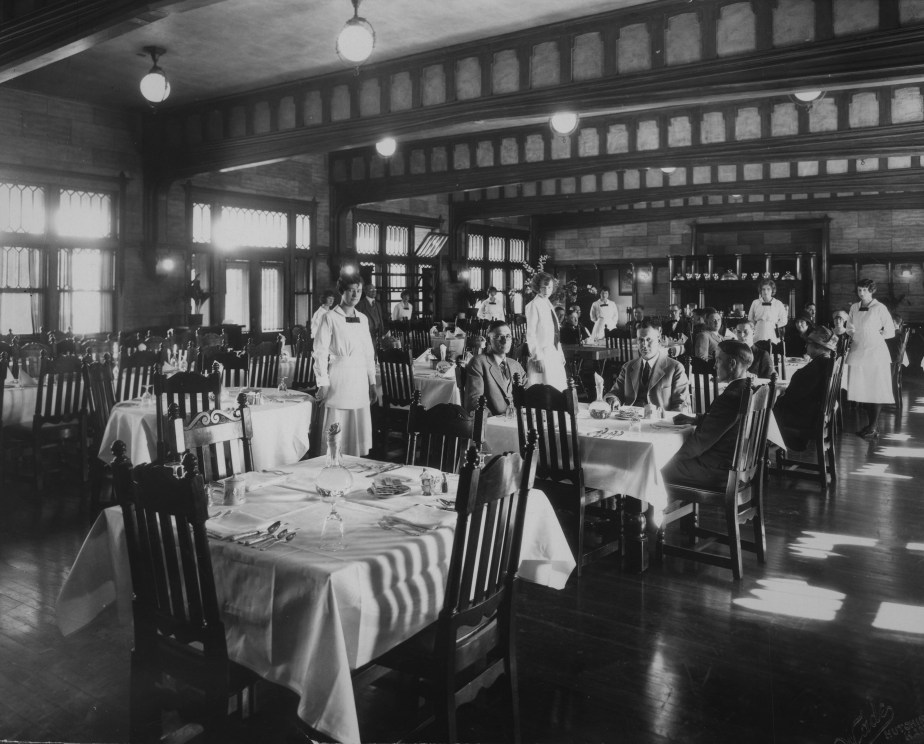
I was only vaguely aware of Fred Harvey, an Englishman who starting in 1853 built a string of restaurants and hotels along the Santa Fe Railroad and then Route 66 between Illinois to California. My friend Pete Racine, the late owner of the Grand Mere Inn in Stevensville, Michigan, had started his career working for the Fred Harvey company in the Chicago area where they had eateries along the toll road before going to work for Win Schuler’s in Michigan and then opening up, with wife Nancy, his own restaurant. But I was surprised to learn that in 1883 Harvey created the Harvey Girls–young, single, well-mannered, and educated American women (oh and they also had to be white) dressed in rather staid uniforms who served food in his restaurants. Being a Harvey Girl was a big deal—The Harvey Girls starring Judy Garland (as the sweet Harvey girl) and vampy Angela Lansbury as a sequined bar queen) was made in 1946 and based on a book by the same name written in 1942. Their uniforms and photos of the women through the years were on display in the one-room museum.

cookbook-cover-reversed-for-emilySome of menu items at the lodge’s Historic Harvey House Café where we ate had been around for a long time. The Cobb salad I ordered dated back to 1940, Chili con Carne first appeared in 1937 and the Ponderosa Chicken Club was even older–1938.
When I got home, I of course Googled it all and discovered that Stephen Fried, author of Appetite for America: Fred Harvey and the Business of Civilizing the Wild West—One Meal at a Time, which was named one of the top ten books of the year by the Wall Street Journal and the Philadelphia Inquirer, had started a website titled The Harvey Girl Cookbook Project. During his intensive research on Harvey, he’d come across hundreds of recipes that had been served in the restaurants, some dating back to the 1880s and decided to post them, asking others to post any they might have and also giving a history of Harvey, the girls and his empire.

The recipes are varied, some for foods that we probably wouldn’t order even if they were still on the menu such as Bull Frogs Sauté Provencal which is basically skinned frogs, dissected (their words not mine) and sautéed with mushrooms and tomatoes, Dandelion Soup (chopped dandelion greens and flowers cooked in milk) and calf brains. There are also recipes for food items we don’t see any more—Guinea Hen, Boneless Squab, Gansenmeir Stuffed Goose, Broiled Pig’s Feet, Calf’s Sweetbreads and Gooseberry Meringue Tart. Recipe styles include a lot of French terms—Epicurienne, Diable, Bonne Femme and Valencienne and older recipes are written in paragraph style like they did a century or more ago.

Fred Harvey interiorAnd, if you’re seriously into this, as I am starting to be, it turns out there are tons of people interested in the history of Fred Harvey and they even have a name—Fredheads. There’s an annual get together, the Fred Harvey Weekend, held this year in New Mexico, October 20-22. For more information facebook.com/events/1917935448430054

As for channeling Fred Harvey into your own kitchen, try perusing the recipes Fried collected. They’re a fascinating lesson in culinary history. I chose a few from the more than 500 Fried collected to include here. For more, visit fredharveycookbook.tumblr.com

Cheese Biscuits

½ cup butter

1½ cups flour

1 pound sharp cheddar cheese, grated

Salt, cayenne to taste

Mix all ingredients, roll into small-sized balls, and bake on greased cookie sheet at 400 degrees for ten to fifteen minutes.

Ham Dumplings

Whip 2 ounces butter until foamy, add 2 whole eggs, 4 ounces fresh bread crumbs, 1 spoonful flour and 3 ounces finely chopped lean ham. Rub through sieve, mix thoroughly and with teaspoon form small dumplings. Poach in boiling consommé and add to soup.

Beef Rolls

4 8-ounce pieces of beefsteak

4 tablespoons butter or margarine

2 teaspoons salt

1 tablespoon all-purpose flour

¼ teaspoon pepper

2 tablespoons catsup

4 slices bacon

2 beef bouillon cubes dissolved in

4 slices onion cut in half

2 cups of water

1 large dill pickle, cut in fourths

Do this:

With a meat cleaver, pound the steaks until they are flat. On each steak place a slice of bacon, an onion slice, and a pickle slice. Roll the steak around the onion and pickle and tie together with apiece of clean string. Spread the flour on a plate and roll the tied steak in it. In a heavy pan with a lid melt the butter or margarine and brown the floured beef rolls and remove them to a plate.

Add 1 tablespoon flour to the butter or margarine still in the pan and mix together. Add the beef broth, made from beef bouillon, and stir this mixture over low heat until slightly thickened.

Then put the browned beef rolls back in the pan, cover, and cook over low heat for 40 minutes.

Remove string before serving. Be sure to serve this main dish nicely as Fred Harvey would have done

Chocolate Custard

1 quart milk

6 eggs

4 ounces sugar

Pinch salt

1 teaspoon vanilla extract

2 ounces bitter chocolate

Melt chocolate in warm milk, beating with egg whip. Mix eggs, sugar, and salt, combine with chocolate milk and add vanilla extract. Fill custard molds and bake in  moderate oven for about 30 min, until set. Let cool, unmold, and garnish with whipped cream.

Fried-150

Acknowledgements: The above photos and information is courtesy of Stephen Fried.


Hauntings of the Underground Railroad: Ghosts of the Midwest

HauntingsUndergroundRailroad_cover jpg

Before the Civil War, a network of secret routes and safe houses crisscrossed theMidwest to help African Americans travel north to escape slavery. Although many slaves were able to escape to the safety of Canada, others met untimely deaths on the treacherous journey―and some of these unfortunates still linger, unable to rest in peace. InHauntings of the Underground Railroad: Ghosts of the Midwest, Jane Simon Ammeson investigates unforgettable and chilling tales of these restless ghosts that still walk the night.032 Vernon Row Houses

This unique collection includes true and gruesome stories, like the story of a lost toddler who wanders the woods near the Story Inn, eternally searching for the mother torn from him by slave hunters, or the tale of the Hannah House, where an overturned oil lamp sparked a fire that trapped slaves hiding in the basement and burned them alive.

DSC_0235Brave visitors who visit the house, which is now a bed and breakfast, claim they can still hear voices moaning and crying from the basement.Ammeson also includes incredible true stories of daring escapes and close calls on the Underground Railroad. A fascinating and spine-tingling glimpse into our past,Hauntings of the Underground Railroad will keep you up all night.

Hauntings

The Old Foodie: A Frenchman’s view of English food in 1823.

The Old Foodie: A Frenchman’s view of English food in 1823.: In 1823 a French liberal economist called Jérôme-Adolphe Blanqui visited England and Scotland. The narrative of his travels was later publi…
