Golden Raspberries: The Perfect End to Autumn

Amber colored with a touch of light pink, golden raspberries are a rare find compared to their red and black equivalents. But they’re worth the search.

“They taste like raspberries dipped in honey,” says Cindy Grewett who raises golden raspberries at Kitty Hill Organics, her 14-acre farm in Dowagiac, Michigan, a small town located close to the Indiana-Michigan border.

“Or candied raspberries,” adds her assistant Ashley Morris.

Golden raspberries at Kitty Hill Organics in Dowagiac, Michigan. Photo Jane Simon Ammeson.

“Have you ever tasted one?” Ron Goldy, Senior Extension Educator at the Southwest Michigan Research and Extension Center, Michigan State University, asks me when I call to get more details about golden raspberries and who else might be growing them in Southwest Michigan.

I tell him I have—Grewett sells them at the St. Joseph Farmers Market held on Saturdays on the bluff overlooking the pier and where the St. joseph River flows into Lake Michigan. People also stop by at the farm where she and her husband live in a 150-year-old farmhouse but it’s best to call ahead to make sure she hasn’t sold out.

Golden Raspberry Custard with Chocolate Sauce. Photo by Jane Simon Ammeson.

“They’re sweeter than red raspberries,” I say.

Cindy Grewett adds golden raspberries to a glass of Tabor Hill Sparkling Wine. Photo by Jane Simon Ammeson.

“But they still taste like raspberries,” Goldy says and he’s right.

I’ve never thought of red raspberries as anything but sweet and tasty. Yet compared to goldens they’re tough stuff with a taste that’s stronger and with just a little more bite.

They may be milder and sweeter but goldens are also more fragile than their black and red counterparts and
thus transporting them is a trickier and more expensive proposition as they’re more likely to bruise and crush.

Kitty Hill Organics. Photo by Jane Simon Ammeson.

“That’s one reason why people don’t grow them,” says Grewett.

“We know what we know– we all get used to eating things we know and are familiar with like red raspberries,” says Goldy, offering another reason why they aren’t as popular as reds.

There’s truth to that. How many of us have bought kohlrabi lately?

“I don’t know of anyone else growing them in the area,” he adds.

All this makes them more of niche market type of fruit, found more often at farmers’ markets than in stores.
There are other distinctions as well, Grewett explains.

Unlike red and black raspberries that have two growing seasons and often are referred to as everbearing, goldens fruit just once in late August and into September.

When looking for goldens, remember they’re also called by the rather bland name of yellow raspberries and the much more exciting champagne raspberries.

More golden raspberries. Photo by Jane Simon Ammeson.

Speaking of that bubbly drink, Maria Neville, owner of Body Logic in downtown St. Joseph suggested adding golden raspberries to a freshly poured glass of champagne, prosecco, or other sparkling wine. It’s about easy as can be except for getting the cork out of the bottle and but the look and taste is both elegant and spectacular. If you’re not in the mood for a cocktail, Grewett suggests adding goldens to seltzer water or lemonade.

“That is if you have any left,” she says, noting that they’re so tasty as is, they’re often consumed straight out of the box.

Grewett also likes goldens, a naturally muted strain of red raspberries, because of their health benefits.
“They’re full of vitamins B and C,” she says, adding that they also contain folic acid, iron, copper, and ellagic acid, a phenolic compound thought to prevent cancer. And despite their delicate looks, goldens are a powerhouse of dietary fiber accounting for approximately 20% of its weight.

Photo by Jane Simon Ammeson

Eating healthy and raising pesticide-free produce is one reason Grewett left a job as a hostess at Tosi’s Restaurant in Stevensville, Michigan one requiring her to dress in heels and formal wear and become a full-time farmer. She already was growing organic fruits, vegetables, meats and eggs for friends and family as well as for herself but wanted to make it easily available for others as well.

Now, when you stop by the farm, she’s typically wearing old jeans or shorts, t-shirts, thick gloves, and knee-high rubber boots good for mucking around in the dirt and mud.

“When people bring their children here and they see carrots or here and they see carrots or fresh beets growing out of the ground or raspberries on the vine they get so excited,” she says. “I like that they can pick and eat a tomato still warm from the sun and not have to worry about chemicals. It’s a great way to show kids—and adults—the connection to what we grow and what we eat.”

Cindy Grewett’ s Golden Raspberry Custard with Chocolate Sauce

2 cups milk

2 tablespoons butter, softened

2 teaspoons vanilla

2 tablespoons corn starch

1/3 cup sugar

¼ teaspoon salt

2 egg yolks, lightly beaten

Golden raspberries

Chocolate sauce

Place milk, butter and vanilla extract in a saucepan and cook at medium heat until mixture is simmering being sure to stir frequently so mixture doesn’t burn.

Remove mixture from heat before it comes to a boil. Mix cornstarch, sugar, salt, and egg yolks in a saucepan, stirring until sugar dissolves.

Return milk and butter mixture to the stove and slowly add cornstarch mixture (if you add too quickly egg yolks will cook), whisking constantly until custard thickens enough to coat the bottom of a spoon, approximately 5 to 10 minutes.

Remove from heat. Let cool. Top with golden raspberries and then drizzle chocolate sauce over the custard. Serve.

Red & Golden Raspberry White Chocolate Napoleon. Photo courtesy of Driscoll’s Berries.

Red and Golden Raspberry White Chocolate Napoleon

Recipe courtesy of Driscoll’s Berries

2 tablespoons butter, melted

1 tablespoon granulated sugar

4 ounces chopped white chocolate or white chocolate chips (about 2/3 cup)

4 ounces reduced fat cream cheese

1/2 cup part-skim or reduced fat ricotta cheese

1 1/3 cup each red and golden raspberries

3 sheets filo dough (14 x 18 inches each)

Confectioners’ sugar

Preheat oven to 350°F.

Line a large baking sheet with parchment paper. Set aside a second baking sheet and parchment paper of the same size.

Place one sheet of filo on work surface.

Brush with one-third butter and sprinkle with half sugar. Cover with the second sheet of filo, brush with one-third butter and sprinkle with remaining sugar. Lay third sheet of filo on top and brush with remaining butter. Trim filo edges evenly and cut stack into 18 rectangles, about 2-1/2 x 4-inches each.

Arrange rectangles in a single layer on parchment lined baking sheet. Cover with second piece of parchment and second baking sheet. (Bake in two batches if pieces don’t fit in one pan.) Bake 15 to 17 minutes until filo is golden brown, lifting top baking sheet to check. Transfer to wire rack to cool. Heat white chocolate in a glass or ceramic bowl in microwave 60 seconds, or just until chocolate is softened. Stir until melted. Stir in cream cheese and mix until smooth. Stir in ricotta and mix well. Mixture can be prepared up to four hours ahead, covered and refrigerated.

To assemble the layers, spread a thin layer (about 1 1/2 teaspoons) white chocolate and cheese mixture on each of the six filo pieces. Top with about 12 raspberries. Spread a layer of filling on six more filo pieces, place white chocolate side down over raspberries. Repeat filling and raspberries on each napoleon. Reserve 1 1/2 teaspoons white chocolate mixture and set aside.

Spread remaining white chocolate mixture on last six pieces of filo. Place white chocolate side down over berries. Dust with confectioners’ sugar and secure a raspberry on top each napoleon with a dab of the reserved white chocolate mixture. Serve within 30 minutes.

Historic Spirits: Preserving the Past and Connecting to the Present with Journeyman Distillery & the Field Museum

The dazzling 1893 World’s Columbian Exposition brought 27 million people to Chicago which was no small feat given that the first gas powered automobile is credited to Karl Benz in Germany in 1886 and Henry Ford’s 1908 Model T was the first car easily accessible to people other than the wealthy.FieldVodka_HighGarden (1)

The crowds came to see all the newest inventions like the Ferris Wheel, the zipper and Cracker Jacks, diet carbonated soda, Aunt Jemima syrup and pancake mix and Wrigley’s Juicy Fruit gum. Plus it was at the Exposition that Pabst Select won the Blue Ribbon in the beer competition and hence forth became known as Pabst Blue Ribbon beer.

But there were other attractions less awe inspiring or recognizable but as important if not more so.Field Gin Fizz

1500 botanicals (a term used to describe seeds, berries, roots, fruits and herbs and spices) were brought from around the world to the exposition to the Field Columbian Museum (now the Field Museum). Among the 40 million objects belonging to the museum—only 1% of which are on display—the majority of these botanicals remain.

Megan Williams, Director of Business Enterprises for the Field Museum, started a beverage program around seven years ago in celebration of the museum’s 125th anniversary. Her idea was to use some of these botanicals as a way of connecting the museum’s past and present.FieldRye_FigOldFashioned (1)

“I am not a researcher here,” says Williams discussing her background, “though I used to teach environmental science. I joined the Field museum as an account manager and then took over the restaurant. I wanted to create a sense of community, a place for people to sit and talk and what better place for that than a bar.”

Combining the communal ambience of a bar with the awesome history of the museum was one of the reasons Williams started the beverage program.

“I wanted to educate people through taste and smell, to be able to taste or smell something that has a historic significance,” she says.

Williams described it as an opportunity to bring people together who love spirits and love learning.FieldGinandOysters

“It’s not just putting a museum label on something though there’s a legitimacy in that,” she continues, noting she’s worked with brewers and wine makers as well in developing Field branded drinks. “But we wanted to take it another step further, working with people who have a passion and understand the museum’s language and mission.”

Contacting the Journeyman Distillery in Three Oaks, she invited Matt McClain, Journeyman’s lead distiller and owners Bill and Johanna Welter to view the botanicals to look at the botanicals.

“The first spirit we talked about was rye, that ended up as the last one made,” says Williams.  “We asked questions such as what would work well in making gin—what could–out of these 1500 botanicals—and where could we source them.”

McClain spent several months researching the botanicals that were at the museum, to determine their history as well as their availability.

“I found that a lot of them were not considered safe or even poisonous,” he says. “Standards were different back then.”FieldVodka

From there, he and Bill Welter chose those they thought would be a good fit for the spirits they wanted to create.

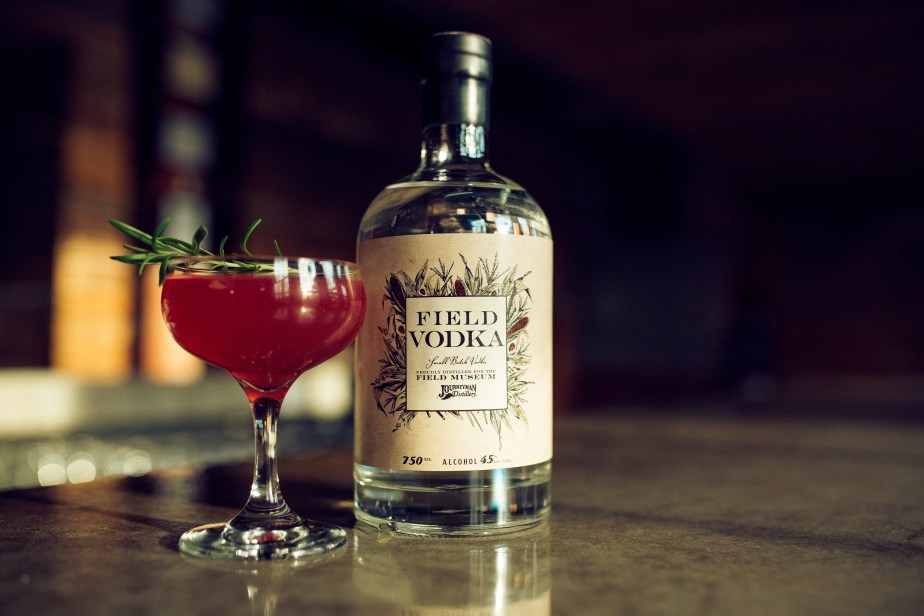
The first product they created was their Field vodka using Bloody Butcher Corn, an heirloom variety often used for making bourbon. The vodka then served as a base for the next distilled spirit, their Field Gin

“We wanted to make a global gin,” says McClain. “So we were pulling species from around the world. We narrowed it down to around 50.”

But once they had the botanicals and began developing recipes, they had to cross off a few more from the list.

“A lot of botanicals that look and taste good, don’t work where you put them in in alcohol, others that I wanted to use were hard to get or arrived too late, I still have agave in the cooler,” says McClain, noting  they used other criteria as well in the selection process. “Bill and I wanted the gin to be lavender focused. Obviously gin also has to have a heavy juniper taste as well. We wanted the gin to have tropical undertones and had to figure out those as well.”Field3Pack

Then they were down to 27 including not only lavender and juniper berries but also prickly ash, anise, mango, ginger, coconut palm sugar, pineapple, papaya, Valerian Root, cinnamon, coriander, Horehound, star fruit and Charoli nuts which are sourced from India.

For their Field Rye Whiskey, they tried several types of figs which McClain describes as the world’s oldest sweeteners, finally deciding that Black Mission figs worked the best. The figs were macerated or soaked in alcohol for three months, a process that brought out subtle and all-natural flavors of bananas, sweet melons and strawberries.

“It’s an incredible whiskey,” says McClain. “It has heavy caramel notes and soft marshmallow like palate.”

Bottles of the Field distilled spirits are available for sale. For those who would like to learn more about their taste, they’re also used in some of the cocktails served at the Staymaker, Journey’s restaurant.

Sidebar: Brews

Beer, which is so Chicago given its rich German heritage, was the first partnership Megan Williams embarked upon when she started her beverage program. Two Chicago breweries, Off Color Brewing and Two Brothers Brewing were among the first to use the botanicals to create beers for the museum. researchers at the Field Museum have spent years excavating and studying the Wari site in Peru. Toppling Goliath introduced PseudoSue pale ale, a nod to the museum’s famous 40 feet long and 13 feet tall at the hip, Tyrannosaurus rex.  Physically SUE is the largest specimen T. rex specimen that’s been discovered so far.

Off Color’s introduced Wari, their artisan beer based on the Peruvian chicha, a purple corn beer native to areas of Central and South America. One of its other tie-ins with the museum is that Field scientists have spent years leading excavations at Cerro Baúl, a remote mountaintop citadel which was the only contact point between the Tiwanaku and the Wari, considered two great kingdoms whose dynamic relationship ultimately contributed to the rise of the Incan Empire. According to Off Color’s website, an essential sacrament shared by both cultures revolved around chichi. It seems that both tribes liked to consume massive quantiles of chicha served in ornately inscribed drinking cups called keros that were discovered during the archaeological expeditions at Cerro Baúl. In this way, Wari and Tiwanaku cemented their relationships. In other words, next time you see a bunch of heavy alcohol consumers at bars, understand they’re just continuing a thousand year ritual similar to that of the Wari and Tiwanaku.

The following recipes are courtesy of the Journeyman Distillery.

Journeyman Fig Old Fashioned

1.5 oz Field Rye

0.5 oz Fresh Orange Juice

0.25 oz Journeyman Bourbon Maple Syrup

Dash of Journeyman Barrel-Aged Balsamic Vinegar

Dehydrated Orange Wheel

Stir ingredients and pour into a rocks glass, over ice. Garnish with dehydrated orange wheel.

Field Vodka Gimlet

1.5 oz Field Vodka

.75 oz Fresh Lime Juice

.5 oz Simple Syrup

Fresh Lime Wheel

Shake ingredients well and strain into a tall glass over ice. Garnish with a fresh lime wheel.

Field Gin Fizz

1.5 oz Field Gin

.75 oz Fresh Lemon Juice

.5 oz Pear Simple Syrup

1 oz Aquafaba or Egg White

Soda

Star Anise

Combine ingredients and dry shake before adding ice to the shaker. Wet shake until froth has built up. Strain into a Collins glass and top with soda. Garnish with Star Anise.